
The Financial Impact of Poor Customer Service: Costs, Metrics and Solutions (2026)
What if the service problems you track as isolated complaints are quietly draining revenue across your business? The financial impact of poor customer service goes beyond the cost of handling a difficult interaction. Customers may stop buying, negative experiences can weaken future demand, and repeat contacts use capacity that could be spent resolving new issues.
These effects are real, but they’re not always easy to attribute. A customer who leaves rarely says that one unresolved enquiry made the decision, while escalation costs can be scattered across contact-centre, sales and retention data. That can make it difficult for leaders to build a credible case for improvement, even when frontline teams see the strain every day.
This article explains how to map the direct and indirect costs of poor service and build a defensible measurement approach using the business data you already hold. We’ll examine the signals behind churn, lost repeat purchases, reputation damage and recovery work, then show how to prioritise improvements that protect customer trust and operating capacity. The aim is to connect better experiences to measurable business value without treating automation as a substitute for human support.
Key Takeaways
- The financial impact of poor customer service includes revenue at risk and avoidable operating costs, but customer churn rarely has a single cause.
- Trace how unresolved friction can lead to repeat contacts, escalations and weaker loyalty, while reviews and word of mouth may affect future demand.
- Build a credible measurement approach by defining scope, setting a baseline, choosing indicators and comparing results over time.
- Track financial outcomes separately from leading signals such as repeat-contact, complaint and escalation rates to spot preventable problems.
- Prioritise recurring issues by customer impact and operational risk. Use automation for routine enquiries while preserving context for human support when needed.
What Is the Financial Impact of Poor Customer Service?
The financial impact of poor customer service is the revenue a business puts at risk, plus the avoidable costs it incurs when service problems create extra work or weaken customer relationships. It can include immediate recovery effort, such as handling a complaint, as well as potential future effects, such as fewer repeat purchases. These effects are related, but they aren’t equally visible in company accounts.
Direct costs are usually easier to identify: staff time spent on repeat contacts, escalations, refunds or other recovery actions. Longer-term effects, including a customer choosing a competitor or a negative review influencing another buyer, are harder to attribute. Customers may leave for several reasons, so it would be misleading to assign every departure to one service failure.
Service can involve anything from answering a simple question to resolving a complex issue. The broader Customer Service context helps explain why service quality matters across customer interactions, but financial analysis needs to reflect your own operations. The impact varies with customer value, interaction volume, service context and the work required to put things right.
Which business outcomes can poor service affect?
Possible consequences include churn, lost repeat purchases, complaints and negative reviews. BBC coverage describes the commercial risk in terms of dissatisfied customers buying elsewhere and harm to a business’s reputation. That’s a useful way to understand possible routes to loss, not a universal formula: one complaint won’t always lead to churn, and one review won’t necessarily change sales.
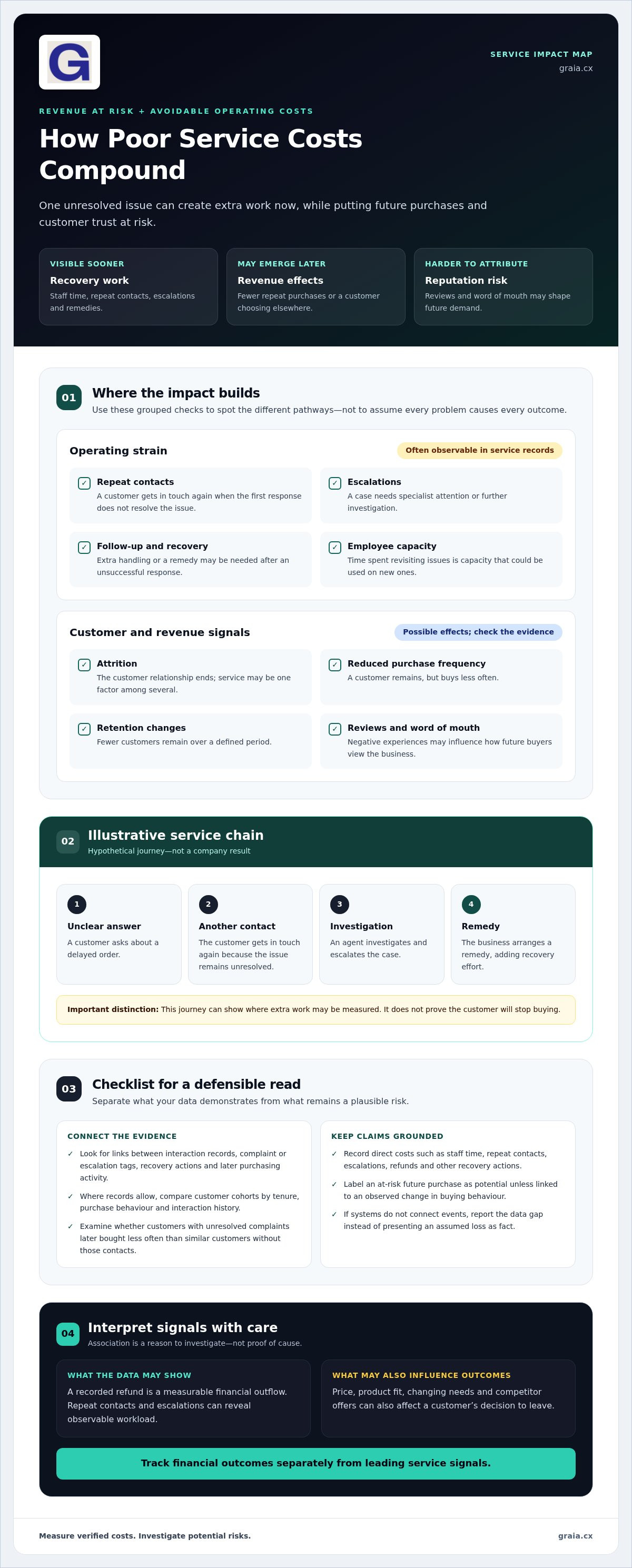
Separate these possibilities from what your reporting can demonstrate. A recorded refund is a measurable financial outflow. An at-risk future purchase is a potential revenue effect unless it can be linked to an observed change in buying behaviour.
Why can one service failure create several costs?
An unresolved issue can create a chain of work. A customer might contact the business again, need an escalation to a specialist, then require a follow-up after the original response fails to resolve the problem. Each step can consume employee time or trigger recovery activity, while adding customer effort and potentially reducing confidence. How much of this can be counted depends on the records available.
Hypothetical journey, not a company result: a customer asks about a delayed order but receives an unclear answer. They make another contact, an agent investigates and escalates the case, then the business arranges a remedy. The journey may involve several contacts and extra staff effort. It doesn’t prove that the customer will stop buying; it shows where associated work could be measured.
To assess a real case, look for links between interaction records, complaint or escalation tags, recovery actions and later purchasing activity. If your systems don’t connect those events, report the gap instead of presenting an assumed loss as fact. Distinguishing verified costs from plausible risks gives leaders a more credible basis for deciding what to investigate next.
How Poor Customer Service Compounds Churn, Recovery Work and Reputation Risk
A service problem rarely stays confined to one interaction. If the first response doesn’t resolve an issue, the customer may make another contact, explain the situation again or ask for an escalation. That creates observable workload for the contact centre while potentially weakening the customer’s willingness to stay. The financial impact of poor customer service can build across several pathways, even when the original failure seems small.
An unresolved issue can generate more work before it creates a visible loss. Repeated recovery activity uses additional agent time, adds case handling and may further weaken customer trust.
How do churn and lost repeat purchases affect revenue?
Attrition means a customer relationship ends. Reduced purchase frequency means a customer still buys, but less often. Lower retention describes a broader pattern in which fewer customers remain over a defined period. These outcomes affect revenue differently, so grouping them together can obscure what’s changing and where service may be a factor.
Where your records allow, compare customer cohorts by tenure, purchase behaviour and interaction history. For example, examine whether customers with unresolved complaints later bought less often than similar customers without those contacts. Treat this as a signal to investigate, not proof of causation: price, product fit, changing needs or competitor offers may also influence a customer’s decision to leave.
Public reviews and word of mouth create another possible route to revenue risk. BBC’s sales-and-reputation framing captures the connection: dissatisfied customers may buy elsewhere, while negative accounts of an experience can shape future buyers’ consideration. Midlands Technical College’s True Cost of Poor Customer Service also discusses direct and indirect effects. Still, review activity is an observable reputation signal, not a precise measure of purchases lost because of a particular service failure.
How do repeat contacts and escalations add operational strain?
Contact-centre records can show repeat contacts, escalations, handling time and the number of cases requiring follow-up. These measures help identify where unresolved issues are creating extra work. They don’t automatically translate into cash savings: reduced handling time may free up capacity, but it becomes a financial saving only if it changes costs or lets that capacity be used productively.
Look beyond the number of contacts. A customer who has to repeat details across channels may need to explain the issue again, prompt another investigation or require a further handoff. Tracking the reason for repeat contact and linking interactions to the same case can help distinguish avoidable recovery effort from legitimate follow-up.
For a broader approach to assessing value, connect these operational signals with business outcomes using Contact Centre ROI with AI. GraiaCX’s customer experience insights can also help frame how service changes relate to customer and operational outcomes.
How to Measure the Financial Impact of Poor Customer Service
A credible estimate starts with a clear boundary. Rather than attributing every lost sale or extra contact to service, connect defined customer experiences with outcomes your data can show. This makes the financial impact of poor customer service easier to assess, explain and revisit as you introduce service changes.
Use a four-step process:
- Define scope. Choose the service issue, channel, customer group and period you’ll examine. Decide what counts as a repeat contact, complaint, escalation or successful resolution.
- Establish a baseline. Record current customer and operational results before making changes. Note how the data is collected and where records may be incomplete.
- Select indicators. Pair leading signals, such as repeat-contact rates, with financial outcomes, such as observed changes in purchase activity or documented recovery costs.
- Compare over time. Revisit the same measures after an intervention. Where possible, use matched periods or customer cohorts, and record other changes that could explain the results.
Keep definitions consistent throughout. If the meaning of “resolved” or “repeat contact” changes between reporting periods, an apparent improvement may reflect a change in measurement rather than customer experience.
Which indicators help reveal service-related impact?
Build a balanced view of customer experience and operational effort. Consider repeat-contact and escalation rates, complaint themes, resolution outcomes and customer retention. Pair them with handling time and case rework to see whether customer friction is also creating workload. Define each measure for your organisation, including its denominator and reporting period, rather than relying on an assumed industry benchmark.
Leading indicators can flag a problem before a financial outcome becomes visible. For instance, a rising rate of repeat contacts about one issue may warrant investigation even if retention hasn’t shifted. Track themes consistently, and distinguish cases that need legitimate follow-up from contacts caused by an incomplete or unclear resolution.
How can finance teams estimate impact responsibly?
For revenue analysis, use internal transaction and customer records to examine what happened to purchasing behaviour after relevant interactions. Where the data allows, compare customers with similar characteristics or interaction histories, and account for seasonality, pricing, product changes and other plausible influences. Attribute only the portion your method can reasonably support.
Estimate recovery effort using documented handling time and your organisation’s own cost assumptions. For example, multiply time spent on tagged repeat contacts and escalations by an appropriate internal cost rate, while stating which roles and activities the calculation includes. Don’t apply generic contact-centre averages as if they were your actual costs.
A relationship between poor service and churn is evidence of correlation, not proof that service caused each customer to leave. Put assumptions, exclusions, sample size, period and attribution limits beside every estimate. If records can’t link service events to customer or transaction outcomes, describe that limitation clearly and treat the result as an estimate, not a precise loss figure.
How to Prioritise Customer Service Improvements Without Losing Empathy
Reducing handling effort isn’t a success if customers have to work harder to get an answer. A shorter interaction can still leave someone confused, require another contact or prevent them from reaching a person who can help. Improvement should reduce friction for customers while making service more sustainable for the people delivering it.
Start with recurring, preventable issues, then assess each against four considerations: customer impact, contact volume, resolution difficulty and compliance risk. A frequent issue that blocks an important customer task may deserve attention before a low-volume inconvenience. A difficult or sensitive case may need stronger human support, even if it affects fewer customers. Use case evidence and customer feedback to understand the problem before choosing a solution.
There isn’t one fix for every failure. A process change may remove an unnecessary step; clearer knowledge may help customers and agents find consistent answers; agent support may make complex work easier to handle; automation may resolve suitable routine requests. These approaches can complement one another, but each should address a defined source of friction rather than simply target lower handling time.
When should a business fix the process before automating?
Fix the process first if customers face unclear policies, fragmented information or broken handoffs. Review complaints, repeat-contact reasons and case notes to find where the journey breaks down. If teams interpret a policy differently or key details are hard to find, automation may reproduce inconsistent answers at greater scale. Clarify ownership, information and decision rules before automating those steps.
Then test one focused change against a defined baseline. Track both the customer experience, such as successful resolution or repeat contact, and operational effects, such as rework. Compare like with like where possible, and check that the change hasn’t simply shifted effort to another channel or team. Expand only when results support it and customers’ important needs remain well served.
How can automation preserve human support?
Use automation where a request is routine, the next step is clear and the response can be grounded in reliable information. Keep a clear route to a human agent for complex, sensitive or unresolved issues. An effective handoff should carry relevant interaction context, so the customer doesn’t have to start again and the agent can focus on resolving the need.
For a deeper look at how these capabilities have developed, explore The AI Customer Service Platform. The right balance isn’t automation at any cost. It’s a service design that resolves appropriate requests efficiently while protecting human judgement and customer trust.
To explore practical perspectives on improving customer experience, browse GraiaCX’s customer experience insights.
How GraiaCX Connects Better Customer Experiences With Measurable Service Outcomes
Once a business has identified a service problem, set a baseline and chosen what to improve, the next question is how to make change measurable. GraiaCX brings conversational agents, human support and omnichannel interactions together so routine needs can be handled efficiently while customers have a clear path to human help. The aim isn’t automation for its own sake. It’s to reduce avoidable effort and assess whether customer experience and operations improve.
How can conversational automation reduce avoidable customer effort?
A conversational agent can use knowledge-grounded responses to answer routine questions based on approved business information. When an enquiry calls for an action, integrations can support defined workflows, such as updating an account or initiating an eligible process. This can help customers complete straightforward tasks without an unnecessary transfer or follow-up.
Clear boundaries matter. If a request falls outside the workflow’s rules, needs human judgement or remains unresolved, the interaction should move to an agent. A contextual handoff can carry the interaction history forward, helping the agent understand what has already happened instead of asking the customer to repeat the full story. That continuity supports a more considered resolution while keeping human attention available for complex needs.
Teams can assess whether this approach is working by tracking successful completion, repeat contacts, escalations and customer feedback alongside operational measures such as case rework. A faster response alone doesn’t prove that the customer’s need was resolved. Measures should reflect the outcome, not just the speed of the interaction.
How should teams evaluate service improvements over time?
Compare results against the baseline established before a change, using consistent definitions and comparable periods or customer groups where possible. Review customer outcomes and operational indicators together. If repeat contacts decline but complaints rise, for example, the change may have reduced contacts without resolving the underlying friction. Note other changes that could affect results, and avoid treating an association as proof that one intervention caused an outcome.
GraiaCX reports 40% fewer escalations and repeat contacts. This is a reported result, not a guaranteed outcome for another organisation. When using any reported impact figure, state what was measured, for whom and over what period so decision-makers can judge its relevance to their own service context.
To make the next step practical, choose one recurring service issue, agree on a customer outcome and an operational measure, then track both before and after a focused change. Explore GraiaCX’s customer experience insights to identify a measurable service opportunity and consider how connected automation and human support could address it.
Turn the Evidence Into a Better Next Move
The financial impact of poor customer service becomes actionable when measurement leads to a focused decision. Rather than trying to solve every service challenge at once, choose one customer journey where a clearer, easier experience would matter. Give the team space to test an improvement, learn from customer feedback and adjust the approach when the evidence points to friction.
As you evaluate options, keep customer trust at the centre of the business case. Contextual handoffs that preserve interaction history can help human agents continue a conversation with less repetition. Treat reported customer-service impact figures carefully: understand the evidence, scope and methodology before using them to forecast results or support an investment decision.
Progress doesn’t require a perfect model from day one. It requires a clear question, measures people can interpret and a willingness to improve what customers experience, not simply what the organisation counts. Explore GraiaCX’s customer experience insights and identify a practical service opportunity to measure next.
Frequently Asked Questions
How do you calculate the financial impact of poor customer service?
Combine documented service-related costs with revenue changes you can reasonably connect to customer experience. For example, total the handling time for repeat cases using your own internal cost assumptions, then examine purchasing patterns for customers affected by a defined issue. Keep the calculations separate, state what data and assumptions you used, and avoid counting the same recovery activity twice. Treat unverified future purchases as potential risk, not a recorded loss.
Can poor customer service cause customers to leave a business?
Yes, a poor experience can contribute to a customer choosing another business, particularly if the issue remains unresolved or the customer has to work hard to get help. It isn’t the only possible reason for leaving. A customer’s needs, product experience, price or circumstances may also change. Treat service complaints as a useful signal, then compare interaction history with later behaviour before attributing a departure to customer service.
What hidden costs can poor customer service create?
Beyond visible refunds or extra contacts, service problems can require supervisor attention, repeat investigations and coordination between teams. They may also reduce the time agents have for new enquiries or complex cases. Reputation effects, such as a prospective customer hesitating after reading a negative review, are harder to quantify. Record these as potential indirect effects unless your own data links them to a measurable change in demand or workload.
How can a business tell whether service problems are causing churn?
Look for patterns rather than relying on individual anecdotes. Compare customers who experienced a specific service issue with a similar group who did not, then check subsequent purchases and retention over the same period. Review other factors, such as changes to pricing or product availability, that may explain the difference. If customer and case records can’t be reliably linked, describe the relationship as an indication, not proof of cause.
Can AI improve customer service without making it feel less human?
Yes, if it takes on suitable routine tasks and leaves people accessible when a customer needs judgement or reassurance. Graia’s conversational agent can use knowledge-grounded information and integrations to respond or support defined actions, while a contextual handoff carries interaction history to a human agent. For example, an agent can continue investigating a complicated account issue without asking the customer to repeat details already shared.
Which customer service metrics should a business track?
Choose measures that show whether customers get help and how much work the service requires. Alongside satisfaction and retention, track first-contact resolution, repeat contacts, escalations, complaints and abandoned interactions. Add handling time and reopened cases to reveal effort that a satisfaction score alone may miss. Define each measure consistently, and break results down by channel or issue type so an overall average doesn’t hide a recurring service problem.
Is one poor customer service experience enough to lose a customer?
It can be, but there’s no single outcome for every customer or situation. The effect may depend on the importance of the issue, the customer’s past experience and how the business responds afterwards. A prompt, clear recovery can help restore confidence; an unresolved problem or difficult handoff may deepen frustration. Treat a single failure as a chance to understand what happened and improve the journey, not as proof that the customer has already left.