
Sentiment Analysis in Customer Service Calls and How It Helps
A transcript captures the words; sentiment analysis in customer service calls can also help interpret the tone and emotion behind them. By assessing language and, where available, vocal cues such as pace or intensity, AI can identify positive, negative or neutral sentiment and show when it shifts during an interaction.
That signal is useful, but it is not the whole story. A frustrated tone may point to an unresolved need, confusion or urgency. Teams get a clearer picture by considering sentiment alongside the conversation’s context and outcome.
This article explains how call centres analyse calls and transcripts, how real-time insights can support agents, and how patterns across conversations can reveal customer needs. It also covers the limits of sentiment scores, including why human judgement matters when language, accents, sarcasm or audio quality affect interpretation.
Key Takeaways
- Learn how AI interprets words, context and vocal cues to identify shifts in a caller’s sentiment.
- See how sentiment trends can help teams understand customer satisfaction alongside resolution and repeat contact.
- Discover how real-time signals can help agents respond to changing needs and supervisors target coaching.
- Understand why call recordings and transcripts need contextual analysis, careful handling and human review.
- Explore how live call translation can support conversations across language barriers.
What is sentiment analysis: How’s it used in call centres?
In a call centre, sentiment analysis uses artificial intelligence (AI) and natural language processing (NLP) to interpret emotion, tone and attitude in customer and agent interactions. It can classify a conversation as positive, negative or neutral, then track changes that may matter to the customer experience.
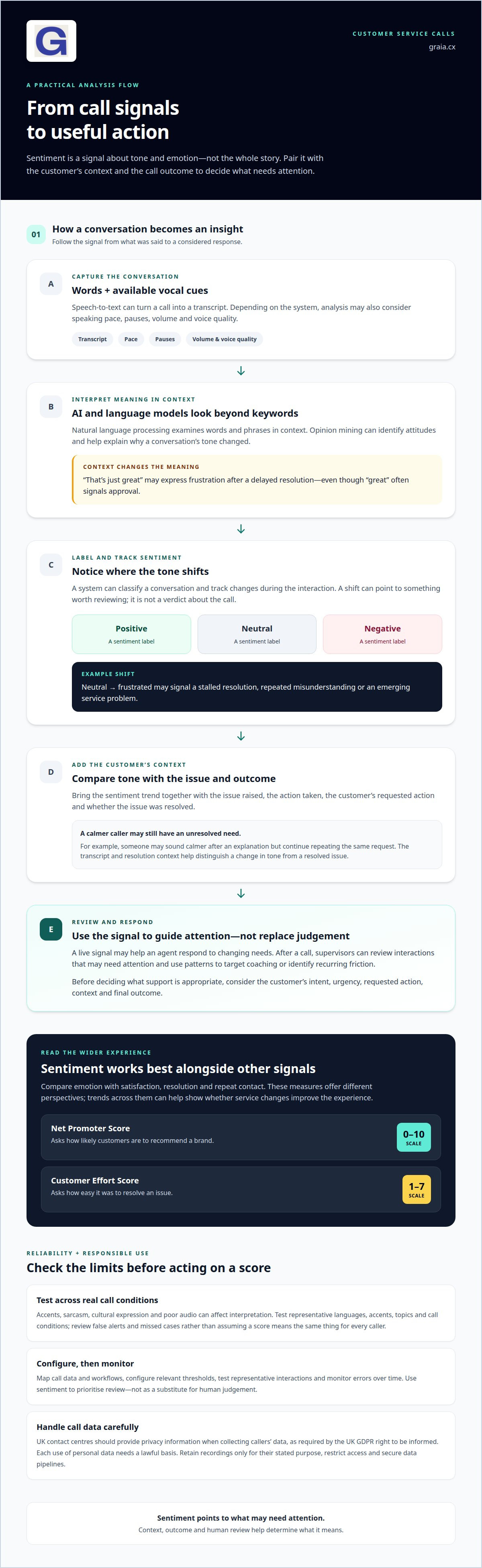
For a voice call, systems can analyse transcribed words alongside cues such as speaking pace, pauses, volume and voice quality. Text models examine words and phrases in context: “That’s just great” may express frustration after a delayed resolution, even though “great” often signals approval. Combining cues gives a richer signal than counting positive or negative words alone.
Opinion Mining with AI and Language Models
Opinion mining uses AI to identify opinions, emotions and attitudes in language, including customer comments and call transcripts. Natural language processing models analyse phrases in context, while large language models can help interpret nuanced wording and summarise why a conversation’s tone changed. This can show the issue behind a sentiment label, such as repeated confusion about a policy. The insight can guide action, but it does not replace the customer’s actual request or the call’s outcome.
Evaluation Across Languages and Call Conditions
Testing across languages and call conditions shows whether sentiment classifications remain useful in different speech and audio contexts. A model assessed on clear English recordings may interpret accents, sarcasm, cultural expression or poor audio differently. For example, a quiet caller may sound calm to a system while using words that signal serious dissatisfaction. Testing representative languages, accents, topics and call conditions helps reveal these gaps. Teams can then review false alerts and missed cases instead of assuming the same score means the same thing for every caller.
Tools, Implementation, and Limitations
When evaluating sentiment analysis, consider how the system interprets complex contact-centre language, how its performance is assessed and how it fits existing technology. Implementation should map call data and workflows, configure relevant thresholds, test representative interactions and monitor errors over time. UK contact centres should also provide privacy information when collecting callers’ data, as required by the UK GDPR right to be informed, according to the UK legislation register. Sentiment can misread irony, accents or noisy audio, so use it to prioritise review, not replace human judgement. For sensitive cases, a person should consider the request, context and outcome before deciding what action to take.
Why is sentiment analysis such a valuable tool for customer satisfaction?
A sentiment signal is useful when it helps explain what happened in a conversation and what needs attention next. Combined with resolution, repeat-contact and quality data, it can connect customer emotions to practical improvements.
Measuring Sentiment in Support Conversations
Sentiment measurement assigns a label, score or trend to a support conversation, helping teams compare customer responses over time. Positive words after an issue is resolved mean something different from positive words spoken before the customer gets an answer. Context matters. Teams can compare sentiment changes with the issue, action taken and outcome, rather than treating a score as a verdict.
To measure impact, contact centres can track sentiment alongside customer satisfaction, resolution and repeat contact. The Net Promoter Score asks how likely customers are to recommend a brand on a scale from 0 to 10; Customer Effort Score asks how easy resolving an issue was on a scale from 1 to 7. These measures offer different perspectives, so trends across them can show whether service changes improve the experience.
Speech-to-Text and Conversation Analytics
Speech-to-text converts a call into a transcript, while conversation analytics examines the transcript and, depending on the system, vocal cues such as pace or intensity. This helps teams connect words and emotions with the customer’s issue. For example, a caller may sound calmer after an explanation but still repeat the same request. The transcript and resolution context help distinguish a change in tone from a genuinely resolved need.
UK contact centres analysing recorded calls should provide callers with privacy information when their data is collected, as required by the UK GDPR right to be informed, according to the UK legislation register. Each use of personal data needs a lawful basis. Recordings should be retained only for their stated purpose, with access restricted and data pipelines secured.
Identifying At-Risk Conversations
At-risk conversation identification uses negative or changing sentiment signals to help supervisors prioritise interactions that may need attention. A sudden shift from neutral to frustrated may point to a stalled resolution, repeated misunderstanding or emerging service problem. The signal prompts review; it does not prove an agent performed poorly. Managers should consider the customer’s intent, urgency, requested action and final outcome before deciding what support is appropriate.
Teams gain a broader view by combining sentiment with a conversation record: the issue raised, emotional trend, action taken and whether the issue was resolved. Across calls, these records can reveal recurring friction, such as customers repeatedly asking for clarification about the same process. Reviewing false alerts and missed cases helps refine thresholds and focus attention on signals that lead to useful action.
For a deeper look at how conversational AI can support customer interactions, explore conversational AI insights.
Real-time sentiment analysis and agent assist
Real-time sentiment analysis tracks emotional changes during a live interaction, helping agents and supervisors respond while support is underway. A shift from calm to frustrated after a proposed solution, for example, can prompt a clearer explanation or timely escalation. The signal is most useful alongside the customer’s intent, urgency and requested action.
Support Agents During the Interaction
Agent assist uses live conversation signals to surface relevant guidance while an agent speaks with a customer. If a caller shows growing frustration about a delayed resolution, an alert could prompt the agent to acknowledge the concern or explain the next step. The system should support a human response, not dictate a script or assume it knows why the customer feels that way.
Contact centres need workflow-specific thresholds and clear rules for what happens after each alert. A mild change might prompt the agent to check understanding; a persistent negative trend could bring a supervisor into the conversation. Teams should define who receives each signal, what action is expected and how managers review mistaken alerts. Without those decisions, real-time insights create noise instead of proactive support.
Coach with Context
After a call, sentiment trends can help supervisors identify interactions for coaching and quality review. For instance, a repeated drop in customer sentiment whenever an agent explains a particular process may reveal a training need, unclear guidance or a process problem. Reviewing the conversation context helps identify the cause instead of treating the score as the answer.
A negative customer signal does not automatically mean the agent performed poorly. The caller may be frustrated with a policy outside the agent’s control, while the agent communicates clearly and reaches an appropriate resolution. Performance reviews should consider sentiment alongside intent, outcome, quality and operational data. For high-impact employee decisions, automated sentiment should be one input among several, with appropriate human review.
Develop Skills and Monitor Both Sides
Patterns across interactions can shape more relevant training. If several calls show agents struggling to explain the same issue, team leaders can use reviewed examples in coaching, then monitor whether communication improves. This makes training specific to real customer conversations. It also helps distinguish a skills gap from a confusing process that needs wider attention.
Customer and agent sentiment both matter. A customer’s frustration may rise as an agent becomes strained, but either signal needs context before action. Teams should monitor models over time using representative interactions, educate relevant staff, and review false alerts and missed cases. Ongoing calibration keeps performance reviews grounded and helps managers identify where agents need guidance, clearer information or a better-supported workflow.
Using contact-centre feedback to understand customer needs
A call is one part of the customer journey, not the whole picture. Contact-centre feedback is more useful when teams connect sentiment with the customer’s issue, actions taken and outcome across channels. For example, a caller may follow up by email because the first interaction did not resolve a delivery problem.
Across voice, chat, email and social messaging, an omnichannel view can reveal whether the same issue keeps appearing. A platform that brings interactions together helps teams distinguish an isolated complaint from a wider pattern. If customers describe a confusing returns process in calls and online messages, that shared feedback points to a service journey worth reviewing.
Sentiment insights can also inform product and process development. A product team might review conversations where customers repeatedly struggle to use a feature, then compare those comments with feedback about successful use. The goal is not to treat every negative interaction as a product defect. Teams should consider the customer’s stated need, conversation context and resolution before deciding whether to change instructions, service processes or the product itself.
Social media monitoring adds another perspective on customer feedback. Public posts show how customers describe an issue in their own words, while calls and private messages may provide details about attempted resolutions. For instance, a rise in posts about a confusing account change can be compared with contact-centre conversations on the same topic. Combining channels helps teams spot emerging concerns without treating any one channel as a complete picture of customer opinion.
To turn patterns into action, teams can group conversations by topic, sentiment trend and outcome. They can then compare recurring issues with resolution and repeat contact, identifying where customers still need help after an interaction. If contacts about a billing explanation often involve follow-up questions, teams could review the explanation and test a clearer version. This creates a practical route from feedback to service improvement, rather than leaving insights in a dashboard.
Closing the loop matters too. When customer feedback leads to a change, a follow-up can explain what was considered and what improved. For example, if customers report difficulty finding an important account option, the team can communicate the change through a relevant channel and monitor later feedback. Sentiment analysis works best as part of a broader voice-of-the-customer strategy: integrate feedback across channels, act on recurring needs and report back on improvements.
Analysing call recordings and transcripts
A sound analysis process turns recordings into evidence about what customers said, how the conversation developed and whether their needs were resolved. It connects the transcript, sentiment changes and call outcome. For example, a negative score near the start means something different if the customer’s concern is acknowledged and resolved before the call ends.
Analysis begins with the recording and its transcript. The transcript shows the words and their sequence; audio can add vocal cues such as pace, pauses and intensity. A tool that assesses individual words alone might mark “fine” as positive, even when the customer says, “Fine, I’ll call again tomorrow,” after an unresolved request. Context changes the interpretation.
Reviewers can then examine sentiment shifts at meaningful points: when the customer explains the issue, hears a proposed action or confirms an outcome. They connect those shifts to the topic and resolution instead of treating the call as one fixed score. For instance, increased frustration after a transfer may indicate friction in the service journey, while a calm ending alone does not prove satisfaction.
Reviewers also compare automated classifications with the conversation itself. They check whether a phrase was attributed to the right speaker, whether the surrounding exchange supports the label and whether poor audio may have affected the result. This can uncover missed sarcasm or a negative signal triggered by a word used positively. Tracking false alerts and missed cases helps teams refine analysis over time.
Privacy protection is part of the process. Before analysing recordings or transcripts, voice-of-the-customer teams should redact card and health details. Access to recordings and transcripts should also be limited to people who need them for the stated analysis. These controls help keep sensitive information out of outputs used for quality review, customer experience analysis or service improvement.
Finally, teams connect call findings with feedback from other channels. If calls, emails and social media comments all describe difficulty completing the same task, that shared pattern may point to a wider issue. The evidence should still be checked against each interaction and its outcome. This helps teams act on recurring problems without assuming every negative comment has the same cause.
- Transcript: what was said and in what sequence.
- Audio: vocal cues that may add context to the words.
- Outcome: whether the customer’s need was resolved or remained open.
To explore how AI can turn conversation data into useful service insight, explore customer conversation analysis.
GraiaCX: Live Call Translation
GraiaCX offers Live Call Translation for contact centres supporting customers across language barriers. It covers over 100 languages, enabling multilingual support without the need for bilingual staff.
For teams analysing customer conversations, language access can help agents understand the issue and continue the interaction in a language the customer can use. Live Call Translation is a natural next step when multilingual calls are part of the service experience and teams want to support those conversations without relying on bilingual staff.
Contact GraiaCX to discuss Live Call Translation for your contact centre.
Turn conversation insight into better service
The next step is to make customer insight part of how service evolves. Treat sentiment as a prompt for thoughtful review, then connect what customers express with the actions and outcomes that follow. This creates a learning loop: teams can refine processes, support agents and assess whether changes address the needs behind difficult interactions.
For contact centres building a connected customer experience, GraiaCX offers Agent Assist, a Conversational Agent and Live Call Translation. These capabilities provide agent guidance, automate routine enquiries and support multilingual conversations, helping teams shape service around different customer needs.
Explore how these capabilities could fit your customer service strategy and contact GraiaCX to discuss your needs. With a clear purpose for each signal and human judgement guiding sensitive decisions, sentiment analysis in customer service calls can help teams turn conversation insight into more responsive support.
Frequently Asked Questions
How will the team analyse it?
Teams can analyse calls by connecting each conversation to the customer’s issue and its outcome. For example, if a caller contacts support twice about the same order, reviewers can examine both interactions to see what changed and where the first response fell short. They can group similar cases by topic, compare patterns and decide which service process to address first.
What is Contact Center Sentiment Analysis?
Contact-centre sentiment analysis uses AI to interpret emotional signals in customer and agent interactions. It can help teams distinguish a caller who sounds dissatisfied from one who is simply asking a direct question. The insight is most useful when paired with the reason for contact and what happened next, so managers can prioritise follow-up rather than relying on tone alone.
What is an example of sentiment analysis at work?
Imagine customers report that a new account feature is difficult to find. Analysis could reveal a recurring rise in frustration during calls about that feature, while related cases show customers needing further help afterwards. A service team could share the pattern with the relevant product team, review the instructions and later assess whether customers can find the feature more easily.
What role does AI play in sentiment analysis?
AI can process conversation data at scale, identifying language patterns and emotional shifts that would take people longer to review across large call volumes. It can flag interactions for closer attention or organise feedback by topic. But AI cannot know the full human meaning behind every phrase, so a reviewer should consider the exchange and outcome before treating a flag as evidence.
What should the programme achieve?
A sentiment programme should help an organisation make clearer customer experience decisions, not simply generate scores. It can surface recurring friction, direct supervisors to interactions needing review and inform improvements to communication or processes. A useful measure of progress is whether teams can connect an insight to a specific action, then observe whether customer outcomes or repeated issues change.
What is sentiment analysis in customer service calls?
Sentiment analysis in customer service calls uses AI to interpret the emotional tone expressed during a customer interaction. It may assess spoken language and, depending on the system, vocal characteristics such as pace or intensity. A result might label a section positive, neutral or negative, helping teams identify where the conversation’s tone shifted and what customer need or service event may explain it.
What are the main business benefits of sentiment analysis for call centres?
Call centres can use sentiment insights to prioritise conversations for review, spot recurring service problems and make coaching more relevant. For example, if customers repeatedly react negatively to the same explanation, a manager can assess whether the wording, process or underlying policy needs attention. This turns conversational evidence into focused action and helps teams understand customer experience beyond isolated satisfaction scores.
How accurate is sentiment analysis for customer service calls, and what affects accuracy?
Accuracy varies with the model, language, accent, call topic and audio quality. Sarcasm or culturally specific expressions can also affect how a phrase should be interpreted. A system may misread a quiet voice or classify a word without understanding the surrounding sentence. Teams should assess performance using representative interactions, review false alerts and missed cases, then refine the model and workflows as patterns emerge.