
Secure conversational AI for contact centres: suitable use cases
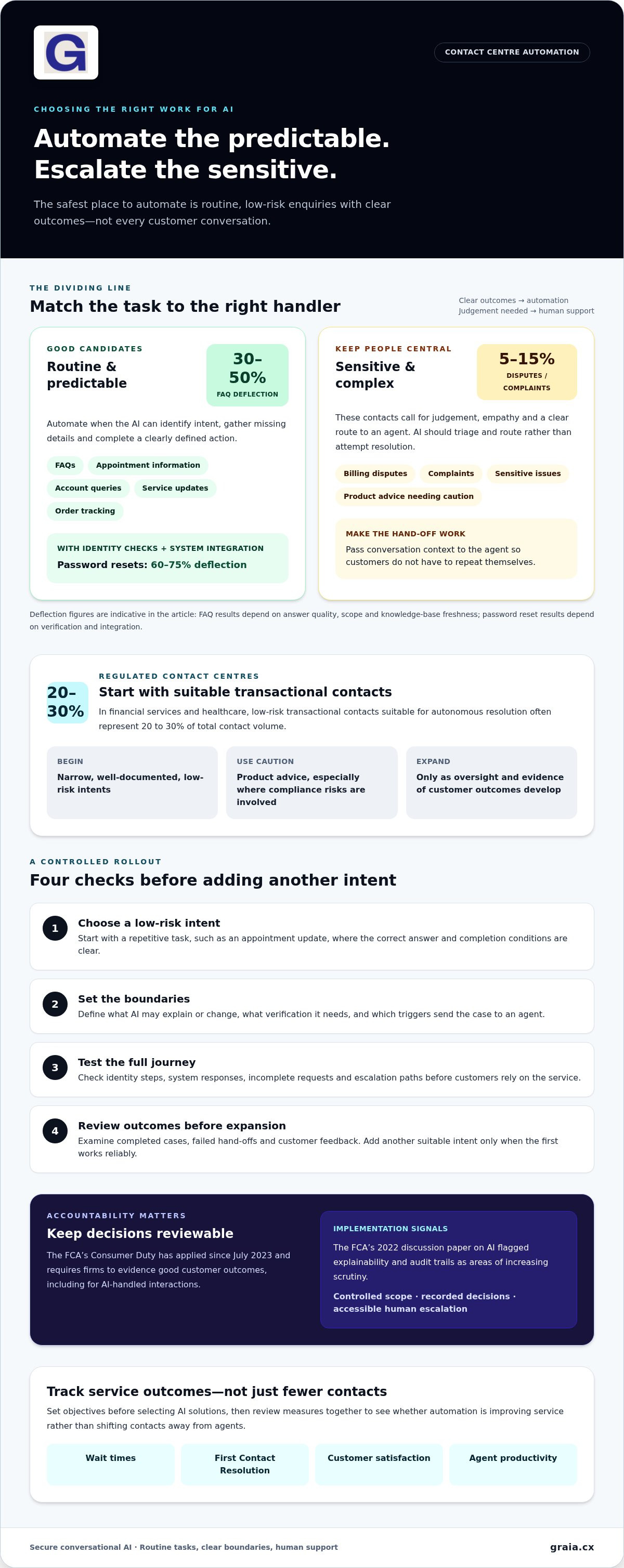
The safest place to automate isn’t every customer conversation, but the routine ones. Secure conversational AI for contact centres is best suited to predictable enquiries such as FAQs, appointment information, account queries and status updates. General FAQs can see 30-50% deflection, while billing disputes are better triaged and routed to a person.
That distinction matters. Customers want simple tasks handled quickly, while complaints and sensitive issues call for judgement, empathy and a clear route to human support. Automation works best when it resolves straightforward requests without making people repeat themselves or struggle to reach an agent.
This article explains which enquiries are suited to automation and how integrations with telephony, CRM and case-management systems help AI respond to customer context. It also covers how conversational agents, agent assist, translation and human oversight work together, and what makes an AI interaction secure and accountable. The focus is practical: where automation can improve service, where people should remain central, and how technology can support both.
Key Takeaways
- Match automation to predictable, low-risk enquiries; route complaints and sensitive cases to people who can apply judgement.
- In regulated contact centres, begin with suitable transactional use cases and expand as oversight and evidence of customer outcomes develop.
- Connect telephony, CRM and case management systems so AI can use relevant customer context and support a joined-up journey across channels.
- Design clear hand-offs: customers should reach a human when needed, with conversation context passed on to avoid repetition.
- See how conversational agents, agent assistance, live call translation and an omnichannel platform can support different contact centre needs.
What contact centre enquiries are best suited to AI automation?
Predictable, repetitive enquiries are strong candidates for automation. Examples include account queries, appointment information, service updates, order tracking and frequently asked questions. Secure conversational AI for contact centres works best when a task has a clear outcome: the AI can identify intent, ask for missing details and complete an eligible action. Customers get a direct route to simple answers, while agents have more time for complex conversations.
UK pricing depends on interaction volume, integration requirements, deployment scope and support. The price is provided after a quote request.
Suitability depends on the task and its supporting systems. Password resets can achieve 60-75% deflection when identity verification and system integrations are in place. General FAQs can reach 30-50%, depending on answer quality, scope and knowledge-base freshness. Billing disputes and complaints are different: realistic deflection is 5-15%, so AI should triage and route these cases rather than attempt resolution.
Regulated contact centres should sequence deployment around customer risk and evidence. In financial services and healthcare, low-risk transactional contacts suitable for autonomous resolution often represent 20 to 30% of total contact volume. Product advice calls for greater caution, particularly where compliance risks are involved. Selecting secure conversational AI for contact centres means defining these boundaries before automation handles live customer journeys.
- Choose a low-risk intent. Start with a repetitive task, such as an appointment update, where the correct answer and completion conditions are clear.
- Set the boundaries. Define what the AI may explain or change, what verification it needs, and which triggers send the case to an agent.
- Test the full journey. Check identity steps, system responses, incomplete requests and escalation paths before customers rely on the service.
- Review outcomes before expansion. Examine completed cases, failed hand-offs and customer feedback, then add another suitable intent only when the first works reliably.
The FCA’s Consumer Duty has applied since July 2023 and requires firms to evidence good outcomes for customers, including AI-handled interactions. The FCA’s 2022 discussion paper on AI flagged explainability and audit trails as areas of increasing scrutiny. These considerations make controlled scope, recorded decisions and accessible human escalation central to implementation.
Implementation time depends on the work involved, not a universal calendar. Mapping intents, preparing knowledge, connecting business systems, testing safeguards and training agents all affect rollout. Secure conversational AI for contact centres can be introduced in stages, giving teams a chance to address operational issues before expanding. A system with incomplete customer records or unclear answers needs more preparation than one handling a narrow, well-documented FAQ.
Set objectives before selecting AI solutions. A team focused on shorter waits may prioritise service-status requests, while one targeting satisfaction may first improve answer clarity and hand-offs. Track wait times, First Contact Resolution, customer satisfaction and agent productivity together. These measures help show whether automation is improving service, rather than simply shifting contacts away from agents.
Integration with telephony, CRM and case management
Platforms vary in how effectively they connect voice, customer records and case workflows. Compare how each handles context, routing and task completion across a realistic customer journey.
Telephony and Platform Integration
Telephony integration connects conversational AI to the systems that handle inbound and outbound calls. It matters because the AI needs to recognise a caller’s request, respond appropriately and route the interaction without creating a disconnected experience. An account-balance query, for instance, may require a secure system lookup, while a complex request needs a clear transfer to a human agent. Assess how the platform fits existing call flows and contact-centre operations.
CRM and Omnichannel Connections
CRM and case-management integration lets AI use relevant customer records and update a case as the conversation progresses. Connected channels can help teams create a more unified journey across chat, voice, email and social media. If a customer moves from web chat to a phone call, for example, the agent should be able to see the issue already described. This avoids repeated explanations and gives the next response useful context.
Back-end system integration can help AI handle account balances, order status and appointment bookings. The connection is what turns a response into a completed task. Without access to the relevant record or workflow, AI may explain what a customer could do, but it can’t reliably complete an update or booking.
Before implementation, map each customer intent to the system that provides its answer. An appointment request may need a booking system, while an order-status question requires order data. Define what information AI can retrieve, which actions it can take and when a human agent must step in. These boundaries help align automation with business processes instead of simply adding a chatbot to an existing phone menu.
- For telephony: assess how callers enter the AI journey and how transfers reach the right team.
- For CRM: examine whether customer context supports a relevant response across channels.
- For case management: check how an enquiry becomes a tracked case and how its status is updated.
Integration quality also affects what teams can measure. If chat, voice and case records remain isolated, managers may struggle to tell whether automation resolved the customer’s issue or merely ended one channel interaction. A connected journey helps teams review the original request, system actions and any later agent involvement together.
Use a real contact journey to compare platform capabilities, from first message to case closure. Explore contact-centre AI insights to build your understanding of how integration shapes service delivery.
Context-aware chatbots and virtual assistants
A context-aware virtual assistant uses the current conversation and relevant customer information to shape its next response. If someone asks, “Where is my order?”, it can use the order reference already provided instead of asking for it again. The interaction feels more coherent and stays focused on the customer’s actual request.
Context means more than a customer’s name. It can include the intent behind a message, answers given earlier and information retrieved from a connected business system. A customer who has already explained a delivery problem should not need to repeat the details as the conversation moves to another step. The system needs to retain and accurately apply the useful information.
Personalisation matters to customers. McKinsey research found that 71 per cent of consumers expect companies to deliver personalised interactions, while 76 per cent get frustrated when they don’t. For a contact centre, that means handling a query in light of its history, rather than treating every new message as an isolated request. The right context can make an automated response more relevant and help an agent understand what has happened.
Context-aware AI can make the transition to a person smoother when a request becomes complex. Before the hand-off, the assistant can pass on a concise summary of the customer’s intent, previous answers and unresolved issue. The agent can then start with the relevant details instead of asking the customer to begin again. The hand-off should be easy to reach and preserve the conversation’s meaning.
- Use relevant context: For an appointment change, retain the date and service already discussed.
- Keep knowledge current: A policy answer should reflect the current guidance used by the contact centre.
- Recognise uncertainty: If a request falls outside the assistant’s reliable knowledge, route it to a person.
- Preserve the conversation: Send the agent a useful summary, not just a transcript without explanation.
Gartner predicts that AI agents will resolve 80% of common customer service issues without human intervention by 2029. That forecast makes boundaries and escalation essential design choices, not afterthoughts. A virtual assistant should handle repetitive interactions within its defined scope, then recognise when a customer needs human assistance. The objective is intelligent handling, not automation at any cost.
Context must also be purposeful. An assistant responding to a billing question needs relevant account information, not unrelated details from an earlier conversation. Teams can define which records support each intent, what information the system may use and what it should pass to an agent. These decisions help keep AI-powered service relevant, with each response tied to the customer’s immediate need.
Explainability, audit trails and human oversight
Trust depends on more than whether a machine produces a plausible response. Contact centres need to understand why AI identified an intent, what information shaped its answer and when a person intervened. For a routine account query, teams should be able to trace the customer’s request, the knowledge used and the action taken. A clear record helps them review service quality and the customer experience.
The FCA’s Consumer Duty has applied since July 2023 and requires firms to evidence good outcomes for customers, including for AI-handled interactions. The FCA’s 2022 discussion paper on AI flagged explainability and audit trails as areas of increasing scrutiny. For financial services, these points make it important to retain meaningful records of automated decisions and review how those decisions affect customers.
An audit trail should help reviewers reconstruct an interaction across channels. It can capture the customer’s stated intent, the response given, relevant system actions and any escalation to a human agent. If a customer disputes an automated answer, for example, the service team needs enough context to see what the system understood and how it reached its response. A transcript alone may not explain the decision.
Explainability also supports practical improvement. If an assistant repeatedly misroutes a particular request, reviewers can compare the customer’s wording with the intent assigned by the system. They can then refine the knowledge, routing rules or escalation criteria. This creates a review cycle: identify an issue, trace its cause, make a controlled change and assess subsequent interactions.
- Record the decision: Preserve the recognised intent, relevant knowledge and action taken.
- Show the hand-off: Note why a human agent became involved and what context they received.
- Review exceptions: Examine unresolved requests, repeated transfers and customer corrections.
- Apply changes carefully: Update a defined rule or knowledge source, then review its impact.
Human oversight should be built into the interaction, not left as a fallback that customers cannot reach. Customers need a clear route to a person when the AI cannot understand the request, the issue becomes sensitive or they ask for help. The agent should receive relevant context, so oversight can resolve the problem rather than restart the conversation.
Forrester predicts that 30% of enterprises will include roles focused on managing, coaching or optimising AI agents and stepping in when systems falter. Such responsibilities can connect operational monitoring with frontline experience. Reviewers can examine machine decisions, while agents report where automated handling misses important context. That feedback makes oversight an active part of service design.
For UK firms, COBS 2.1 requires communications to be clear, fair and not misleading. Explainable responses, recorded decisions and accessible human review help teams assess whether automated communications meet that standard. These controls support responsible use of AI while keeping people accountable for the service customers receive.
AI technologies used in contact centres
Contact-centre AI combines technologies rather than relying on a single chatbot. Natural-language understanding interprets customer requests, virtual agents handle defined interactions, and agent-support tools help people during live conversations. Secure conversational AI for contact centres brings automation and human support together, matching each capability to a service need while keeping agents involved where judgement matters.
Natural-language technology lets customers describe their request without navigating rigid menus. Intent recognition identifies what they need and can route complex cases to the appropriate team. For example, a resident asking about a missed waste collection can be directed to the relevant local-authority service. This helps manage demand while making the customer journey more direct.
Virtual agents handle common requests across voice and digital channels, using relevant knowledge to answer questions or guide customers through a defined process. An enquiry about opening times calls for a different response from a report involving a vulnerable person. Secure conversational AI for contact centres should account for these differences and provide a suitable route to human help when a situation calls for care or discretion.
Agent support tools can surface knowledge-base articles, customer context, compliance prompts and next-best-action suggestions during a conversation. For example, an agent handling a delivery complaint can access relevant guidance without searching separately. AI-driven translation can also help customers communicate in a preferred language, while quality-assurance technology can identify interaction patterns for review. Some platforms can automatically review 100 per cent of customer interactions.
- To manage demand: use intent recognition to direct requests to the right service or team.
- To support resolution: use virtual agents for tasks with clear answers and outcomes.
- To empower agents: provide relevant knowledge and guidance during customer conversations.
- To improve accessibility: use language capabilities when customers need another way to communicate.
Gartner predicts that AI agents will resolve 80% of common customer service issues without human intervention by 2029. That forecast points to the growing role of automation, but technology must still fit the service. Secure conversational ai for contact centres brings virtual agents, agent guidance and escalation into a connected service approach. Explore contact-centre AI insights to consider how these technologies can support your customer journey.
GraiaCX: Conversational Agent
GraiaCX’s Conversational Agent is a practical option for contact centres aiming to automate routine enquiries while keeping human support accessible. It understands customer intent and emotion, resolves routine enquiries autonomously, and supports smoother service across customer interactions.
The Agentic Omni-Channel Platform brings voice, chat, email and social messaging together with AI-driven automation. Agent Assist provides real-time guidance and next-best-action suggestions for human agents. For multilingual conversations, Live Call Translation supports more than 100 languages.
Consider these capabilities when planning a service that connects automation with agent support and customer choice across channels. To discuss your contact centre’s needs, contact GraiaCX or visit graia.cx.
Build a service model ready for what comes next
The next step is to decide how AI should fit your contact centre’s future operating model. Assign a clear owner to each automated journey, define how teams will review outcomes and involve agents in improving the experience. This turns secure conversational AI for contact centres from a technology project into an intentional service capability.
GraiaCX supports this approach with its Conversational Agent, Agent Assist and Live Call Translation. These offerings address automated customer interactions, real-time support for agents and multilingual conversations. Start with the capability that best fits your current service priorities and the experience you want customers to have.
Bring your goals, customer journeys and operational challenges into the conversation. Contact GraiaCX to discuss your needs and explore a considered next step for your contact centre. Better service begins with a clear purpose and the confidence to keep improving.
Frequently Asked Questions
How does conversational AI work?
Conversational AI interprets a customer’s message, identifies the likely intent and chooses a relevant response or action. In a contact centre, it might recognise a request to change a delivery, retrieve the order record and follow the permitted workflow. If key details are missing, it can ask a clarifying question. If the request is outside its scope, the interaction can move to a human agent.
How secure is customer data with AI contact centre solutions?
Security depends on how a solution handles information throughout the customer interaction, not simply on the use of AI. Assess encryption, access permissions, data retention, system integrations and whether customer conversations are used for model training. Review who can access transcripts and how incidents are managed. For example, a contact centre should know which teams can view recordings and what controls apply to exported conversation data.
Does AI reduce the need for human agents?
AI can reduce the volume of routine tasks agents handle, but it cannot replace human judgement. People remain essential for sensitive complaints, ambiguous requests and situations where customers need empathy or discretion. A practical workforce plan might use automation for straightforward information requests, reserve agents for complex cases and review hand-offs to ensure customers receive appropriate support.
How quickly can organisations introduce AI into their contact centre?
GraiaCX states a typical deployment timeline of 4-6 weeks. The work depends on the chosen use case, readiness of knowledge content, integrations and the testing needed before launch. A focused rollout, such as handling one defined enquiry type, gives teams a contained way to assess the customer journey. Broader channel coverage or more involved system actions require additional planning and validation.
What deflection rate can you realistically expect from conversational AI?
A well-implemented system handling transactional queries can realistically deflect 25 to 45% of a contact centre’s full contact mix. Treat this as a planning range, not a target for every operation. Results depend on the proportion of automatable enquiries, the quality of answers, available system integrations and whether customers complete their task. Track successful resolution, not just conversations that end in automation.
What makes conversational AI secure for contact centres?
Security relies on controls for data, access and AI behaviour working together. Define which customer information the system may use, restrict access to authorised roles and set rules for what AI can answer or change. Test how it responds to unexpected or malicious inputs. For example, verify that it rejects a request to disclose another customer’s account details rather than treating it as a normal enquiry.
Which security certifications should UK contact centre AI providers have, such as ISO 27001 and Cyber Essentials?
ISO 27001 and Cyber Essentials can help buyers assess aspects of information-security management and cyber security, but a certificate alone doesn’t establish that every AI workflow is secure. Review its scope, the systems and services it covers, and how access, data handling and incidents are managed. Also assess the AI application itself, including its integrations, permissions and safeguards against inappropriate responses.
How does UK GDPR apply to conversational AI and customer call recordings?
For UK GDPR planning, treat identifiable call recordings, transcripts and chat histories as personal information that requires controlled handling. Map why each data item is collected, who can access it, how long it is retained and how customer requests are managed. Explain data use clearly to customers. If speech is transcribed for service handling, for example, document that processing and follow the organisation’s data-governance procedures.