Real-time transcription and analysis for call centres: what it costs
Can a live transcript keep pace with different accents, dialects and the realities of a busy call? It can help teams understand conversations as they happen, but accuracy may be affected by accents, technical language, overlapping speech and audio quality. The cost of real-time transcription and analysis for call centres depends on factors such as call volume and which analysis features are included, rather than one universal rate.
It’s reasonable to expect more than words on a screen: supervisors need useful insights, while agents need information in time to act. This guide explains how live speech-to-text and call analysis work, what influences AI transcription costs, and how summaries, speaker labels and accent coverage fit into the picture. It also looks at how transcripts can support agent guidance and reporting, and why traceability and careful data handling matter when conversations contain sensitive information.
Key Takeaways
- Separate transcription from conversation analysis: a transcript captures the words, while analysis can surface sentiment, themes and quality signals.
- Estimate speech-to-text costs by considering call volume, audio conditions and the features you need, rather than relying on a single headline price.
- Use automated summaries and extracted insights to make conversations easier to review, while keeping findings traceable to the original interaction.
- Speaker diarisation can clarify who said what, helping teams interpret transcripts and review calls more effectively.
- Assess accent coverage, response speed and data handling together to understand whether live analysis will support agents in the moments that matter.
What is a conversation analyzer?
A conversation analyser turns call transcripts into signals about customer sentiment, service quality and outcomes. For example, it can help a supervisor find calls where frustration rose before a complaint.
It can support coaching by highlighting specific moments for review, such as an unresolved question or abrupt handover. Agents and supervisors can then discuss the context instead of relying on a general score alone.
Real-Time Sentiment Analysis
Real-time sentiment analysis classifies language during a call to track changes in a customer’s expressed mood. Models may detect wording that suggests satisfaction, confusion or frustration, then update the sentiment as the conversation develops. For example, a customer may begin calmly and become frustrated after repeating an account problem. That shift can cue an agent to acknowledge the concern and clarify the next step.
Sentiment Alerts and Escalation
Sentiment alerts flag defined changes in a call, such as rising frustration, for agent or supervisor attention. In quality assurance, a flagged moment can direct review towards a difficult exchange rather than relying only on random call samples. An alert is a prompt, not proof of poor service: the words, context and outcome still matter. This distinction helps keep coaching fair and grounded.
Sentiment analysis and opinion mining examine customers’ language to identify reactions, recurring concerns and specific topics. A model might group phrases about a delayed delivery under dissatisfaction while separating praise for a helpful explanation. These classifications help teams identify patterns across calls, not just isolated comments. Human review remains useful when irony, ambiguous wording or mixed feelings make a phrase difficult to interpret.
Automated call quality assurance applies defined evaluation criteria to transcripts. Criteria might cover whether an agent acknowledged a stated problem, explained a relevant option or confirmed the agreed next step. The system can flag missing or unclear evidence, while a supervisor checks the transcript against the call’s context. This makes checks more targeted and gives coaching a specific moment to discuss.
AI transcription can give supervisors visibility into 100% of interactions, rather than only random samples. That coverage can reveal recurring friction points that a small sample may miss, such as customers repeatedly asking for clarification about the same process. Coverage doesn’t mean every automated interpretation is correct; accents, overlapping speech and poor audio can affect transcripts. Analysts should trace important findings back to the original interaction.
Call sentiment and resolution analysis connect a customer’s expressed mood with the call’s outcome. A positive closing phrase alone may not show whether the underlying issue was resolved, so teams can consider sentiment alongside the recorded resolution and follow-up. For example, a call may end politely while a question remains unanswered. Reviewing both signals helps distinguish a courteous conversation from effective service.
How much does AI real-time speech-to-text cost?
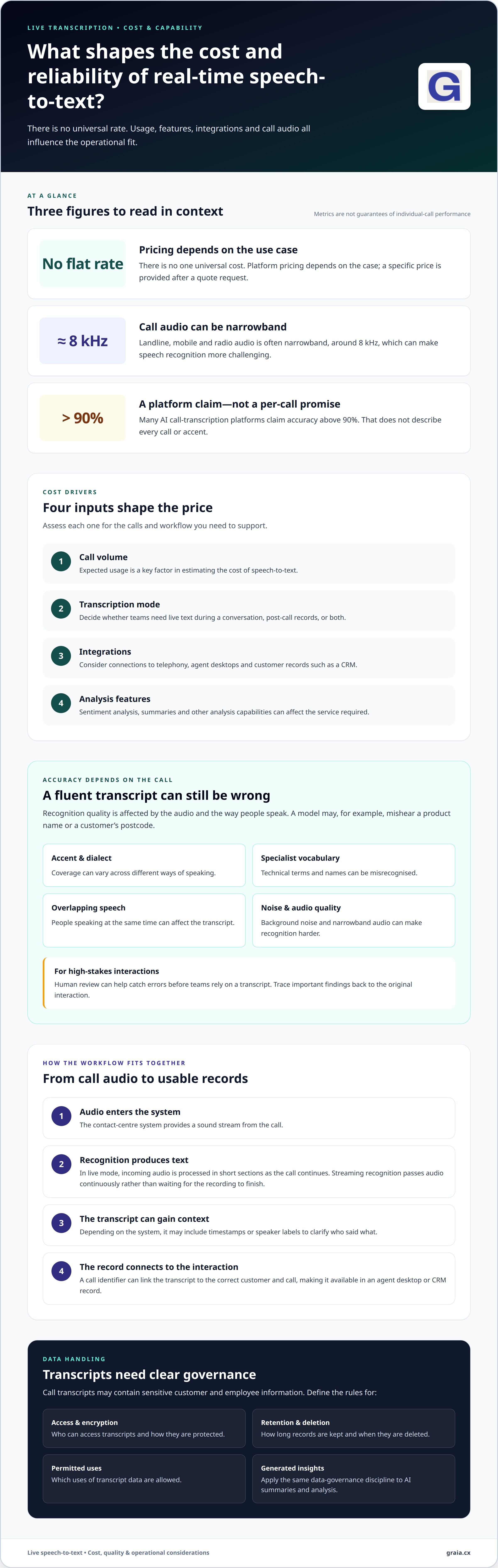
AI speech-to-text converts call audio into written words, either during a conversation or afterwards. There isn’t one universal cost: pricing depends on the service’s charging model and the capabilities, usage and infrastructure involved. For a particular platform, the price depends on the case and is given after a quote request; key cost factors include call volume, transcription mode, integrations and analysis features.
Live speech-to-text transcription processes incoming audio in short sections, then displays the recognised words as the call continues. Streaming speech recognition passes audio continuously to a recognition model rather than waiting for the recording to finish. Depending on the platform, the transcript can support an agent during the call or later analysis.
Transcription of call audio begins with a sound stream from the contact-centre system. The recognition model identifies speech sounds, predicts words and produces text. It may also add timestamps or speaker labels, depending on the system. Audio quality affects the result: call-centre audio from landlines, mobiles and radios is often narrowband, around 8 KHz, which can make speech recognition more challenging.
Accuracy also depends on accents, dialects, specialist vocabulary, overlapping speech and background noise. A model may mishear a product name or a customer’s postcode, so a fluent-looking transcript isn’t automatically accurate. Many AI call-transcription platforms claim accuracy above 90%, but that claim doesn’t describe every call or accent. For high-stakes interactions, human review can help catch errors before teams rely on the transcript.
Integration connects transcription with telephony and customer records. A typical flow sends call audio to speech recognition, associates the transcript with a call identifier, then makes the text available in an agent desktop or CRM record. Matching each transcript to the correct customer and interaction is essential for useful search and reporting.
Security and retention need equal attention. Transcripts can contain sensitive customer and employee information, so organisations should define who can access them, how they’re encrypted, how long they’re retained, when they’re deleted and which uses are permitted. Apply the same data-governance discipline to AI-generated analysis and summaries as to the transcript itself.
To understand the operational fit, assess the audio path, expected call volume, required integrations and whether teams need live text or post-call records. Then consider how accent coverage and review workflows affect the customer experience. These factors explain why a transcription service’s cost depends on more than speech recognition alone. Explore contact-centre AI insights for further context on applying AI to customer conversations.
Automated call summaries and insight extraction
A transcript captures what was said; automated summaries and insight extraction turn that record into a usable account of the interaction. A summary might identify the customer’s issue, the agent’s response, the agreed action and whether the issue was resolved. This helps teams review the substance of a call without reading every line first.
The process starts with a transcript made available to an approved AI or analytics application. The system identifies relevant details, organises them into a summary, then applies categories or tags. A call about a missed delivery might receive tags for “delivery”, “complaint” and “follow-up”, while its summary records the requested action. Teams can search and group interactions using those shared labels.
A useful conversation summary preserves the sequence that makes an outcome understandable. It distinguishes the customer’s initial concern from the answer given and the final agreement. For instance, “customer asked about a charge” is less useful than noting that the agent explained the charge and promised a further review. Keep summaries concise without losing context or the next step.
Insight extraction looks across interactions to detect recurring themes that individual call summaries may not reveal. If customers repeatedly mention confusing instructions, analysis can group those comments and show where the issue appears. Teams can then examine the original calls, assess whether the pattern is meaningful and decide what to do. Transcript themes are signals to investigate, not automatic proof of a root cause.
Tags make findings easier to filter. A contact centre might classify calls by intent, product, complaint type, resolution status or requested follow-up. A consistent taxonomy helps analysts compare like with like; overlapping or vague tags can blur the results. If a call concerns both a billing question and a service complaint, clear tagging rules help preserve both topics instead of forcing an incomplete label.
Summaries and extracted findings should remain traceable to their source interactions. A supervisor reviewing a “repeat contact” theme needs to open the relevant call and check what happened, rather than rely on a detached label. This context helps validate the summary, catch transcription errors and distinguish an unresolved issue from a customer who simply requested more information.
Use outputs for specific tasks: give agents concise handover notes, help supervisors prioritise follow-ups or identify recurring friction for service teams. Keep access to transcripts and metadata aligned with organisational policy, and apply the same data-governance discipline to AI-generated analysis. The value comes from linking each action or insight to evidence, a clear owner and a meaningful resolution.
Speaker diarization
Speaker diarisation separates a call transcript into turns labelled by speaker, such as “Agent” and “Customer”. Instead of reading one continuous block, a supervisor can see who said each phrase. The customer’s question and the agent’s response, for example, remain distinct, making the exchange easier to follow during review.
Speech recognition converts audio into words, while diarisation assigns those words to speakers. The system analyses audio patterns and marks where one voice appears to stop and another begins. These labels distinguish speakers within an interaction; they don’t necessarily identify a person by name. That difference matters when interpreting a transcript.
Speaker separation becomes more complex when people interrupt, speak over one another or have similar-sounding voices. A customer might begin speaking before an agent finishes explaining a process. The system may then assign overlapping words imperfectly or attach a phrase to the wrong speaker. Reviewing the audio alongside the transcript can help clarify an unclear exchange.
Talk-time measurement uses speaker labels to estimate how long each person spoke. A supervisor can compare the agent’s speaking intervals with the customer’s, then listen to calls where the pattern seems unusual. The result is a review cue, not a complete measure of service quality: a longer agent turn could reflect a careful explanation, an interruption or an unresolved conversation.
Context gives talk-time figures meaning. If a customer needs help describing a complicated issue, extended customer speech may be appropriate. If an agent dominates a call, the recording can show whether they clarified the problem or spoke over the customer. Reviewing the turn sequence helps coaching focus on listening, clear explanations and relevant follow-up.
Language can also affect speaker labelling. A call that switches between languages may include changes in pronunciation, vocabulary and speaking rhythm. Those shifts can complicate recognition, particularly when speakers overlap or audio quality is poor. A practical review checks whether each labelled turn matches the voice and whether the transcript captures the words clearly enough for its intended use.
For agent support, speaker labels can make the conversation easier to scan, helping an agent quickly locate a customer statement or earlier response. In post-call analysis, they can help supervisors review interruptions, handovers or talk-time patterns. Treat labels as processing outputs that need context, not as a judgement by themselves. The original interaction remains the reference for important decisions.
Real-time transcription and call analysis
Live transcription turns a call’s audio into text while the conversation is underway. Analysis can use that stream to surface customer intent, relevant information or defined prompts. For example, an agent may receive a knowledge suggestion when a caller describes a recurring account issue. Timing is central: guidance that arrives after the agent has moved on cannot shape the exchange.
Contact-centre platforms, speech-recognition services and analytics tools can be combined to support transcription and call analysis. Some deployments connect a telephony stream to transcription, then pass the results to agent or supervisor tools. Consider how each component fits the workflow: live agent guidance, post-call reporting or both. The technology should work with the call centre’s systems and the way its teams handle interactions.
Live transcripts can assist agents during calls and support search, reporting, quality management and summaries afterwards. In a call about a delayed payment, a live prompt might help an agent find relevant guidance, while the transcript later supports a review of the explanation given. Combining transcript data with routing, customer and outcome information can make reporting more useful than analysing words alone.
Latency affects whether live analysis helps. If the system takes too long to recognise a customer’s request, a suggested response may arrive after the conversation has shifted. A pilot should assess the delay between a spoken phrase and the corresponding transcript or prompt. It should also check whether guidance is relevant, easy to interpret and delivered at a useful point in the call.
To pilot and measure the technology, define a focused use case first, such as agent guidance for a common enquiry. Compare current call handling with the pilot workflow, then assess transcript completeness, recognition errors, prompt relevance and agent feedback. Track outcomes that match the use case, such as whether an issue was resolved or required follow-up. Review recordings alongside transcripts to understand why results differ.
Keep the pilot structured. Include representative call types and speech patterns, record where the system struggles, and distinguish transcription faults from weak analysis or workflow issues. Supervisors can review flagged interactions with agents, then use the findings to refine prompts and evaluation criteria. Assign a clear owner to the review process, and give agents a practical way to report distracting or mistimed prompts.
Finally, treat data handling as part of the design, not an afterthought. Set access, retention and permitted-use practices for transcripts and generated analysis before expanding the pilot. For a clearer view of how AI can support live service, explore contact-centre AI insights.
GraiaCX: Live Call Translation
GraiaCX’s Live Call Translation supports multilingual customer conversations without requiring bilingual staff. It enables live call translation in over 100 languages, helping agents and customers communicate across language differences as a conversation unfolds.
For call centres serving customers in multiple languages, this can complement transcription and analysis by addressing a separate need: understanding the conversation across languages, not only recording it as text. Agent Assist can also provide real-time support to agents, while the Agentic Omni-Channel Platform brings voice, chat, email and social messaging together.
If multilingual conversations are a priority for your contact centre, contact GraiaCX to discuss how Live Call Translation could fit your needs.
Turn conversation data into better decisions
The next step is to connect your technology choices to the experience you want customers and agents to have. A considered approach to real-time transcription and analysis for call centres starts with a clear operational priority, then aligns the right tools and workflows around it. This keeps the focus on practical needs rather than features alone.
GraiaCX offers a Conversational Agent, Live Call Translation and Agent Assist to support different parts of the contact-centre experience. Choose according to where your teams need support, from handling routine enquiries to helping agents communicate across languages or access timely guidance.
Move forward with a defined use case and a clear view of what better service means for your organisation. Explore how GraiaCX can support your contact centre and take the next step with confidence.
Frequently Asked Questions
Can you transcribe a range of accents and dialects?
Speech-recognition systems can process calls featuring different accents and dialects, but their output depends on the audio and language patterns involved. Evaluate the system with representative recordings, including regional pronunciation, specialist terms and callers who switch languages mid-conversation. Review names, addresses and other details where a misheard word could change the next action. This helps identify where phrase lists or human review may improve the result.
How does real-time transcription and analysis work in call centres?
A call-centre system streams audio to speech recognition, which turns speech into text as the interaction unfolds. Analysis can then identify topics or intent and present relevant prompts to an agent. For example, a request to change an appointment could trigger a search for the correct process. After the call, the transcript can support reporting or review, with the call record linking the text to its interaction context.
What features should call centre speech analytics software include?
Prioritise features that fit the workflow: live transcription, speaker separation, searchable records, useful filters and summaries tied to their source calls. Agent prompts should arrive quickly enough to support the conversation, while supervisors need ways to review uncertain or incomplete transcripts. Consider access controls, encryption, retention settings and integration with telephony and customer records. These capabilities help teams use analysis while governing the underlying conversation data.
How accurate is real-time transcription for UK accents, dialects and noisy calls?
Accuracy varies with pronunciation, call clarity, overlapping speech and specialist vocabulary, so a single score won’t describe every interaction. Assess performance using calls that reflect your customers and channels, then compare transcripts with recordings. Look closely at names, postcodes and product terms, since a small recognition error can change meaning. Track recurring error types and decide which need phrase-list updates, agent correction or human review.
How much does call centre transcription and analytics software cost in the UK?
For an AI call-analysis system, assess the features and workflow you need, from live transcription and agent guidance to summaries and searchable analysis. Compare proposals by their scope, including integrations, storage and support requirements, rather than by a headline rate alone. A transcription-only setup is different from a connected system that also provides live guidance and post-call analysis.
What are the UK GDPR and PECR rules for recording and analysing customer calls?
Call recording and analysis should align with applicable UK GDPR, PECR, privacy and recording requirements. The practical governance plan should define permitted uses, transcript access, encryption, retention and deletion, then apply the same discipline to AI-generated summaries and analysis. The details depend on the organisation’s purpose and call-handling setup, so document how information is managed and who can access it.