
Real-Time Agent Assistance for Lower Effort and Better Service
Post-call AI can explain what happened, while real-time guidance helps an agent respond during the interaction. The benefits of real-time agent assistance include surfacing relevant knowledge, process reminders and possible next steps as the conversation unfolds. The agent remains responsible and can use, adapt or disregard suggestions to meet the customer’s needs.
That distinction matters in busy UK contact centres, where agents may need to listen, search for answers and follow workflows at the same time. Timely, relevant guidance can reduce task switching and help teams deliver more consistent support. Poorly timed or excessive prompts, however, can distract rather than help.
This article explains how live assistance works, where it can ease agent workload, and how it supports consistent service and compliance reminders. It also covers the metrics teams can use to assess its impact and compares live guidance with post-call AI, which analyses interactions after they end. Understanding what each approach contributes helps teams use them together effectively.
Key Takeaways
- Use live prompts to bring relevant knowledge, workflow steps and customer context into the interaction, while leaving judgement with the agent.
- Design guidance to be timely, selective and easy to dismiss so it supports attention instead of competing with the conversation.
- Ground compliance reminders in current, approved information and make them visible where agents work.
- Assess impact using measures such as first-contact resolution, repeat contact, average handle time, transfer rate and customer satisfaction.
- Pair live assistance, which supports decisions during an interaction, with post-call AI, which can inform later quality reviews and coaching.
How does live agent guidance improve call centre performance?
Live guidance can help an agent find relevant information while a customer is speaking. For example, a prompt can surface a troubleshooting step before the caller has to repeat the problem.
Agent Effectiveness and Customer Outcomes
Agent effectiveness means resolving a customer’s need accurately and efficiently during an interaction. Live guidance can support this by identifying intent, retrieving relevant knowledge and suggesting a next step. For a billing query, it might display an approved explanation alongside account details. The agent can then focus on listening and choosing a response that fits the customer’s situation.
Context makes suggestions more useful. A customer who has already contacted support about a delayed order shouldn’t have to explain the full history again. With relevant account context and previous interactions in view, the agent can acknowledge the earlier issue, check what has changed and explain the next action clearly. This can reduce repetition and help the customer feel heard.
There are risks: inaccurate suggestions can misdirect an answer, and over-reliance can weaken an agent’s judgement. Before acting, agents need to assess each prompt against the conversation, approved knowledge and the customer’s circumstances.
Guidance also needs to arrive at the right moment. A troubleshooting suggestion shown while a customer describes an error may help the agent investigate; the same prompt after the issue is resolved could distract. Systems can identify topics, entities and events in conversation, but relevance depends on accurate detection and trusted information.
Customer and Brand Experiences
Customer and brand experience is shaped by the quality and consistency of support. Live guidance can help agents explain processes clearly, use approved answers and recognise when a conversation needs escalation. For example, a prompt may remind an agent to clarify a confusing account charge before discussing possible resolutions. This can make support more coherent without making the conversation sound scripted.
Customers notice avoidable friction: repeating details, waiting while an agent searches, or receiving conflicting explanations. Access to relevant knowledge during a conversation can reduce time spent navigating disconnected resources. The result depends on the information’s accuracy and relevance, not on the number of prompts. Selective suggestions leave room for empathy and natural conversation.
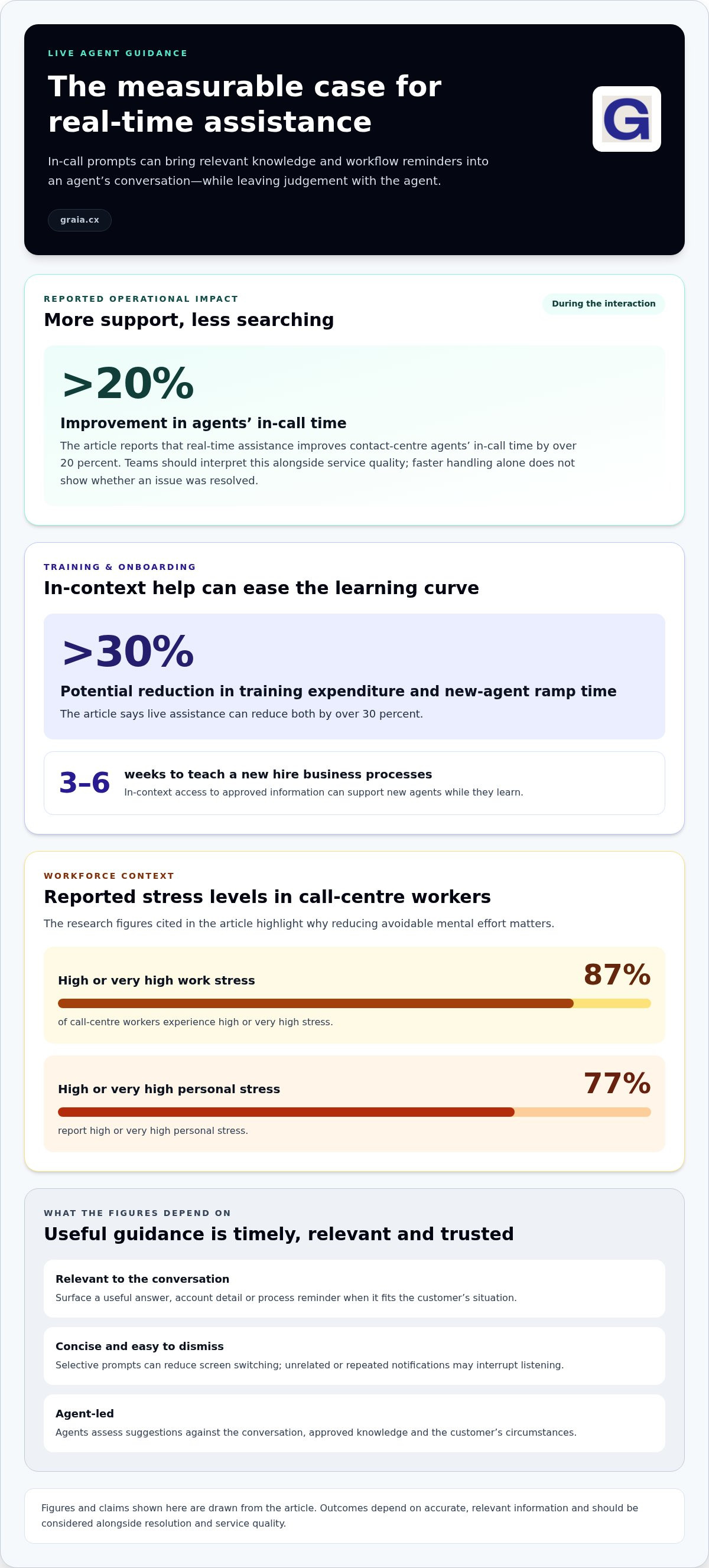
Teams can assess the customer experience through customer satisfaction, customer effort and resolution outcomes. They can also review whether guidance helped agents find an answer or complete a workflow. Real-time assistance improves contact-centre agents’ in-call time by over 20 percent, but teams should interpret that measure alongside service quality. Faster handling alone does not show whether the customer’s issue was resolved.
For a practical review, compare interactions involving similar customer intents. Check whether agents found relevant guidance, customers had to repeat information, and the conversation reached a suitable resolution. This links system prompts to the customer experience, rather than treating prompt delivery as success in itself.
Reducing cognitive load and designing for agent attention
Live assistance can lift productivity by reducing searches and helping agents complete workflows during conversations. It can also reduce training expenditure and new-agent ramp time by over 30 percent.
Reducing Agent Cognitive Load
Cognitive load is the mental effort needed to track information and make decisions. In a contact centre, agents may listen, search, record details and follow processes at once. Relevant prompts can bring an approved answer or process reminder into the agent’s workflow, reducing screen switching and the details they must hold in working memory.
Design matters. A prompt should relate to the conversation, appear at a useful moment and be easy to dismiss. If a customer describes a failed payment, for example, a relevant troubleshooting step may help. Unrelated prompts or repeated notifications can interrupt listening and add to the workload they were meant to ease.
Keep the agent desktop focused on the next useful action. Present a concise knowledge result, key account detail or workflow reminder, rather than several competing options. Agents can evaluate the suggestion and continue speaking naturally. The system should support attention, not require agents to stop the conversation to use another application.
Agent Stress and Retention
Agent stress is the pressure created by sustained demands, complex tasks and limited time to respond. Research in the brief reports that 87% of call centre workers experience high or very high stress, while 77% report high or very high personal stress. These figures underline why reducing avoidable mental effort matters for contact-centre teams.
Assistance can make procedures easier to access during a difficult interaction. For example, a prompt can surface an escalation step when a customer’s issue exceeds the agent’s authority. Clear guidance can reduce the need to recall every process from memory, while the agent still uses judgement to respond appropriately. It does not remove emotional demands or resolve every cause of staff turnover.
Training also benefits from accessible, in-context guidance. Teaching a new contact-centre hire a business’s processes can take three to six weeks. Real-time assistance can help new agents find approved information while learning, and may reduce training expenditure and ramp time by over 30 percent. It works best alongside clear onboarding, coaching and practice, not as a replacement for them.
To protect attention, teams can review agent adoption, recommendation acceptance and time saved on workflow steps. If agents routinely ignore prompts, investigate whether the guidance arrives too often, lacks context or interrupts their work. A useful next step is exploring contact-centre guidance and AI to consider how assistance can fit agents’ daily workflows.
Consistent support and compliance reminders
Real-time prompts can help agents follow approved guidance during customer interactions. In contact centres, compliance adherence can improve by 10-15 percent with real-time assistance.
For UK GDPR, treat identifiable conversation details and account context as personal data. Configure assistance to use relevant information, restrict access appropriately and follow the organisation’s established retention and data-handling controls.
Consistency starts with the material behind each prompt. A system can match a conversation to approved knowledge or workflow logic, then display relevant guidance in the agent workspace. For example, a billing query could trigger the current explanation and relevant account process. Agents still need to assess whether the information fits the customer’s circumstances.
This distinction matters because a prompt can standardise a process without making every conversation identical. An agent may need to explain the same policy differently to a customer who is confused, distressed or dealing with an unusual account issue. Guidance should support the response, not replace listening or professional judgement.
Keep the knowledge base current and clearly governed. If a policy changes, outdated wording can lead to inconsistent answers across calls, chats and emails. Assign responsibility for reviewing approved content, remove superseded versions from agent access, and connect prompts to the relevant workflow. A customer asking to correct an account detail, for instance, should see the appropriate handling steps rather than a generic response.
Compliance reminders work best when they appear at the right moment. A reminder linked to a specific conversation stage can help an agent complete a required workflow step. A permanent banner, by contrast, may become background noise. Use defined triggers and concise wording so agents understand the action without losing focus on the customer.
There are limits. If the system misidentifies intent, it may surface irrelevant or outdated guidance. If an agent follows every recommendation without checking the context, an incorrect prompt can influence the answer. Make suggestions easy to dismiss or correct, and keep the agent responsible for deciding what to say and do.
Review real interactions to assess whether guidance supports consistent handling. Compare each prompt with the approved source, the action taken and the customer’s outcome. Track agent adoption and recommendation acceptance alongside compliance adherence. Low acceptance may point to poor timing, unclear wording or a mismatch between the prompt and workflow.
Treat privacy and service quality as connected design concerns. Limit displayed account details to what the interaction requires, and avoid exposing unnecessary information on shared screens. Clear access controls, relevant prompts and well-maintained knowledge help agents deliver consistent support without turning compliance into a mechanical script.
Contact centre performance metrics such as AHT, FCR and CSAT
Measure live assistance through service outcomes, not prompt counts alone. Average handle time (AHT), first-contact resolution (FCR) and customer satisfaction (CSAT) each show a different aspect of performance.
AHT tracks the time agents spend handling interactions, including related follow-up work. If knowledge searches slow a call, relevant guidance may reduce that effort. Compare AHT for similar customer intents before and after introducing assistance. A shorter call is useful only if the customer’s issue is still resolved appropriately.
FCR measures whether an issue is resolved during the customer’s first contact. Track repeat contacts by reason, alongside transfers and resolution outcomes. For example, if billing enquiries take less time but more customers call back, lower AHT hasn’t improved the result. Reviewing both measures helps reveal that trade-off.
CSAT captures customers’ reported satisfaction, while customer effort measures how difficult they found resolution. Compare both with interaction type and channel. A prompt that helps an agent explain a complicated process may improve the experience, even if the conversation takes longer. Together, these measures show the quality and efficiency of support.
- AHT: Compare average handling time by customer intent, including relevant follow-up work.
- FCR: Review first-contact resolution alongside repeat contact and transfer rates.
- CSAT and effort: Relate customer feedback to the interactions where guidance appeared.
- Workflow measures: Track knowledge search time, agent adoption and recommendation acceptance.
Evidence for return on investment needs careful interpretation. Some companies implementing AI in call-centre services report a 50% reduction in cost per call, but that figure covers AI services broadly, not live agent assistance alone. PepsiCo saves more than 438 hours each month through access to consumer insights, which is an example of time saved, not a direct measure of agent-assist ROI.
Build an evaluation around comparable interactions. First, record baseline AHT, FCR, CSAT, repeat contacts, transfer rate and knowledge search time. Then compare the same measures after deployment, grouping results by intent, channel and team. This helps separate the effect of guidance from changes in enquiry mix or operating conditions.
Include adoption and recommendation acceptance in the analysis, but don’t treat either as a business outcome. High acceptance could mean prompts are useful, or that agents follow suggestions without enough scrutiny. Pair those figures with resolution quality and customer feedback for a more balanced view of operational impact and customer experience.
Connect improvements to the workflow that produced them. If search time falls while FCR rises for a specific enquiry type, that pattern offers clearer evidence than an overall average. Review exceptions, too: an increase in transfers or repeat contacts can show where prompts need more context or more relevant knowledge.
Real-time assistance compared with post-call AI
Real-time assistance analyses live voice or digital interactions and offers guidance during the conversation. Post-call AI analyses completed interactions, helping teams review quality, identify patterns and shape future coaching.
Agent assistance supports a live decision; coaching develops skills through feedback, often after a review. A chatbot responds directly to customers, while a knowledge base stores information agents can search. For example, an agent-assist prompt can surface a relevant article during a billing query.
The difference is timing. If a customer describes a failed payment, live guidance might present a troubleshooting step before the call ends. Post-call analysis could later flag the interaction for review, helping a coach assess the agent’s response and identify a learning opportunity.
These approaches can complement one another. Data from live assistance can feed post-contact quality and coaching analytics. A team might review conversations where agents dismissed a suggestion, then check whether it was irrelevant, poorly timed or difficult to apply. This turns live experience into insight for improving future guidance.
Real-time assistance can analyse live voice or digital interactions, but useful prompts depend on accurate intent detection, trusted knowledge and timely delivery. Returning a suggestion within a conversational turn has a typical target of 300-500 milliseconds. Workflow integration also matters: guidance should appear where agents handle calls, chats or emails.
Implementation starts with the interaction type and agent task. Identify common intents, such as account access or delivery questions, then connect approved knowledge and relevant workflow steps. Configure prompts around useful events, test their accuracy with representative conversations, and refine the wording before wider use.
Next, introduce the guidance in the agent workspace and observe how it performs during live interactions. Check whether prompts arrive at the right moment, match the conversation and help complete a task. Make recommendations easy to dismiss so agents can keep their attention on customers when the context calls for another response.
Evaluate both sides of the system. Track agent adoption and recommendation acceptance, then examine resolution quality and customer effort. Separately, use post-call analysis to identify recurring knowledge gaps and coaching needs. If agents repeatedly search for the same answer, that may point to a knowledge or workflow improvement.
The practical choice isn’t always one method over another. Use live assistance when agents need support during customer interactions; use post-call AI to examine patterns and inform quality reviews. To explore how these approaches can fit contact-centre workflows, explore contact-centre AI insights.
GraiaCX: Conversational Agent
GraiaCX brings live agent support and automated customer interactions into a connected contact-centre platform. Its Agent Assist can surface next-best-action suggestions, while the Conversational Agent can handle routine enquiries autonomously. This combination is useful when teams want to support agents while automating suitable customer journeys.
The Agentic Omni-Channel Platform brings voice, chat, email and social messaging together with AI-driven automation. For multilingual interactions, Live Call Translation supports more than 100 languages, helping teams serve customers without relying on bilingual staff.
Consider these capabilities when your contact centre needs more consistent guidance across channels, multilingual conversations or automation for routine enquiries. Schedule a consultation with GraiaCX to discuss how its platform can support your contact-centre needs.
Make live guidance part of a better service experience
The next step is to identify where timely support would make the greatest difference for your team. Start with a recurring point of friction, such as agents searching across systems or struggling to find the right workflow during a complex interaction. Then define what useful guidance should help them do and who will keep its source information current.
This focus gives teams a clearer way to shape the experience around agent judgement, rather than simply adding more prompts. The benefits of real-time agent assistance are strongest when guidance addresses a specific need, fits naturally into daily work and responds to customer context.
As you plan, consider how live support should complement later review and coaching. This connects each interaction to ongoing service improvement while keeping the conversation human. A thoughtful starting point can turn technology into practical support for agents and customers.
Contact GraiaCX to explore agent assistance and take the next step towards more attentive, capable service.
Frequently Asked Questions
What is Real-Time Agent Assist?
Real-Time Agent Assist is software that analyses an active customer interaction and provides relevant support to a human agent. For example, during a discussion about a disputed charge, it might identify the topic and bring up an account procedure. The agent reviews the information and decides how to respond. The tool supports the agent’s work rather than taking control of the conversation.
What is real-time agent assistance in customer service?
In customer service, real-time agent assistance gives staff contextual information as they handle a call, chat or email. For example, an agent handling an order change might see the applicable fulfilment steps in their workspace. This differs from customer-facing automation, which responds directly to the customer. Assistance helps the person serving them make an informed decision during the interaction.
What are the main benefits of real-time agent assistance for contact centres?
Real-time assistance can help agents handle unfamiliar or complex enquiries with relevant information close at hand. For example, an agent answering a new product query may need to find a specific explanation while keeping the conversation moving. Guidance can also make important workflow steps easier to find. Contact centres can assess its value by reviewing agent feedback and the outcomes of interactions involving less familiar topics.
How does real-time agent assistance improve first-contact resolution and customer satisfaction?
It can support first-contact resolution by helping an agent identify a relevant answer or action before ending the interaction. If a customer reports that an account change hasn’t taken effect, for example, the agent may use available context to investigate the next appropriate step. Clear, accurate help can reduce unnecessary follow-up and frustration. Customer satisfaction still depends on the resolution and how the agent communicates it.
Does real-time agent assistance reduce average handling time and call transfers?
It can help reduce handling time when agents spend less time searching for information or completing avoidable workflow steps. Relevant guidance may also help an agent resolve an enquiry without an unnecessary transfer. For example, a clear process for an account update can help an authorised agent handle the request directly. Compare results for similar enquiry types, considering resolution quality alongside speed and transfer patterns.
What evidence or case studies quantify the ROI of real-time agent assistance?
Reported measures include over 20% improvement in agents’ in-call time and over 30% reductions in training expenditure and new-agent ramp time; some companies report a 50% reduction in cost per call.