
Proactive customer service examples that keep customers informed
Good service shouldn’t begin only after a customer reports a problem. The most useful proactive customer service examples show how a business anticipates a need and shares relevant information or help before the customer has to ask. That might mean flagging a likely disruption, sending a delivery update or explaining how to resolve a common issue.
Customers value clear, timely communication, especially when plans change or they’re waiting for an answer. But proactive support is more than sending messages: it uses customer signals to decide what information will help, when to share it and which channel to use.
This article explains proactive customer service and how predictive analytics can help organisations identify emerging needs and points of friction. It also covers practical ways to keep customers informed, from service alerts and appointment reminders to product updates, and how timely communication can make support more useful and personal.
Key Takeaways
- Proactive support shares useful information before a customer needs to ask, while reactive support responds after an issue is raised.
- Predictive analytics can help identify emerging needs and service friction, so teams can respond with more relevant guidance.
- Timely updates about delays, appointments or availability can help customers plan their next steps with greater confidence.
- Choose the message and channel around what customers need to know, and use customer data thoughtfully to make communication relevant.
- Automation and agent support can help deliver consistent information while keeping human assistance available for more complex conversations.
1. What is proactive customer service?
Proactive customer service means acting before a customer needs to report a problem or request information. For example, an internet provider might alert customers to a service disruption before they start troubleshooting. Reactive customer service begins after a customer gets in touch, such as when they call to ask why their connection has stopped working. Both approaches matter, but they address different moments in the customer journey.
The difference is the timing and trigger. A proactive message responds to a signal or an expected need; reactive support responds to a customer’s question, complaint or request. If an airline tells travellers about a delay as soon as it becomes known, they have time to consider their plans. If a traveller has to contact customer support first, the interaction is reactive. A seamless experience can combine both: send useful updates early, then make it easy to reach a person if the update doesn’t solve the issue.
UK companies can apply this approach across industries. A bank might alert a customer to unusual account activity, while a clinic could send an appointment reminder. A car dealership might suggest maintenance based on a vehicle’s history, and an internet provider could flag a developing network issue. Each example starts with a different signal, but the aim is the same: share relevant information before a customer has to ask. The message should help the customer decide what to do next, not create unnecessary concern or contact.
For UK GDPR and PECR, organisations should use customer data responsibly, respect privacy and account for consent requirements. The right approach depends on the data, communication channel and purpose of the message, so a service update should not automatically be treated like marketing outreach.
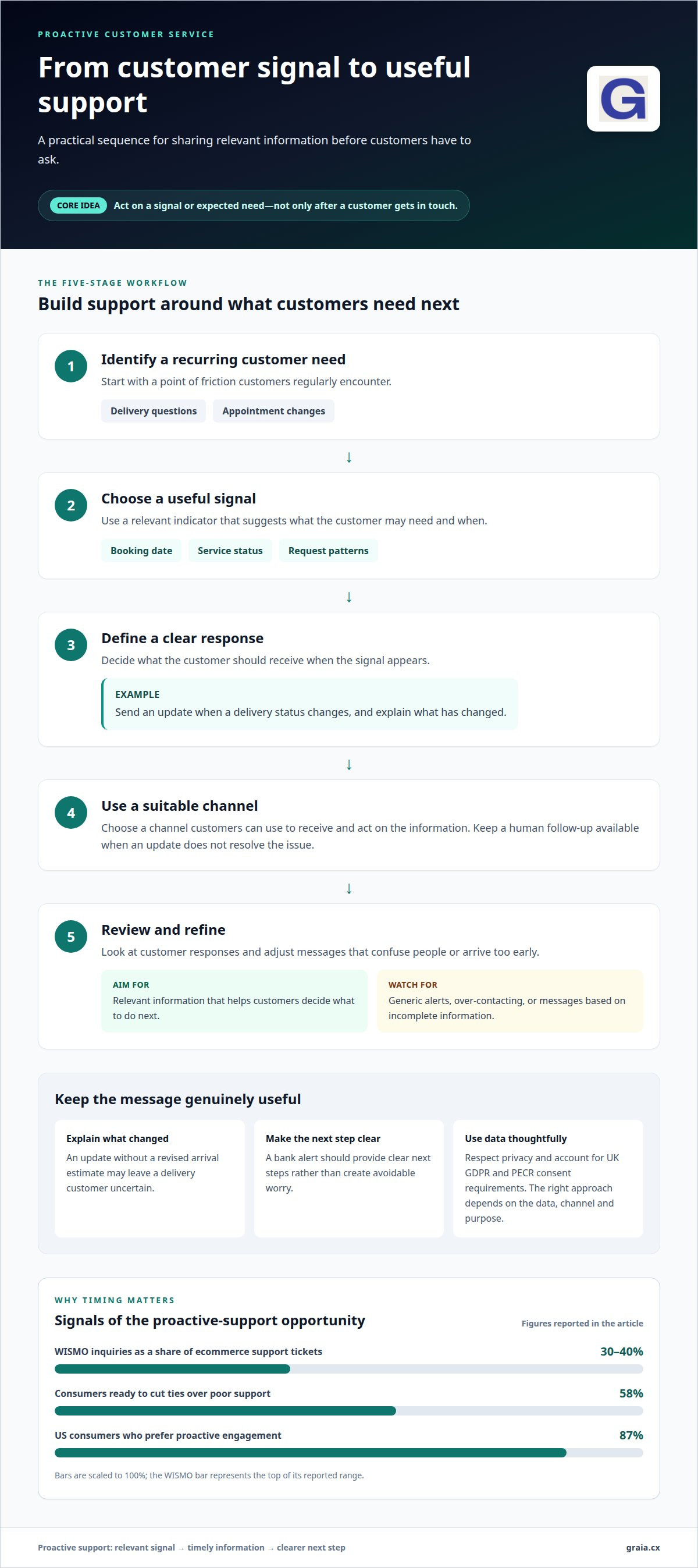
A business can build proactive support through a practical sequence:
- Identify a recurring customer need, such as delivery questions or appointment changes.
- Choose a useful signal, such as a booking date, service status or customer request pattern.
- Set a clear response, such as sending an update when a delivery status changes.
- Select the channel customers can use to receive and act on that information.
- Review customer responses and adjust messages that cause confusion or arrive too early.
Common mistakes include sending generic alerts, contacting people too often or acting on incomplete information. For instance, a delivery message without a revised arrival estimate may leave a customer just as uncertain. A bank alert without clear next steps can cause avoidable worry. Keep each message relevant, explain what has changed and provide a suitable way to follow up. Proactive support works best when it reduces effort rather than shifting it onto the customer.
WISMO inquiries account for 30-40% of ecommerce support tickets; 58% of consumers are ready to cut ties over poor support, while 87% of US consumers prefer proactive engagement. Such strategies can reduce incoming tickets.
2. Predictive analytics and proactive support
Predictive analytics turns customer and operational data into signals teams can act on. A retailer, for example, could analyse past contact patterns and current service activity to anticipate a rise in questions about a delayed product launch. Teams can then prepare clear guidance before queues build. Gartner found that 13% of customers reported receiving any proactive service, highlighting a gap between anticipation and customers’ experience.
AI and automation help interpret customer signals at scale. A CRM system can organise customer history, while AI and machine learning can identify patterns linked to likely needs or preferences. For example, a customer who repeatedly seeks help with the same account task could receive a relevant guide before contacting an agent. A Conversational Agent can handle routine enquiries autonomously, while Agent Assist can offer human agents real-time next-best-action suggestions for more complex conversations.
Prediction should guide communication, not dictate it. A useful system combines the signal, the likely customer need and a suitable response. If analytics identify customers at risk of missing an important service step, the business can send a timely, personalised explanation. Agents can then focus on cases where context, judgement or reassurance matters. The 2024 Customer Experience Trends Report states that 70% of organisations actively invest in tools that capture and analyse intent signals.
Predictive technologies can also use data from connected equipment. For example, sensors on industrial machinery can report changes in temperature or vibration. Remote asset monitoring can use those readings to identify a potential fault, allowing a service team to arrange maintenance before equipment stops working. This is predictive maintenance: acting on condition data rather than waiting for a breakdown or customer complaint.
To make analytics useful in customer support, organisations can follow a deliberate sequence:
- Choose a clear problem, such as repeated questions about a product feature.
- Bring together relevant signals, including service history, customer feedback and operational data.
- Set a response for each meaningful signal, such as sending guidance or routing a case to an agent.
- Review whether the response helped customers resolve the issue, then refine the trigger or message.
McKinsey reports that AI-powered proactive engagement can reduce service interactions by 40–50%. The aim isn’t simply to deflect contact; it’s to prevent avoidable effort while preserving human support when needed. Predictive analytics can also help teams identify patterns across channels, rather than treating each interaction as an isolated event. For practical perspectives on applying AI to customer experience, explore AI and customer experience insights.
That distinction matters: predictive analytics can help businesses anticipate increases in service requests or identify customers at risk, giving them a chance to act before problems escalate. It can also reveal trends and patterns that help address potential issues and identify upselling and cross-selling opportunities. A customer relationship management system can manage and analyse customer data, while AI and machine learning can help predict customer behaviour and preferences.
Ecommerce brands can use proactive AI for the predictable 80% of support needs and reserve human agents for the high-stakes 20%. Car dealerships can offer maintenance based on customers’ vehicle histories and usage patterns. Internet of Things devices and remote asset monitoring can provide real-time data for proactive customer service and maintenance.
3. Benefits of proactive customer support
Anticipating a customer’s next question can reduce effort and strengthen satisfaction. For example, a software company could send a clear setup guide after a customer activates a new feature. The customer can make progress without waiting for an agent, while support teams focus on cases that need judgement. Proactive support creates value when a message addresses a real need, rather than simply adding another notification.
Customers can also feel recognised when communication reflects their situation. Gartner reports that 90% of customers who received proactive service found it valuable. A retailer might share care advice for a recently purchased item, while a subscription service could explain a change before it appears on the next statement. Relevant timing and plain language help build trust. Generic messages, by contrast, can feel intrusive and weaken the relationship.
There can be a commercial impact, too. nShift reports that post-purchase proactive engagement can increase repeat buying rates by 6–12%. A useful delivery update or follow-up can keep customers informed after checkout and support confidence in the purchase. McKinsey reports that AI-powered proactive engagement can increase customer satisfaction by 15–20%. These findings point to potential benefits, but the business still needs to connect each message to customer needs and measure its own results.
Efficiency is another benefit. A service team that answers predictable questions in advance may receive fewer avoidable contacts, leaving agents more capacity for complicated cases. McKinsey says businesses can cut costs by 20–30% using AI to shift to proactive customer service, and grow revenue by 5–8%. These are reported outcomes, not a guaranteed result for every organisation. The effect depends on how well the intervention addresses the cause of customer contact.
To measure impact and return on investment, compare a defined group receiving proactive communication with a suitable baseline. Track contact volumes, repeat contacts, customer satisfaction, retention and conversion alongside the cost of creating and delivering the intervention. One useful measure is whether a billing explanation reduces later queries without increasing complaints.
Use a balanced set of measures, not ticket reduction alone. A falling contact count could mean customers found an answer, or that they gave up seeking help. Review customer feedback alongside operational data, then refine messages that cause confusion. For example, if a software update notice prompts more support requests, clarify what changes and where users can find help. Loyalty grows through dependable experiences over time, not a single automated message.
Proactive communication can also reveal opportunities to improve. If customers repeatedly ask about the same product step, a business can improve its instructions and let customers know what changed. That closes the feedback loop: customers see their input acted on, while teams address a recurring source of friction. The strongest measure of success is whether customers can move forward with less uncertainty and greater confidence.
4. Timely updates and product-release notifications
A useful notification gives customers information while they can still act on it. An airline can tell travellers about a flight delay and share available rebooking options, helping them make a plan sooner. If the situation changes again, a follow-up should explain what has changed instead of repeating the original alert.
Practical proactive customer service examples include delivery progress messages, appointment reminders, billing schedules, account balance notices and maintenance updates. A clinic can remind a patient about an upcoming appointment and explain how to request a change. An online retailer can explain a delivery delay before customers contact support. Each message should answer a likely question and make the next step clear.
Delivery notifications can also reduce uncertainty after checkout. According to nShift research, proactive ecommerce delivery notifications can reduce “where is my order?” enquiries by 60–70%. That outcome depends on messages being timely and useful: a status update that says only “delayed” leaves customers wondering what happens next. Sharing the latest delivery information helps customers decide whether to wait or make other arrangements.
Back-in-stock alerts are another practical example. A retailer can notify a customer when an item they wanted becomes available again, instead of asking them to keep checking the product page. MarketingSherpa reports a 14–22% conversion rate for back-in-stock emails. SMS back-in-stock alerts have a 98% open rate, according to the research figures. A relevant alert should identify the item clearly and let the customer choose whether to act.
Product-release notifications can make a new feature easier to adopt. For example, a software company could tell affected users when an update is available, explain what has changed and point them to relevant guidance. Recommendations should reflect the customer’s product or use case. Sending the same announcement to everyone can obscure useful information and weaken the customer experience.
Before sending, teams can use a short quality check:
- Confirm that a real event or customer need triggered the notification.
- State what changed, who is affected and what action is available.
- Use a channel suited to the message, such as email for release details or SMS for a brief time-sensitive alert.
- Provide an update if the situation changes, and avoid sending duplicate alerts.
These steps help teams communicate potential issues without overwhelming customers. For example, if an appointment time changes, notify the affected patient promptly and include the revised details. A delivery alert should distinguish an estimated arrival from a confirmed one. Clear wording, relevant timing and practical recommendations make notifications more useful and give customers greater control over what to do next.
5. Definition of proactive customer service
Proactive customer service is the deliberate practice of identifying a likely customer need and responding before the customer asks for help. The response might share information, prevent a foreseeable problem or make the next step easier. For example, a software company could explain a product change to affected users before they encounter it. The defining feature isn’t the message format; it’s the connection between a customer signal and a useful action.
That distinction matters. A scheduled email sent to every customer may be timely, but it isn’t necessarily proactive support if it ignores individual needs. A message becomes genuinely proactive when a relevant signal prompts a response that helps someone move forward. If customers repeatedly struggle with an account step, a business could improve the instructions and make them available before the next interaction.
Customer feedback can provide those signals. Hilton has used natural language processing to identify friction points in guest feedback, including towel quality. This shows how organisations can look beyond individual complaints and spot patterns that point to improvements. Proactive service also treats feedback as an ongoing input, rather than waiting until a customer completes a survey after the experience has ended.
A useful definition includes three connected actions:
- Notice: use a customer interaction, feedback or operational signal to spot a need.
- Respond: share relevant guidance or take a practical step before the customer has to request it.
- Learn: review whether the response helped, then improve the service or communication.
For example, a hotel might notice repeated comments about a confusing check-in process. It can clarify arrival instructions, then review later guest feedback to see whether the same friction persists. Proactive customer service includes both individual communication and changes to the underlying experience. Addressing a recurring cause can help more customers than sending repeated explanations one by one.
Proactive service doesn’t mean replacing every human interaction with automation. A clear account update may resolve a routine question, while a sensitive complaint may need a thoughtful conversation with an agent. The right response depends on the customer’s situation and the complexity of their need. In both cases, the organisation acts on a signal rather than waiting for preventable confusion to grow.
For a practical application, map one recurring customer difficulty to its signal, response and feedback loop. Then assess whether the response reduces effort and improves the experience. Explore practical customer experience insights to develop that approach.
GraiaCX
GraiaCX helps organisations put proactive customer service into practice by connecting AI-driven automation with customer conversations across voice, chat, email and social messaging. Its Agentic Omni-Channel Platform supports a joined-up experience, while a Conversational Agent handles routine enquiries and Agent Assist offers real-time suggestions to human agents. For organisations serving customers across language barriers, Live Call Translation supports multilingual conversations without requiring bilingual staff.
These capabilities are useful when customers need timely, consistent information across channels or teams want to resolve routine questions while giving agents more context for complex interactions. Start with the customer need: identify where communication breaks down, then shape automation and agent support around that moment.
To discuss how GraiaCX could support your proactive customer service goals, contact GraiaCX.
Turn customer signals into better service
Start by choosing one customer moment where earlier, clearer communication could make a real difference. Map the signal, decide what response would help and review whether customers can move forward more easily. This turns proactive customer service examples into a practical starting point for improving how your organisation listens and responds.
Technology can support that work without losing sight of the human conversation. GraiaCX offers a Conversational Agent, Live Call Translation and Agent Assist to help organisations shape customer interactions across automated and human support. The focus remains on making communication more relevant and giving customers a clearer path to help.
Start with the customer need that matters most to your team, then build from there. Contact GraiaCX to discuss your needs and explore a more proactive approach to customer service.
Frequently Asked Questions
What is proactive customer service?
Proactive customer service means using a customer need or emerging issue as a reason to help before the customer asks. For example, a subscription business could explain a change to an account feature before the customer tries to use it. Strong proactive customer service examples share a clear purpose: reducing uncertainty or effort. They differ from unsolicited messages that offer no relevant information or useful next step.
How can businesses identify customer issues before customers contact support?
Businesses can look for patterns in contact-centre records, customer feedback and product activity. For instance, if several customers abandon the same online form at one field, that may point to a confusing instruction or technical obstacle. A CRM can bring relevant customer history together, while analytics can flag recurring issues for investigation. Teams can then address the underlying friction and monitor whether the pattern continues.
What tools and technologies help deliver proactive customer service?
Useful tools include CRM systems for organising customer information, analytics for spotting trends and automation for triggering relevant communications. IoT sensors can report equipment conditions that may call for maintenance, while a Conversational Agent can respond to routine enquiries. Choose technology based on the signal and the action required. For example, an alert workflow could flag a recurring service issue for an agent to review before sending guidance.