
Presenting CX Automation ROI Through Value, Costs and Outcomes
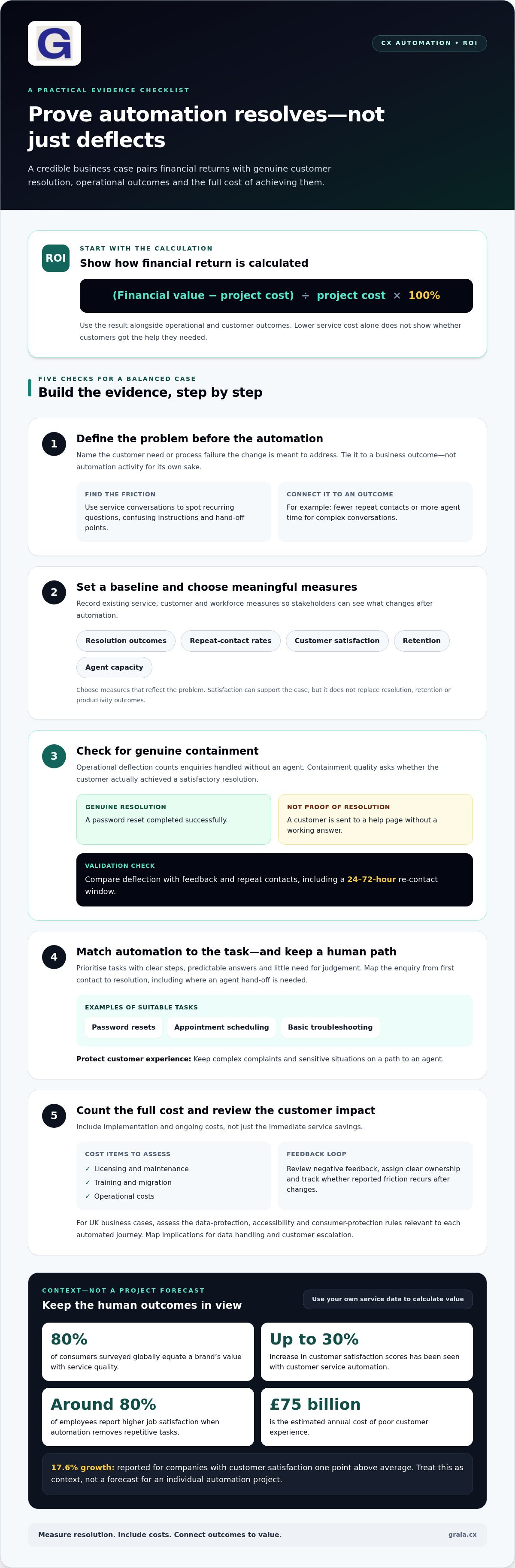
A compelling case for presenting CX automation ROI to stakeholders is built on evidence, not promises. Calculate ROI by subtracting project cost from financial value, dividing the result by project cost, then multiplying by 100%. Pair that figure with operational outcomes, because a lower service cost means little if customers still struggle to get help.
It’s understandable to focus on savings: CX automation can reduce repetitive work and free agents to handle more complex conversations. But stakeholders need the full picture, including the quality of containment, customer outcomes and the costs of achieving them.
This article explains how to establish a useful CX baseline, assess automation costs and distinguish genuine resolution from interactions that simply end in a self-service channel. You’ll also learn how to connect financial results with customer satisfaction, resolution speed and agent capacity, then shape those findings into a clear, balanced case for decision-makers.
Key Takeaways
- Define the customer or operational problem first so the business case measures a meaningful outcome, not automation for its own sake.
- Build a baseline from existing service, customer and workforce measures to show what changes after automation.
- Assess containment quality by checking whether customers reach a genuine resolution, not simply whether an interaction ends in self-service.
- Include implementation and ongoing costs, such as licensing, maintenance and training, to present a more complete view of value.
- Give stakeholders a clear account of financial returns alongside operational effects, including customer experience and team capacity.
What is containment quality and why does it matter for ROI?
Containment quality measures whether automation genuinely resolves a customer’s need, rather than simply ending an interaction. That distinction matters: 80% of consumers surveyed globally equate a brand’s value with the quality of its service.
For UK business cases, assess the data-protection, accessibility and consumer-protection rules relevant to each automated journey. Map their implications for data handling and customer escalation. ROI analysis should also account for training, migration and operational costs, according to UK Government guidance.
Customer Experience and Operational Deflection
Operational deflection counts enquiries handled without an agent; customer experience asks whether customers achieved a satisfactory resolution. A password reset completed successfully is useful automation, while a customer diverted to a help page without a working answer is not. Compare deflection with repeat contacts and feedback, including a 24-72-hour re-contact window, to distinguish genuine containment from an unresolved interaction.
Suitable tasks have clear steps, predictable answers and little need for judgement, such as password resets, appointment scheduling or basic troubleshooting. Map the enquiry from first contact to resolution, then identify where automation can answer confidently and where a human hand-off is needed. Keep complex complaints and sensitive situations on a path to an agent so efficiency doesn’t come at the expense of customer experience.
Qualitative Gains in Satisfaction and Team Morale
Qualitative gains describe improvements in how customers and employees experience service, including greater satisfaction and less repetitive work. Customer service automation has been seen to increase satisfaction scores by up to 30%. Around 80% of employees report higher job satisfaction when automation removes repetitive tasks. These indicators add human context to operational results, especially when agents can devote more attention to complex conversations.
Use customer feedback to spot friction that completion rates can hide. For example, if customers report confusion after an automated account change, review the wording and hand-off point, then track whether the issue recurs. Assign clear ownership for reviewing negative feedback and acting on it. Timely follow-up can help protect retention by addressing problems before they influence a customer’s decision to leave.
Financial Returns from Better Customer Experience
Financial returns connect a better customer experience with outcomes such as retention, revenue and referrals. The research estimates that poor customer experience costs £75 billion annually. It also reports that companies with customer satisfaction one point above average grew by 17.6%. Use these figures as context, not as a forecast for an individual automation project; calculate value from the outcomes your own service data can support.
For a credible case, link each improvement to a measurable business effect. If feedback identifies a recurring billing problem, track resolution, subsequent contacts and retention alongside the effect on handling work. Satisfaction scores help explain the experience, while repeat-contact and retention measures show whether the change delivered value. Presenting these together prevents operational deflection from being mistaken for financial return.
Automation ROI: What’s the Impact on Your Business?
A credible business case starts with a defined problem and connects automation to measurable operational and financial outcomes. Without that link, activity metrics may look positive while the underlying customer or business issue remains unresolved.
Defining the Business Problem
Define the process failure or customer need that automation should address. This gives decision-makers a clear reason to invest and a way to judge whether the change worked.
Be specific about where friction occurs. For example, if customers repeatedly contact support to check an order update, identify the process behind those contacts and its effect on customers and agents. Service conversations can reveal recurring questions, confusing instructions and hand-off points. Group insights by issue, then connect each one to a business outcome, such as fewer repeat contacts or more agent time for complex cases.
A Conversational Agent may suit a predictable enquiry with a clear answer and resolution path. Explain why the process is suitable, what success looks like and where human support remains necessary.
Business Outcomes Beyond Satisfaction Scores
Business outcomes describe what changes for the organisation, rather than how customers rate a single interaction. They matter because satisfaction scores alone don’t show whether customers stayed, issues were resolved faster or productivity improved.
Choose metrics that reflect the problem. If the aim is to reduce avoidable repeat contacts, track repeat-contact rates and resolution outcomes. If the aim is to improve retention, examine whether customers who experienced the changed journey continue their relationship with the business. Use satisfaction as supporting evidence, not as a substitute for these outcomes.
Conversations can also surface insights beyond the contact centre. Repeated questions about a product feature may point to unclear website content or a process that needs redesign. Share these patterns with the teams responsible for the process, then track whether their changes reduce customer effort. Globally, 57% of surveyed CX leaders anticipate that AI in customer experience will lead to improved financial performance, but a business case still needs its own relevant measures.
Calculating and Presenting Automation ROI
Automation ROI compares the financial value created with the project cost. Calculate it as financial value minus project cost, divided by project cost, then multiplied by 100%. This gives stakeholders a consistent way to compare projected value with investment.
Make the calculation meaningful by defining which benefits count and how they connect to the problem. For example, estimate the value of reduced repeat handling or recovered agent capacity, and keep assumptions visible. Measure efficiency over a clearly stated period so stakeholders can compare results meaningfully. Separate observed results from forecasts, so stakeholders can see what supports the case.
Present the business value in a concise narrative: the problem, the affected process, the chosen metrics, the costs and the expected outcomes. A clear account helps finance, operations and CX leaders assess the same evidence from their own priorities. For further context on CX strategy and automation, explore customer experience automation insights.
Measuring CX value and establishing a baseline
Tailor the case to finance with costs and savings, to operations with workflow and productivity measures, and to CX leaders with customer outcomes. For a phased pilot, define its scope, baseline, success criteria and decision point before launch.
Establishing a CX Value Baseline
A CX baseline records customer and operational performance before automation changes the journey. It provides a comparison point, helping teams distinguish genuine improvement from seasonal demand or unrelated process changes.
Choose measures that fit the service problem, such as resolution, repeat contacts, satisfaction, retention or agent productivity. Record the same measures across the same channels and period, then document data definitions. This matters because 40% of surveyed CX leaders say a lack of consolidated data and analytics hinders their ability to improve customer experience. Forrester Research reports that fewer decision-makers track outcomes such as productivity or stakeholder experience than track CX’s contribution to organisational success.
Executives need a concise view of how customer outcomes connect to organisational priorities. Forrester Research states that the vast majority of global CX decision-makers at large enterprises do not measure the value of their CX programme. Present the baseline, target outcome and measurement method together, then review automation ROI regularly to keep the case accountable.
Measuring Automation Costs and Value
Measuring automation costs and value means comparing the full investment with benefits observed against the baseline. This helps finance assess savings without overlooking the resources needed to build and operate the change.
Include implementation, migration, training, licensing, maintenance and ongoing operational effort in the cost model. Track each category over the project’s expected ownership period, rather than treating initial deployment as the only expense. To assess value, connect measured changes to financial effects: fewer repeat interactions may release agent capacity, while faster resolution may improve service performance.
Keep assumptions visible. Distinguish cash savings from capacity released, since available staff time becomes a financial saving only when work or resourcing changes. A simple spreadsheet can list each metric, its baseline, post-launch result, calculation and evidence owner. This makes the business case easier to scrutinise and update.
Proving Value Before Scaling
Proving value before scaling means showing that a bounded automation use case meets its success criteria before expanding it. This limits exposure and lets teams learn from real customer and operational results.
Start with a contained process, such as a common enquiry with a consistent resolution path. Compare its results with the baseline, review customer feedback and identify exceptions that still need agent support. If the evidence shows less avoidable work without weaker customer outcomes, assess whether the same process exists in other channels or teams.
Scale in deliberate stages. Recheck performance after each expansion, because new customer groups or conversation types can change containment and workload. Assign an operational owner to monitor the measures, a CX lead to review feedback and a finance partner to validate savings. These roles turn an initial result into a governed improvement programme.
Phasing a Pilot and Setting Success Criteria
A phased pilot tests automation in a defined service area, using pre-agreed criteria to decide whether to continue, change or expand it. This gives executives a clear decision path instead of an open-ended technology proposal.
Set out the pilot’s scope, baseline, target measures, data sources and review responsibilities before launch. Include a customer outcome, an operational measure and a financial measure so success does not depend on deflection alone. Define a decision gate that records whether the evidence supports scaling, further testing or redesign.
Present next steps alongside the results: name the accountable team, specify what will be monitored and describe which process could follow. For finance, foreground cost assumptions and validated savings; for operations, show workflow impact; for CX leaders, show customer feedback and resolution quality. This structure makes presenting CX automation ROI to stakeholders a focused decision about evidence, risk and the next investment.
How should you measure the cost side of automation ROI?
Count the full investment, from initial set-up through ongoing ownership, before comparing costs with expected value. Hidden costs include migration, training, maintenance and operational effort. Omit them, and the business case understates what delivery requires.
Licensing, Maintenance, and Training Costs
Licensing, maintenance and training are recurring or implementation costs that belong in the project’s total cost model. Including them helps finance assess the full commitment, not just the initial deployment.
List each cost against the workflow it supports: platform licensing, configuration, migration, staff training, ongoing maintenance and operational ownership. UK Government guidance says ROI analysis should account for training, migration and operational costs. The Scottish Government notes that automating processes with smart technologies could require substantial initial set-up.
Training also affects how quickly teams can use a new process effectively. For example, include the time agents spend learning revised workflows, along with the effort needed to maintain scripts and analytics. These costs can sit across different budgets, so assign an owner and record them consistently.
Efficiency Gains and Cost Impacts
Efficiency gains describe how automation changes handling effort, workflow capacity and service costs. Measuring them matters because faster processing does not automatically create cash savings.
For a customer service workflow, compare the time and staff effort required before and after automation. Then determine whether released capacity reduces overtime, avoids additional resourcing or lets agents focus on complex enquiries. Record the difference between cash savings and time made available: they represent distinct forms of value.
Track quality alongside efficiency. If a workflow gets faster but creates repeat contacts, the extra handling can reduce the net benefit. Use customer feedback and operational analytics to identify rework, exceptions and hand-offs, then include the effort needed to resolve them. This gives a more realistic view of cost than reporting speed alone.
ROI Timelines and Hidden Costs
ROI timelines show when measured benefits begin to offset the complete cost of an initiative. They matter because set-up effort and ongoing ownership can shift when value appears.
Build a model across multiple years, including licensing, maintenance, training and operational support. Well-defined business process automation projects can show initial returns within a few months, but timing depends on implementation effort, adoption and whether expected savings materialise. Separate initial and recurring costs so stakeholders can see how the investment evolves.
Risks that reduce ROI include poor process selection, unclear ownership, weak data and workflows that require frequent exceptions. For example, a script that fails to handle common variations may send more enquiries to agents, adding work instead of reducing it. Include testing, monitoring and process updates in the cost model, then compare actual costs with forecasts. Regular reviews can reveal whether maintenance or rework is eroding value and where the workflow needs refinement.
Presenting financial and operational benefits to stakeholders
Stakeholders need to see how customer experience automation affects financial performance and daily service delivery. A strong case connects each benefit to a measurable outcome, explains the evidence and makes clear what decision follows.
Connect customer outcomes to financial value
Start with the financial outcome, then show how the service change could contribute to it. For example, a customer experience director who followed up swiftly with at-risk customers avoided significant churn and added £1 million in recurring revenue to the bottom line. This illustrates why customer feedback and retention can matter financially, not just as experience measures.
Separate observed results from anticipated value. Globally, 57% of surveyed CX leaders anticipate that AI in customer experience will lead to improved financial performance. That expectation can frame the strategic opportunity, but your business case should show its own evidence, such as changes in retention, repeat contacts or revenue linked to a defined customer journey.
Show operational impact alongside returns
Operational benefits explain what changes for customers and employees as work moves through a service. Report measures such as handling time, resolution quality, agent capacity and escalation patterns beside financial outcomes. Customer service automation has been seen to reduce handling times by around 25%, giving stakeholders a concrete benchmark to consider against their own baseline.
Make the effect tangible with a workflow example. If automation handles a routine enquiry, show whether agents gain time for complex conversations and whether customers still reach a suitable resolution. Globally, 60% of surveyed CX leaders expect AI to make supervisors, quality managers and planners more efficient and effective over the next one to three years. Describe the capabilities needed to realise that value, including suitable processes and clear ownership.
Make the stakeholder case decision-ready
Build a concise dashboard with a small set of financial and operational indicators. For each metric, state its baseline, current result, measurement period and accountable owner. Distinguish channel-level outcomes in a platform-wide view, so an apparent improvement in one workflow doesn’t conceal more escalations or repeat contacts elsewhere.
Shape the findings around the decision at hand. Finance needs cost assumptions and attributable value; operations needs workload and workflow effects; CX leaders need resolution quality, feedback and loyalty signals. Close with a clear next step, such as continuing measurement, refining the process or considering expansion after reviewing results. This turns analytics into a practical investment decision.
Use these financial and operational measures to sharpen your stakeholder case, then explore CX automation insights for further perspective.
GraiaCX: Conversational Agent
GraiaCX’s Conversational Agent can resolve routine customer enquiries autonomously, making it relevant when your ROI case identifies repeatable interactions for automation. It can understand customer intent and emotion, while Agent Assist gives agents real-time next-best-action suggestions for more complex conversations.
For organisations measuring service across channels, the Agentic Omni-Channel Platform brings voice, chat, email and social messaging together. Live Call Translation supports multilingual conversations in over 100 languages, enabling support without bilingual staff.
These capabilities can align automation with the business outcomes in your case, whether the priority is routine enquiry handling, agent support or multilingual service. To discuss how GraiaCX fits your CX automation goals, contact GraiaCX or visit graia.cx.
Turn Your CX Business Case Into the Next Move
Treat your business case as a living decision tool, not a presentation that ends when approval arrives. As delivery progresses, compare actual results with the assumptions stakeholders approved, then use differences to refine priorities, ownership and future investment. This keeps presenting CX automation ROI to stakeholders connected to decisions teams can act on, rather than a single projected return.
This work can also reveal where the right support would strengthen your roadmap. GraiaCX offers a Conversational Agent for routine enquiries, Agent Assist for real-time agent support and Live Call Translation for multilingual conversations. Each can form part of a CX automation approach shaped around customer needs and operational priorities.
Bring your business objectives and automation challenges into a practical discussion about the next step. Discuss CX automation with GraiaCX and keep building a case grounded in measurable value and better customer experiences.
Frequently Asked Questions
How do you build an automation ROI model that holds up in the boardroom?
Build a boardroom-ready model by linking a defined service problem to auditable inputs, outcomes and ownership. For example, for order-status enquiries, show current contact volume, the share suitable for automation, successful resolutions, escalations and agent capacity released. Include project and ongoing costs, identify each data owner, and distinguish measured results from assumptions. A downside, expected and upside scenario lets directors challenge the model without treating forecasts as realised value.
What does "ROI" actually mean for CX automation?
ROI expresses the financial return generated relative to the investment required to achieve it. For CX automation, that return may include attributable savings or additional revenue, while the wider business case can also account for service quality and employee experience. Keep financial ROI distinct from these operational and customer outcomes. Improved customer feedback, for example, can strengthen the strategic case, but it should not count as cash value unless a defensible link to financial results exists.
What metrics should be used to measure customer experience automation ROI?
Choose measures that reveal business impact and whether customers get their needs resolved. Useful metrics include containment quality, repeat contacts, customer satisfaction, retention, resolution speed, escalation rates and agent productivity. A retailer automating delivery updates, for instance, could compare successful resolutions with repeat enquiries and escalations. Pair customer measures with operational data, then use revenue or cost measures where the connection can be demonstrated. Avoid relying on completion volume alone.
How do you calculate the ROI of customer experience automation?
Subtract project cost from financial value, divide the result by project cost, then multiply by 100%. For instance, calculate the value of attributable savings and revenue over a defined period, subtract the full project costs for that same period, and divide by those costs. Use consistent timeframes and avoid counting the same benefit twice, such as valuing released agent hours as savings while also counting the same capacity as additional output.
What are typical CX automation cost savings and payback periods?
There is no single savings figure that fits every customer service workflow; volume, complexity, implementation effort and ongoing ownership all affect the result. Business automation can reduce operational costs by 10-50%, depending on the process and level of implementation. Well-defined business process automation projects often show initial returns within a few months. Treat these as context, then model the specific workflow’s costs and measured benefits to estimate its payback.
How can automation improve customer satisfaction, retention and revenue?
Automation can improve these outcomes by resolving straightforward needs quickly and giving agents more capacity for nuanced customer conversations. For example, an automated account query can provide a clear answer, while a complaint requiring judgement goes to an agent with its context intact. Customer feedback then helps teams identify friction, refine the journey and address issues affecting loyalty. Connect any claimed retention or revenue impact to observed customer behaviour rather than assuming satisfaction gains automatically create sales.
What costs should be included in a CX automation business case?
Include more than the software subscription: account for initial setup, configuration, integration or migration, training, licensing, maintenance and ongoing operational support. Consider the internal time needed for process design, content updates, analytics and exception handling too. For example, a workflow that needs frequent script changes requires ongoing ownership beyond launch. Show which costs recur and which are one-off, and assign them to relevant teams to avoid overlooking work outside the project budget.
How should CX automation ROI be compared with human-led service or other technology investments?
Compare options against the same customer need, service scope, measurement period and outcome definitions. For human-led service, include the effort needed to resolve relevant enquiries, while accounting for customer outcomes and cases requiring human judgement. For other technology investments, apply consistent assumptions for implementation, ownership and value. A fair comparison shows where automation complements people, where another approach performs better, and which option best advances the organisation’s stated priorities.