
Omnichannel vs Multichannel Customer Journey: What Changes for Customers?
What if customers care less about how many channels you offer and more about whether they have to start again on each one? That’s the practical question behind the omnichannel vs multichannel customer journey. Customers value choice, but repeating details when they switch from chat to phone or email can turn convenience into frustration.
If customer histories sit in separate tools or teams, adding another channel won’t necessarily make the experience feel connected. The difference is continuity: multichannel offers several ways to get in touch, while omnichannel aims to carry relevant context from one interaction to the next. That doesn’t automatically mean replacing your contact-centre stack.
This article explains what changes for customers, how to identify friction in a journey, and where each approach may fit. You’ll also find practical steps for assessing handoffs, measures and integration options. The goal is to help customers move between channels without making them carry the whole conversation themselves.
Key Takeaways
- Assess the omnichannel vs multichannel customer journey by looking beyond the number of channels to whether information and context carry between them.
- Trace a real customer journey across touchpoints to find where handoffs create repeated questions or inconsistent responses.
- Use customer feedback alongside measures such as transfers, repeat contacts and resolution to prioritise the friction that matters most.
- Multichannel can work well when channels serve distinct customer needs. Choose an approach based on how people actually seek support.
- Start with one high-friction journey, then check integration options, ownership, security and fallback paths before deciding what to change.
Omnichannel vs multichannel customer journey: what is the difference?
Customers may be able to reach an organisation by email, phone, webchat or messaging and still experience service as disconnected. The distinction in the omnichannel vs multichannel customer journey is not simply how many contact options are available. It’s whether those options operate independently or help a customer continue an interaction without starting again.
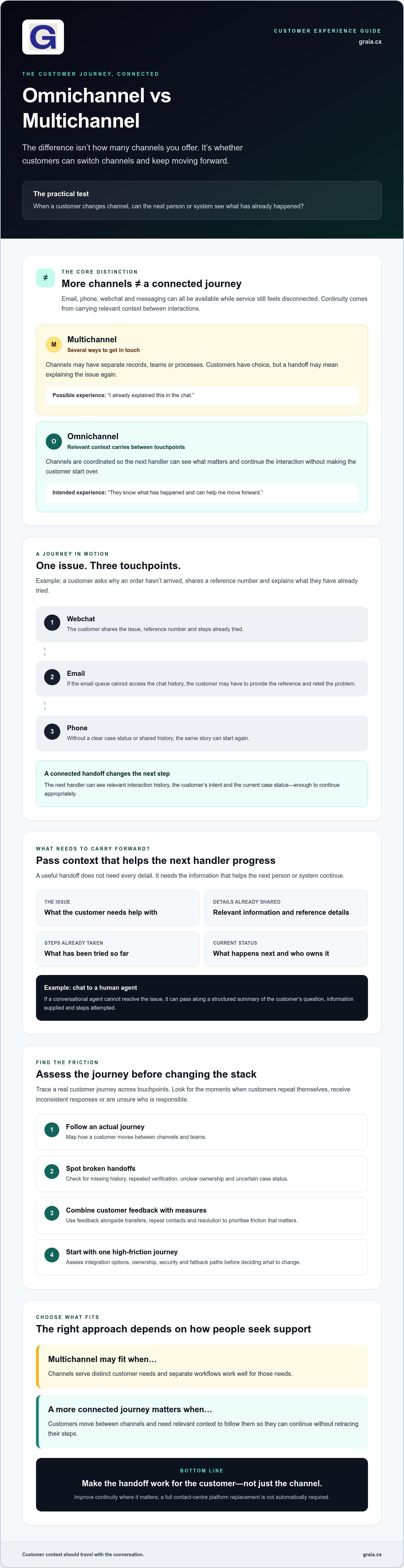
Multichannel means serving customers through several communication channels, which may have separate records, teams or processes. Omnichannel coordinates channels and relevant context so an interaction can continue across touchpoints. The Omnichannel concept is used across sectors, but the practical test for customer service is straightforward: when a customer changes channel, can the next person or system see what has already happened?
What does a multichannel customer journey look like?
A multichannel service offers choice, with each channel potentially meeting a different need. A customer might email to explain an issue, then phone when they need a quicker answer. If the phone team can’t see the email or its history, the customer has to explain the situation again. Channel choice can improve access, but separate workflows don’t guarantee a joined-up experience.
What makes an omnichannel customer journey connected?
An omnichannel customer journey connects communication channels so relevant context can carry between interactions, allowing customers to continue a conversation without repeating information. That doesn’t mean every channel must work identically. It means the handoff is designed to preserve what matters, such as the customer’s issue, details already provided and steps already taken.
Offering several options is not enough to make a journey omnichannel. Channels need a way to share relevant information and coordinate what happens next. For example, if a customer moves from webchat to a human agent, a useful summary can explain the issue and what the automated interaction has already tried. The agent can then make progress rather than ask the customer to start over.
Assess the experience from the customer’s perspective: can they move from one channel to another and make progress without retracing their steps? That answer reveals more than a channel count. It also helps clarify whether separate channels are serving distinct needs effectively, or whether disconnected handoffs are adding avoidable effort.
How customer context moves, or gets lost, between channels
A customer starts in webchat to ask why an order hasn’t arrived. They share the reference number and explain what they’ve already tried. When the chat ends without a resolution, they email the support team. If the email queue can’t access the chat history, the customer may need to provide the reference and retell the problem. If they then call, the same story can start again.
That’s where a channel change tests the omnichannel vs multichannel customer journey. The issue isn’t the number of touchpoints. It’s whether the next person or system can see enough to move the case forward.
Where does customer context break in a multichannel journey?
Context can be lost when channels use separate queues or records, when chat notes aren’t attached to a customer’s history, or when verification has to be repeated because relevant details weren’t carried over. Even when information is visible, unclear ownership can leave the customer unsure who is responsible for the next step.
These aren’t inevitable features of multichannel service. They’re possible design or integration problems. But when an unresolved issue moves between channels without a clear case status, teams may duplicate work, give inconsistent updates or struggle to see what has already happened. For the customer, each handoff risks feeling like a fresh start.
What enables a connected omnichannel handoff?
A useful handoff gives the next handler relevant interaction history, the customer’s intent and the current case status. CRM and contact-centre platform (CCaaS) integrations may help coordinate workflows by making this context available across the systems involved. The aim isn’t to pass along every detail. It’s to give the next handler what they need to continue appropriately.
For example, if a conversational agent can’t resolve a webchat issue, it could escalate the interaction to a human agent with a structured summary of the customer’s question, information already supplied and steps attempted. The agent can pick up from there, checking or confirming anything that still needs clarification. Clear ownership matters too, so it’s evident who is responsible for progressing the case.
Continuity depends on accessible context, not channel count. Use that as a practical test: when a customer changes channel, can the next handler understand the issue, see its status and take the next step without asking the customer to rebuild the history? For more perspectives on connected service experiences, explore GraiaCX’s customer experience articles.
Omnichannel vs multichannel: compare customer experience and operations
The right approach depends on how customers use your channels and what it takes to resolve their needs. In the omnichannel vs multichannel customer journey, the comparison isn’t about declaring one model universally better. It’s about whether separate channels serve customers effectively or whether people need to move between them with their history and case status intact.
| Area | Multichannel | Omnichannel |
|---|---|---|
| Channel availability | Customers can choose from several channels, which may serve different purposes. | Several channels are coordinated as parts of a connected service journey. |
| Context sharing | Interaction history may remain within the channel where it began. | Relevant history and case details can be available across touchpoints. |
| Handoffs | A customer may need to explain the issue again when moving to another channel. | Handoffs are designed to help the next handler continue from the current point. |
| Measurement | Performance may be viewed channel by channel. | Teams can also examine how interactions progress across the full journey. |
| Operational coordination | Teams and workflows may operate separately, though they don’t have to. | Workflows aim to coordinate teams and systems around the customer’s ongoing need. |
Which customer journey signals suggest channel fragmentation?
Look for customers repeating explanations, handoffs that don’t reach the right team, duplicate cases or different resolution patterns by channel. Pair customer feedback with operational indicators such as transfers, repeat contacts and unresolved cases. Feedback shows where the experience feels difficult; contact-centre measures can help locate where that difficulty occurs.
Compare like with like. Review the same journey stages and customer segments before concluding that a channel is underperforming. A channel may work well for a straightforward request but be less suited to a case that needs follow-up across teams. Check whether the issue is the channel itself, the handoff, or the process that follows it.
What should leaders compare before choosing an approach?
Start with customer needs and actual channel usage. Then assess your existing systems, the effort required to connect them and who owns each handoff. Check whether staff can access relevant history when they need it, subject to appropriate access controls and governance. If customers rarely switch channels and each channel resolves its purpose well, multichannel may be a practical fit. If cases commonly span touchpoints, coordination may address a real friction point.
For broader context on how AI capabilities in customer service platforms are developing, read this AI customer service platform guide. Use it to inform your evaluation, not as a substitute for evidence from your own customer journeys.
How to assess and improve your customer journey across channels
Start with evidence, not a platform decision. Map one journey before redesigning every channel. A focused review can show where customers lose time or context and help you target improvements before considering wider changes.
- Select one customer need. Choose a common request that may involve more than one touchpoint, such as changing an appointment or resolving a delivery query. Keep the scope specific enough to follow from first contact to outcome.
- Map the touchpoints. Record how customers enter the journey, which channels they use, where they switch channels and how the case ends. At each step, note what information customers provide and whether it remains available to the next handler.
- Inspect handoffs. Compare the intended process with real interactions and customer feedback. Look for repeated questions, transfers without clear ownership, missing case updates and points where customers need to chase progress.
- Prioritise the friction. Identify the breakdowns that create the most customer effort or operational rework. Choose a practical change, assign ownership and define how you’ll assess whether it helps.
Which measures reveal whether continuity is improving?
Review customer comments alongside operational measures such as repeat contacts, transfers, resolution and channel-specific completion. Feedback can explain why a journey feels difficult; operational data can help show where interactions stall or require extra handling. Consider customer effort too, using an established feedback measure or a consistent review of what customers report.
Interpret measures together. A lower transfer rate alone, for example, doesn’t prove customers are resolving their needs more easily. Agree on metric definitions and establish a baseline before comparing results. Then review the same journey stages and customer groups over time. This makes it easier to distinguish a genuine improvement from a change in how an outcome is recorded.
For another lens on assessing operational value, read GraiaCX’s contact-centre ROI guide. Use your journey findings to decide which changes to test and how to track their effect. To explore further perspectives, browse GraiaCX’s customer experience articles.
Build a connected journey without assuming a full platform replacement
A connected customer journey doesn’t automatically mean replacing every system in your contact centre. Start by choosing a high-friction journey, then find out whether existing tools can share the context and status needed to improve it. This keeps the omnichannel vs multichannel customer journey decision grounded in customer needs, not a technology overhaul by default.
How can existing contact-centre systems support connected journeys?
Before selecting new technology, review how your current CCaaS, CRM, case-management tools and channels work together. Map where customer information is created, where it’s stored and which teams need access during a handoff. An incremental integration may be an option, but validate it technically and operationally rather than assuming systems will connect as required.
For a high-friction journey, check:
- Integration: Can relevant interaction history and case status be shared between the systems involved?
- Ownership: Is it clear which team or handler is responsible for the next action?
- Security: Can staff access the information they need under your organisation’s access controls?
- Fallbacks: What happens if an integration or automated step is unavailable or can’t progress the case?
These checks help define what to connect, what to retain and where process changes may be needed. For broader architecture considerations, consult GraiaCX’s agentic CCaaS platform reference.
When can AI and human agents work together across channels?
Automation may suit routine interactions with clear steps, while a human agent may be more appropriate when a request is complex, sensitive or needs judgement. The handoff is crucial: relevant conversation context, customer intent and any action already taken should accompany the transfer, so the customer isn’t left to restart the interaction.
For example, a conversational agent might handle an initial request and escalate it when it can’t resolve the issue. A human agent can use the available summary to continue, while checking any details that need confirmation. Define escalation triggers, responsibility and fallback routes for the specific journey, then test the full path before expanding the approach.
Choose changes based on the journey evidence, and explore more customer-experience insights from GraiaCX as you consider your next steps.
Make your next journey change practical
The key difference in the omnichannel vs multichannel customer journey is whether customer context travels with the interaction. Multiple channels can improve access, but continuity depends on how well teams and systems carry relevant information forward. Start by mapping one journey, identifying where customers encounter friction and agreeing how you’ll measure progress.
You don’t need to assume that improving continuity means replacing every system. Assess your existing tools and integrations, then prioritise a change that addresses a clear customer need. The right next step may be better coordination between channels, clearer ownership or a more reliable handoff to a person when an automated interaction needs support.
Graia offers conversational agents that can work across voice, chat, messaging and email, use system integrations to take action, and escalate to human agents with the interaction context. Graia’s agentic CCaaS platform also integrates with providers including Genesys, NICE CX and Avaya. Consider these capabilities against your own requirements, alongside the integration, ownership and fallback checks above. Explore Graia customer-experience insights to see how conversational AI could support a more connected customer journey.
Frequently Asked Questions
What is the main difference between omnichannel and multichannel customer service?
Multichannel customer service offers customers several ways to get in touch, while omnichannel service coordinates those channels so interactions can continue with relevant context. In a multichannel setup, an email, chat and phone call may have separate histories. In an omnichannel journey, a handoff is designed to help the next person or system understand the customer’s need and what has happened so far.
Can a business be multichannel without being omnichannel?
Yes. A business can offer email, phone, webchat and messaging while managing each channel through separate workflows or records. Customers have a choice of contact methods, but information may not follow them between channels. That’s multichannel service without full cross-channel continuity. It may still work well if customers usually complete their needs within one channel and those channels meet their distinct purposes effectively.
Is omnichannel customer service always better than multichannel service?
No. The right model depends on customer behaviour and the needs each channel serves. If people typically resolve straightforward requests through one channel, coordinating every interaction may add complexity without clear value. Omnichannel coordination can be useful when customers often switch channels or need follow-up on an ongoing case. Compare customer feedback and journey performance before deciding where more continuity would help.
How do you measure an omnichannel customer journey?
Assess the whole journey, not just individual channel performance. Track measures such as repeat contacts, transfers, resolution and channel-specific completion, and review customer feedback about effort or repeated explanations. Define each measure consistently and establish a baseline before comparing results. No single metric proves a journey is connected; consider whether customers can make progress across touchpoints and whether the next handler has useful context.
Does omnichannel customer service require replacing existing systems?
No. A more connected experience may be possible by improving how existing contact-centre, customer-record and case-management systems share relevant information. Start by mapping a high-friction journey and checking which systems and teams are involved. Then validate integration options, access controls, ownership and fallback processes. This helps identify whether a targeted change can address the issue before you consider broader technology decisions.
What happens when a customer switches channels in an omnichannel journey?
Relevant context should be available to help the customer continue rather than restart. Depending on the journey, this may include the reason for contact, details already provided, actions taken and the current case status. For example, when a conversation moves from chat to a live agent, a useful summary can help the agent pick up the issue. They can still confirm details when needed.
Can AI support both omnichannel and multichannel customer journeys?
Yes. AI can support interactions in one channel or across coordinated channels, depending on how it’s configured and integrated. A conversational agent may handle a suitable routine request, while a human agent takes over when the interaction needs further help. For continuity, relevant conversation context should accompany the handoff. Without shared context, adding AI to several separate channels doesn’t automatically create an omnichannel journey.