
Metrics for Evaluating Customer Service AI: The 2026 Enterprise Framework
If you are still measuring your digital workforce by how quickly they end a conversation, you are effectively blindfolding your enterprise. Legacy KPIs like Average Handle Time were built for a manual era, yet they remain the primary yardstick for systems capable of complex, autonomous reasoning. You likely feel the tension between the pressure to automate and the fear that a single hallucination could erode years of brand equity. Finding sophisticated metrics for evaluating customer service AI is no longer just an operational goal. It is a survival requirement in a 2026 landscape governed by the EU AI Act and rising customer expectations.
You deserve a measurement framework that captures the true depth of agentic intelligence. This article will empower you to master the metrics that prove ROI beyond simple deflection, focusing instead on automated resolution rates and AI empathy. We will examine the specific tools required to audit AI reasoning, ensure compliance with Article 50 transparency mandates, and reduce agent stress through seamless hybrid handoffs. By the end of this guide, you will have a clear roadmap to transform your contact centre from a cost centre into a precision-engineered engine of growth.
Key Takeaways
- Move beyond the "deflection trap" to understand why traditional KPIs like Average Handle Time often obscure the true quality of autonomous customer interactions.
- Safeguard your brand reputation by tracking grounding accuracy and hallucination rates through rigorous contextual retrieval audits and reasoning trails.
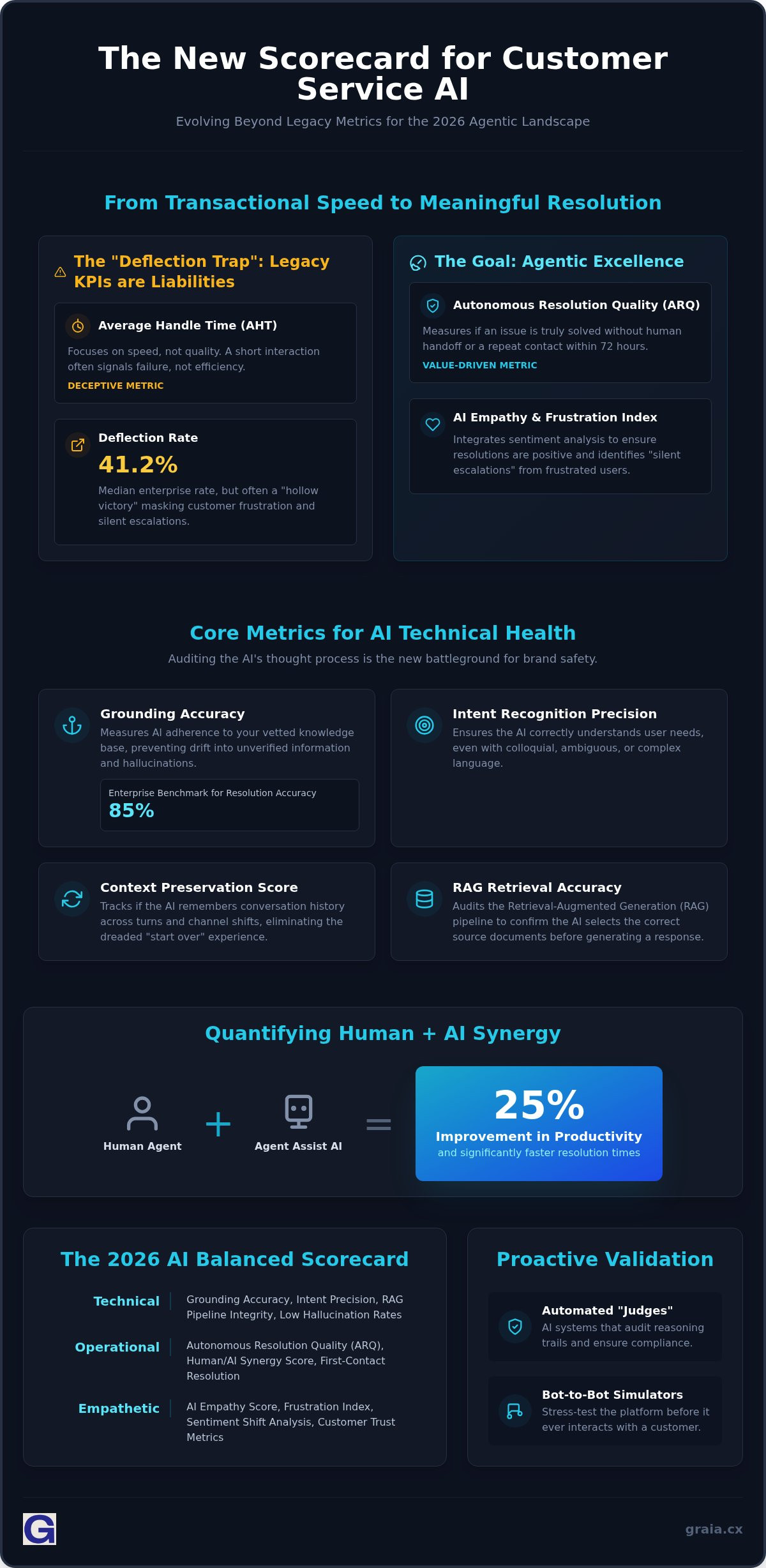
- Quantify the synergy between humans and machines, leveraging Agent Assist to drive a 25% improvement in productivity and significantly faster resolution times.
- Implement a sophisticated 2026 scorecard that integrates technical, operational, and empathetic metrics for evaluating customer service AI into a unified enterprise framework.
- Learn how automated "Judges" and bot-to-bot simulators provide the necessary stress-testing to validate your agentic CCaaS platform before it reaches the customer.
Why Legacy Metrics Fail Agentic Customer Service AI
The metrics that governed the last decade of the contact centre have become liabilities. You cannot manage a sophisticated digital employee using the same stopwatch logic applied to a 1990s switchboard. As we move through 2026, the industry is waking up to a harsh reality: traditional Key Performance Indicator (KPI) sets are fundamentally incompatible with agentic reasoning. To lead in this era, you must evolve beyond the superficial data points that once sufficed for basic chatbots.
Consider the "Deflection Trap". While the median tier-1 deflection rate for enterprise programs currently sits at 41.2%, this figure is often a hollow victory. High deflection frequently masks a systemic failure where customers aren't being helped; they are simply being exhausted until they give up. Relying on these outdated metrics for evaluating customer service AI encourages systems that prioritise avoidance over assistance, ultimately damaging the very brand equity you've worked to build. We are witnessing a decisive shift from transactional speed to relationship-based outcomes.
Average Handle Time (AHT) is equally deceptive in this new landscape. In a human-centric model, low AHT suggests efficiency. In an Agentic CCaaS environment, a longer handle time might actually indicate a superior outcome. If your Conversational Agent is processing a complex refund or navigating a multi-step technical diagnostic, a five-minute interaction that results in a first-contact resolution is infinitely more valuable than a thirty-second deflection. Efficiency is now measured by the depth of the solution, not the brevity of the exchange.
The Hidden Cost of the 'Bot Black Hole'
Traditional reporting often misses the "silent escalation." This occurs when a user terminates an AI interaction out of frustration only to call back minutes later. We must shift toward measuring a "Frustration Index" that tracks sentiment shifts and repetitive query loops. Legacy IVR metrics fail here because they cannot interpret the nuance of an LLM-driven conversation. They see a closed session; they don't see the resentful customer on the other end who is now twice as likely to churn. Identifying these gaps requires a move away from binary "success" markers toward a more empathetic understanding of the user journey.
Redefining Success: From Deflection to Resolution
The focus must pivot to Autonomous Resolution Quality (ARQ). In 2026, we distinguish between an interaction that is merely "contained" and one that is truly "resolved." A contained call might just be a customer who stopped typing. A resolved call is one where the issue is settled without a human handoff and without a repeat contact within 72 hours. This shift requires integrating sentiment analysis to ensure the resolution was reached with the "AI Empathy" your brand promises. Success is no longer about how fast the AI can get off the phone. It's about the precision of the reasoning it applied to solve the problem permanently.
Technical Health: Core Metrics for Conversational Agents
Uptime is a hygiene factor; accuracy is the battleground. While traditional systems focused on whether the server was running, modern metrics for evaluating customer service AI must interrogate the integrity of the thought process itself. In 2026, technical health is defined by the AI's ability to remain tethered to truth while navigating the complexities of human intent. You cannot manage what you do not audit with granular precision.
Grounding Accuracy represents the most critical frontier for brand safety. It measures how effectively your Conversational Agent adheres to your vetted knowledge base without drifting into unverified territory. The current enterprise benchmark for resolution accuracy is 85%, but high-performing systems aiming for total reliability must push higher. This requires a shift from simple keyword matching to true semantic understanding. Intent Recognition Precision must remain high even when customers use colloquial or ambiguous language. Additionally, your Context Preservation Score tracks whether the agentic intelligence remembers the user's intent across channel shifts, preventing the repetitive "start over" experience that destroys trust.
Auditing the RAG Pipeline
The integrity of your output depends entirely on the sophistication of your Retrieval-Augmented Generation (RAG) architecture. You must measure Retrieval Accuracy to ensure the AI selects the correct document from your siloed data before it begins generating a response. Generation Quality then evaluates if the resulting prose is brand-compliant and factually sound. Hallucination Rate is the frequency of AI-generated responses that contradict the provided knowledge base. Reducing this rate to near-zero is essential for maintaining enterprise authority. To understand how these technical layers impact your broader strategy, it is helpful to explore the latest insights on agentic reasoning and architectural transparency.
Process Accuracy and Hybrid Flows
Agentic CCaaS platforms are no longer just talking; they are doing. This shift requires a focus on Task Completion Rate (TCR), which tracks the success of API-driven actions like processing a refund or modifying a booking. In regulated environments, there is no room for creative interpretation. You must ensure 100% process accuracy by measuring how strictly the AI adheres to deterministic business rules during "Hybrid Flows."
To achieve this level of control, GraiaCX utilizes "Judges," which are specialized AI-powered evaluators that automate quality management at scale. These Judges work alongside the GraiaCX Simulator, which performs bot-to-bot stress testing to identify potential process failures before a customer ever sees them. By leveraging Conversational Agent Insights, you can access full audit trails for AI reasoning, providing the validated proof of accuracy required by modern stakeholders and regulatory bodies alike.
The Synergy Score: Measuring AI Impact on Human Agents
AI is not a replacement for human talent; it is a force multiplier. In the high-stakes environment of the modern contact centre, the most critical metrics for evaluating customer service AI often relate to how effectively the technology empowers the person behind the headset. We must move beyond counting heads and start measuring the elevation of human potential through what we call the "Synergy Score." This framework acknowledges that the most sophisticated outcomes arise when human intuition is supported by machine precision.
Agent Assist effectiveness serves as a primary pillar of this human-centric measurement. By providing real-time suggestions and surfacing relevant knowledge articles, AI directly influences First Contact Resolution (FCR). This isn't just about speed. It's about accuracy and confidence. When an agent has the right answer delivered instantly, their cognitive load drops significantly. We see this most clearly in the reduction of "wrap-up" time and the elimination of manual data entry. Additionally, the implementation of Live Call Translation has transformed multilingual support. It removes the linguistic barriers that previously caused significant agent stress, allowing your team to serve a global audience with ease and empathy.
Handoff Excellence: The Seamless Transition
The moment of escalation is a critical touchpoint where brand loyalty is either forged or fractured. If a customer has to repeat their story, the synergy has failed. We track the Repeat Information Rate to ensure that the transition from a Conversational Agent to a live representative is invisible to the user. High-quality handoff context involves more than just a transcript; it requires an automated summary that highlights the customer's intent, emotional state, and previous attempts at resolution. Measuring Agent Satisfaction (ASAT) in these AI-augmented environments reveals a clear trend: agents feel more supported and less burnt out when they are equipped with high-fidelity digital partners.
Productivity Gains and ROI
The financial impact of these human-AI partnerships is undeniable. Data from leading Agentic CCaaS platforms shows a 25% improvement in agent productivity. This gain is achieved by automating routine tasks, which allows your human experts to focus on high-ticket, complex queries where empathy and critical thinking are paramount. This shift increases the "Value-Per-Interaction" and naturally leads to a reduction in turnover. When agents are no longer bogged down by repetitive drudgery, they stay longer. This provides a direct path to proving ROI through reduced hiring and onboarding costs, creating a stable and high-performing workforce for 2026 and beyond.
Building the AI Balanced Scorecard
A single metric is a data point; a scorecard is a strategy. To navigate the complexities of 2026, your framework must integrate technical precision with human sentiment. Establishing robust metrics for evaluating customer service AI requires a multi-dimensional approach that balances the needs of the board, the agent, and the end-user. "Good" in the enterprise sector has moved past simple uptime. It now demands an 85% resolution accuracy benchmark while maintaining a 15 to 25% escalation rate, ensuring a healthy equilibrium between automation and human expertise.
Weighting these metrics is a strategic choice that reflects your brand’s maturity. In regulated industries, accuracy must always trump speed; a fast hallucination is a liability, not an efficiency. Your scorecard must also fuel "Continuous Learning" cycles, where insights from your AI "Judges" feed directly back into your RAG pipeline. This creates a self-optimizing system that learns from every edge case, ensuring your digital workforce evolves alongside your customer's needs.
Customer-Centric KPIs
While Net Promoter Score (NPS) remains a staple, it is often a lagging indicator that fails to capture the immediate emotional resonance of an AI interaction. You must pivot toward sentiment-derived satisfaction, which uses natural language processing to score every interaction in real time. This is paired with the Customer Effort Score (CES). How much friction did the user encounter while navigating the reasoning path of your Conversational Agent? Finally, brand alignment metrics ensure your AI’s tone matches your configured brand voice, preventing the clinical coldness that often plagues generic bots.
Operational and Financial KPIs
The financial conversation is also evolving. We are moving away from the narrow "Cost Per Call" and toward the more holistic Cost Per Resolved Interaction (CPRI). This metric accounts for the long-term value of a permanent solution versus a temporary deflection. By tracking SLA adherence in automated queues and monitoring the reduction in escalation rates, you can begin proving the Contact Centre ROI with AI through factual, long-term value tracking. This shift allows you to demonstrate to stakeholders that automation is a driver of quality, not just a tool for cost-cutting.
To refine your measurement strategy and see these frameworks in action, read our latest analysis on enterprise AI performance.
How GraiaCX Quantifies Agentic Excellence
Governance in the agentic era requires a definitive departure from manual oversight. GraiaCX provides the architectural depth needed to move beyond reactive dashboards and into the territory of proactive, automated auditing. We understand that metrics for evaluating customer service AI must be as sophisticated as the Large Language Models they govern. By providing a transparent window into every logical path and decision point, we help your enterprise transition from blind trust to validated performance through every layer of the tech stack.
Transparency is the bedrock of our reporting philosophy. Through Conversational Agent Insights, we provide full audit trails that detail the AI's reasoning, specific knowledge base searches, and every API call made during a session. This level of visibility is essential for stakeholder trust and meeting the transparency mandates of the EU AI Act. By integrating these deep insights with Power BI, we enable your team to build custom, enterprise-grade reporting that aligns digital workforce performance with your most ambitious business objectives.
Automated Quality Management with Judges
Manual sampling is a relic of the past that leaves the vast majority of your customer interactions unmonitored and uncorrected. GraiaCX eliminates this vulnerability through our AI "Judges," which are specialized evaluators designed to score every interaction against your specific brand guidelines. These Judges assess politeness, policy adherence, and emotional resonance with a level of consistency that human reviewers simply cannot match. GraiaCX's 'Judges' provide 100% coverage of all interactions, unlike manual sampling. This comprehensive oversight removes human bias from the quality assurance process and provides a statistically significant foundation for continuous model optimization.
Predictive Optimization with the Simulator
True resilience is built in the laboratory, not in the live production environment where brand reputation is at stake. The GraiaCX Simulator allows you to run bot-to-bot conversations that stress-test your reasoning paths and hybrid flows before they ever reach a customer. This is particularly critical when managing an "Agentic Swarm," where multiple specialized agents must hand off context and intent without friction. By simulating thousands of these interactions, you can identify potential hallucinations or API failures with surgical precision. This proactive testing is the cornerstone of modern metrics for evaluating customer service AI, ensuring that your platform is not just functional, but genuinely resilient. Experience the future of Agentic CX with GraiaCX.
Mastering the New Standard of Intelligence
The transition to agentic CCaaS is a journey toward technical and emotional precision. You've seen how legacy KPIs fail to capture the depth of modern reasoning, yet the solution isn't to abandon measurement. It's to embrace it with greater sophistication. By prioritizing grounding accuracy and human-AI synergy, you turn a black box into a transparent engine of growth. Establishing robust metrics for evaluating customer service AI is the first step toward true operational maturity in 2026.
Our framework provides the clarity needed to scale with confidence. With 60% faster resolution times and a 25% improvement in agent productivity, the impact of this evolution is both measurable and profound. You can now rely on audit-ready AI reasoning trails to satisfy stakeholders and regulatory bodies alike. The path to a resilient, empathetic contact centre is clear; the tools to navigate it are already within your reach.
Transform your contact centre with the Graia Agentic Platform
The future of customer experience is no longer a distant vision. It is a reality you can build today.
Frequently Asked Questions
What is the most important metric for evaluating customer service AI?
Autonomous Resolution Quality (ARQ) stands as the definitive metric because it validates that a problem was solved permanently. Unlike simple containment, ARQ tracks whether a customer returns within 72 hours for the same issue. This is a fundamental pivot in metrics for evaluating customer service AI. It prioritizes long-term brand health over the superficial volume counts that previously dominated the industry.
How do I measure AI hallucination rates in a contact centre?
You measure hallucination rates by deploying AI Judges to audit conversations against your verified knowledge base. These evaluators identify factually incorrect assertions that contradict your source material. Tracking this provides a "Truth Score" for your RAG architecture. By maintaining reasoning trails, you can identify the exact prompt or document that caused the error, allowing for surgical refinements to your grounding strategy.
Should I still use Average Handle Time (AHT) for AI interactions?
Average Handle Time remains a useful metric for human agents but often fails when applied to AI. For humans, tools like Live Call Translation can reduce AHT by up to 25% by removing linguistic barriers. For AI, a longer handle time might indicate a superior, multi-step resolution that prevents future calls. Focus on the total cost per resolution rather than the seconds spent on a single session.
What is the difference between deflection and resolution in AI metrics?
Deflection is a volume metric that tracks calls prevented from reaching an agent, while resolution is a quality metric that tracks issues solved. High deflection can hide poor experiences if customers simply give up. Resolution requires the AI to execute a specific task, such as a refund, and ensure the customer is satisfied. Modern metrics for evaluating customer service AI must emphasize resolution to drive genuine ROI.
How can I prove the ROI of an AI agent assist tool?
Proving ROI involves quantifying the 25% productivity uplift seen when agents use AI-driven suggestions. Measure the reduction in manual wrap-up tasks and the 60% improvement in average resolution times. Additionally, factor in the savings from reduced agent attrition and the elimination of expensive bilingual hiring premiums. These operational gains provide a clear financial narrative that justifies the investment in agentic intelligence.
What are AI 'Judges' and how do they help with quality management?
AI Judges are automated evaluators that score 100% of your interactions on politeness, policy adherence, and brand alignment. Traditional manual sampling only covers a tiny fraction of conversations, leaving your enterprise exposed to hidden risks. Judges remove this blind spot by providing a consistent, unbiased assessment of every session. They ensure that your digital workforce remains empathetic and compliant without increasing your supervisory headcount.
Can AI sentiment analysis replace traditional CSAT surveys?
Sentiment analysis offers a real-time view of customer emotions that traditional CSAT surveys often miss due to low response rates. While CSAT measures a customer's memory of an event, sentiment analysis tracks their actual experience as it unfolds. It functions as a leading indicator of brand loyalty. By analyzing every word, you can intervene in failing interactions before they result in a negative survey score.
How do I measure the accuracy of my AI's knowledge base retrieval?
You measure retrieval accuracy by auditing the RAG pipeline to ensure the AI selects the most relevant document for each query. This involves comparing the retrieved source against the customer's stated intent. Using the GraiaCX Simulator allows you to stress-test these retrieval paths in a bot-to-bot environment. This identifies weak confidence levels and potential hallucinations before they impact a live customer interaction.