
Live Call Translation: 2026 Enterprise Buying Guide
What if the value of live call translation isn’t just lower language-related operating costs, but also the calls your contact centre can serve more effectively? Bilingual staffing and language queues can limit coverage, while a translation investment must earn its place alongside existing systems and workflows. A sound cost-benefit analysis of live call translation compares the full cost of operating it with measurable gains, rather than relying on labour savings alone.
This guide shows you how to build that business case using your contact centre’s own data. You’ll assess potential value in call handling, first-contact resolution and access for customers who prefer another language, while accounting for accuracy, customer experience, compliance and implementation. You’ll also learn how to test assumptions before scaling and evaluate operational fit, including how SIP voice connectivity and an embedded agent widget can support integration with existing platforms. The result should be a transparent model that helps you decide where live translation can strengthen service and what evidence you need before expanding its use.
Key Takeaways
- Build a cost-benefit analysis of live call translation around a consistent call volume, language mix, service scope and analysis period.
- Map implementation and ongoing costs, then compare them with measurable operational outcomes using your contact centre’s baseline data.
- Assess staffing flexibility, queue performance, customer outcomes and agent experience separately to identify where translation could create value.
- Evaluate accuracy through custom vocabulary, phrase lists, agent controls and monitored call outcomes, not assumptions alone.
- Turn the business case into practical requirements for languages, call types, integrations and workflow controls before scaling.
Why live call translation belongs in a contact-centre business case
Language access is an operating decision, not simply a translation feature. Live call translation is real-time spoken-language support during a customer-service conversation, helping a customer and an agent communicate across languages while the call is in progress. Unlike document translation, it must keep pace with a live exchange. It is also designed around an individual service interaction and the contact-centre workflow.
Traditional telephone interpreting connects a caller and service representative through an interpreter. The Telephone Interpreting overview provides background on that established model. Live call translation can support a different workflow, but both approaches address the same practical need: helping people understand one another during a call.
For a contact centre, the case is broader than potential financial value. Consider access to service in a customer’s preferred language, interaction quality and consistency, workforce flexibility, and the oversight needed to manage translated conversations. These are distinct outcomes. Better language coverage may matter even when savings are difficult to isolate, while a shorter queue alone does not prove that customers received an effective resolution.
Where language friction creates operational drag
Map what happens when a customer needs language support: language-specific routing, time spent waiting, transfers to a bilingual agent, repeat contact after an incomplete answer, or a call that cannot be handled within the existing coverage model. Each step can affect capacity and customer experience, but the impact varies by interaction.
Segment the evidence by call type, customer group, language and operating hours. A complex account query, for example, may involve more transfers and follow-up than a straightforward status request. Use contact-centre records and staff insight to identify where friction occurs. Avoid applying one average assumption across every language or interaction.
What a credible cost-benefit analysis must answer
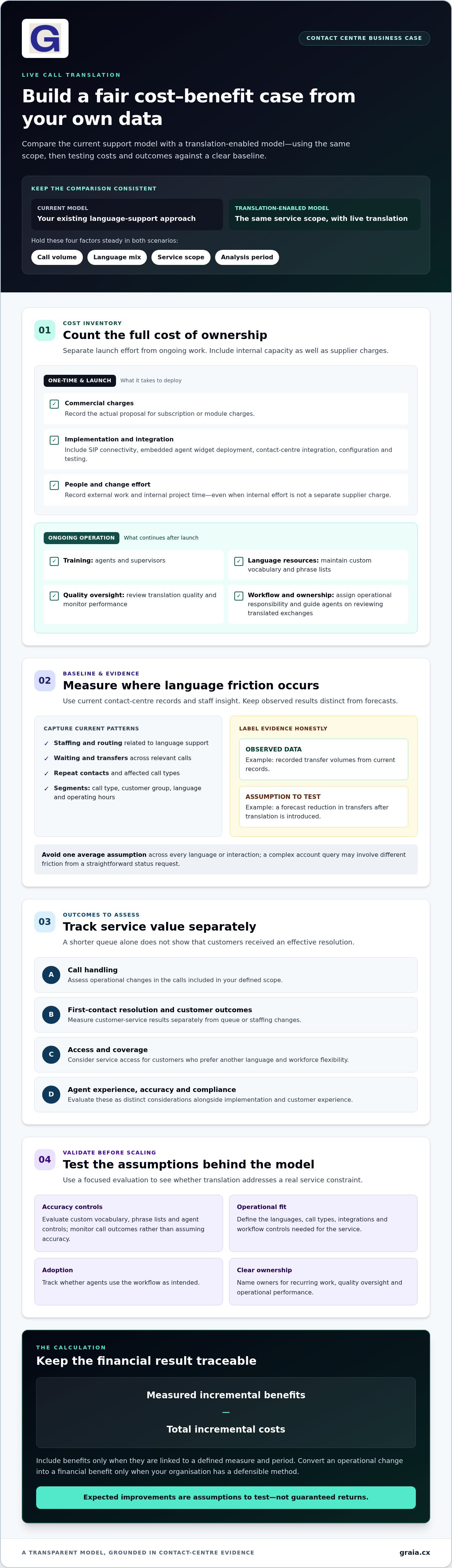
A defensible cost-benefit analysis of live call translation compares the current support model with a translation-enabled model across the same call volume, language mix, service scope and period. Include deployment and integration work, configuration, training, ongoing operation, administration, workflow changes and quality oversight. Assess financial effects separately from access, customer-service, compliance and workforce outcomes.
Set a baseline before estimating value. Define the affected calls, the measures that will show change, where the data will come from and how adoption will be tracked. A favourable model depends on your organisation’s starting point and whether agents use the workflow as intended. Treat expected improvements as assumptions to test, not guaranteed returns. A focused evaluation can show whether translation addresses a real service constraint before you expand its use. For feature and evaluation context, see the live call translation software buying guide.
How to calculate the total cost of live call translation
A useful model starts with a fair comparison. Choose an analysis period that reflects your planning cycle, then apply the same call volume, language mix and service scope to both scenarios: your current operating model and one that includes live call translation. If one scenario covers different languages or call types, the comparison won’t show whether any change comes from translation or from a shift in scope.
Total cost of ownership for live call translation is the combined one-time and recurring effort required to deploy, operate, maintain and oversee the capability throughout the chosen analysis period. Separate these costs so decision-makers can see what it takes to launch and what continues after deployment.
Build a complete cost inventory
Start with the actual commercial proposal for subscription or module charges. Then document implementation work, including SIP connectivity, embedded widget deployment, contact-centre integration, configuration and testing. Record internal project time as well as external work. Even when it doesn’t appear as a separate supplier charge, internal effort still uses organisational capacity.
Include the work needed to keep the service effective after launch. That may involve agent and supervisor training, maintaining custom vocabulary and phrase lists, reviewing translation quality, monitoring performance and assigning operational ownership. Add change-management tasks and adjustments to agent workflows, such as guidance on reviewing translated exchanges. Distinguish one-time implementation effort from recurring operating costs, and name the owner for each activity.
Set the baseline and calculate break-even
Build your baseline from current records rather than broad assumptions. Capture language-related staffing and routing, waiting and transfer patterns, repeat contacts, and the call types affected. Keep observed results separate from estimates. Recorded transfer volumes are observed data; a forecast reduction after introducing translation is an assumption to test.
Use one consistent calculation: measured incremental benefits minus total incremental costs. Include only benefits linked to a defined measure and period. Convert an operational change into a financial benefit only when your organisation has a defensible method for doing so. Report access, service quality and workforce outcomes separately if they can’t be reliably expressed in monetary terms.
Calculate break-even only after validating the inputs, including adoption, workload, implementation effort and ongoing oversight. Show assumptions alongside observed results, then test how the result changes if adoption or measured outcomes differ from the central scenario. This makes uncertainty visible instead of hiding it inside a single forecast.
For further background as you define evaluation criteria and the operating model, browse Graia’s contact-centre insights.
Which live translation benefits can your contact centre measure?
Measure outcomes, not expectations. For each proposed benefit, record the baseline, metric, data source and measurement period before introducing live call translation. This helps distinguish a real change from shifts in demand, call mix or staffing. It also keeps service and workforce value visible without forcing every outcome into a financial estimate.
Measure operational and customer outcomes
Track average handle time, first-contact resolution, transfers, repeat contacts and language-related waiting. Compare similar call types and language groups across equivalent periods, and note changes in demand or operating conditions. Pair efficiency measures with customer outcomes: review satisfaction feedback and complaint patterns to see whether a faster interaction also resolves the customer’s need.
Use a measurement plan like this to make assumptions explicit:
| Benefit to assess | Metric and baseline | Potential data source | Attribution risk |
|---|---|---|---|
| Staffing flexibility | Language-related reliance on bilingual agents | Workforce and routing records | Staffing changes may influence the result |
| Language access | Calls served by language and call type | Call records and language routing data | Demand or language mix may shift |
| Queue performance | Waiting, transfers and abandonment by language | Queue and telephony reports | Seasonality or other queue changes may contribute |
| Resolution and experience | First-contact resolution, repeat contacts, satisfaction and complaints | CRM, survey and complaint records | Case complexity and survey response may vary |
| Agent experience and quality | Agent feedback, corrections and quality findings | Surveys, reviewed calls and QA records | Training and workflow changes may affect results |
Account for quality, compliance, and workforce value
Efficiency only matters if the conversation remains clear and appropriate. Review terminology accuracy, agent corrections, escalation reasons and quality-assurance findings alongside call metrics. Track whether particular phrases or call types lead to recurring misunderstandings, then use those findings to guide vocabulary tuning and workflow adjustments.
Assess access and workforce effects in their own right. Measure whether customers can reach service in their preferred language with less reliance on language-specific queues, and gather agent feedback on cognitive load. Don’t assign monetary value to these outcomes unless your organisation has a defensible method.
Graia’s live call translation materials report typical average handle time reductions of 15–25% after 4–6 weeks of tuning and typical first-contact resolution increases of 5–10 points. Treat these as hypotheses to test against your own baseline, not forecasts or guarantees. Results depend on context and measurement. A contact-centre ROI guide can help frame broader measurement principles. A credible cost-benefit analysis of live call translation keeps observed results, assumptions and attribution limits clearly separate.
How to compare options and address the accuracy objection
Accuracy concerns deserve a practical answer, not a blanket assurance. Compare the current language-support model with translation-enabled calls using the same call types, languages, service scope and measurement period. Then assess whether the translation workflow supports clear, appropriate conversations and gives agents enough visibility to manage uncertainty.
Compare the operating models, not just the technology
Bilingual staffing can offer direct language fluency, while language-specific routing directs callers to agents who speak their language. Translation-enabled calls provide another way to extend language coverage through existing contact-centre workflows. Each model has different implications for flexibility, queue design, staff capacity, oversight and implementation effort. The right comparison depends on your call mix and service objectives, not an assumption that one approach fits every interaction.
Map the operational differences before assessing the technology. Consider which calls need specialist language expertise, where routing creates delays, and how agents will work with translated speech. Review integration requirements, access to original audio, formality controls and the points where an agent can review or cancel a message. These details can affect customer confidence and the effort required to supervise the workflow.
Test translation quality and workflow fit
Design a bounded pilot around representative languages, accents, call types and specialist terminology. Include routine conversations as well as interactions where names, product terms or established phrases matter. Before the pilot begins, agree who reviews calls, how agents raise concerns and which outcomes trigger escalation. Set quality thresholds and scale-or-stop decision gates in advance, so the decision follows evidence rather than enthusiasm.
Review translated exchanges for meaning and usability, not just whether a phrase sounds plausible. Compare partial translations with original audio, record agent corrections, and collect feedback from agents and customers. Use findings to refine custom vocabulary and phrase lists, then monitor whether changes improve interactions. Graia’s live call translation includes custom vocabulary, formality controls, partial translation, original audio and an adjustable agent-message cancellation window. These controls provide concrete evaluation points, not a promise of a particular outcome.
- Scale if quality, workflow adoption and agreed service measures meet the pilot’s pre-set thresholds.
- Adjust and retest if issues appear fixable through terminology tuning or workflow changes.
- Stop if unresolved quality or operational concerns outweigh the case for expansion.
Use pilot findings to strengthen the cost-benefit analysis of live call translation, separating observed results from assumptions before making a wider deployment decision. For more background, browse Graia’s contact-centre insights.
From business case to deployment: evaluate Graia live call translation
A validated business case becomes useful when it translates into clear deployment requirements. Specify which languages, call types and customer journeys are in scope, which contact-centre integrations are needed, and what agents and supervisors must be able to do during a translated call. This keeps implementation focused on the service problem you set out to solve, rather than expanding the pilot before its value is understood.
Graia’s live call translation uses SIP for voice connectivity and an embedded agent widget, with integrations for Genesys, Avaya, NICE CX, Five9 and SIP-enabled platforms. These options support integration with an existing contact-centre environment without a rip-and-replace approach. Include the relevant platform and call flows in the project requirements so that technical fit is assessed alongside customer and agent experience.
Plan a controlled implementation
Set a bounded pilot with named owners across contact-centre operations, technology, quality and agent training. Document call routing, the languages and call types included, agent responsibilities, and how conversations will be reviewed. Establish baseline measures and agree how data will be collected before launch. This gives the team a consistent reference point for interpreting results.
- Scope: Select the languages, call types and workflows that reflect the business case.
- Prepare: Configure relevant custom vocabulary and phrase lists, and brief agents on the translation workflow.
- Review: Define how quality findings, agent feedback and call outcomes will be recorded.
- Compare: Track changes against the baseline and account for shifts in call mix or staffing.
Evaluate features against real operational needs. Custom vocabulary and phrase lists can represent organisation-specific terminology; formality controls let teams assess how translated language fits the service context. Original audio gives agents access to the source speech, while audit-ready transcripts support review of the interaction. These are practical criteria for testing quality and workflow fit, not substitutes for monitored outcomes.
Make the scale decision with evidence
At the pilot’s decision point, review total costs alongside validated operational, customer, quality and workforce outcomes. Separate observed results from assumptions, and document unresolved risks, integration requirements, governance needs and ongoing ownership. If results vary by language, call type or workflow, use that evidence to refine the scope rather than treating the pilot as a single overall verdict.
Use the pilot’s findings to update your cost-benefit analysis of live call translation. Scale only when the evidence supports the intended service outcomes and your organisation is prepared to manage the operating model. For ideas to inform your customer experience strategy, explore Graia’s customer experience insights.
Turn evidence into your next decision
A strong business case shouldn’t end when a pilot does. Make its findings part of an ongoing decision process: assign an owner, agree when outcomes will be reviewed, and revisit assumptions if call demand, language needs or workflows change. This keeps the cost-benefit analysis of live call translation connected to the service your contact centre actually delivers, rather than letting an early forecast stand in for current evidence.
Use each review to decide what deserves refinement, what is ready to scale and what should remain out of scope. Keep customer access and agent confidence in view alongside operational measures. The aim isn’t to adopt technology for its own sake, but to make language support more responsive while protecting the quality of each interaction.
To plan your next step, explore Graia’s customer experience insights. Clear ownership and evidence can help your contact centre move forward with purpose and confidence.
Frequently Asked Questions
How do you calculate the ROI of live call translation?
Calculate ROI by comparing measured benefits with incremental costs over the same period, using your contact centre’s own operational data. For a cost-benefit analysis of live call translation, consider whether fewer repeat contacts or transfers create a measurable benefit, and avoid counting the same improvement twice. If a resolved call also reduces repeat contact, don’t treat both as separate savings unless your calculation accounts for the relationship. Keep projections distinct from pilot results.
Can live call translation reduce the need for bilingual agents?
It can reduce dependence on bilingual staffing for supported interactions, but that doesn’t mean every call should follow the same path. A straightforward account query may suit a translated workflow, while a sensitive or complex case could still need a bilingual agent or another escalation route. Compare coverage and queue outcomes by language and call type, then decide where translation complements existing expertise without weakening customer support.
How can a contact centre measure whether live call translation is working?
Track comparable calls by language and call type, and check whether trends hold across equivalent periods. Alongside handle time and resolution, review transfer reasons, repeat-contact themes, agent corrections and customer comments. A shorter call may not represent success if the customer calls back to clarify an answer. Note changes in staffing, call complexity and demand so your review can distinguish translation’s contribution from other operational shifts.
Is live call translation accurate enough for customer service?
It depends on the language, audio, accent, terminology and context, so test it on representative service conversations rather than relying on a scripted demonstration. Graia supports custom vocabulary and phrase lists to account for brand or specialist terms. Graia’s materials report that terminology training can improve speech-to-text accuracy, but treat that as a claim to validate: review pilot calls, agent corrections and customer understanding before drawing conclusions.
Does live call translation replace human agents?
No. Live call translation supports communication across languages; agents still interpret customer needs, apply judgement and resolve issues. An agent handling an unusual billing dispute, for example, may need to clarify details, explain options and decide whether the case requires escalation. Define when agents should pause, seek assistance or move a conversation to another support path, so translation strengthens language access while human accountability remains clear.
What happens if a translated agent response needs correcting?
Graia’s live call translation includes an adjustable agent-message cancellation window, allowing an agent to revise or cancel a response before it is sent. During evaluation, test how this control works in the agent’s actual call flow, including what happens when a correction is needed quickly. Pair it with original-audio access and review guidance, then record corrections to identify recurring terminology or workflow issues.
Can live call translation integrate with an existing contact-centre platform?
Graia uses SIP voice connectivity and an embeddable agent widget, with integrations that include Genesys, Avaya, NICE CX and Five9. Map the call journey from routing through the agent workspace, and identify how translation will be accessed during an active conversation. Test that workflow in the intended environment to assess integration fit without assuming you need to replace your existing contact-centre platform.