
Limitations of Scripted Chatbots and Where They Fall Short
A tightly controlled chatbot can be accurate and still leave customers stuck. The limitations of scripted chatbots appear when a conversation strays beyond predefined routes: they may miss context, misunderstand follow-up questions or repeat requests for information. They work best for predictable queries, but complex or sensitive issues call for a human handover with the conversation history intact.
That doesn’t make scripted flows obsolete. They can keep routine answers consistent and give businesses control over a bot’s responses. Generative AI can respond more flexibly to changing topics and context, but it needs oversight because its answers can be inaccurate.
This guide explains how scripted chatbot flows work, where they fall short and when to involve a human. It compares scripted and generative AI to help you weigh control, flexibility and customer care in your support experience.
Key Takeaways
- Use predefined flows for predictable queries where consistency and control matter most.
- Recognise when emotional nuance, complex reasoning or an unexpected request calls for a human handover.
- Design handovers to preserve useful conversation context, so customers don’t have to start again.
- Weigh generative AI’s flexibility against its need for oversight, accurate knowledge and careful testing.
- Consider a blended approach that matches each type of customer query to the most suitable support.
What Are Scripted Chatbot Flows?
A scripted chatbot follows a predefined sequence of prompts, choices and responses. For example, a delivery flow might request an order number and then display tracking information. The bot selects from programmed paths rather than composing every answer freely. This gives teams control, but also explains the limitations of scripted chatbots when a customer’s intent falls outside the paths they designed.
Each choice acts like a branch in a decision tree. If a customer selects “change an order”, the flow can ask which item and offer approved next steps. But a follow-up such as “Can I change the address too?” may not fit the next programmed step. Without context from earlier messages, the bot might repeat its first question or return to the wrong menu.
Losing context matters in multi-step customer service. A customer might provide an account reference, explain a billing problem, then add that the charge appeared after a cancellation. A flow that treats each message separately may ask for the reference again or answer only part of the issue. Stronger design carries key details forward and checks intent before responding.
A poor match between a customer’s message and a programmed route can also lead to irrelevant or outdated responses. For instance, a billing script might direct someone to make a payment when they’re disputing a charge. Clear fallback responses and tested routes reduce this risk, but cannot cover every unexpected request.
For UK services handling personal information, chatbot design should follow applicable data-protection requirements. Explain why you collect information such as an account reference, collect only what the interaction needs, protect it, and set appropriate retention and access controls.
The effort to build and maintain a flow depends on the number of routes, the complexity of its rules and its connections to business systems. A simple FAQ needs fewer branches than a returns journey involving order status, eligibility and exceptions. Each policy or process change can require human review, updated responses and testing across affected paths.
Incorrect answers can mislead customers or prompt the wrong action, especially when a flow relies on outdated content or misreads intent. A confident-sounding response isn’t proof of accuracy. Review representative conversations, test unusual inputs and make escalation available when the bot cannot match a request reliably.
There is no fixed satisfaction or abandonment rate for scripted flows. A customer may complete a clear password-reset path quickly, while repeated questions or a dead-end menu can create friction and prompt them to leave. Review where conversations stop, which fallback appears and whether the issue gets resolved to pinpoint weak steps.
Scripted chatbots can support multiple languages when teams create and maintain suitable flows for each. Translation alone may miss local expressions or change the meaning of a choice. Accessibility also depends on the interface: clear labels, keyboard-friendly choices and concise instructions make options easier to use.
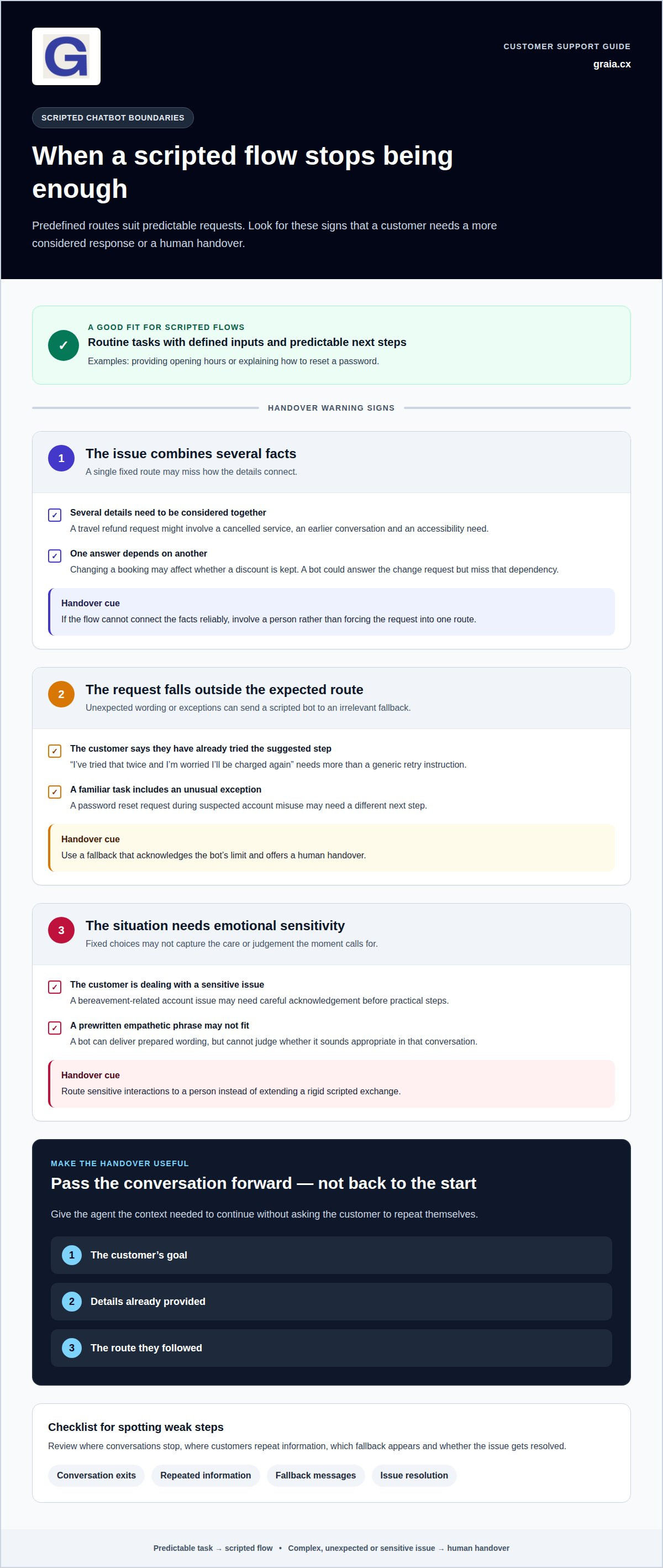
When a request goes beyond the flow, hand over the conversation with relevant context. Pass on the customer’s goal, details already provided and the route they followed, so an agent can continue without restarting the exchange. Scripted responses work best for defined tasks; unfamiliar or sensitive situations need a considered next step.
Difficulty handling complex or emotionally nuanced issues
Scripted flows work best when a customer’s request matches a defined path. They become less effective when an issue combines several facts, requires judgement or involves emotional sensitivity.
Complex and Unstructured Knowledge
Complex, unstructured knowledge depends on relationships between details rather than a single fixed answer. A customer disputing a travel refund, for example, might mention a cancelled service, an earlier conversation and an accessibility need. A flow built around one refund category can struggle to connect those details. The result may be a relevant-sounding response that misses the real problem and weakens the customer experience.
Multi-part queries expose the same constraint. “Can I change my booking and keep the discount?” combines two requests with a possible policy dependency. A scripted bot may answer the booking part but fail to account for how a change affects the discount. Teams can create branches for known combinations, but each needs clear rules and accurate content. As exceptions grow, maintaining these interactions becomes harder.
Unexpected Scenarios and Rigid Responses
A scripted chatbot handles an unexpected scenario by matching it to an available route or fallback. If a customer says, “I’ve tried that twice and I’m worried I’ll be charged again,” a generic retry instruction ignores both the repeated failure and the concern. That rigid response can feel dismissive. A useful fallback should acknowledge the limit and offer a human handover.
Emotional nuance is difficult to reduce to fixed choices. A customer reporting a bereavement-related account issue may need careful acknowledgement before practical steps. A bot can deliver a prewritten empathetic phrase, but it cannot genuinely feel concern or judge when the phrase sounds inappropriate. For sensitive interactions, route the conversation to a person rather than extending a scripted exchange.
That doesn’t make automation ineffective. Routine tasks with defined inputs, such as providing opening hours or explaining how to reset a password, suit scripted responses. Teams can review the answer in advance, and the route remains predictable. The challenge is recognising when a familiar request contains an exception, such as a password reset during suspected account misuse.
Useful insights come from reviewing where customers leave a flow, repeat information or reach fallback messages. For example, repeated exits from a claims branch may signal missing policy routes, unclear wording or a need for agent support. Use those patterns to refine routine interactions while keeping a clear escalation path for unusual cases.
For further ideas on shaping customer conversations, explore guidance on conversational customer experience.
Misunderstanding and misinterpretation of human language
Scripted chatbots match customer messages to phrases, keywords or menu choices, so natural language can expose gaps in the flow. A customer who types “My parcel’s gone missing” may not trigger a route written for “Where is my delivery?” The meaning is similar, but the wording differs. Dialect, slang, abbreviations, spelling mistakes and informal expressions add more ways to miss the intent.
Even a clear keyword can carry different meanings. “Cancel it” might refer to an order, a subscription or a pending appointment. If the bot doesn’t retain the subject established earlier in the conversation, it may launch the wrong process. A useful design asks a brief clarifying question, such as “Do you mean your order or your subscription?” instead of guessing.
Follow-up messages create another challenge. After asking about a delayed delivery, a customer might write, “And what about the other one?” A rigid flow may not know which item “the other one” refers to, especially if the customer has discussed several orders. Scripted routes can capture choices reliably, but need explicit branches for likely references and a clear fallback for ambiguous replies.
Conversation patterns can help teams identify common language gaps. If customers repeatedly type “sent it back” when a returns route expects “return an item”, that phrase can inform the flow’s recognised inputs. Review real conversations for recurring expressions, then update relevant routes and test examples with different wording. This improves matching without assuming every customer uses the same vocabulary.
When a bot reaches its limits, a human handover should preserve useful details. A concise summary can include the customer’s goal, key information already shared, the route followed and the unanswered question. An agent taking over a delivery enquiry, for example, needs to know which order the customer meant, not just that the bot reached its fallback.
Handover is especially valuable when conversations deviate from programmed scenarios. Set a clear trigger for repeated failed matches, unresolved clarification or an explicit request for an agent. If someone writes “I’ve explained this already”, the flow shouldn’t send them through the same prompts again. Transfer the interaction with its history so the customer doesn’t have to start over.
Large language models can interpret varied wording and use conversational context to select relevant responses. That flexibility can make conversations feel more intelligent, but it doesn’t remove the need for boundaries: generated answers may still be off-topic or inaccurate. Before choosing an approach, assess the task, available knowledge and potential impact of a mistake.
For a script, clear language, tested alternatives and a purposeful handover work together. A flow that recognises “change my appointment”, “move my booking” and “can I come another day?” can route the same intent more effectively. When meaning remains unclear, asking a brief question or passing the conversation to an agent is better than repeating an irrelevant response.
Human backup for complex queries
Automation should support customer service teams, not remove human judgement from difficult interactions. A bot can resolve a defined query, while an employee handles exceptions, sensitive circumstances and decisions requiring professional judgement. This division keeps routine requests moving without forcing every customer through an automated route.
AI chatbots can automate 88% of queries, but businesses are advised to review them weekly and retain human customer service backup for complex queries. The figure describes potential automation, not a reason to remove escalation. A customer disputing a charge, for example, may need an agent to consider account history and explain available options.
Set clear triggers for a handover. Escalate when a bot cannot answer from approved information, when the customer asks for a person or when repeated attempts fail to resolve the issue. A complaint involving financial hardship may also need human attention because the right response depends on individual circumstances, not just a standard script.
A useful transfer gives the agent enough context to continue. Include the customer’s goal, relevant details already shared, the bot’s responses and the unresolved point. For an appointment query, that might mean noting the requested date and why the available options didn’t work. The agent can then focus on resolving the issue instead of asking the customer to repeat the exchange.
Human backup also needs a clear operational path. Define which team receives each type of query, what information the bot passes on and what happens if the first route cannot resolve it. A delivery problem, for example, may need a different specialist from an account-access issue. Without defined routing, handover can simply move the customer into another queue.
Review conversations regularly to find where automation reaches its limits. Look for unresolved queries, repeated transfers and cases where agents had to correct a bot’s response. These patterns show whether a flow needs clearer instructions, a better fallback or earlier escalation. They also help teams distinguish a genuine exception from a routine question that needs a more precise scripted answer.
AI-powered models can interpret varied requests and retrieve information, but still need oversight. Generative systems may produce inaccurate answers; traditional scripts may fail when a request doesn’t match a programmed path. Human review helps contain both risks, especially when an incorrect answer could prompt a customer to take the wrong action.
Automation works best when people remain accountable for complex outcomes. Let bots handle predictable tasks, then give employees the authority and context to manage exceptions. Check whether the query was resolved, whether the handover preserved continuity and whether the final response addressed the actual need. These checks make human support part of the service design, not an afterthought.
Choosing between scripted and generative AI chatbots
Choose an approach based on the query, not the label attached to the technology. A scripted flow suits predictable inquiries with approved answers, such as opening hours or a straightforward order-status request. Generative AI suits varied wording and conversations that need context. The strongest design often combines both, using programmed routes for routine tasks and AI support where requests need more interpretation.
Scripted automation offers control. Teams define each response and route, helping keep answers consistent on clearly bounded topics. It can also be simpler to implement than a generative system, particularly when the scope is narrow. The trade-off is maintenance: new policies, products or exceptions require people to revise and test affected flows.
Generative AI can interpret a broader range of questions and adapt responses to the conversation. A customer might ask about a delayed delivery, then add a delivery instruction in the same exchange. A generative system can use that context to shape its reply rather than relying only on a programmed menu. But fluent wording doesn’t guarantee accuracy. Outdated knowledge or a misunderstood request can still produce a misleading answer.
Implementation also differs. Generative systems may need more planning, testing and checks for accuracy. Connecting them to customer records or other business systems requires careful consideration of how data is accessed and used. For a narrow set of repetitive inquiries, a simpler scripted route may be more practical. Broader automation needs stronger oversight and a dependable escalation path.
A hybrid model assigns work by risk and complexity. Use scripted responses for approved, repeatable answers; use AI to interpret less predictable language; and send unresolved or sensitive matters to an employee. This keeps automation focused while protecting the customer experience when a situation needs judgement. Agent Assist can support employees with real-time suggestions, helping them handle queries without making the chatbot the final decision-maker.
Before choosing an approach, map the inquiries customers actually make, the consequences of an incorrect response and how often information changes. Then test realistic conversations, including follow-ups, incomplete details and unexpected wording. Review response accuracy, resolution outcomes and customer feedback after deployment. These checks reveal whether a flow needs clearer programming, better knowledge or a human route.
There is no universal winner. A fixed FAQ may not need generative flexibility, while a conversation spanning several topics can expose a rigid script’s limits. Match the technology to the work, keep people responsible for complex decisions and improve the design using observed interactions. Explore practical guidance on conversational AI to inform that evaluation.
GraiaCX
GraiaCX helps organisations balance automated customer interactions with the human support complex queries require. Its Conversational Agent can resolve routine enquiries, while the Agentic Omni-Channel Platform brings voice, chat, email and social messaging together with AI-driven automation. For conversations requiring human judgement, Agent Assist provides real-time support, including next-best-action suggestions for employees.
This approach is useful when predefined scripts struggle with varied customer intent or teams want automation to support, not replace, human service. The right balance depends on the enquiries customers bring, the information needed to answer them and when an agent should take over.
Contact GraiaCX to discuss how these capabilities could support your customer conversations.
Design your next step around the customer
Use the limitations of scripted chatbots as a prompt to shape a more deliberate support experience, not as a reason to automate every interaction. Start with the moments when customers need clarity, continuity or human judgement. Then decide which tasks suit fixed responses, where generative flexibility adds value and how people can step in when the conversation demands more.
That balance can evolve as customer needs and business processes change. GraiaCX brings together a Conversational Agent, Live Call Translation and Agent Assist to support automated and human-led interactions. The aim is to make technology serve the conversation while keeping people involved where they make the difference.
Explore how GraiaCX can support your chatbot strategy, and take the next step towards more responsive customer conversations.
Frequently Asked Questions
What are the main limitations of scripted chatbots?
Scripted chatbots are limited by the routes and responses people programme. They can struggle when a customer combines requests, changes topic or needs an answer shaped by personal circumstances. For example, a bot may explain a standard returns process but fail to address an item that arrived damaged. Clear fallback options and well-defined tasks help keep the flow from becoming a dead end.
How do scripted chatbots handle unexpected or ambiguous questions?
They match the message to a programmed route, ask for clarification or show a fallback response. If a customer says, “I need to stop it,” the bot may need to establish whether “it” means an order, payment or subscription. A useful flow asks a focused follow-up rather than guessing. If clarification doesn’t resolve the request, offer a route to human support.
Why do rule-based chatbots struggle with context and follow-up questions?
Rule-based bots typically depend on programmed conditions, such as a selected menu option or recognised phrase. A follow-up like “Can I change that as well?” only works if the bot connects “that” to the earlier topic. If it treats the message as a new request, it may ask the customer to repeat details or send them down an unrelated route. The flow must represent context explicitly.
Can scripted chatbots understand natural language, slang, and spelling errors?
Scripted chatbots can recognise natural-language variations when those phrases or matching rules are included in their design, but coverage isn’t automatic. A delivery flow might recognise “parcel”, “package” and “order”, yet miss a regional expression or typo. Teams can improve recognition by reviewing anonymised examples, adding common alternatives and testing misspellings. Unrecognised inputs still need a useful fallback, not repeated failed prompts.
How do scripted chatbots compare with AI chatbots and large language models?
Scripted chatbots return responses from predefined routes, giving teams close control over wording and process. Chatbots powered by large language models can interpret varied phrasing and use conversational context, but generated answers need oversight because they may be inaccurate or off-topic. A hybrid approach can use fixed rules for sensitive actions, such as changing account details, while AI interprets the customer’s request.
When are scripted chatbots a good choice despite their limitations?
They’re a strong fit for narrow, repeatable tasks with stable answers, such as explaining how to reset a password or where to find a standard form. A scripted flow is especially useful when every customer should follow the same approved steps. Define its scope clearly, keep information current and provide an escalation route for exceptions. Broader, less predictable queries may need a different approach.