
In-house vs outsourced call translation costs
The lowest visible cost isn’t always the lowest overall. In-house vs outsourced call translation involves more than a salary or per-call fee: internal hiring brings ongoing staffing and technology costs, while freelance and outsourced options can make spending more responsive to demand. The right model must also handle changing call volumes without compromising the conversation.
It’s understandable to favour an in-house team for control and familiarity, or an external linguist for flexibility. Each approach affects cost predictability, capacity and how quickly multilingual support can adapt when demand shifts. Outsourcing may be more cost-effective when training and technology are included, while in-house provision can suit steady, consistent workloads.
This comparison explains how in-house, freelance and outsourced interpreting differ, what drives their costs, and where each model may fit best. It also covers how live call translation can support changing volumes without requiring bilingual staff, so you can weigh the practical trade-offs before deciding.
Key Takeaways
- Assess the expertise and customer experience technology each model brings, not just the visible staffing cost.
- Choose a setup around your call patterns, language needs, quality expectations and desired level of control.
- Include training, technology and the time employees spend on language work when assessing total cost and predictability.
- Plan for volume peaks by considering how external linguistic capacity could support your internal team.
- Distinguish live call translation from other interpreting arrangements so the solution fits the conversation and support workflow.
Choosing a Translation Vendor: In-House or Outsource?
The choice depends on the languages, expertise and customer experience technology needed for live calls. Compare each model against your call types, specialist terminology and expected demand.
In-House Translation Teams
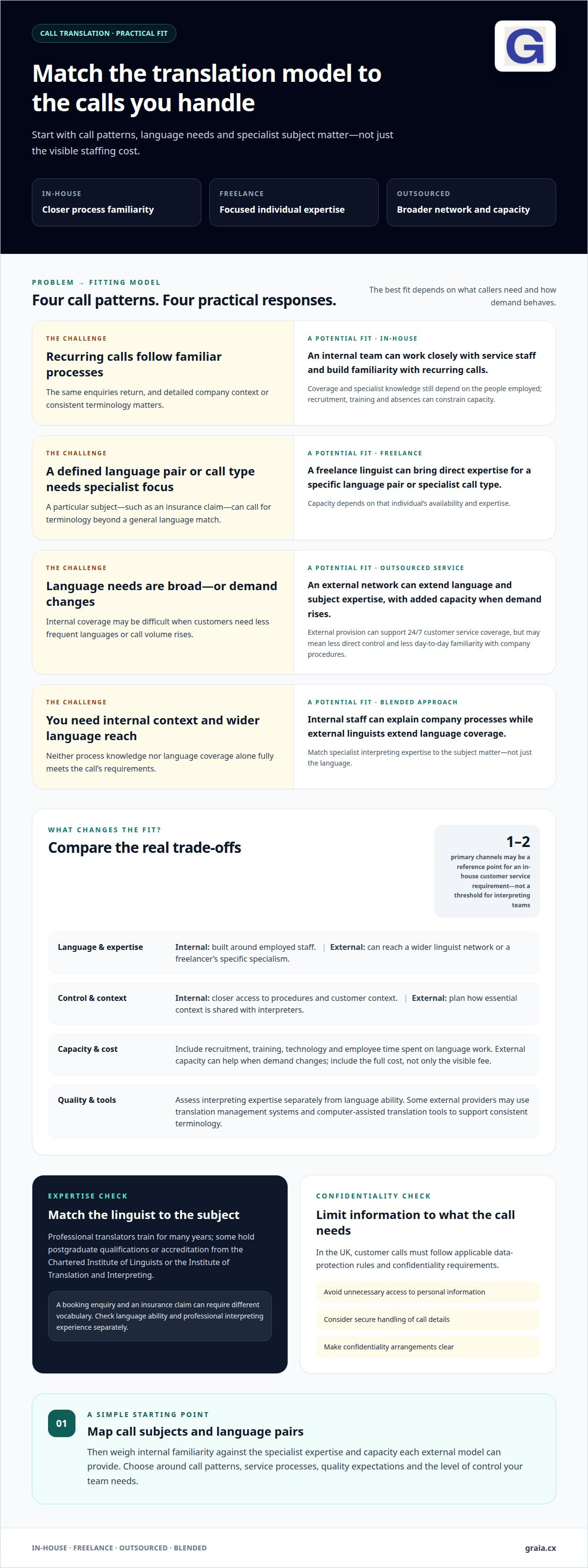
An in-house team works closely with service staff and can learn how your organisation handles recurring calls. That familiarity can support consistent terminology in specialist settings such as financial services or healthcare. However, its experience depends on the people you employ and the languages they cover. Adding a less common language or specialist subject may require further recruitment and training.
Outsourced Interpreting Services
Outsourced telephone interpreting gives you access to external linguists rather than relying only on employees who speak another language. Professional translators train for many years, and some hold postgraduate qualifications or accreditation from the Chartered Institute of Linguists or the Institute of Translation and Interpreting. An external network can offer broader language-pair and subject expertise, while an in-house team brings closer day-to-day knowledge of your customers.
A freelance linguist can provide direct, individual expertise for a specific language pair or specialist call type. This can be a focused fit, but capacity depends on that freelancer’s availability and expertise. An agency may draw on multiple linguists, including specialists in writing and target-language culture. It may also use translation management systems and computer-assisted translation tools to maintain consistent terminology across customer-facing content.
For calls, match expertise to the subject matter, not just the language. A conversation about an insurance claim may involve different vocabulary from a booking enquiry. A specialist linguist can interpret relevant terminology, while your internal team explains company processes. A blended approach can combine these strengths: internal staff provide context, and external linguists extend language coverage beyond the team’s expertise.
In the UK, customer calls must be handled in line with applicable data-protection rules and confidentiality requirements. For outsourced interpreting, key risks include unnecessary access to personal information, insecure handling of call details and unclear confidentiality arrangements. Limit shared information to what the conversation requires.
| Option | Language and subject expertise | Customer experience technology | Best fit |
|---|---|---|---|
| In-house team | Built around employed staff | Uses the organisation’s available systems | Recurring calls and familiar processes |
| Freelance linguist | Focused on an individual’s specialisms | Depends on the working arrangement | Defined language pairs or call types |
| Outsourced service | Can draw on a wider linguist network | May use translation support tools | Broader language needs or changing demand |
Start by mapping call subjects and language pairs. Then weigh internal familiarity against the specialist expertise and capacity each external model can provide.
Criteria for choosing between in-house and outsourced service
Choosing between in-house vs outsourced call translation depends on call demand, language mix, service processes and the level of control your team needs. Compare the practical trade-offs against your customer journeys instead of treating one structure as the default.
In-House Service Advantages and Disadvantages
An in-house service gives employees direct access to internal procedures and customer context. They can build familiarity with recurring enquiries and work closely with service teams. The trade-off is that language coverage and specialist knowledge depend on the people you employ. Recruitment, training and staff absences can also limit the team’s ability to cover changing call patterns.
In-house provision works best when calls are predictable and closely tied to detailed internal processes. Its drawbacks become clearer when customers need languages employees don’t speak, or when demand changes faster than staffing can adapt. Speaking a language alone doesn’t establish professional interpreting expertise, so assess language skills and interpreting experience separately.
Outsourced Service Advantages and Disadvantages
Outsourced telephone interpreting connects calls with external language professionals, extending support beyond the organisation’s employees. It can cover less frequent language needs and add capacity when call demand rises. The trade-off is less direct control over who handles each call and less day-to-day familiarity with the organisation’s procedures.
External support can be useful when specialist coverage or flexible capacity matters more than having every interpreter embedded in the business. Outsourcing can also support 24/7 customer service coverage, a capability associated with external provision. That doesn’t make it the right fit for every organisation. Weigh coverage needs against the value of direct internal knowledge, and consider how staff will share essential context with interpreters.
Language and Call Volume Considerations
An in-house team is more practical when the same language pairs recur often enough to support consistent work. If calls span several less frequently requested languages, maintaining internal coverage can be harder. A typical in-house customer service requirement may involve 1 to 2 primary channels, but this is a reference point, not a threshold for interpreting teams.
Call volume matters as much as language mix. Consider how often calls need interpreting, whether demand is steady and whether peaks occur at particular times. A stable flow in a small set of languages may favour internal capability; varied demand across languages may favour outsourced capacity. A hybrid arrangement can retain internal knowledge while using external support for less common requests.
To make an in-house vs outsourced call translation decision, map the languages, call frequency, specialist subject matter, coverage expectations and need for internal familiarity. Then decide which capabilities should sit inside the team and where external support could help. For further perspective on multilingual customer support, consider how changing language demand affects your service processes.
Outsourcing costs and cost predictability
Compare the full cost of delivering language support, not just the visible charge for each call. In-house expenditure can include staff time, training and technology; outsourcing shifts more of the cost towards purchased interpreting capacity.
For UK organisations, total in-house costs depend on the languages required, call frequency, staffing arrangements, training needs and technology. An employee who interprets alongside another role also spends time away from their usual responsibilities. A useful in-house vs outsourced call translation comparison accounts for that lost time, not only direct expenditure.
The UK Government recommends including opportunity costs in cost-benefit analysis alongside direct cash expenditure. For a call team, consider what employees could otherwise have done with the time spent supporting interpreted calls. This can reveal costs that may not appear in a staffing or technology budget.
Training and tools can change the comparison. An in-house programme may require investment in language capability and systems that help maintain consistent terminology. Outsourced translation can be more cost-effective than assigning linguistic work to employees with other responsibilities when training and technology costs are considered.
Outsourcing lets you buy specialist capacity without building every capability internally. The trade-off is that expenditure follows the service arrangement and call demand. Costs can be harder to forecast when language needs, call duration or demand vary. A steady flow of similar calls is easier to budget for than occasional requests across changing language pairs.
To compare models consistently, separate costs into practical categories:
- Internal staffing: time spent interpreting, coordinating calls and supporting colleagues.
- Capability building: training and tools needed for the required languages and terminology.
- External provision: service charges associated with the interpreting arrangement and usage.
- Operational impact: work displaced when employees provide language support instead of handling usual tasks.
Test each cost category against realistic patterns, such as a normal week and a busier period. For in-house provision, estimate the staff time needed to cover calls while maintaining other responsibilities. For outsourcing, consider how changes in volume or language requirements affect purchased capacity. This makes the comparison more useful than a single headline figure.
Predictability depends on how stable your requirements are. A consistent call mix can make internal staffing easier to plan, while variable demand can make flexible external support valuable. A hybrid approach can reserve familiar, repeatable work for internal teams and use outsourced capacity for less frequent requirements.
Keep assumptions visible in your in-house vs outsourced call translation assessment. Record which calls need language support, which teams provide it, and what training or technology each model requires. Revisit the comparison when processes or language demand change. This helps distinguish lower immediate expenditure from lower overall resource use, and shows where costs may shift between models.
Scalability for fluctuating contact volumes
Call demand rarely stays level. A product launch, seasonal rush or service disruption can increase the need for interpreted conversations, while quieter periods leave dedicated capacity underused. The key is to match language support to demand without disrupting the customer experience.
An in-house team offers direct control over schedules and call-handling processes. But increasing capacity means assigning more employee time, changing shifts or recruiting people with the required language skills. A retailer preparing for a seasonal promotion, for example, may need extra support for a short period rather than a permanent increase in staffing. Internal teams can also face competing priorities when call volumes rise unexpectedly.
Outsourcing can provide access to additional linguists when demand grows or a high volume of calls needs support within a short timeframe. Translation agencies can supplement in-house teams during busy periods and handle large requests. This makes external capacity useful when demand spikes are difficult to predict or involve different language pairs.
Capacity isn’t just a question of headcount. Language mix, call subject and timing all affect how support can scale. A sudden increase in one commonly requested language presents a different need from scattered calls across several languages. External linguistic networks can help cover a broader mix, while internal teams retain knowledge of company-specific processes.
A hybrid model can balance these strengths. Internal staff can handle familiar, recurring calls, while outsourced support absorbs peaks or less frequent language requests. For example, a business could keep regular customer enquiries with its in-house team and bring in external capacity during a product launch. This can expand support without making every temporary increase a permanent staffing commitment.
To plan for fluctuations, map the demand pattern before choosing how much capacity to keep internally:
- Identify the trigger: Note whether peaks follow promotions, service changes or seasonal activity.
- Map the language mix: Separate regular language requirements from occasional requests.
- Locate pressure points: Identify the call periods when existing staff capacity is stretched.
- Assign the flexible work: Decide which calls external linguists could cover during busy periods.
Review the plan when campaigns, customer needs or service processes change. A model built around a steady flow may not suit a sudden surge, while an arrangement sized for a peak may leave spare capacity during quieter periods. For fluctuating contact volumes, a resilient approach is often a defined internal core, with a clear way to add external linguistic resources when demand increases.
What is the difference between in-house and outsourced telephone interpreting?
Telephone interpreting enables a spoken conversation between people who don’t share a language. An interpreter listens and conveys each speaker’s meaning during the call. In-house provision uses employees within the organisation; outsourced interpreting uses an external language professional. This differs from written translation, such as translating an email or customer letter after it has been drafted.
With in-house interpreting, an employee may already understand internal terminology and processes. For example, someone familiar with a bank’s account-opening workflow can recognise the names of its teams and products. But speaking a language doesn’t automatically provide professional interpreting skills. The employee must convey both speakers’ meaning accurately while managing the flow of a live conversation.
Outsourced telephone interpreting brings an external professional into the call. This can separate interpreting from an employee’s other responsibilities and provide access to specialist language expertise. For example, a customer discussing an insurance claim may need an interpreter familiar with relevant terminology. The external interpreter may be less familiar with the organisation’s internal processes, so clear context helps keep the conversation focused.
The operational difference matters too. An in-house interpreter is part of the organisation’s staff and working arrangements. External interpreting relies on a service relationship and an agreed call process. In either model, the organisation’s employee remains responsible for explaining its own decisions, products and procedures. The interpreter conveys the conversation between speakers; they don’t make business decisions or replace the organisation’s subject specialist.
For a typical interpreted call, the roles can be understood in three steps:
- Set the context: The employee explains the purpose, such as a delivery query or a payment issue.
- Interpret each turn: The interpreter conveys what the customer and employee say, without taking over the discussion.
- Confirm the outcome: The employee summarises the agreed next step, such as updating an account or arranging a follow-up.
Choose the model that fits the call’s frequency and subject. Repeated conversations involving detailed company procedures may benefit from an employee’s ongoing familiarity. Calls across less familiar languages or specialist topics may need external interpreting expertise. A mixed approach can assign routine language support internally while using external professionals for other requirements. Base the decision on the actual conversation, not simply on whether an employee speaks the language.
For customer calls, keep the speaking order clear and use concise sentences, especially when discussing names, dates or account details. These practices help an interpreter convey the intended meaning without unnecessary ambiguity. To explore practical approaches to call translation and multilingual support, consider how each model fits your customer conversations.
GraiaCX: Live Call Translation
GraiaCX offers Live Call Translation for organisations that need multilingual customer conversations without relying on bilingual staff. It supports calls in over 100 languages, helping teams handle language needs across changing contact volumes.
For a customer enquiry that needs a clear, real-time exchange, live call translation connects language support to the conversation itself. The right fit depends on whether your priority is multilingual calls, automated handling of routine enquiries, or assistance for agents during customer interactions.
If your current approach makes language coverage difficult to scale, contact GraiaCX to discuss how Live Call Translation could support your customer calls.
Make multilingual support part of your next decision
Treat language access as part of the customer experience, not simply a staffing arrangement. As your contact strategy develops, the decision about in-house vs outsourced call translation can shape how naturally customers engage and how effectively teams respond across languages. A useful next step is to connect language support with the wider service journey, so customers experience a coherent conversation rather than a separate process.
GraiaCX offers Live Call Translation for multilingual calls, alongside a Conversational Agent for routine enquiries and Agent Assist for supporting agents during customer interactions. These capabilities help organisations consider language access alongside automation and live assistance, rather than as an isolated operational choice.
Discuss how these options could fit your customer service priorities. Contact GraiaCX to discuss your needs, and take the next step towards more accessible customer conversations.
Frequently Asked Questions
Can an external provider really understand the specifics of your business?
Yes, an external interpreter can work with business-specific terminology when given relevant context. For example, a utilities provider can explain its account types, common fault descriptions and the difference between an engineer visit and a billing query. A short terminology guide helps keep recurring phrases consistent. For sensitive or technical calls, the employee should still explain company decisions and procedures directly, while the interpreter conveys each speaker’s meaning.
Can you have an internal IT person and an external provider?
Yes. An internal IT employee can manage day-to-day systems and relationships with staff, while an external provider supplies specialist expertise. In a call interpreting operation, internal technology teams can manage contact-centre workflows, access and internal processes, while an external service contributes language support. Define responsibilities clearly, including who handles technical incidents, account permissions and call-routing changes, so requests reach the right team.
Is outsourcing compatible with a customer-centric strategy?
Yes, outsourcing can support a customer-centric strategy when it helps people communicate in their preferred language and preserves a clear, respectful conversation. For example, a customer explaining a complicated refund issue should be able to describe the problem fully, rather than struggle with unfamiliar terminology. Set expectations around clarity, respectful turn-taking and accurate interpretation, then use customer feedback and call reviews to identify where the experience needs improvement.
What happens if quality degrades after outsourcing?
Address the issue through a defined quality-review process. Record the problem, such as a product name being interpreted inconsistently, then identify whether it stems from terminology, call audio or the conversation process. Share specific examples through the agreed service channel and update relevant terminology guidance. Review later calls for the same issue. For a serious misunderstanding, use the organisation’s normal escalation process to correct the customer’s understanding promptly.
How much does in-house versus outsourced telephone interpreting cost in the UK?
There is no single total that applies to every UK organisation. In-house costs can include staff time, recruitment, training and the technology needed to support interpreting; external costs depend on the service arrangement and usage. Compare equivalent call patterns and include time employees spend away from other duties. Costs depend on the case and are provided after a quote request; language requirements, interaction volume and scope affect the total.
How do outsourced telephone interpreting providers handle availability, response times and rare languages?
External providers may draw on linguists across locations and timeframes, which can help with urgent requests or less common language pairs. Availability and response times depend on the language, timing and service arrangement, so define the required coverage in operational terms. For example, separate routine calls from urgent customer situations and decide how each should be handled. This gives teams a clear process without assuming every language has identical availability.
How can a UK organisation choose a provider and set up an in-house or outsourced call interpreting service?
Start by mapping the languages, call subjects and customer journeys that need interpretation. Next, assign responsibility for internal terminology, technology and quality reviews. For an external arrangement, define call-routing steps, escalation contacts and how recurring terminology issues will be communicated. Test the process with a representative conversation, such as a booking change or account query, then review whether the customer and employee can complete the interaction clearly.