
How to Use Emotion AI to Improve CX with Faster Support
Customer support can be more helpful when it recognises the emotion behind a message, not just the words. To understand how to use emotion AI to improve CX, start by using signals in text or voice to identify possible frustration or confusion, prioritise urgent needs and tailor responses. Route sensitive or complex issues to human agents.
Customers expect quick answers, but speed alone does not make an interaction feel supportive. Emotion AI, also known as affective computing, analyses wording, tone and speech patterns to infer how someone may be feeling. These signals can guide a more relevant response, but they should not replace human judgement or be treated as proof of a customer’s feelings. The goal is to help support teams respond with greater awareness.
This article explains how emotion AI works and where it can strengthen customer experience, from faster triage and real-time sentiment analysis to more personalised interactions and fewer avoidable escalations. It also explores why human oversight matters when emotional signals inform customer support.
Key Takeaways
- Use emotion insights alongside surveys and interviews to understand customer friction as it happens, while recognising that each method reveals a different part of the experience.
- Prioritise urgent or sensitive interactions and bring in a human agent when the situation calls for empathy or judgement.
- Tailor responses to the customer’s apparent needs, then use recurring emotional patterns to identify where journeys cause confusion or anxiety.
- Combine text and speech sentiment signals to help teams understand changing customer reactions during an interaction and respond with greater relevance.
- Review emotion AI for accuracy and fairness, and use its insights to reduce friction rather than manipulate customer decisions.
Why Emotion AI Is the Key to Improve Your CX?
Emotion AI can reveal friction that a satisfaction score alone may miss. For example, a customer might complete a purchase but still show signs of confusion about delivery options.
Emotion Insights Versus Traditional Research
Emotion insights use signals from interactions to detect possible emotional responses, while surveys, interviews and focus groups ask customers to describe their experiences. That distinction matters: a post-interaction survey records what someone remembers, while analysis during a website visit can highlight the page where confusion begins.
Each method serves a different purpose. A survey can measure satisfaction across a broad group; an interview can explain why a feature frustrates someone; and a focus group can surface contrasting views. Emotion AI adds behavioural context, such as repeated wording in a support message or hesitation around a form. Used together, these methods help teams recognise patterns without treating inferred emotions as confirmed feelings.
For product development, teams can connect those patterns to specific changes. If visitors repeatedly struggle with a returns page, designers can revise the wording and assess whether customers find it clearer. The insight is useful because it links emotional signals to an identifiable product decision.
Emotional Insights as a Competitive Advantage
Emotional insights can give a business an advantage by revealing unmet customer needs before they become recurring service problems. For example, a retailer might find that shoppers feel uncertain when product details omit care instructions, then improve those descriptions.
The value comes from acting on a clear pattern, not collecting emotion data for its own sake. A product team can rank pain points by where they occur, how often they appear and how strongly they disrupt the journey. It can then prioritise fixes that remove friction, distinguish the experience and support customer satisfaction. Competitors may offer similar products; clearer interactions can make choosing and using them easier.
Emotion AI Costs and Business Impact
The cost of emotion AI software depends on the case and is given after a quote request; factors include project scope, data sources, integrations and reporting needs. For a business, those choices determine whether the work focuses on written support conversations, website journeys or another customer touchpoint.
To measure customer experience and return on investment, set a baseline before implementation, then compare relevant outcomes after changes. A team might track satisfaction scores, repeat contacts, complaints, abandoned journeys and resolution rates. Connect each measure to the intended action: for example, did rewriting a confusing returns page reduce related support contacts? Reviewing results over time helps distinguish meaningful progress from a temporary shift.
Business Examples of Emotion AI
Retailers can use facial coding and eye-tracking insights to assess store layouts and product arrangements. Online businesses can examine how visitors move through pages, while teams testing a website can use emotional cues to identify areas that may confuse or frustrate visitors.
Product teams can also assess emotional responses to advertising or video content before launch, then refine the creative material. In customer support, text analysis can flag wording that suggests frustration, while voice analysis can identify changes in tone during a call. Different inputs can inform different decisions, from improving a web page to preparing a more relevant response.
Faster response times and escalation to human support
Emotion signals can help support teams prioritise customer interactions and direct each issue towards an appropriate response. The aim is faster resolution, with human empathy available when complexity or distress calls for it.
Escalating Complex or Emotional Needs
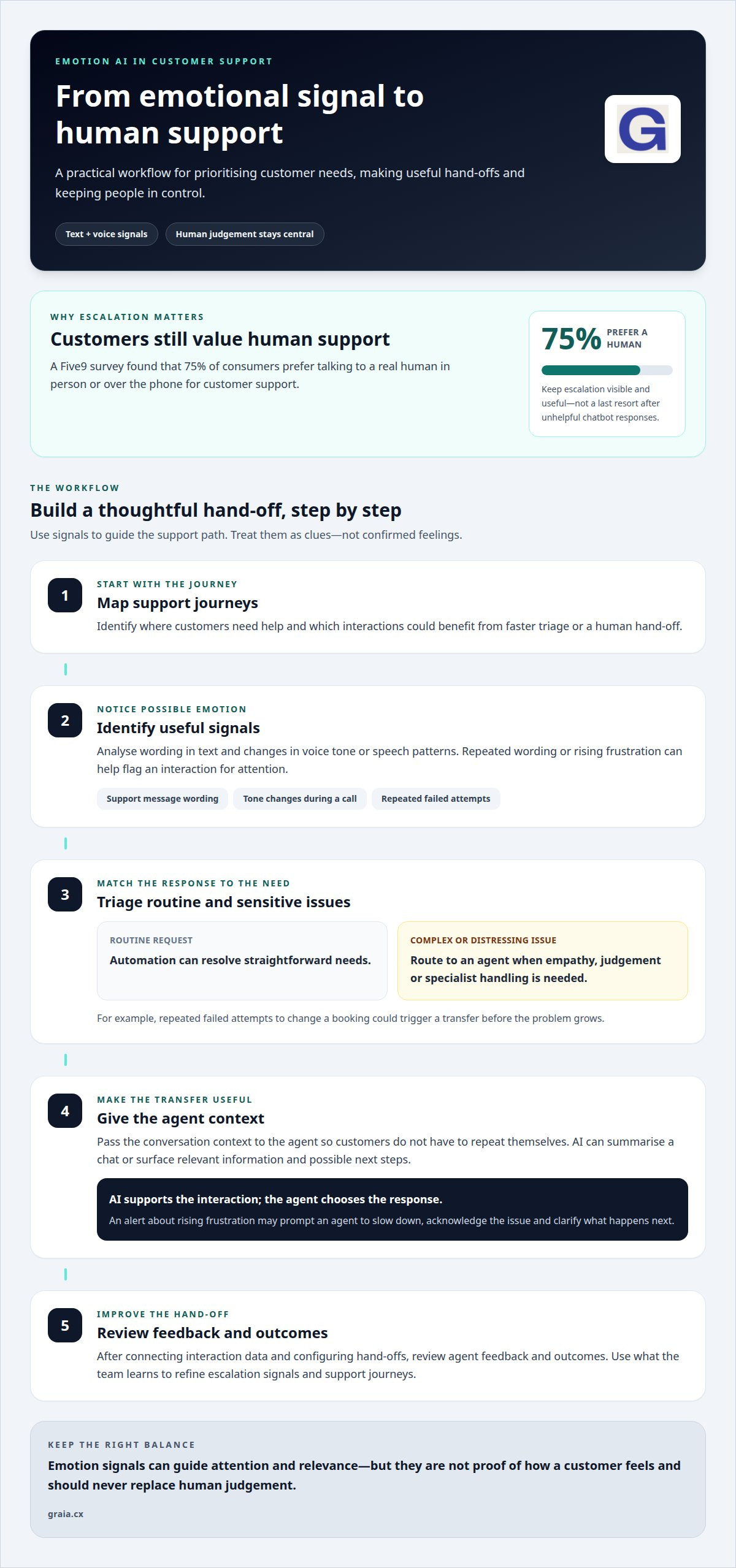
Human escalation means routing an interaction to an agent when an issue needs judgement, empathy or specialist handling. Automation can resolve routine requests, but a distressed customer may need someone who can listen and adapt.
Sentiment analysis can flag signs of rising frustration in a call or chat, helping a team intervene before the problem grows. For example, repeated failed attempts to change a booking could trigger a transfer, with the conversation context passed to the agent. This saves customers from repeating themselves and gives the agent a clearer starting point.
A Five9 survey found that 75 percent of consumers prefer talking to a real human in person or over the phone for customer support. That preference supports a clear design principle: make escalation visible and useful, not a last resort after a chatbot repeats unhelpful responses.
Agent Assistance and Human-AI Collaboration
Agent-assist tools analyse customer interactions and give staff relevant guidance as they respond. This allows an agent to focus on the customer’s concern while AI helps surface context, possible next actions or useful information.
During a call, an alert about rising frustration can prompt an agent to slow down, acknowledge the issue and clarify the next step. In chat, AI can summarise the conversation so a colleague joining mid-case understands what has happened. These suggestions support decisions; the agent remains responsible for choosing a response that fits the customer.
For implementation, map support journeys, identify escalation signals, connect relevant interaction data and configure hand-offs. Then review agent feedback and outcomes to refine alerts and routing. A Conversational Agent can handle routine enquiries, while Agent Assist supports human responses. An Agentic Omni-Channel Platform can coordinate customer interactions across channels.
Balancing Automation with Human Empathy
Balanced automation handles predictable tasks while keeping a straightforward path to human support. Fast responses improve customer experience only when customers can reach a person for sensitive or unusual needs.
Automation can gather basic information or answer routine questions, giving staff more time for complex cases. But a chatbot should not keep someone in a loop when they signal confusion, urgency or frustration. Clear escalation options and a smooth transfer make empathy part of the service design, not an afterthought.
Ninety percent of consumers say an immediate response to support requests is important or very important, and most define immediate as 10 minutes or less. Use this expectation to assess response workflows, not to replace judgement with speed alone. For more context on customer support and AI, explore customer experience insights.
Emotion-aware personalisation
Emotion-aware personalisation adapts an experience to signals about what a customer may need at that moment. For example, a visitor who seems confused by a subscription choice may benefit from a clearer explanation, not another promotional message. The aim is a more relevant interaction, not a guess presented as fact. Emotional signals should guide a response while leaving customers in control of their decisions.
AI-driven personalisation can combine emotional cues with the context of an interaction. In a support chat, a customer repeatedly asking about a delayed delivery may need a direct status update before any product recommendations. If their wording suggests frustration, the system can prioritise clarity and acknowledge the inconvenience. A customer asking about a feature may instead benefit from a concise explanation and an option to explore further.
That distinction can make an experience feel more considered. Someone uncertain about an unfamiliar service may respond better to plain language and a simple next step. A customer ready to proceed may prefer a faster route to completion. A practical answer to how to use emotion ai to improve cx is to adapt the timing and framing of information, rather than relying only on broad audience categories or past purchases.
Personalisation at scale means applying these choices across many interactions without sending every customer the same scripted response. For instance, a service team can group conversations by signals such as confusion, urgency or satisfaction, then tailor prompts to each situation. A human agent can still adjust the response for the individual. This approach supports consistent service while preserving the flexibility that builds meaningful customer relationships.
Emotional cues must be handled with care. A message written in capital letters might indicate anger, urgency or simply someone’s writing style; it should not trigger a firm assumption. Businesses should explain how emotional data is used, obtain explicit consent before collecting and analysing it, and protect sensitive information. Regular reviews can also reveal whether a system misreads particular groups or contexts.
The strongest personalisation connects a signal to a helpful action, then measures what changes. If customers seem anxious about a warranty choice, clearer explanations could reduce uncertainty; teams can then review related enquiries and customer satisfaction. When deciding how to use emotion ai to improve cx, focus on improving the experience, not manipulating people into spending. Testing and refining responses can make interactions more relevant while keeping customer needs at the centre.
Real-time speech and sentiment analysis
Real-time analysis interprets signals during customer service interactions, giving teams a chance to respond while a conversation is unfolding. Emotion AI infers possible feelings from text, voice, facial cues or behaviour, then uses those signals to guide a relevant response.
Real-Time Emotional Insights
Real-time emotional insights are signals about a customer’s changing emotional tone, surfaced during an interaction. They matter because an agent can adjust their approach before a concern becomes a complaint.
For example, a caller may begin calmly but speak faster and sound more strained while explaining a billing issue. An alert can prompt the agent to pause, clarify the charge and ask what would resolve the concern. The signal informs judgement; it does not prove exactly how the caller feels.
Sentiment analysis can classify text as positive, negative or neutral. Tracking changes across a conversation adds context: a customer’s final message may sound positive after an agent explains a confusing policy. That shift can help teams understand which responses support satisfaction and loyalty.
Detecting Emotions Across Customer Signals
Emotion AI detects patterns in customer signals and uses them to infer possible emotional states. It matters because the same words can carry different meanings depending on how someone writes, speaks or behaves.
In a call, systems can analyse speech rate, pitch, tone and stress. A customer saying “that’s fine” in a tense, clipped voice may need a different response from someone speaking calmly. In text, wording, capitalisation, punctuation, repeated letters and context can help distinguish urgency from a routine request.
Some systems analyse facial cues in video or camera feeds, while online businesses can review screen recordings to see where visitors hesitate or leave a page. A long pause on a payment explanation may point to friction, but it is not proof of anxiety. Combining signals with the interaction context gives teams a stronger basis for action.
Real-time language translation can also help service teams understand and respond across languages. For example, an agent can receive a translated call conversation and use sentiment cues to notice a change in the customer’s tone. Clear translation matters: emotional signals depend on context, and a phrase that sounds abrupt in one language may be ordinary in another.
Use these technologies to inform human decisions, not to make assumptions about individual customers. Teams can review flagged interactions, compare them with agent feedback and refine the system when signals are misleading. They should also explain how emotional data is used and protect sensitive information. This disciplined approach makes sentiment a practical service input while preserving trust.
Reducing complaints and escalations
Emotion AI can help teams identify interactions where frustration is building and respond before customers feel forced to complain. Its value comes from connecting a signal to a clear response, then fixing the causes of repeated friction.
For example, a sentiment system might detect increasingly negative language across a customer’s messages about a delayed refund. It can flag the case for a human agent, who can review the conversation and address the unresolved issue. The handover works best when the agent receives relevant context instead of asking the customer to explain everything again.
Use patterns across interactions to find recurring sources of dissatisfaction. If customers repeatedly express confusion about a cancellation process, identify where they encounter difficulty and prioritise a clearer explanation or simpler journey. Support teams can also review flagged conversations to identify helpful responses, then use those examples in coaching. This turns emotion signals into service improvements, not just alerts.
Escalation needs care. A system may misread sarcasm, writing style or an unusual situation as frustration, so an inferred emotion should not determine a customer’s outcome on its own. Give human agents the authority to assess the interaction, correct a mistaken signal and choose a response. Teams can review false alarms and missed signals, then refine the criteria and routing rules.
Security and responsible data use are part of the process. Businesses should explain what emotional information they collect and how they use it, obtain explicit consent before collecting and analysing it, and protect sensitive data. Limit access to people who need it for their work, define retention practices and avoid collecting signals without a clear customer-support purpose.
For UK regulatory compliance, build privacy and data-protection considerations into the project from the start. Map which data each system processes, who can access it and how customers can understand its use. Document the purpose of each signal and regularly review the system for unfair or inaccurate assessments across different groups. Human oversight and ongoing audits help keep emotion AI accountable as interactions and models change.
Measure the impact by comparing complaint themes, repeat contacts, escalations and customer satisfaction before and after a service change. For instance, fewer repeat questions about refund progress after revised refund messaging may indicate that friction has eased. Pair these measures with agent feedback; a lower escalation count alone could hide customers giving up instead of getting help.
Explore practical approaches to customer experience AI to see how responsible analysis can support earlier intervention and better service decisions.
GraiaCX
GraiaCX helps businesses connect emotion-aware support with faster, more coordinated customer interactions. Its Conversational Agent understands intent and emotion, resolves routine enquiries and escalates to human agents when an issue needs more attention. Agent Assist gives agents real-time suggestions, including next-best actions, to help them respond with context and care.
For teams managing voice, chat, email and social messaging, the Agentic Omni-Channel Platform brings interactions together with AI-driven automation. Live Call Translation supports multilingual conversations, helping businesses serve customers across language barriers. These capabilities can help support teams recognise customer signals, respond consistently and keep human judgement in the loop.
If you’re considering how emotion AI could fit your customer experience strategy, contact GraiaCX to discuss your needs.
Make your next CX improvement measurable
The best next step is a focused pilot, not a sweeping transformation. Choose one customer journey where a better response could make a meaningful difference, then define what success should look like before introducing emotion AI.
For example, a support team could focus on a journey that often leaves customers uncertain. Agree how emotional signals should inform the service, when a human should take over and how the team will review outcomes. Clear boundaries help staff use AI with judgement, while a defined measure makes it easier to decide whether the change merits wider adoption.
This offers a practical way to assess how to use emotion AI to improve CX: start with a specific customer need, keep people accountable for decisions and refine the approach using real interactions. Thoughtful implementation builds capability while keeping the experience centred on the customer.
When you’re ready to explore a suitable approach for your organisation, discuss your CX goals with GraiaCX. A considered first step can help turn emotional insight into a more responsive customer experience.
Frequently Asked Questions
Understanding emotional AI: what is emotional AI?
Emotional AI, also called affective computing, uses technology to infer emotional states from human signals. These may include written language, voice, facial expressions or physiological data. It does not read minds or establish exactly what someone feels; it identifies patterns that may indicate an emotion. For example, software might flag a message as frustrated based on its wording, while a person reviews the context before acting.
What is AI customer experience?
AI customer experience means using artificial intelligence to support or shape interactions throughout a customer journey. AI might help a customer find an answer, assist an agent preparing a reply or identify where a digital journey creates friction. The aim is to make service more relevant and efficient while involving people wherever judgement or personal attention matters.
What is emotion AI and how does it improve customer experience?
Emotion AI analyses customer signals to infer possible emotional responses and help businesses adapt their service. For instance, if a customer’s messages suggest uncertainty about a renewal, a support system could offer a clearer explanation instead of another sales prompt. Teams can then review whether the response helped resolve the concern. The technology is most useful when it supports customer needs, rather than treating an inference as fact.
What are the accuracy limits and risks of emotion AI, including bias and misreading emotions?
Emotion AI can misread signals because the same words, tone or expression may mean different things in different contexts. Sarcasm, stress, language differences and individual communication styles can affect an assessment. Systems may also interpret signals less accurately for some groups. Businesses should review errors, test outcomes across customer groups and give human agents the authority to challenge an inference. Emotional classifications should guide review, not determine a customer’s treatment on their own.
When should businesses disclose emotion AI use and obtain customer consent in the UK?
Businesses should explain how they use emotion AI before collecting or analysing emotional data, and obtain explicit customer consent before processing begins. Tell people what signals are used, why they are analysed and how the resulting insights may affect their service. For example, explain whether voice or written interactions are assessed to help route support. Clear communication helps customers make an informed choice and understand AI’s role.
How does emotion AI compare with sentiment analysis and traditional customer feedback tools?
Sentiment analysis generally classifies the tone of text as positive, negative or neutral. Emotion AI can assess a broader range of signals, including voice or facial cues, to infer possible emotional states. Surveys, interviews and focus groups ask customers to describe their experience directly, offering stated opinions and explanations. These approaches complement each other: direct feedback captures what customers report, while AI can help reveal patterns during interactions.