
How to scale multilingual support with AI across channels
Language coverage doesn’t have to grow one hire at a time. Scaling a multilingual support team with AI starts with prioritising languages by customer demand and market importance, then using AI across channels to handle routine enquiries and support agents when conversations need a human touch. Begin with a focused pilot, measure how well it serves customers in each language, and expand based on what you learn.
It’s understandable to worry that automated support could miss the nuance and reassurance people expect when they need help. The answer isn’t to automate every interaction. Match the response to the conversation, with clear routes to human support for complex, sensitive or high-stakes issues.
This guide explains how to choose languages for an initial rollout, connect AI support across chat, email, social messaging and voice, and adapt to changing demand without building a separate team for every language. You’ll also learn what to monitor during a pilot and when human judgement remains essential, so you can expand coverage while keeping the customer experience clear and personal.
Key Takeaways
- Prioritise languages using customer demand and market importance, then tailor interactions to the customer’s language and context.
- Use AI translation and suggested responses to help agents serve customers across languages, while keeping people involved in sensitive or complex conversations.
- Connect support across chat, email, social messaging and voice so customers can get help through the channels they use.
- Track service quality by language and adjust coverage as demand shifts, rather than scaling every market in the same way.
- Choose multilingual chatbots and voice systems for routine interactions, with clear escalation paths when a conversation needs human judgement.
Scaling Multilingual Customer Service with AI
Build language coverage around customer demand, then connect translation, intent recognition and personalisation. A measured rollout helps teams improve service without treating every language or interaction identically.
-
Prioritise Languages by Demand and Potential
Rank languages using recent enquiry volumes and each market’s strategic importance. For example, compare Spanish enquiries with demand from a smaller emerging market before allocating review capacity. Give high-volume languages fuller support, including native review; smaller languages can start with AI responses and translated escalation. Revisit priorities when enquiry patterns or market plans change. This keeps the rollout tied to actual customer needs, not assumptions about which languages matter most.
-
Select Multilingual AI and Translation Tools
Choose tools that combine translation with natural language understanding, rather than simply translating words. The right fit for a UK business depends on supported languages, channel coverage, helpdesk integration, data handling and how agents can review AI outputs. No single tool suits every operation. Compare capabilities against real enquiries, including Spanish messages with idioms, spelling variations or product terms.
For UK GDPR and data protection, map what customer information enters each AI workflow, its purpose, access and retention. Set appropriate safeguards for processing and review how suppliers handle data. Select tools that support those controls, and involve your privacy lead when assessing the workflow.
-
Adapt AI to Language and Utterance Variation
Train intent recognition to understand different ways customers express the same need. A customer might write “I can’t get in”, “login’s broken” or “my account won’t open”; the system should route each phrase towards account-access help. Include native-language examples, regional vocabulary and common misspellings in test conversations. Review misunderstood queries, refine intents and knowledge content, then test again before expanding automation. This reduces reliance on exact wording and helps AI respond to meaning.
-
Personalise Support by Language and Location
Use the customer’s chosen language and relevant location context to shape the response. Language can guide the reply; location can help distinguish market-specific product information or service processes. Avoid inferring sensitive personal details from language or location, and don’t let an assumed location override the customer’s stated preference. In a live voice conversation, translation can help an agent and customer communicate without requiring them to speak the same language.
Integrate AI with the helpdesk so language, intent, conversation history and escalation status follow the interaction. Measure results separately by language: track resolution time, repeat contacts, escalation patterns and customer satisfaction. Compare these measures over time, then investigate whether weaker results stem from translation, intent recognition or gaps in localised answers. Use what you learn to adjust workflows before extending coverage.
When does human support remain necessary?
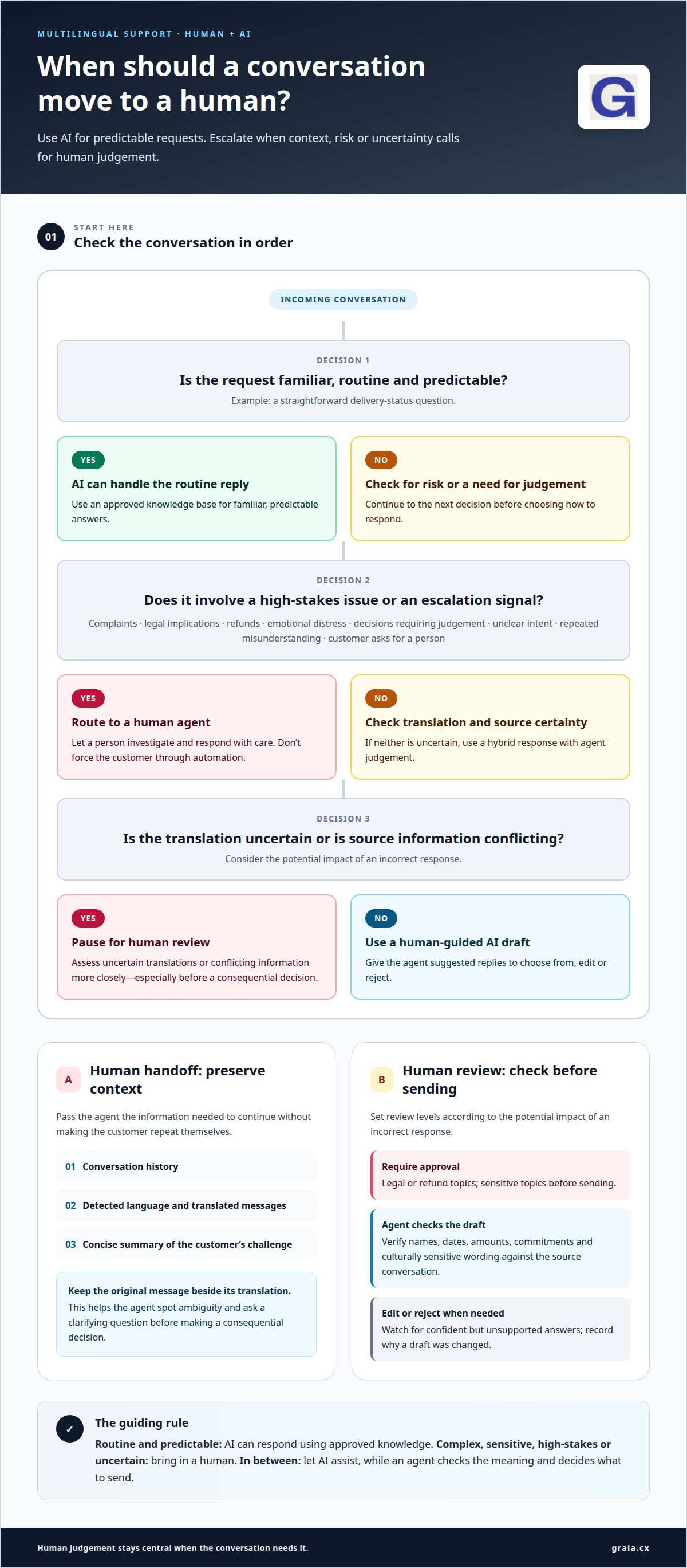
Use AI for routine, predictable requests, human agents for complex or high-stakes cases, and a hybrid model when translation or suggested replies support human judgement. Train agents to assess meaning, context, terminology and uncertainty. Translation errors or biased phrasing can distort tone, misroute an issue or erode customer trust.
-
Identify Issues That Need Human Support
Route conversations to a person when they involve complaints, legal implications, refunds, emotional distress or decisions requiring judgement. A chatbot can handle a familiar delivery-status request, for example, but a disputed charge involving several events needs an agent who can investigate and respond with care. Treat repeated misunderstandings, unclear intent and customer requests for a person as escalation signals, rather than forcing the conversation through automation.
When escalating, pass the agent the conversation history, detected language, translated messages and a concise summary of the customer’s challenge. This context helps the agent avoid asking the customer to repeat information. Keep the original message visible beside its translation, so the agent can spot ambiguity and ask a clarifying question before making a consequential decision.
-
Set Human Review and Approval Thresholds
Set review levels according to the potential impact of an incorrect response. AI can draft routine answers using an approved knowledge base, while an agent reviews sensitive topics before sending. Require human approval for legal or refund topics, and route uncertain translations or conflicting source information for closer assessment. This tiered approach keeps straightforward interactions moving while directing human attention where an error could materially affect the customer.
Give agents a small set of AI-generated draft responses to choose from, edit or reject. Train them to check names, dates, amounts, commitments and culturally sensitive wording against the source conversation. They also need practice spotting confident but unsupported answers, correcting terminology and recording why a draft was changed. These examples can reveal gaps in prompts, translation quality or knowledge content.
-
Evaluate Translation Risks and Customer Experience
Test the whole interaction, not just sentence-level translation. A phrase can be grammatically correct yet sound abrupt, miss a customer’s frustration or change the meaning of a policy. Review samples across languages for mistranslated negation, ambiguous product terms and biased assumptions about names or location. When the source message is unclear, a neutral clarification is safer than a confident guess.
Compare customer satisfaction, repeat contacts, resolution time and escalation patterns by language. A sudden rise in repeat queries may point to unclear translated instructions; longer handling time may indicate that suggested replies need better context. Use agent feedback alongside customer outcomes, then update the relevant knowledge base or review threshold. For practical ideas on improving multilingual support workflows, explore multilingual customer support insights.
AI-powered multilingual customer service applications
Apply multilingual AI to routine enquiries, repeatable workflows and clear information needs. Keep a human route available whenever a customer’s issue requires judgement or careful explanation.
-
Deploy Multilingual Chatbots
Use a chatbot to answer repeat questions in the customer’s language, such as explaining how to reset an account password or track an order. Ground its responses in an approved knowledge source, so answers reflect current product information rather than improvised wording. Configure it to recognise when it cannot answer clearly and offer a route to an agent. This makes automation useful without trapping customers in a loop of irrelevant replies.
Test complete conversations in each supported language, not just translated sample sentences. For example, check whether a customer asking about a delayed parcel gets the right information after phrasing the question another way. Review misunderstandings, incomplete answers and unsuccessful hand-offs before expanding the chatbot’s role. Keep responses concise, and make it easy for customers to clarify or correct what they meant.
-
Automate Multilingual Support
Automate predictable customer service tasks across chat, email and social messaging. A workflow might detect a message’s language, identify its intent, find a relevant knowledge article and draft a response in that language. Preserve the original message and conversation context so an agent can understand the request if the automated exchange needs review.
Maintain one authoritative source for product facts and policies, then use it to inform responses across languages. If an answer changes, update the source content before relying on translated versions. Avoid disconnected language-specific answers that could contradict one another. Track the questions automation resolves, the interactions it escalates and the topics that repeatedly need clarification. These signals show where knowledge content or workflows need refinement.
- Separate routine requests from issues where an incorrect answer could make the problem worse. A chatbot may explain a known service interruption, but a customer reporting that it caused a failed payment needs a route to a person. Keep the explanation factual, avoid promising an outcome, and let the agent review the customer’s circumstances before replying.
Use automation to gather useful details, such as the affected service or the customer’s preferred language, without making them repeat information. When the conversation moves beyond a known workflow, pass its history and previous responses to the agent. This hand-off preserves context and lets a person focus on resolving the actual issue, rather than reconstructing the exchange from the beginning.
- Evaluate customer satisfaction alongside resolution quality in each language. A quick automated reply isn’t a successful resolution if the customer has to contact support again or receives an unclear explanation. Review repeat contacts, escalations and customer feedback to identify patterns, such as a translated instruction that customers consistently misunderstand.
Product problems can test customer trust, so use language support to explain what is known, what action the customer can take and where human help fits. Don’t use automation to minimise a complaint or imply that a customer should tolerate a poor experience. When reviews reveal confusion, refine the knowledge source and response flow, then assess whether the next conversations lead to clearer, more complete outcomes.
Demand fluctuations and the limits of hiring multilingual agents
Demand can rise unevenly across languages, channels and trading periods. Combine targeted recruitment with AI support so language coverage can flex without removing human judgement.
- Map demand before recruiting. Review contact volumes by language, channel and time of day, then identify where queues repeatedly build. A global support team might see steady English enquiries but sharp seasonal peaks in another language. Distinguish temporary surges from sustained demand before adding permanent coverage. This helps avoid hiring for a short-lived spike while leaving persistent language gaps unresolved.
Meaningful 24/7 coverage can require around 2-3 agents per language. That makes a dedicated rota difficult to justify for every lower-volume language. Match recruitment plans to sustained demand and the level of service each market needs, rather than treating every language as a separate full-sized team.
-
Add AI Reply Suggestions for Agents
Give agents AI-generated drafts to accelerate routine replies, while keeping the final decision with the person handling the case. Offer 1 to 3 suggested responses so agents can select, adapt or reject wording. A draft can help an English-speaking agent answer a translated customer message, but the agent should preserve the customer’s meaning and tone.
Use suggestions grounded in approved support content, and make them easy to edit. Agents need practice recognising translation errors, checking key details and escalating uncertain meaning. Review edited or rejected drafts for recurring gaps, such as outdated guidance or a phrase that sounds abrupt in another language. This feedback can improve accuracy without turning suggestions into automatic, unchecked replies.
- Recruit for the work that needs people. Prioritise language skills for complex escalations, sensitive conversations and markets where native review matters. Assess candidates on clear written communication, active listening and the ability to explain policies accurately. Bilingual agents can bring cultural understanding as well as fluency, but recruitment alone won’t solve sudden peaks across multiple languages.
Plan coverage around the customer journey. For example, a smaller language group might need a specialist escalation path, while AI handles routine enquiries first. This balances human expertise against workload and helps agents focus on cases where judgement most affects satisfaction.
-
Use Virtual Agents and Chatbots
Use a virtual agent for repeatable enquiries with clear, approved answers. It can handle common requests in multiple languages and route unfamiliar questions to a human agent with the conversation context. This can absorb changing contact volumes without requiring a separate queue for every language, while preserving an escalation route when a customer’s needs become more complex.
Set boundaries around what the chatbot can resolve, then monitor completion, repeat contacts and escalations by language. A rise in unresolved queries may point to inaccurate translation or a knowledge gap. Adjust the workflow before extending automation, and keep people available for complaints, ambiguous requests and conversations that call for empathy.
Multilingual chatbots, virtual assistants and voice systems
Treat chatbots, virtual agents and voice translation as distinct parts of one service journey. Choose each capability according to the task, channel and language involved.
- Match the system to the conversation. Use a chatbot for structured questions with clear answers, such as explaining how to update account details. A virtual agent can handle a broader sequence, such as identifying a delivery query, collecting relevant details and directing the customer to the next step. Define the boundary between these tasks before deployment, so customers aren’t offered a pathway the system can’t complete.
- Design a consistent multilingual journey. Treat the customer’s language as a service preference, not just a translation setting. For example, a Spanish-speaking customer who starts in chat should be able to continue with an agent without restating the issue. Carry the conversation history, detected intent and previous answers between channels. Keep key product terms consistent, and let customers correct the system if it misunderstands their request.
- Use voice systems where conversation matters. Live translation can help an agent and customer communicate by phone when they don’t share a language. Define how the agent handles pauses, names, product terms and unclear speech. For example, an agent discussing a technical fault can confirm an important detail in plain language before continuing. Voice translation supports communication; the agent remains responsible for understanding the issue and responding appropriately.
- Test language performance separately. Don’t assume that a successful English conversation proves equivalent quality in every language. Test common intents, regional phrasing, interruptions and hand-offs in each launch language. Track whether customers reach the right answer, repeat themselves or request an agent. If Spanish interactions show more misunderstood intents than English interactions, inspect the relevant language examples and knowledge content before expanding the system’s role.
- Set enterprise controls before expanding. Assign ownership for conversation flows, approved answers, escalation routes and changes to source content. When a policy changes, update the source and check how that change appears across chatbot, virtual-agent and voice journeys. Review unresolved cases and agent feedback together, then refine prompts, translations or routing rules. Explore practical guidance for multilingual AI support as you shape the next stage of your rollout.
GraiaCX
GraiaCX helps organisations bring multilingual automation, agent assistance and customer conversations across channels into one support approach. Its Agentic Omni-Channel Platform combines voice, chat, email and social messaging, while a Conversational Agent can handle routine enquiries. Live Call Translation supports conversations in over 100 languages, and Agent Assist provides real-time help to human agents.
Consider GraiaCX when language demand spans several channels, routine queries are adding pressure, or customers need translated voice support without separate language-specific teams. The right mix depends on where AI can resolve an interaction and where an agent’s judgement matters. Contact GraiaCX to discuss your multilingual support needs.
Build your next stage of multilingual support
Make language access part of how your support operation evolves, rather than a separate initiative outside everyday service. As you plan scaling a multilingual support team with AI, decide who owns language quality, how customer feedback shapes improvements, and when automation should give way to human judgement. These decisions help keep growth aligned with the experience you want customers to have.
GraiaCX’s Conversational Agent, Live Call Translation and Agent Assist can support different parts of this approach, from automated interactions to agent-led conversations. Choose the capabilities that fit your channels and support needs, then define how they work together in practice.
A clear next step is to discuss where multilingual AI could fit within your existing support workflows. Contact GraiaCX to discuss multilingual support and consider how to make every customer conversation easier to understand and resolve.
Frequently Asked Questions
What is Multilingual AI support?
Multilingual AI support uses language technology to interpret and respond to customer enquiries across languages and channels. For example, it can recognise a request written partly in English and partly in another language, then route it by meaning rather than exact phrase matching. A useful setup also preserves the original message, giving agents context if a customer later needs help with a detail the AI has misunderstood.
How can AI scale multilingual customer support teams?
AI can extend language coverage by handling suitable routine interactions and helping agents respond to others. To scale a multilingual support team with AI, map one customer journey first, such as a booking enquiry that starts in chat and may move to email. Define which replies can be automated, where an agent takes over, and what context transfers. Expand only after reviewing unresolved queries and customer feedback from that journey.
How accurate is real-time AI translation for customer service, and when is human review needed?
Translation accuracy varies with language, audio clarity, specialist terms and the surrounding conversation, so there isn’t one accuracy figure for every interaction. Test representative customer examples, including product names and phrases with more than one possible meaning. Human review matters when a mistranslation could alter a commitment, payment detail or complaint response. If a phrase is unclear, an agent can ask the customer to clarify before acting.
How should businesses choose which languages to support and prioritise?
Prioritise languages by combining enquiry patterns with the organisation’s plans for each market. A language with modest current volume may still matter if a product launch or new customer journey is planned there. Compare the requests customers make, the channels they use and where service gaps create friction. Then set a review point to reassess priorities as customer behaviour and business focus change.
What UK GDPR and other data protection rules apply to AI multilingual customer support?
For UK GDPR and data protection, map what customer information enters each AI workflow, why it is used, who can access it and how long it is retained. Set appropriate safeguards, review how suppliers handle data, and involve your privacy lead when assessing the workflow.