
How to Manage Seasonal Call Volume Spikes: A 2026 Guide
Could the biggest seasonal call-volume risk be a plan built around headcount alone? If you’re working out how to manage seasonal call volume spikes, you already know that historical patterns can guide staffing, but they don’t prevent queues from rising when demand shifts or complex enquiries take longer to resolve. Black Friday falls on Friday, 27 November 2026, giving contact centres a clear planning milestone, but the pressure can extend across channels and beyond a single peak day.
A resilient plan connects demand forecasting with customer access and agent support. This guide shows you how to turn historical data into a practical view of when demand may rise, adapt coverage across voice and digital channels, and help agents handle sensitive or complex interactions without losing context. You’ll also see how conversational agents can take on routine seasonal enquiries, while Agent Assist supports human agents when judgement and empathy matter most.
The goal isn’t simply to get through the busiest weeks. It’s to maintain continuity for customers and give your team the clarity and support to deliver a better experience under pressure.
Key Takeaways
- Distinguish predictable seasonal demand from sudden incidents so your response matches the cause of the surge.
- Build a forecast by reviewing past peak periods, accounting for business changes, modelling scenarios and assigning clear owners.
- Compare staffing, cross-skilling, self-service, automation and channel distribution to choose the right mix for different contact types.
- Use a real-time operating loop to monitor queue health, diagnose pressure, act, communicate and review unresolved demand.
- Learn how to manage seasonal call volume spikes while supporting routine enquiries with conversational agents and helping human agents handle complex interactions.
Why seasonal call volume spikes test more than contact-center capacity
A seasonal call-volume spike is a predictable rise in customer contacts linked to a recurring pattern: a holiday, promotion, billing date, renewal window or travel period. Its timing may be familiar, but its shape can change. A campaign might increase order-status questions, while a renewal period could bring fewer contacts overall but more complicated account queries.
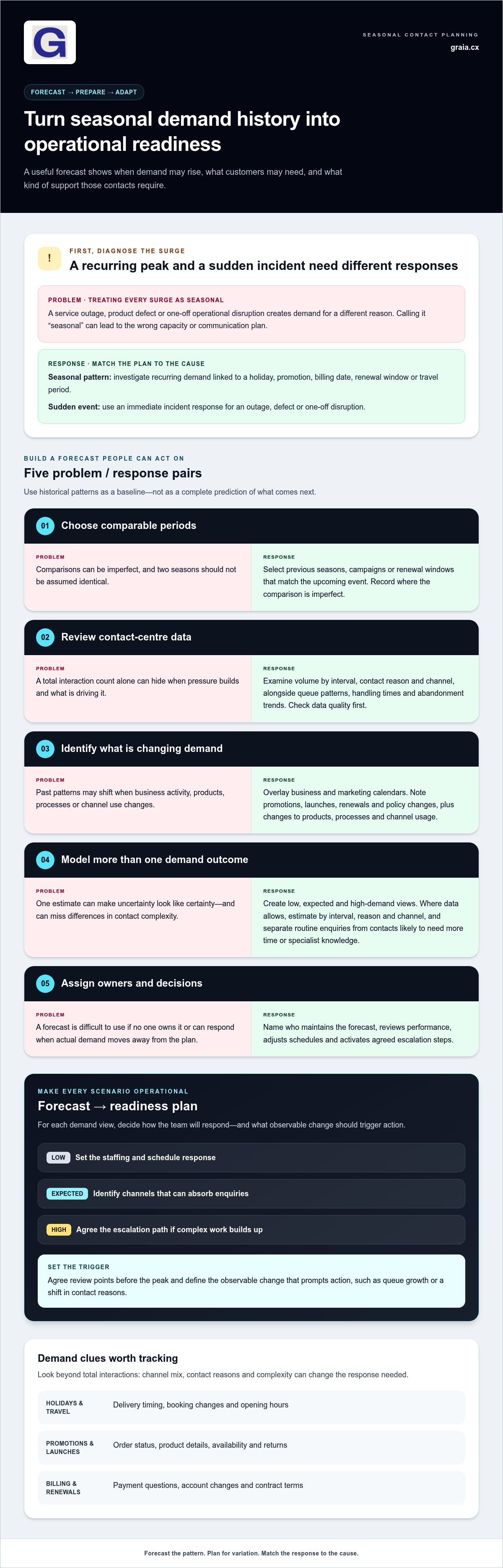
That distinction matters. A seasonal peak follows a pattern the organisation can investigate and plan for. A sudden event, such as a service outage, product defect or one-off operational disruption, creates demand for a different reason and may require an immediate incident response. Treating every surge as “seasonal” can obscure the cause and lead to the wrong capacity or communication plan.
Peak pressure is about more than the number of calls. Customers may switch from webchat to voice when a question remains unresolved, or contact the centre more than once if the first response is rushed. These dynamics affect queue access, resolution quality and sentiment, while agents face greater workload and less room to give each interaction their full attention. Foundational Call Center Operations include managing both incoming demand and the service capacity available to respond.
A seasonal spike is the gap between recurring demand and the capacity available to resolve it well. The wider or longer that gap remains, the more it can strain both customer experience and the team delivering it.
Which seasonal patterns drive customer contacts?
Build a view of demand by matching contact-centre history with business and marketing calendars. Look beyond total interactions: check whether the channel mix, contact reasons or complexity also changed. More chat contacts may call for a different response than a rise in lengthy billing queries.
- Holidays and travel periods: delivery timing, booking changes and opening hours.
- Promotions and product launches: order status, product details, availability and returns.
- Billing dates and renewals: payment questions, account changes and contract terms.
Why do seasonal spikes become a customer-experience problem?
When incoming work exceeds available capacity, queues grow and customers may wait longer or abandon their attempts to get help. Pressure can then compound: a rushed response may leave an issue unresolved, prompting a repeat contact that adds more work to an already busy queue. Monitor contact reasons and repeat demand alongside volume to see whether the underlying experience is deteriorating, not just getting busier.
Understanding how to manage seasonal call volume spikes starts with identifying what is recurring, what has changed and where customers are struggling. That diagnosis gives the next planning steps a stronger foundation.
How to forecast seasonal call volume and prepare capacity
A useful forecast turns past patterns into decisions people can act on. It should show not only how much demand may arrive, but when it may arrive, what customers are likely to need and what kind of support those contacts require. Historical volume is a baseline, not a complete forecast: it shows what happened under previous conditions, not what will happen after the business or customer journey changes.
Use this sequence to build a forecast that can guide both preparation and live operations:
- Select the periods to compare. Choose previous seasons, campaigns or renewal windows that match the upcoming event, and record where the comparison is imperfect.
- Review contact-centre data. Examine volume by interval, contact reason and channel, alongside queue patterns, handling times and abandonment trends. Check data quality before drawing conclusions.
- Identify the demand drivers. Overlay business and marketing calendars, including promotions, product launches, renewals and policy changes. Note changes to products, processes and channel usage that could alter the pattern.
- Model demand scenarios. Create low, expected and high-demand views. Where the data allows, estimate volume by interval, reason and channel, and distinguish routine enquiries from interactions likely to require more time or specialist knowledge.
- Assign owners and decisions. Name who maintains the forecast, who reviews performance and who can adjust schedules or activate agreed escalation steps when actual demand moves away from the plan.
What data should a seasonal forecast include?
Compare like with like, but don’t assume two seasons are identical. Review comparable periods alongside contact reasons, queue patterns, handling times and abandonment trends. Add known business events and document assumptions, such as a campaign running for the first time or a policy change affecting eligibility. Flag uncertainty explicitly; a clear range is more useful than presenting one estimate as certain.
How should leaders translate forecasts into readiness?
Make each scenario operational. For low, expected and high demand, specify the staffing and schedule response, the channels that can absorb enquiries, and the escalation path if complex work builds up. Set review points before the peak and agree what observable change triggers action, such as queue growth or a shift in contact reasons. This connects the forecast to day-of decisions rather than leaving it as a planning document.
Once the peak begins, compare actual demand with the forecast at regular intervals. If the gap widens, check whether volume, channel mix or handling complexity has shifted, then update the response and communicate the change to the people affected. This makes how to manage seasonal call volume spikes a repeatable operating discipline, not a one-off prediction exercise. For further ideas on practical contact-centre planning, explore contact-centre planning insights.
Staffing, self-service, or omnichannel support: compare your peak-season levers
No single lever fits every surge. Additional people can help with a defined queue, while automation can absorb repeatable enquiries and channel choice can make support more accessible. The right mix depends on the contact reason, how quickly you can prepare, the effort customers must make and the operational support behind each option.
Use this comparison to match capacity to the work, not simply to the headline volume. Activation speed is relative: existing training, processes and technology can change how quickly any lever is ready.
| Lever | Speed to activate | Suitable contact types | Customer effort | Operational dependencies |
|---|---|---|---|---|
| Staffing | Depends on schedules and available capacity | Complex, sensitive or varied enquiries | Low when customers reach the right person promptly | Forecasts, scheduling, skills and supervision |
| Cross-skilling | Requires preparation and practice | Common enquiries that adjacent teams can learn to resolve | Low if the agent can complete the request without another transfer | Focused training, clear guidance and routing by skill |
| Self-service | Depends on existing content and journey readiness | Simple tasks customers can complete independently | Low for clear, easy journeys; high if information is hard to find | Accurate content, accessible design and a human route when needed |
| Automation | Depends on configured flows and tested answers | Repeatable questions with grounded responses | Low when resolution is direct and handoff retains context | Reliable knowledge, escalation paths and ongoing review |
| Channel distribution | Depends on available channels and clear signposting | Tasks suited to chat, email or messaging rather than a call | Low when customers can choose and continue without repeating details | Connected interaction history, routing and channel coverage |
When should a contact centre add or redeploy human capacity?
Use flexible schedules or redeploy cross-skilled teams when your forecast points to specific busy periods or queues. Prepare agents for likely seasonal contact reasons before demand arrives; a quick briefing and accessible guidance can help, but they don’t replace practice for unfamiliar or sensitive work. Skill-based routing then directs each customer to an agent equipped for the request, reducing avoidable transfers.
Where can automation and channel choice relieve pressure?
Automation suits repeatable questions, such as providing grounded information about an order process, when the customer can move to a human agent for an unusual or sensitive case. Chat, email and messaging can serve tasks that don’t require a live conversation. But a channel shift shouldn’t make customers start again: retain interaction context across handoffs. Real-time Agent Assist can surface knowledge and next-best-action suggestions to support agents handling complex live contacts.
To understand how to manage seasonal call volume spikes, balance efficiency with customer choice: automate the routine, preserve a clear human path and avoid shifting effort onto the customer. Review each lever against the actual contact mix, then adjust as needs change.
How to manage a seasonal call spike in real time
A forecast sets direction. Live conditions tell supervisors when to adapt. The goal isn’t to chase every fluctuation, but to spot meaningful changes early and respond without creating confusion for customers or agents. Keep one operating picture that brings queue health, service access, contact reasons, agent availability and unresolved demand together.
Use a repeatable loop so each adjustment has a reason, an owner and a follow-up:
- Monitor. Review live queue growth, wait patterns, abandonment, channel mix and agent availability. Compare actual demand with the forecast, and watch for emerging contact reasons or unresolved work accumulating across channels.
- Diagnose. Identify what has changed. Is one queue under pressure, are contacts taking longer, or are customers moving from digital channels to calls? A sudden cluster of similar complaints may point to an incident or customer-impacting issue, not routine seasonal demand.
- Act. Choose a targeted response. Adjust schedules or skill-based routing, redirect suitable routine requests to clear self-service, or activate an agreed escalation path for complex cases. Avoid changes that relieve one queue by creating hidden demand elsewhere.
- Communicate. Tell agents and supervisors what is changing, why, who owns the decision and when it will be reviewed. Keep guidance concise and consistent, especially if queue messages, routing rules or automated answers need updating.
- Review. Check whether the change improved access and reduced unresolved demand without harming resolution quality. Record what happened, what assumptions held and what needs attention in the next review.
Which signals should supervisors monitor during a peak?
Read indicators together, not in isolation. A growing queue alongside rising abandonment suggests a different response from steady queues with a new contact reason emerging. Compare actual volume and channel mix with the forecast, then check whether handling complexity or agent availability has shifted. Escalate patterns that suggest an outage, product issue or other customer-impacting event through the relevant operational process.
How can teams adjust without disrupting customer journeys?
Make changes visible to the people who must deliver them. Assign an owner to routing and schedule decisions, and ensure current policies, offers and operational information are reflected in self-service and automated answers. When an automated or digital interaction needs a human response, pass along its context so customers don’t have to repeat their story. Monitor the handoff as part of service access, not as a separate technical step.
Knowing how to manage seasonal call volume spikes in real time means pairing timely action with clear communication and checking the effect of each adjustment. Explore more contact-centre guidance to strengthen your approach.
How GraiaCX can support a human-centred seasonal contact-center plan
Seasonal readiness depends on more than adding capacity. It means matching routine enquiries to efficient support while giving people a clear path to an agent when they need judgement, empathy or help with an unusual case. GraiaCX brings conversational agents, Agent Assist and omnichannel interactions together to support that balance across voice, chat and email.
For routine requests, a Conversational Agent can respond across these channels and take action through customer systems. If an enquiry falls outside its scope or needs a human response, it can escalate the interaction with context, helping the customer continue without starting from the beginning. GraiaCX reports up to 80% of routine inquiries resolved autonomously, giving contact-centre leaders a specific performance claim to assess against their own seasonal contact mix.
How can GraiaCX help absorb routine seasonal inquiries?
Use automation for repeatable requests with clear answers and defined outcomes, such as routine account or order enquiries. A smooth escalation path matters just as much as the automated response: carry forward the customer’s question and relevant interaction context so agents can pick up the conversation with less repetition. GraiaCX also reports 60%+ call containment with Agentic CCaaS in production. These figures describe platform outcomes, not a guaranteed result for every operation.
Human support remains central. Agent Assist can provide suggestions, live coaching, AI-generated summaries and knowledge-based quick actions to support agents handling complex or sensitive interactions during a busy period. Rather than asking people to choose between automation and a human conversation, this approach can direct routine work to automation while helping agents focus on interactions that need care and informed judgement.
How can GraiaCX support agents and existing contact-center operations?
Context should follow the customer across channels and through each handoff. GraiaCX supports voice, video, chat, email and social messaging, enabling connected interactions rather than disconnected queues. Agent Assist can help a human agent understand what has already happened and surface relevant knowledge, while AI-generated summaries can support continuity when work moves between stages.
For high-stakes processes, Hybrid Flows can combine automated steps with human involvement where needed, supporting 100% compliance and full auditability. GraiaCX integrates with major platforms including Genesys, NICE CX, Avaya and Five9, with a no rip-and-replace approach to integration simplicity. That lets organisations consider how the platform can fit into existing contact-centre operations while building a more connected seasonal response.
A human-centred plan uses technology to make service more accessible and agent work more supported, not to remove the human connection customers may need. That’s the principle behind GraiaCX’s tagline: Empower the Human. Elevate the Experience. To explore further ideas for planning and improving contact-centre operations, Explore GraiaCX guidance.
Make your next peak a learning cycle
Your next seasonal period can do more than test readiness. Treat it as a chance to learn how demand, customer needs and service decisions interact, then use those observations to strengthen the next plan. Set a clear improvement goal before the peak, and agree how you’ll assess whether changes helped both customers and agents.
If you’re considering technology as part of that improvement, weigh platform claims against the outcomes your team needs. GraiaCX cites a 2× boost in agent productivity and a Typical after 4-6 weeks deployment timeline. Use these as context for planning, not a substitute for defining operational measures that fit your contact centre.
The most effective next step is a focused one: identify a seasonal pressure point, decide what a better experience would look like, and explore how connected contact-centre support could help you move towards it. For practical ideas to inform that work, Explore GraiaCX contact-center guidance.
With a clear learning goal and the right support around your team, you can approach how to manage seasonal call volume spikes with greater confidence and keep improving peak by peak.
Frequently Asked Questions
How far ahead should a contact center plan for seasonal call volume spikes?
Start as soon as the next recurring demand period is visible in your business calendar. The time needed depends on how much preparation is involved, from checking contact data and agreeing schedules to refreshing guidance or testing customer journeys. If you’re considering how to manage seasonal call volume spikes, work backwards from the expected peak and set owners and decision dates for each readiness task.
What data is most useful for forecasting seasonal customer-service demand?
Use records that show when customers contacted you, which channel they used, what they needed and whether the issue was resolved. Consistent contact-reason tags make comparisons more meaningful; review uncategorised or miscoded interactions before relying on them. Separate exceptional events, such as a service interruption, from normal seasonal patterns so one unusual day doesn’t distort expectations for the whole period.
How can a contact center prepare for a spike that exceeds its forecast?
Agree a contingency plan before demand rises, including who can authorise a response and what options are available. For example, teams might move trained people to a pressured queue, simplify a customer journey or direct routine requests to an appropriate self-service route. Define fallback steps for issues that can’t be resolved there, and make sure agents know how to raise customer-impacting incidents.
Can AI handle seasonal customer-service calls without removing human support?
Yes. AI can take on suitable routine enquiries, while people remain available for cases that involve unusual circumstances, sensitivity or judgement. Set clear boundaries for what automation can answer or do, and make escalation easy to find. Human agents can then focus on the interactions that benefit from empathy and problem-solving, rather than being expected to handle every repetitive request themselves.
How can teams prevent customers from repeating information during an AI handoff?
Design the handoff so the receiving agent can see the customer’s original request and the steps already taken. A useful summary should capture the issue, relevant details provided and any action attempted, rather than simply marking the conversation as transferred. Agents should acknowledge that context and confirm any missing detail, instead of making customers restart the interaction from the beginning.
What should supervisors monitor during a seasonal call-volume spike?
Look for changes that reveal where customers are encountering friction, not only whether calls are increasing. For example, a rise in repeat contacts about one task may point to unclear information, while more transfers could suggest a routing or skills mismatch. Review these patterns by queue and channel, and share emerging themes with the teams responsible for customer communications and service operations.
How can a contact center tell whether its peak-season plan worked?
Before the busy period, decide what success means for customers and the team, then compare results with an appropriate earlier period. Consider access to service, resolution quality, repeat contacts, unresolved work and agent feedback together. Note which actions helped, where assumptions proved wrong and what created extra effort. Turn those findings into specific changes for the next seasonal plan, rather than relying on volume alone.