
How to Continuously Improve Voicebot Performance: A Practical Guide
What if a voicebot’s “successful” call is actually a customer giving up? Containment and completion metrics can look healthy while callers repeat themselves, hit a workflow dead end or leave without the help they need. Knowing how to continuously improve voicebot performance starts with looking beyond the headline numbers and learning from what happened in real conversations.
It’s not enough to tweak prompts whenever a problem appears. Teams need to identify whether a failure stems from speech recognition, missing knowledge, workflow logic or the way the bot communicates, then test a focused change before it reaches customers. That discipline helps protect the experience from regressions and keeps human support within reach when automation isn’t the right answer.
This guide lays out a repeatable improvement loop: review conversation evidence, diagnose the cause, prioritise measurable and low-risk changes, and test them against realistic scenarios. You’ll also learn how to evaluate results through customer outcomes, assign clear ownership and build in human oversight, so each release becomes an informed step forward rather than a guess.
Key Takeaways
- Learn how to continuously improve voicebot performance by establishing a clear baseline and repeating a cycle of evidence, change, testing and review.
- Trace customer friction through the conversation journey to distinguish recognition issues from gaps in knowledge, workflow or system actions.
- Rank improvement ideas by customer impact, evidence, implementation risk and reversibility before choosing a fix.
- Build realistic tests from recurring failure patterns, then document what changed and what the results reveal.
- Give teams clear ownership for reviews, updates and release approval, and use handoff reasons and agent feedback to guide the next improvements.
How to continuously improve voicebot performance: start with the right baseline
Improvement needs a reference point. Before changing prompts, conversation flows, retrieval sources or speech settings, capture how the voicebot performs now and how customers experience it. Without that baseline, a later rise or fall in a metric is difficult to interpret: the cause might be the change, a different mix of calls or an unrelated system update.
Think of continuous improvement as a repeating cycle: gather conversation evidence, prioritise a change, test it in a controlled way, then review the results and decide what to do next. Chatbots provide the foundations for voicebots, including their use of natural language processing and their limitations; Chatbot technology and its evolution offers an overview of that wider context. For a live voicebot, however, the baseline must reflect the full spoken customer journey, not just whether a conversation stayed automated.
Containment is not the same as resolution. A contained interaction ends without a transfer to a human; a successful resolution means the customer’s intended task was completed appropriately, without avoidable repeat effort or an unresolved need. Treat containment as an operational signal, not proof that the customer got help.
Which voicebot metrics show meaningful progress?
Agree on definitions before comparing results. For example, define containment as the share of eligible interactions ending without human transfer, task completion as the share meeting a specified outcome, and transfer as a handoff to a person. Track abandonment separately, including where it occurs, and define repeat contact by the same customer and issue within a consistent follow-up window.
Pair these measures with customer feedback and effort signals, such as repeated requests, corrections or a need to restate information. Review compliance indicators alongside them, so an apparently efficient journey doesn’t conceal a policy failure. Segment results by intent, journey stage, language and escalation reason. A strong overall score can mask a specific route where callers routinely encounter friction.
How should teams establish a reliable baseline?
Choose a review period that reflects normal call patterns, then document its call mix and any known changes, such as a campaign, service disruption or workflow release. Compare like-for-like groups, such as callers pursuing the same intent through the same journey stage, rather than relying on an aggregate score that blends different needs together.
Before interpreting results, record each metric’s definition, data source and exclusions. Note whether the figures come from call records, conversation reviews, customer feedback or operational systems, and how incomplete interactions are handled. This makes the baseline reproducible and helps the team distinguish real movement from changed measurement.
- Task outcome: Was the intended action completed, and is there evidence to support that conclusion?
- Customer experience: Did the caller have to repeat, correct or abandon the request?
- Safe handling: Were transfers, disclosures and other required steps followed?
Once these measures are defined, teams can investigate underperforming journeys with a shared reference point. That is the foundation for learning how to continuously improve voicebot performance without mistaking a tidy dashboard for a better customer experience.
Diagnose voicebot performance issues across the conversation journey
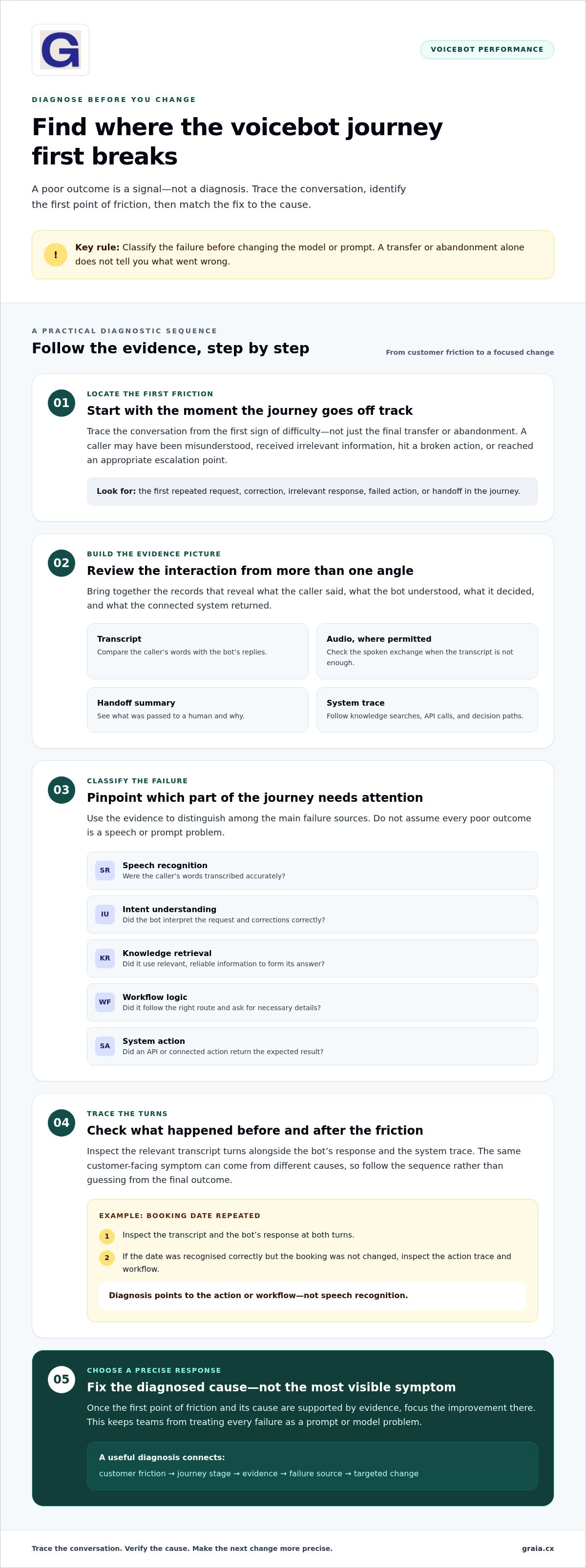
A poor outcome is a signal, not a diagnosis. A caller who gets transferred may have been misunderstood at the first turn, received irrelevant information, encountered a broken action or reached a sensible escalation point. Find the first moment friction appears in the journey, then trace what happened next. This keeps teams from treating every failure as a prompt or model problem.
Diagnostic rule: classify the failure before changing the model or prompt. Review the transcript, audio where permitted, handoff summary and system trace together. Each reveals a different part of the interaction: what the caller said, what the bot understood, what it decided and what the connected system returned. Conversation traces can expose knowledge searches, API calls and decision paths, helping teams follow the evidence rather than guess at the cause.
- Speech recognition: Were the caller’s words transcribed accurately?
- Intent understanding: Did the bot interpret the request and corrections correctly?
- Knowledge retrieval: Did it use relevant, reliable information to form its answer?
- Workflow logic: Did it follow the right route and ask for the necessary details?
- System action: Did an API or other connected action return the expected result?
Map each issue to the journey stage where it first appears, not just the final transfer or abandonment. If a customer says the booking date twice, for instance, inspect the transcript and the bot’s response at both turns. If the date was recognised correctly but the booking was not changed, focus on the action trace and workflow rather than speech recognition. That distinction makes the next improvement more precise.
How can teams tell speech problems from dialogue problems?
Check whether transcripts capture names, product terms and the caller’s intended request. Then compare the recognised words with the bot’s reply and the customer’s next turn. A correction such as “No, I said Tuesday” may reveal a recognition error; an accurate transcript followed by an irrelevant reply points towards intent understanding or dialogue design.
Listen, where permitted, for interruptions, long silences and repeated questions. These can indicate turn-taking or timing friction, but context matters: a pause may also reflect a caller searching for information. Don’t change speech settings until the evidence shows where the misunderstanding begins.
When are retrieval, workflow, or integration issues responsible?
For inaccurate or inconsistent answers, inspect the evidence retrieved and whether it supports the response. For a failed action or incorrect route, trace the workflow decision and the system’s response. A clear request that produces a failed update is different from a vague request that needs clarification.
Handoff context adds another diagnostic clue. Review what information the bot collected, what it passed on and where it could have explained the fallback more clearly. This helps teams distinguish a necessary escalation from a preventable dead end. GraiaCX’s voice AI insights and guidance can offer further context as teams develop their review practice.
Compare voicebot improvement opportunities before choosing a fix
Once a failure has been classified, resist the urge to change the first thing that looks plausible. Compare candidate fixes against four criteria: customer impact, strength of the evidence, implementation risk and reversibility. A change affecting a frequently used journey may deserve attention, but a lower-volume issue involving safety, privacy or policy should take priority. Volume matters, but it isn’t the only measure of importance.
Keep the intervention aligned with the layer causing the problem. A missing or outdated answer may need a knowledge correction; a required verification step may call for a workflow adjustment. An API failure points towards integration work, while misheard words may warrant a speech configuration change. A broader prompt or model change should have stronger evidence, especially if it could affect several journeys.
Which issues should teams prioritise first?
Address safety, privacy and policy failures first, even when they appear in few interactions. Next, consider recurring customer friction supported by clear evidence, such as repeated questions, avoidable transfers or customers having to restart a request. Weigh how many people are affected, how seriously the issue blocks resolution and how confident you are in the diagnosis. An isolated anomaly may be worth monitoring; a credible risk should not wait for a pattern.
Use a comparison like this to make trade-offs visible before assigning work:
Observed symptom: The bot gives an incomplete answer. Likely layer: Knowledge retrieval or source content. Candidate intervention: Correct the source or improve how relevant evidence is retrieved. Validation measure: Check answer accuracy and task completion on representative queries.
Observed symptom: The caller provides the right details, but the requested action doesn’t happen. Likely layer: Workflow or integration. Candidate intervention: Review required steps, decision rules and API responses. Validation measure: Confirm the action succeeds and the caller receives an accurate confirmation.
Observed symptom: Names or spoken terms are repeatedly misrecognised. Likely layer: Speech configuration. Candidate intervention: Review recognition settings and test the affected vocabulary. Validation measure: Compare transcription accuracy and correction frequency in the relevant journey.
Observed symptom: Similar misunderstandings occur across different journeys. Likely layer: Shared dialogue or model behaviour. Candidate intervention: Consider a broader prompt or model change, with safeguards. Validation measure: Test the original issue and other journeys that may be affected.
When is a small change better than a model change?
Choose the narrowest intervention that addresses the evidence. If the source is missing, stale or hard to retrieve, correct the knowledge before changing how the bot speaks. If a process depends on fixed rules, eligibility checks or required details, adjust deterministic workflow steps rather than relying on a more general model response.
Reserve broader model or prompt changes for patterns supported across multiple journeys. They can influence behaviour beyond the original complaint, so test likely side effects and define a rollback point. This disciplined comparison is central to how to continuously improve voicebot performance: prioritise the change most likely to help customers, while keeping its risks visible and its impact measurable.
Run a controlled voicebot improvement and testing cycle
A change should be a testable hypothesis, not a hunch. Use the evidence from a diagnosed failure to define what you expect to improve, what must remain stable and how you’ll judge the result. This makes how to continuously improve voicebot performance a disciplined operating practice, with a clear record of why each change was made and what the team learned.
Use the same cycle for changes to prompts, knowledge, workflows, integrations or speech settings:
- Select a problem: Choose a specific failure pattern and the journey it affects.
- Form a hypothesis: State the likely cause, proposed change and expected customer outcome.
- Test the change: Run representative scenarios against the existing baseline and agreed guardrails.
- Review the results: Check whether the intended outcome improved without introducing new failures.
- Document the learning: Record the evidence, decision, owner and any follow-up monitoring.
For example, if callers regularly correct a misunderstood date, the hypothesis might focus on handling date expressions, rather than changing the whole dialogue. The test should check that correction and related date scenarios, while confirming that the bot still follows the right workflow.
How should teams design useful voicebot tests?
Build scenarios from real failure patterns, but remove or mask personal details and handle test material according to the organisation’s data practices. Cover common intents as well as edge cases, ambiguous requests, interruptions, corrections and handoffs. Use approved knowledge and realistic system responses, so a simulated success reflects the conditions the bot is expected to handle.
Score each scenario against distinct criteria: task success, whether the answer is grounded in approved information, conversation quality and policy adherence. A smooth, polite exchange isn’t a pass if the task fails or the bot gives unsupported information. Define expected behaviour in advance, including when the right response is to clarify or hand the conversation to a person.
How can teams release changes without losing control?
Keep a change record with the problem evidence, hypothesis, owner, test cases, baseline comparison and release decision. Before release, review both the target measure and guardrails for related journeys. A change may solve one issue yet alter tone, routing or responses elsewhere, so test the journeys most likely to be affected.
After release, monitor the affected interactions against the same measures and review new failure signals. Set a clear decision point for whether to keep, revise or reverse the change. If a change breaches a safety, policy or customer-experience guardrail, roll it back before pursuing its intended gain. That principle makes improvement controlled, not cautious for its own sake.
Explore practical guidance on voice AI testing to support your team’s next review cycle.
Sustain voicebot performance with transparent oversight and human learning
A repeatable improvement process needs clear ownership, not just useful analytics. Assign responsibility for reviewing conversations, maintaining knowledge sources, changing workflows, running tests and approving releases. One person may hold more than one role, but each decision should have an accountable owner. That clarity helps teams turn findings into action while keeping appropriate human oversight in place.
Keep an audit trail for material changes. Record the interaction evidence, the proposed fix, who approved it, which tests were run and what happened after release. This creates a shared history that helps teams understand why the voicebot behaves as it does, revisit earlier decisions and avoid solving the same problem twice. It also makes it easier to spot when a change needs another review.
How can human agents strengthen the improvement loop?
Handoffs are a valuable source of learning. Review structured handoff summaries alongside agent corrections and feedback to identify recurring unresolved needs. Then distinguish a knowledge gap, such as missing or unclear source material, from a policy boundary or a request that needs human judgement. These causes call for different responses, and not every escalation should be removed.
Turn approved findings into specific test cases and, where appropriate, update grounded source material. For example, if agents repeatedly clarify the same eligibility condition, confirm whether the knowledge source needs greater precision or whether the bot should route that decision to a person. Human expertise improves automation when it informs what the bot should answer, what it should do and when it should hand over.
How can GraiaCX support a measurable improvement process?
Transparent traces can help teams connect conversation outcomes to system behaviour. Conversational Agent Insights can expose knowledge searches, API calls and decision paths, giving reviewers evidence to investigate where an interaction diverged from its intended journey. The Simulator supports bot-to-bot conversations for workflow stress testing before deployment, while AI-powered Judges can evaluate simulated conversations for tone, politeness, brand voice and policy adherence. Together, these capabilities can inform testing and review; human owners still decide what a result means and whether a change is ready.
For broader strategic context, explore the AI customer service platform guide and the contact centre ROI guide. They can help connect operational learning with wider platform and value discussions.
Ultimately, how to continuously improve voicebot performance is a shared discipline: evidence from customers and agents informs carefully scoped changes, while testing, ownership and records keep learning transparent. Explore more practical CX and AI insights to support your team’s next steps.
Make the next improvement a shared commitment
The next step is to make learning part of how your contact centre works, not a project that fades after launch. Set a regular review rhythm, give someone responsibility for turning evidence into a decision, and make space for customer and agent feedback. That creates a practical answer to how to continuously improve voicebot performance: keep each change connected to a real need and a clear reason to act.
Use transparent traces to see where a conversation searched for knowledge, called an API or followed a decision path. Before a change reaches customers, the Simulator and Judges can support scenario testing and evaluation. These capabilities help teams ask a more valuable question than “Did we make a change?”: “Does this change behave as intended, and does it serve the customer?”
Progress comes from consistent attention, thoughtful human oversight and the confidence to learn from each release. Explore more practical CX and AI insights and find fresh perspectives to guide your next improvement. Small, well-governed steps can build a more capable and considerate voice experience over time.
Frequently Asked Questions
How often should a team review voicebot performance?
Review performance on a regular schedule, with extra checks after a material change or an unexpected rise in complaints, transfers or repeat contacts. A weekly review may suit a high-volume service with frequent updates, while a stable, lower-volume journey may need a longer review window to gather useful evidence. Set the cadence around customer risk and change frequency, and make sure urgent safety or policy concerns can be escalated immediately.
Can a voicebot improve without changing its underlying AI model?
Yes. Teams can improve results by correcting knowledge sources, refining retrieval, adjusting deterministic workflow steps, improving prompts or changing speech configuration. For example, if a bot gives the wrong delivery advice because its source material is outdated, updating that content may address the cause without replacing the model. This is often a more targeted way to approach how to continuously improve voicebot performance, while limiting the possibility of affecting unrelated journeys.
How much call data is needed to evaluate voicebot performance?
There’s no universal call count that proves a change worked. The useful amount depends on how common the journey is, how varied customer requests are and how serious an error would be. Include enough interactions to cover meaningful variations, such as different phrasings or outcomes. For infrequent intents, extend the review period and supplement live evidence with carefully designed simulations. Be cautious about drawing conclusions from a small, unrepresentative set.
Can accents or background noise affect voicebot performance?
Yes. Speech recognition may behave differently with varied accents, speaking speeds, microphone quality or background sounds. Check whether errors cluster around particular words or conditions, rather than assuming the customer’s speech is the problem. Test natural variations of the same request, including names and organisation-specific terms, and compare the recognised text with the response. This can reveal whether the issue lies in recognition, turn-taking or the bot’s interpretation.
Is it safe to use live customer calls to test a voicebot change?
Live calls can provide valuable evidence, but they shouldn’t be treated as risk-free test material. Use only the information needed for the review, restrict access appropriately and follow your organisation’s approved data-handling practices. Where possible, create test scenarios that capture the failure pattern without retaining identifiable details. Test changes in simulation first, then use a controlled release and monitor for unintended effects before expanding exposure.
What should teams do when a voicebot change makes performance worse?
Pause further rollout and restore the last known-good version if the change breaches an agreed customer, safety or policy guardrail. Preserve the test results and affected interaction evidence, then compare the new behaviour with the previous version to find what shifted. Check both the target journey and related paths, since a change may create side effects elsewhere. Record the decision and use the failure to strengthen future test coverage.