
How to build a business case for conversational AI costs
A strong business case for conversational AI starts with operational evidence, not excitement about the technology. Building a business case for conversational AI means assessing the opportunity through the UK government’s Five Case Model: Strategic, Economic, Commercial, Financial and Management. Develop the case in three stages, from a Strategic Outline Case to an Outline Business Case and then a Full Business Case.
You may already see how conversational AI could ease pressure on customer service teams, improve access to support or help agents work more effectively. The challenge is showing how those changes create measurable business value while accounting for implementation, ongoing operations and adoption. This guide explains how to set objectives, map use cases and workflows, assess costs and benefits, plan a phased rollout and track results. It offers a practical framework for deciding where conversational AI can support your organisation, and where another approach may be more suitable.
Key Takeaways
- Build the case around business goals and a specific customer-service need, then develop it through the Strategic Outline Case, Outline Business Case and Full Business Case.
- Map implementation and ongoing operating costs, including data preparation, integration, training and optimisation, before estimating potential value.
- Plan adoption with the teams whose workflows will change, and track performance over time so you can communicate results and refine the approach.
- Compare measurable benefits with costs, account for optimism bias and use phased deployment to test assumptions before expanding.
- Assess whether conversational agents can handle routine customer enquiries while supporting agents with complex interactions and multilingual conversations.
How Conversational AI Chatbots Transform Business Operations?
Assess conversational AI against a specific business goal, such as reducing repeat enquiries or improving customer access. For UK deployments involving personal data, assess UK GDPR and data-protection obligations, and map the relevant AI and sector requirements to each use case.
-
Set Strategic Intent and a Balanced Scorecard
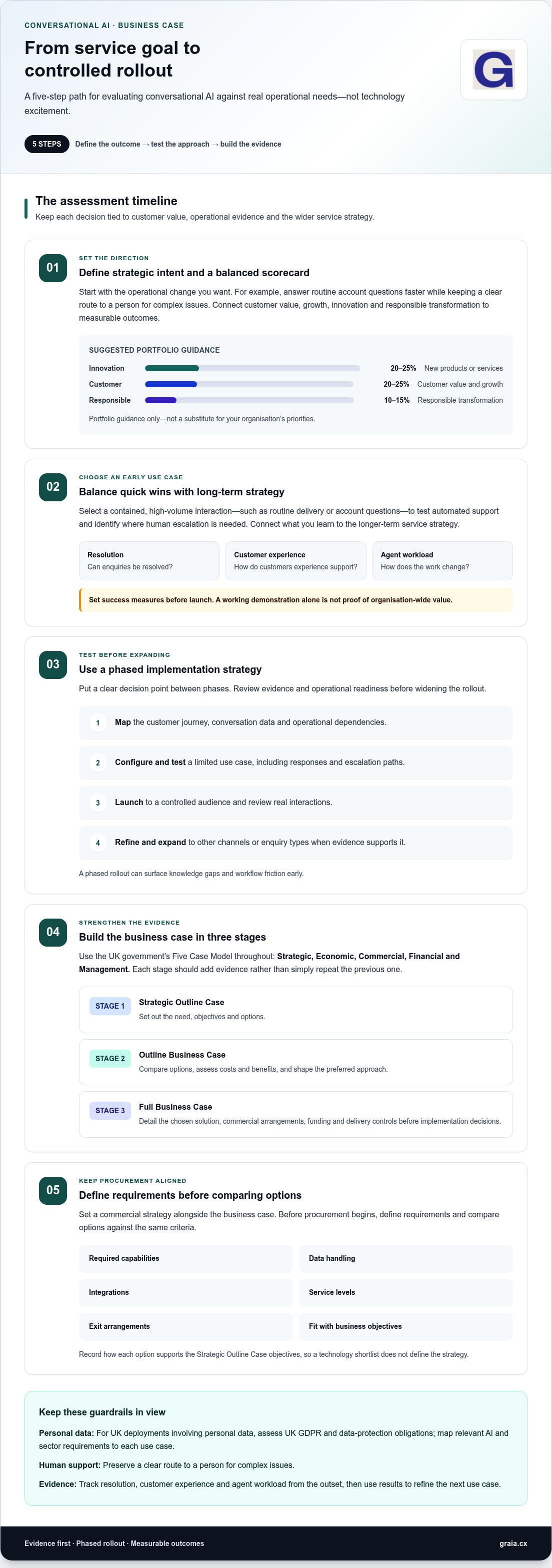
Define the operational change you want before selecting a chatbot use case. For example, target faster answers to routine account questions while preserving a clear route to a person for complex issues. Use a balanced scorecard to connect customer value, growth, innovation and responsible transformation to measurable outcomes. Its suggested allocations are 20-25% of AI portfolio initiatives for innovation and new products or services, 20-25% for customer value and growth, and 10-15% for responsible business transformation. Treat these as portfolio guidance, not a substitute for your organisation’s priorities.
-
Balance Quick Wins With Long-Term Strategy
Choose a contained, high-volume interaction for an early use case, then connect its results to your longer-term service strategy. A chatbot that handles routine delivery or account questions can test whether customers use automated support and show where conversations need human escalation. Set success measures before launch, including resolution, customer experience and agent workload. A working demonstration is not proof of organisation-wide value. Use its findings to refine the next use case and future operating model.
-
Choose a Phased Implementation Strategy
Plan implementation in phases, with a clear decision point between each one. Start by mapping the customer journey, conversation data and operational dependencies. Then configure a limited use case, test responses and escalation paths, and launch it to a controlled audience. Review real interactions before expanding to other channels or enquiry types. This approach surfaces knowledge gaps and workflow friction early, while keeping rollout focused on the strategic outcome rather than automation for its own sake.
-
Build the Business Case in Stages
Develop the case using the UK government’s Five Case Model: Strategic, Economic, Commercial, Financial and Management. Begin with the Strategic Outline Case, setting out the need, objectives and options. Use the Outline Business Case to compare options, assess costs and benefits, and shape the preferred approach. Complete the Full Business Case before implementation decisions, detailing the chosen solution, commercial arrangements, funding and delivery controls. Each stage should strengthen the evidence, not simply repeat the previous document at greater length.
- Set a commercial strategy alongside the business case. Before procurement begins, define the required capabilities, data handling, integrations, service levels and exit arrangements. Compare options against the same requirements, and record how each supports the Strategic Outline Case objectives. This keeps procurement decisions tied to business value and stops a technology shortlist from defining the strategy.
AI project implementation and operating costs
Building a business case for conversational AI requires a complete cost model covering setup, transition and ongoing operations. Separate one-off implementation work from recurring platform and staffing costs so decision-makers can see what drives the total cost of ownership.
-
Identify Implementation and Operating Costs
List costs by project phase, from data preparation and integration to configuration, testing and launch. Add recurring items such as platform operation, maintenance, monitoring, security reviews and content updates. Gartner research indicates that data preparation and integration typically consume 50-65% of AI project resources. Treat these activities as core delivery work, with dedicated budget and ownership, rather than incidental technical tasks.
-
Assess Transition and Organisational Change Costs
Map how new workflows will affect roles, training and customer interactions before estimating transition effort. Agents, for example, may need time to learn escalation procedures and use AI-generated guidance confidently. Include manager coaching, process redesign, staff communications and temporary disruption to productivity. Don’t assume existing costs disappear immediately: established and redesigned processes may need to run in parallel during rollout.
-
Summarise Business Costs
Bring implementation, transition and ongoing expenses into one structured view, separating cash expenditure from staff time and operational impact. Show when each cost occurs, who owns it and which assumption underpins it. For example, distinguish launch integration work from continuing content maintenance. A shared cost model helps finance and operations leaders challenge assumptions and identify omissions before comparing expected benefits.
- Model workforce costs using evidence from your organisation. The example business case uses staff turnover of 8% per annum per annum, equivalent to approximately 40 employees per year. Use these figures as an illustrative scenario, then calculate your baseline from actual turnover and replacement costs rather than applying an example mechanically.
- Include disengagement alongside recruitment and operating expenditure. The example business case cites Gallup’s estimate that disengaged employees cost organisations 34% of salary in lost productivity. Treat these as modelled outcomes, not guaranteed savings. A disciplined approach to building a business case for conversational AI makes the assumptions behind such projections visible.
For a structured perspective on platform and service design, explore conversational AI insights alongside your internal cost model.
Department adoption and communicating results
Adoption depends on how each department’s workflows change, not simply on access to a tool. Connect team feedback and performance measures to the rollout plan so results inform the next decision.
-
Plan Department Adoption
Map how customer service, operations and IT will use conversational AI, and assign an owner in each department. Customer service might review handovers, for example, while IT manages system access and data connections. Explain how the new workflow supports agents, and make time for practice with realistic customer interactions. Don’t announce a launch without giving affected teams a way to raise issues and shape the process.
-
Set KPIs for Adoption and Outcomes
Define measures before deployment, separating staff adoption from customer and operational outcomes. Track whether employees use the system in relevant workflows, alongside successful resolution, escalation patterns, response times, customer feedback and agent workload. Compare results with a baseline for the same interaction types. A high resolution rate can mislead if customers repeat enquiries or agents have to correct incomplete answers.
-
Map ROI Horizons Across Adoption Stages
Match expected returns to the maturity of the initiative. The business case places early returns at 0-12 months Experimenting and Early Adopting Stage, followed by 1-2 years Adopting and Optimising Stage. It places returns from wider transformation and scaling at 2+ years Transforming and Scaling Stage. Use these horizons to distinguish early operational learning from returns that depend on broader adoption and optimisation.
-
Communicate Results
Give department leads, finance and executives a shared view of progress, tying each measure to an agreed business objective. Show the baseline, current result, customer impact and operational effect together. For example, report whether fewer routine enquiries reach agents while customer feedback remains positive. Include barriers and corrective actions: a report showing only favourable results won’t support sound decisions about expansion.
-
Connect Feedback to Decisions
Turn employee and customer feedback into specific changes to workflows, content or escalation rules. If agents repeatedly flag an unclear handover, review those interactions and adjust the process before expanding the use case. Record the change and its effect against the relevant KPI. This feedback loop shows teams how their input shapes decisions and gives leaders evidence for the next stage of adoption.
Economic appraisal, cost-benefit analysis and optimism bias
Calculate ROI by comparing net benefits with total project costs. Calculate total cost of ownership by adding implementation and ongoing costs across the appraisal period. Key risks include poor data quality, incorrect responses, weak escalation paths, integration problems and low staff adoption.
-
Conduct an Economic Appraisal and Cost-Benefit Analysis
Compare each option’s costs and benefits across the same appraisal period. Include direct expenditure, staff time, transition effort and operational changes, then assess benefits such as reduced handling effort, improved service access or revenue opportunities. The Economic Case should include cost-benefit analysis and optimism bias adjustments. Test assumptions against operational evidence, and don’t count every released staff hour as a cash saving or treat every projected benefit as certain.
-
Estimate Financial Benefits and Return on Investment
Translate operational outcomes into financial effects only when the link is clear. For example, estimate the value of agent time freed by resolving routine enquiries, then distinguish redeployed capacity from reduced expenditure. Show potential revenue uplift separately from cost savings to avoid counting the same benefit twice. Compare expected net benefits with the full project cost, and identify which assumptions have the greatest effect on profit.
-
Calculate ROI and Total Cost of Ownership
Use a consistent formula: ROI equals (total benefits minus total costs) divided by total costs, expressed as a percentage. For total cost of ownership, add implementation, integration, data preparation, training, platform operation, monitoring, maintenance and optimisation across the chosen appraisal period. Use the same period and cost boundaries for every option. Keep assumptions visible, including the expected volume of eligible interactions and the share resolved without agent support.
-
Assess Scalability Benefits
Model how costs and benefits change as interaction volumes or channels expand. Automation may help teams handle more routine enquiries without increasing manual work at the same rate, but the case must include added data, integration and oversight needs. Compare a contained use case with a broader rollout, and identify the operational threshold at which expansion creates value. Don’t assume results from one department will transfer unchanged to another.
- Assign an owner to each benefit and define how analytics will measure it after launch. Set a baseline, record the data source and schedule reviews comparing actual outcomes with appraisal assumptions. The Management Case should include an evaluation plan in line with the Magenta Book. Use findings to update forecasts, investigate missed benefits and decide whether to optimise, expand or stop the initiative.
AI-powered customer service and conversational agents
Assess conversational AI as a customer-service capability by connecting each automation opportunity to an interaction, information source and outcome.
- Choose a customer need with a clear start and finish, such as checking an order’s status or explaining a returns process. Map the customer’s steps, the information required and where the interaction becomes complex. This shows whether automation can resolve the enquiry or should guide the customer to an employee. A narrowly defined use case gives you a clearer basis for evaluating service impact than a broad goal to automate support.
- Identify the source of every answer before designing conversations. A response about returns, for example, may depend on current policy, order details and delivery status. Assign an owner to each information source, then map how the conversational system will access relevant knowledge and connect with existing service workflows. Conflicting or outdated sources can lead to inconsistent guidance. Include content maintenance and clear ownership in the operating model.
- Measure completed interactions, not just conversations started. In some industries, chatbot conversation rates have been observed to reach up to 70%, but that figure isn’t a forecast for your organisation. Define what counts as a successful resolution, then track repeated enquiries, transfers to employees and customer feedback. For example, an order-status exchange should count as resolved only when the customer receives useful, accurate information without needing to restart the conversation.
- Assess how support through websites, apps and messaging platforms could improve service access. Map which enquiries suit those channels and define a clear handover for sensitive, unusual or unresolved cases. A straightforward policy question may suit automation, for example, while a disputed charge may need an employee who can understand context and respond with judgement.
- Evaluate the impact on customers and agents together. Review conversation samples for answer quality, missed intent and unnecessary handovers, then connect the findings to customer feedback and operational measures. Agent-facing support can also provide next-best-action suggestions during complex interactions, helping teams use customer context without removing human judgement. Use analytics to identify where the system needs better information or conversation design before adding enquiry types.
Explore conversational AI customer-service insights to develop your customer-interaction assessment.
GraiaCX: Conversational Agent
GraiaCX’s Conversational Agent helps organisations automate routine customer enquiries, putting business-case use cases and measures into practice. It understands intent and emotion, resolves routine interactions autonomously, and connects customers with human support when an enquiry needs further attention.
For a joined-up service model, the Agentic Omni-Channel Platform brings voice, chat, email and social messaging together with AI-driven automation. Agent Assist provides real-time suggestions, while Live Call Translation supports conversations in over 100 languages. These capabilities are relevant when your appraisal identifies opportunities to improve routine service, support agents through complex interactions or serve multilingual customers.
Explore how GraiaCX’s conversational AI offerings align with your service objectives, or contact GraiaCX to discuss your requirements.
Turn your case into a confident next step
Turn your assessment into a practical decision: identify the customer experience you want to improve, the teams involved and the evidence that will guide progress. Building a business case for conversational AI is more than an approval exercise. It creates a shared way to connect customer needs, operational priorities and technology choices as your organisation learns and adapts.
GraiaCX offers a Conversational Agent, Agent Assist and Live Call Translation. Consider how each could support the use cases and service outcomes in your business case, keeping human judgement central where interactions need it. A focused discussion can help translate your priorities into a suitable solution approach.
Contact GraiaCX to discuss your project and take the next step towards customer service that works better for customers and teams.
Frequently Asked Questions
What should a business case for conversational AI include?
Include the business need, options considered, expected costs and benefits, delivery approach, risks, governance and evaluation plan. For a UK public-sector-style structure, organise the case around the Strategic, Economic, Commercial, Financial and Management cases. Add decision owners and assumptions, such as which enquiries qualify for automation and what happens when the system can’t resolve one. This helps reviewers assess whether the proposal is viable, not just technically attractive.
What are typical conversational AI implementation and ongoing costs in the UK?
There is no single typical UK cost for conversational AI projects. Total cost depends on scope, data readiness, integrations, channels, testing, training, platform operation and ongoing optimisation. Build a project-specific estimate by separating one-off implementation work from recurring costs, then assign an owner and timing to each item. Include staff time as well as direct expenditure, and model different interaction volumes to understand how operating needs may change as usage grows.
What measurable benefits and KPIs can conversational AI deliver?
Conversational AI can support faster handling of routine enquiries, better service access and more consistent answers. Measure these outcomes through resolution without human intervention, repeat contact rates, escalation quality, response time and customer feedback. Track agent workload and employee use separately: customer-facing performance alone doesn’t show whether teams have adopted new workflows. Compare each measure with a pre-launch baseline and assess the same enquiry types for a meaningful comparison.
What data is needed to estimate conversational AI demand and business impact?
Use customer interaction records, enquiry categories, channel volumes, handling times, repeat contacts and escalation reasons to estimate potential demand. Add operational data on staffing, workflows, service outcomes and knowledge content, then identify which records are reliable and current. Customer feedback can reveal friction that volume reports miss. Combine these sources to estimate which interactions suit automation, what information they need and how changes could affect customer experience and team workload.
What are the steps to pilot and scale conversational AI?
Start with a defined use case, a baseline, success measures and a named operational owner. One example implementation plan allocates two weeks to planning, then proposes a one-month pilot involving 50 employees across teams. Use the pilot to test conversation quality, handovers, staff workflows and data connections. Review findings with participating teams, resolve issues, and expand only when evidence supports the next use case, channel or department.
How can businesses assess vendor security, integration and support requirements?
Define data-handling requirements, integration needs, service levels, security reviews and exit arrangements before procurement. Compare vendors against the same requirements and the relevant data-protection, AI and sector obligations for each use case.