
How migration costs and billing change with agentic CCaaS
Legacy contact centres hold service back when rigid systems make change slow, integrations fragile and customer journeys harder to manage. Migrating from a legacy contact centre to agentic CCaaS changes the cost model too: providers charge per seat, while usage and additional capabilities can affect the bill. The shift is not simply a switch from one platform fee to another; it calls for a clear view of migration work, ongoing use and the features your operation needs.
It’s understandable to expect a cloud platform to simplify service and spending, but costs can be harder to forecast if usage, integrations or essential legacy tools are overlooked. This article explains where older platforms constrain customer service, which migration risks to manage, and how to assess total cost of ownership, billing, integrations, privacy and AI governance. You’ll also see why a phased rollout and realistic view of agent workflows matter when moving towards a contact centre that can adapt as customer needs change.
Key Takeaways
- Set baseline measures for customer satisfaction and handling times so migration issues become visible before they affect service.
- Plan a phased rollout around real agent workflows, core routing needs and the integrations your operation relies on.
- Assess total cost of ownership by accounting for per-seat charges, usage and any additional capabilities, then monitor consumption to manage billing.
- Build privacy, security and AI governance into the migration, with clear boundaries for the tasks automated systems can complete.
- Identify where legacy technology slows change or limits service, then prioritise the improvements that matter most to customers and agents.
1. Effects of failed migration on customer satisfaction and handling times
A poorly planned migration can make familiar customer journeys slower, less consistent and harder to complete. A caller might have to repeat account details after a transfer, reach the wrong queue or lose context when moving from chat to voice. Each break adds effort for customers and agents. Audit the current contact centre before migration to identify these weak points and establish a comparison for the new platform.
Agentic CCaaS combines cloud contact-centre capabilities with AI agents that can understand requests and complete defined service tasks. Unlike legacy platforms, which often depend on fixed routing and scripted IVR flows, agentic systems can interpret intent and act across a customer journey. For example, an AI agent could handle a routine billing query, while an agent takes over when the request needs judgement or approval.
Start planning with real customer journeys, not a channel checklist. Map the steps for common requests, including authentication, routing, resolution and follow-up. Record where customers abandon tasks, repeat information or need human support. Then test those journeys on the proposed CCaaS platform with agents using realistic scenarios. A proof of concept can expose missing automatic call distribution (ACD) functions or integration gaps before they disrupt live service.
Set baseline measures before launch. Track customer satisfaction, handling time, containment, transfer rates and repeat contacts by journey, then compare the same measures after each rollout stage. A 20% reduction in handling time and a 15% improvement in customer satisfaction are examples of migration success metrics, not universal targets. Measure containment alongside customer outcomes, because automation that closes a contact without resolving the issue can conceal a poor experience.
Build staff training, clear customer disclosure and human escalation into the transition plan. Train agents on changed workflows and handovers, explain when customers are interacting with AI, and give them a clear route to a person when automation reaches its limits. In an AI-to-AI interaction, such as a customer’s assistant contacting a service agent, preserve the customer’s intent and context, and keep a human escalation path for exceptions.
Ombudsman Services handled over 40,000 calls per month before moving to a cloud-based contact centre, showing why journey continuity matters at scale. During migration, test authentication, routing, summaries and quality checks together, rather than treating each feature as an isolated change. Agentic AI can resolve routine requests autonomously, but defined approval boundaries and monitored outcomes help prevent faster handling from becoming a faster route to customer frustration.
2. Phased rollout, integrations and GDPR compliance
A phased rollout can limit disruption by moving one defined service journey before expanding across the organisation. Start with a channel or customer journey, such as voice or chat, while other teams remain on the legacy platform. A pilot can expose routing errors, integration failures and training gaps before wider deployment. Define rollback steps and assign ownership for each issue identified during the pilot.
Compare agentic CCaaS providers against the work your centre must deliver, not feature lists alone. Assess core routing, conversational AI, integration patterns, reporting and UK availability against your operating requirements. A provider comparison should also test whether agents can access the context they need across voice, chat and customer records. A proof of concept using real scenarios helps reveal differences between a polished demonstration and everyday enterprise workflows.
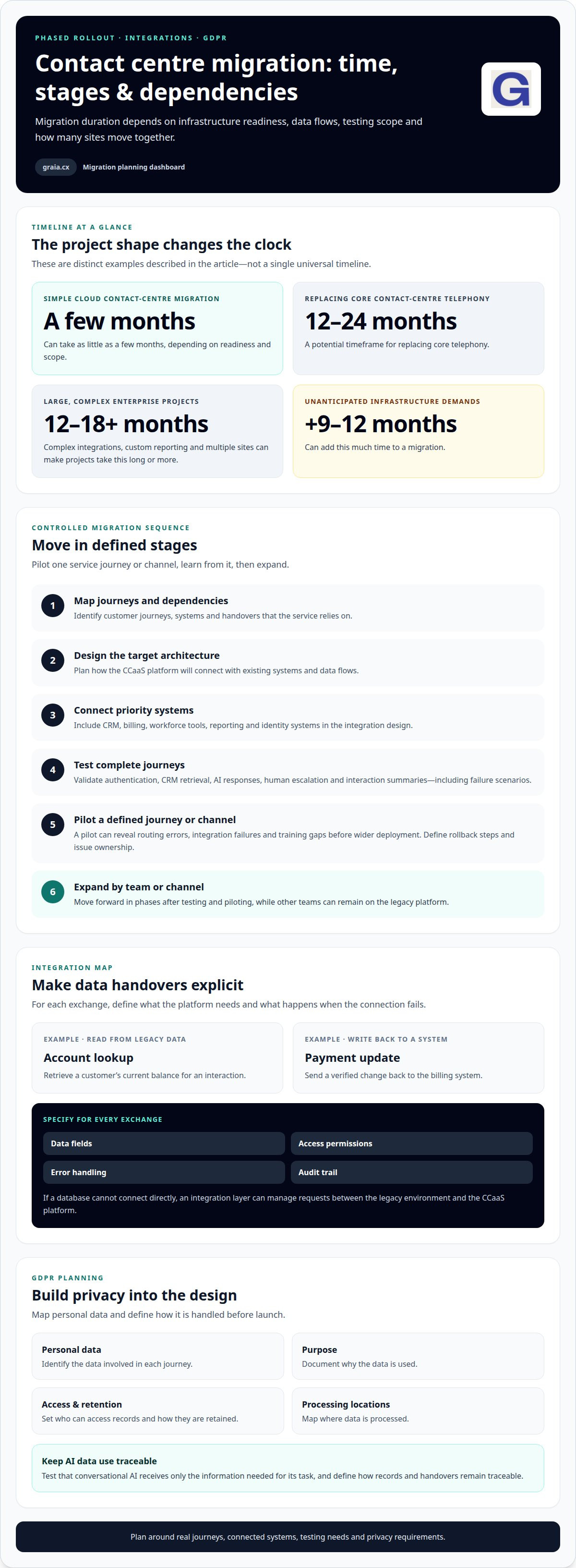
For on-premises databases, map which records the platform needs at each interaction step. For example, an account lookup might retrieve a customer’s current balance, while a payment update sends a verified change back to the billing system. Define the data fields, access permissions, error handling and audit trail for each exchange. If the database cannot connect directly, an integration layer can manage requests between the legacy environment and the CCaaS platform.
Migration steps should follow a controlled sequence: map journeys and dependencies, design the target architecture, connect priority systems, test, pilot, then expand by team or channel. Include CRM, billing, workforce tools, reporting and identity systems in the integration design. Replacing core contact-centre telephony can take 12 to 24 months. Large enterprise projects with complex integrations, custom reporting and multiple sites may take 12-18 months or more, while unanticipated infrastructure demands can add nine to 12 months.
Simple cloud contact-centre migrations can take as little as a few months. The timeline depends on infrastructure readiness, custom-built systems, data flows, testing scope and how many sites move together. Organisations should plan GDPR compliance alongside platform design by mapping personal data, purposes, access, retention and processing locations. Test that conversational AI receives only the information needed for its task, and define how records and handovers remain traceable.
During testing, validate the complete journey: authentication, CRM retrieval, AI response, human escalation and interaction summary. Include failure scenarios, such as a database timeout or a customer changing channels mid-request. A clear integration plan makes these handovers visible before launch and gives teams a practical basis for resolving defects. For more guidance on contact-centre migration planning, explore the related insights.
3. Total cost of ownership and usage-based billing
For organisations migrating from a legacy contact centre to agentic CCaaS, the business case needs more than a comparison of platform fees. Establish a total cost of ownership baseline covering seats, usage, integrations, support, analytics, routing and retained systems. Separate one-off migration work from ongoing operating costs. This helps show whether savings come from removing infrastructure, reducing manual work or changing how customer contacts are handled.
With seat-based charging, the number of enabled users can affect recurring expenditure. Usage can add another variable, so monitor contact volumes, interaction duration and automated task activity against the billing model. A seasonal rise in voice contacts, for example, may affect consumption even if staffing stays stable. Forecast different demand patterns and review actual use regularly to spot unexpected charges early.
Feature requirements matter too. Additional CCaaS capabilities may cost more than the basic platform, and replacing legacy call recording or workforce management can create overlapping costs. A contact centre might retain its existing recording system if it cannot transition cleanly. Include both systems in the cost model until the old tool can be retired, rather than counting its removal as an immediate saving.
Migration overruns often follow from assumptions about integrations, infrastructure and feature parity. Companies spend 14% more on cloud migration than anticipated. Reduce exposure by baselining required features, testing custom connections and separating essential launch needs from later enhancements. A billing-system integration, for instance, needs cost planning for design, testing and ongoing maintenance, not just the initial connection.
Labour savings depend on which tasks automation can complete and how often customers use it successfully. Increasing self-service fulfilment from 35% to 70% could cut around a third of call centre labour costs. Model this against your own task mix, escalation rates and workforce needs. Routine requests may shift to self-service, while complex cases still require skilled human support and appropriate staffing.
For more predictable budgeting, link financial measures to operational analytics. Track cost per resolved contact alongside containment, repeat contacts and transfers, so lower handling costs do not hide unresolved customer needs. Set a baseline before rollout, then review usage and actual expenditure after each migration stage. Automating simple routing enquiries may save agent time, while complex cases still need human support.
When migrating from a legacy contact centre to agentic CCaaS, model the transition and steady state separately. Include parallel running, staff training, data migration, integration work and retained legacy capabilities. Compare transition and sustainable operating costs over the same planning period. This gives finance and operations a shared view of the trade-offs and helps leaders decide which capabilities to migrate first.
4. Security, compliance and third-party AI governance
Security controls need to cover each point where customer data moves during the transition. Map data from telephony, CRM, recording and AI services, then identify who can access it and why. A migration security baseline recommends TLS 1.3 encryption in transit and AES-256 encryption at rest. Apply the same review to test environments, where copied customer records can otherwise create overlooked exposure.
Data sovereignty depends on where information is stored, processed and accessed. Document the locations used by the CCaaS platform and any third-party AI services, including subprocessors. For example, a voice transcript might pass from the contact centre platform to an AI model before an agent receives its summary. Map that flow and record the purpose, access controls and retention approach at each stage.
A UK GDPR review should examine how each customer journey uses personal data, rather than treating the platform as a single processing step. Trace a billing query from authentication through AI assistance, agent escalation and recording. For each action, document the data involved, its business purpose, authorised users and deletion process. This gives privacy, security and operations teams a shared view of the journey before deployment.
Set clear boundaries for third-party AI before an agentic system takes action. Define which tasks it may complete independently, which require customer confirmation and which need human approval. An AI agent might update an account after authentication, while a disputed payment could require an agent’s decision. Set escalation rules, test them against realistic cases and keep records of the system’s actions.
Use a controlled approval process for model changes. Record the model version, configured task, data inputs and test results before each release. If a supplier changes its model or processing arrangements, assess the effects on customer outcomes and security controls before deployment. Assign an internal owner to approve changes, review incidents and suspend an automated action if its behaviour falls outside agreed boundaries.
Security and service flexibility need to work together. Give AI services only the access required for their defined tasks, and separate read-only retrieval permissions from account-change permissions. Test failure scenarios such as an unavailable identity service, an inaccurate transcript or an unauthorised request. During the transition, monitor access logs, escalations and unusual actions. Use the findings to refine controls without weakening the human route for sensitive cases.
Before expanding a pilot, review evidence from security tests, privacy mapping and governance approvals. Confirm that encryption applies to relevant data flows, access permissions match job roles, and every automated action has an accountable owner. This makes compliance part of the deployment decision rather than a later correction, while giving teams a practical record of how customer information is protected.
5. Reasons to migrate from legacy contact centre platforms
Legacy platforms can constrain service because fixed infrastructure makes change slow. Some enterprise contact centres still rely on IVR systems and automatic call distributors deployed in the late 1990s or early 2000s. Ageing technology continues routing millions of customer conversations every day, while technical debt can consume 20% to 40% of development time. That leaves less capacity for improving customer journeys or adapting service to new demand.
Small changes can become operational projects. Updating routing flows or deploying IVR changes in legacy environments can take weeks, while a new call flow may be deployed in hours on a modern platform. Capital One reported that its previous contact centre system required three to six months to roll out new features. When a policy or customer need changes, that delay can leave agents working around outdated processes.
Capacity is another pressure point. Legacy contact centres can face logistical challenges when call volumes double or triple during seasonal peaks. Scaling physical infrastructure to meet that demand can be difficult. Cloud platforms can provide routing, IVR, analytics, workforce optimisation and integrations without on-premises infrastructure, giving operations teams more flexibility to respond to changing channel volumes and service patterns.
Agentic AI adds a further reason to modernise: it can complete defined tasks rather than only present information or follow fixed scripts. Gartner predicts agentic AI will autonomously resolve 80% of common customer-service issues by 2029. AI augmentation can also automate 30% to 50% of contact-centre processes, while supporting agents with routine work. These are forecasts and potential capabilities, not a substitute for testing against your own customer journeys.
Modernising a contact centre can give teams more flexibility to adapt service and automate some repetitive tasks. But it may not natively provide every legacy feature, such as voicemail, internal-agent call recording or comprehensive unified communications. Existing integrations and reporting may also need redesign. Prioritise the capabilities customers and agents rely on rather than assuming that every feature must be replaced one for one.
Start with the business constraint that creates the greatest service friction. If slow routing changes delay new journeys, test how quickly the target platform can adapt. If seasonal peaks strain infrastructure, assess how the new operating model handles demand. If repetitive tasks dominate agent workflows, identify which actions can be automated safely. Gartner also predicts agentic AI will drive a 30% reduction in operational costs by 2029, making a measured business case essential. Explore contact-centre migration insights to shape the next step.
GraiaCX: Conversational Agent
GraiaCX’s Conversational Agent can help organisations automate routine enquiries as they move beyond legacy contact centre workflows. It understands intent and emotion, can take action through customer systems, and escalates more complex interactions to human agents.
For a broader transition, the Agentic Omni-Channel Platform brings voice, chat, email and social messaging together. Agent Assist provides real-time support, including next-best-action suggestions, while Live Call Translation enables multilingual conversations in over 100 languages without requiring bilingual staff.
Consider GraiaCX when legacy routing limits service, routine contacts take up agent time or customers move between channels. Schedule a consultation to discuss your contact centre needs.
Turn your migration plan into a stronger service model
For organisations migrating from a legacy contact centre to agentic CCaaS, the next step is to turn strategic goals into a practical operating model. Decide which customer journeys should change first, where human judgement remains essential and how success will guide future deployments. This gives technology and operations teams a clear direction.
GraiaCX’s Conversational Agent, Agent Assist and Live Call Translation support different parts of the customer experience, from automated interactions to agent support and multilingual conversations. The right starting point depends on where your customers and workforce need the greatest improvement.
Bring your migration priorities and service challenges into a conversation with GraiaCX. Discuss your contact centre migration and take the next step towards a more adaptable customer experience.
Frequently Asked Questions
How do legacy contact centres hold you back?
Legacy systems can make service changes dependent on specialist technical work, slowing responses to customer needs. A team may struggle to update an IVR journey when product policy changes, for example, or agents may need to switch between separate screens to see customer context. These constraints affect service flexibility and staff workload. Map delays, workarounds and repeat contacts in your current operation to identify the strongest case for change.
What does agentic CCaaS cost in the UK, including migration and ongoing fees?
There’s no single UK price for agentic CCaaS because costs depend on the platform scope and operating model. The price depends on the case and is given after a quote request; relevant factors include seats, interaction volumes, selected AI capabilities, integrations, migration work and any legacy systems retained. Separate one-off transition costs from recurring charges in your budget. Then model expected usage and seasonal peaks, so financial planning reflects how your contact centre actually operates.
How can legacy CRM, telephony, workforce management and data systems be integrated with CCaaS?
Integrate systems by defining what information and actions must pass between platforms. For example, a CRM can provide customer context, workforce management can supply schedules, and telephony can carry voice interactions. APIs or an integration layer can connect systems, depending on their interfaces and architecture. Define data ownership, permissions, error handling and audit records for each flow. Test realistic cases, including unavailable systems, before expanding beyond a controlled pilot.
What UK GDPR, PECR and Ofcom requirements apply to AI agents in contact centres?
Assess UK GDPR, PECR and Ofcom considerations against the specific ways an AI agent handles customer interactions. Document the personal information used, its purpose, who can access it and how long records are retained. Review outbound contact practices, call recording and customer disclosures where relevant to your service. Map which communications activities fall within your organisation’s regulatory responsibilities, record decisions and assign owners for ongoing review as the AI’s tasks change.
What are the security, privacy, reliability and compliance risks of agentic contact centre AI?
Key risks include unauthorised access, exposure of sensitive information, inaccurate responses, service interruptions and actions outside approved boundaries. An AI agent connected to account systems, for example, needs tightly scoped permissions and a clear human escalation route when a request is ambiguous. Review supplier data flows, access controls, incident handling and service dependencies. Test failure cases before release, keep an audit trail of automated actions and monitor outcomes so teams can respond if behaviour changes.
How do leading agentic CCaaS providers compare on features, integrations and UK availability?
Compare providers on core routing, conversational AI, integration patterns, reporting and UK availability. Test them with real scenarios to check agents can access customer context across voice, chat and records.