
How AI Reduces Inbound Calls Through Better Routing
Voice AI can reduce inbound call volume by resolving routine enquiries and routing more complex requests to the right team. For mid-market businesses, reducing inbound call volume with AI can lower call volumes by 40%. The key is to address the reasons people call, not simply make it harder to reach a person.
High call volumes put pressure on teams and leave customers waiting. Reducing inbound call volume with AI is not just about automation. It means making the first interaction useful: resolving straightforward needs and directing other callers to the right support. This article explains how voice AI can handle common contact reasons, route callers appropriately and help prevent repeat calls. You’ll also learn why understanding customer journeys matters and how to assess whether AI fits your operation.
Key Takeaways
- Identify the contact reasons that drive routine calls, then automate straightforward enquiries while escalating exceptions to a person.
- Map customer journeys to uncover where unclear updates or unfinished service create avoidable calls.
- Use intent-based routing to direct each request towards the right support path instead of making callers navigate unnecessary menus.
- Reduce predictable follow-up calls by sharing timely updates through suitable channels, including planned outbound messages.
- Distinguish between requests for information and requests that require an action, so callers receive the right response first time.
1. How Does Voice AI Reduce Inbound Call Volume?
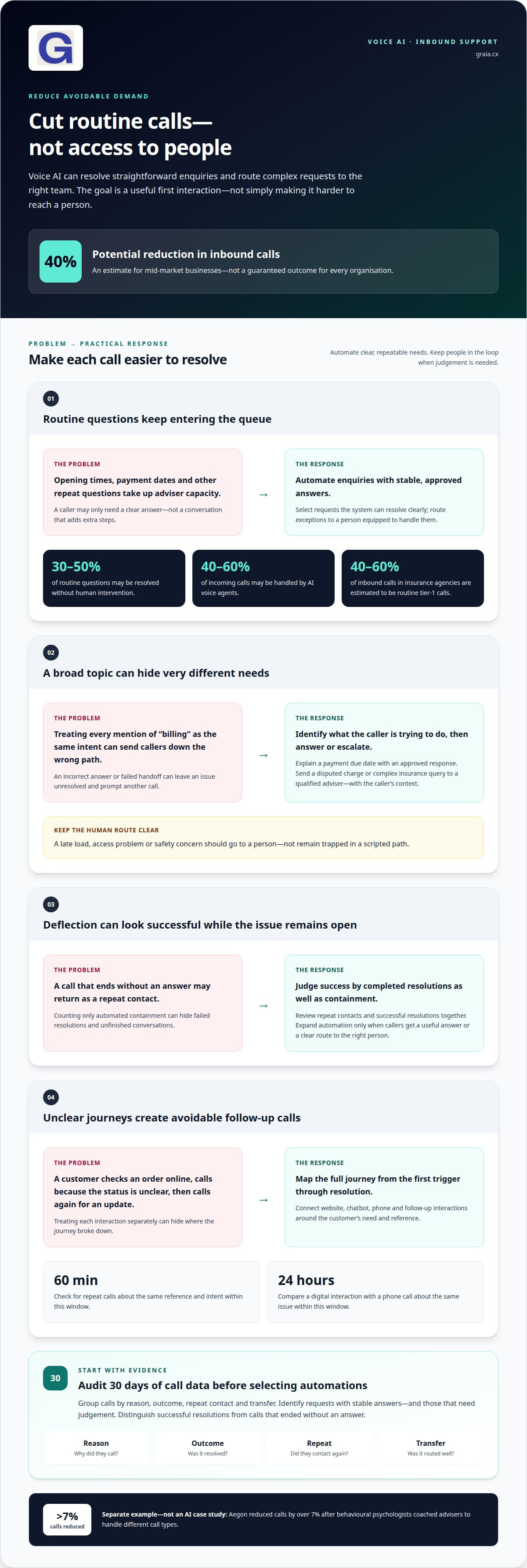
Voice AI reduces calls by resolving routine inquiries at first contact and routing exceptions to people equipped to handle them. For mid-market businesses, estimates suggest it can reduce inbound call volume by 40%. Automated voice systems can resolve 30 to 50% of routine questions without human intervention, while AI voice agents can handle 40 to 60% of incoming calls. These are potential outcomes, not a single result every organisation should expect. A sound approach to reducing inbound call volume with AI starts by selecting enquiries that automation can resolve clearly.
The distinction is the work behind each call. A caller asking for an opening time or payment date may need a clear answer; a disputed charge or unusual insurance claim needs careful review. An automated system can identify the intent, provide an approved response for routine billing or policy inquiries, and pass exceptions to an adviser with the caller’s context. In insurance agencies, 40–60% of inbound calls are estimated to be routine tier-1 calls that may be resolved without a human.
Before selecting automations, a provider should audit 30 days of call data. They can group calls by reason, outcome, repeat contact and transfer, then identify which requests have stable answers and which require judgement. The audit should also distinguish successful resolutions from calls that ended without an answer. This prevents operational targets from rewarding deflection while unresolved issues return to the queue.
Financial services offer practical examples. Reducing inbound call volume with AI could mean answering a routine question about a payment due date or explaining how to find a statement, then routing a suspected error or complex insurance query to a qualified team. The system should not treat every mention of “billing” as the same intent. The caller’s purpose and the information needed to resolve it determine whether automation is appropriate.
At a warehouse, callers may ask whether a vehicle can enter, where to report or how to check a delivery’s status. Voice automation can provide consistent door, gate and yard instructions or collect the details needed to route an exception. A late load, access problem or safety concern should go to a person, not remain trapped in a scripted path.
Results depend on the calls selected and the quality of the handoff. Aegon reduced calls by over 7% after behavioural psychologists coached advisers to handle different call types; this is a measurable example of call-demand improvement, not an AI case study. AI deflection also carries risks: incorrect answers can mislead callers, while failed handoffs can leave complex cases unresolved and prompt repeat calls.
For a controlled rollout, start with a narrow set of repeatable enquiries, define escalation triggers and review outcomes against repeat contacts and successful resolutions. Expand automation only where callers receive a useful answer or a clear route to the right person.
2. Understanding contact reasons and mapping customer journeys
Reducing calls starts with understanding why customers contact support. Map the journey from the first trigger through resolution, including any website visit, chatbot exchange, phone call or follow-up. For example, a customer may check an order online, call because the status is unclear, then call again for an update. Treating these as separate interactions can hide a broken journey.
Contact reasons should describe what the customer needs, not just which team answered. Tag call records by intent, such as changing an appointment, checking a claim, querying a payment or reporting a delivery problem. Comparing those tags with outcomes helps distinguish a resolved request from a transferred call or unfinished conversation. Advisor input can also reveal repeat reasons that call codes miss.
First-call resolution matters because successful containment is not the same as a completed answer. Track calls resolved without a later contact alongside repeat calls about the same reference and intent within 60 minutes. Also compare a digital interaction with a phone call about the same issue within 24 hours. That sequence can signal that self-service delayed demand instead of resolving it.
A useful measurement set combines containment, repeat contact and operational throughput. Containment shows which requests end in automation; repeat-call rates show whether customers still need help; throughput shows whether work moves through the service journey. Read the measures together. If containment rises while repeat contacts also rise, the automated path may end too early or miss information needed to resolve the request.
After introducing digital self-service, compare contact rates for matching intents before and after the change. Also examine whether customers switch channels, contact support again about the same reference or reach a person without having to repeat details. A customer who checks a claim online and then calls about its status needs a connected answer, not another isolated interaction.
Advisor training can improve the quality of resolutions as well as the accuracy of journey maps. Aegon reduced calls by over 7% after behavioural psychologists coached advisers to handle different call types. Teams can use conversation reviews to identify unclear explanations, missed next steps and handoffs that cause another call. Conversational AI can support agents with next-best-action suggestions, while resolution quality remains central to performance review.
Assess UK GDPR, PECR and Ofcom requirements in the context of each interaction, including the data involved, whether a message is marketing and the communication channel. Build this review into journey mapping rather than assuming one rule applies identically to every call and chatbot exchange.
For a practical view of how customer conversations connect across channels, explore contact-centre and AI insights.
3. Conversational AI and intelligent call routing
Conversational AI handles spoken requests by interpreting intent, asking relevant follow-up questions and responding to routine needs. Unlike a fixed menu, it can use a caller’s answer to guide the next interaction. IBM’s report says chatbots can resolve up to 80% of routine customer questions. That figure describes routine enquiries, not every complex or sensitive call.
For healthcare, a chatbot can answer basic patient enquiries, such as how to prepare for an appointment or where to find a clinic’s opening information. Accenture research found that 64% of patients are open to using AI for basic healthcare interactions. A virtual agent can respond to common questions, then direct symptoms, urgent concerns or unclear requests to a human. Clinical judgement stays with the appropriate professional.
AI chatbots can offer immediate answers to routine questions, while IVR systems guide callers through predefined menu choices. Human agents remain essential for complex cases, exceptions and situations requiring empathy. Forrester found that 75% of customers believe it takes too long to reach a live agent, so routing should reduce friction, not create another barrier. Most IVR systems add 2 to 4 minutes of menu navigation before callers reach a person.
Professional routing begins by matching each intent to a suitable outcome. A provider can configure pathways for account questions, appointment changes or delivery updates, with escalation when the system cannot identify the request or complete it. During service disruptions, early communication and intelligent routing can handle 50 to 60% of calls. Clear messaging matters: callers need to know what the system can do and how to reach human support.
For overflow, a provider can pilot voice automation on one line or during a defined high-demand window before extending it. A warehouse pilot plan routes overflow or all inbound calls to voice AI during the 6–9 a.m. gate-open window in its third week. A phased rollout lets teams evaluate whether the routing handles real requests and whether exceptions reach the right staff. Businesses should train and test the system for accurate responses before broader implementation.
AI virtual agents can connect with UK phone systems and contact-centre software through an implementation designed around existing call flows and tools. Connecting CRM or other records can provide relevant customer context and support more coherent handoffs; the integration depends on the systems and workflow. Test call transfers, context passing and failure paths before launch. During a pilot, review routing outcomes and conversations, then adjust intents, prompts and escalation rules based on callers’ needs.
4. Can voice AI reduce repeat inbound calls?
Yes, when it answers the question that would otherwise bring someone back. Shipment enquiries show the pattern clearly: a caller checks an ETA, receives no useful update, then calls again. Four callbacks about the same reference number are a warning sign of warehouse call-volume pressure. That pattern points to an information gap, not simply a need for faster call handling.
Identify predictable status enquiries and design outbound updates around them. One planned outbound touch typically prevents one to three unplanned inbound interruptions. For example, a timely message about a delayed delivery can explain the new status and next step. If the shipment’s position changes, keep the information accurate: an outdated ETA can trigger another call.
Useful updates address the reason for contact. For a delayed load, a message can give the current status and explain where the customer can follow the case. A continually updated issue log gives customers a place to check progress without calling for each update. Where an SMS template suits the journey, use it to deliver a concise notification and direct the customer to relevant information.
Not every inbound call needs the same route. Segment demand by intent, such as ETA requests, delay reports, access problems, appointment changes or urgent exceptions. Automation may answer a routine status enquiry, while a damaged delivery or time-critical yard issue may need direct handling by an agent. Intent-based segments keep routine conversations moving without burying urgent cases.
Measurement should connect the message to the subsequent contact. Providers can compare calls about the same reference and intent before and after an update, then check whether customers still call about the unresolved issue. A digital message followed by a call about the same issue within 24 hours indicates that the interaction delayed demand rather than reducing it. Falling call counts alone do not prove that customers received resolution.
A practical provider-led process starts by matching common call reasons with reliable status information. The provider then creates messages for known events, such as a delay, and defines what happens when the information is unavailable or the customer needs help. Each message should offer a clear path for exceptions, rather than leaving callers with a status notification and no way forward.
After launch, review repeat calls by reference, intent and outcome. If ETA calls decline but delay complaints persist, the update may be timely but incomplete. If customers call after receiving a message, examine whether it answered their question or explained the next step. This analysis helps refine outbound communication while keeping a human route available for issues automation cannot resolve.
5. Distinguishing informational requests from actions
Classify each conversation by its intended outcome: getting information, changing an account, making a booking or seeking human judgement. “What time does the branch close?” needs an answer; “change my appointment” requires an action. That distinction determines whether automation can respond immediately or should guide the customer through a controlled process.
AI chatbots and voice agents work best with routine queries that have clear, approved answers. Examples include opening times, payment dates, delivery instructions or where to find a statement. Map these intents to reliable information and test whether the system recognises different ways customers phrase the same question. Unclear wording should prompt clarification, not a confident guess.
Actions need a different pathway. Updating a delivery address, changing an appointment, or disputing a transaction may affect a customer record or trigger work elsewhere. The provider identifies what information the process requires, which system or team completes it, and what confirmation the customer should receive. If the request cannot be completed, the interaction should explain the next step rather than imply success.
Intent alone is not enough. A caller asking about a payment could want the due date, need to report an incorrect charge or request a payment arrangement. Design follow-up prompts that distinguish these outcomes. For example, asking whether the customer needs information or wants to challenge a charge can route the conversation more precisely.
Providers also define boundaries for sensitive or ambiguous conversations. A chatbot can explain where to find an insurance document, while a disputed claim may need an adviser to review the circumstances. A voice agent can collect the reason for contact and pass relevant context onwards. It should not present an informational response as a completed account action.
Testing should cover ordinary requests and exceptions. Providers can assess sample conversations for correct intent recognition, useful answers, successful completion and appropriate escalation. A test set might include a clear question about a statement, a request to change an appointment, and a customer who changes their mind mid-conversation. These examples reveal whether the digital journey handles real language and changing needs.
After launch, providers can review conversations that ended without resolution and identify where classification failed. If customers repeatedly ask for a person after requesting a simple answer, the prompt or knowledge content may be unclear. If an action appears complete but generates another contact, the handoff or confirmation needs attention. These checks keep automation focused on outcomes, not just shorter queues.
For practical guidance on shaping customer conversations around clear outcomes, explore digital customer-service insights.
GraiaCX: Live Call Translation
GraiaCX offers Live Call Translation for organisations supporting customers who speak different languages. It enables multilingual support across over 100 languages without the need for bilingual staff. This can help teams keep complex conversations accessible when a customer’s request needs human attention rather than an automated answer.
For routine enquiries, GraiaCX’s Conversational Agent can help customers directly, while Agent Assist supports agents in real time. The Agentic Omni-Channel Platform brings voice, chat, email and social messaging together with AI-driven automation. These capabilities support a service model that routes straightforward requests efficiently while preserving human help for more nuanced cases.
Contact GraiaCX to discuss how Live Call Translation could support your customer conversations.
Turn call demand into a better service journey
Treat call demand as a signal, not simply a queue to shrink. Choose a customer journey where the need is clear, the outcome can be measured and a helpful handoff is possible. This gives your team a practical starting point for reducing inbound call volume with AI while keeping service quality at the centre.
GraiaCX’s Conversational Agent can address routine enquiries, Agent Assist supports agents during customer interactions, and Live Call Translation enables multilingual conversations. Together, these capabilities help create a service model that balances efficient automation with human understanding.
Start a conversation about the customer journeys you want to improve. Contact GraiaCX to discuss voice AI and consider the next step towards more purposeful, responsive service.
Frequently Asked Questions
How Does Voice AI Reduce Inbound Call Volume?
Voice AI can resolve routine enquiries or direct callers to the appropriate support path, reducing avoidable agent-handled interactions. It can answer questions such as how to access an account statement while recognising that a disputed payment needs human attention. GraiaCX’s Conversational Agent understands intent, resolves routine enquiries autonomously and escalates requests to people. The key is matching each task to an appropriate outcome, rather than treating every call as an automation opportunity.
Can voice AI reduce repeat inbound calls?
Yes, if it gives customers a useful answer or moves their issue towards resolution. For example, after a customer reports a billing error, a system can capture the relevant details and route the case with conversation context. If the issue remains open, an accurate update can prevent a call made only to ask what happens next. Review repeat contacts alongside completed outcomes, so fewer calls do not mask unresolved problems.
How Can Mid-Market Businesses Get Started with a Voice AI Provider?
Start by choosing one customer journey to improve, such as delivery enquiries or appointment changes. Define the desired outcome, the information the system may use and when a human should take over. Then test real examples, including unclear requests and exceptions. A focused starting scope helps assess the customer experience and operational fit before extending automation to other journeys.
How Can AI Platforms Help Prevent the Backlog Spiral Before It Starts?
AI platforms can handle suitable routine interactions and help teams prioritise requests that need human attention. For example, an incoming service issue might generate many questions about account access, while urgent cases still need prompt review. Routing each interaction by intent can protect agent capacity for complex work. Teams should also watch for emerging contact reasons and update customer information as issues develop, rather than waiting for unresolved enquiries to accumulate.
How Can a Provider Reduce Call Volume Without Making It Harder for Customers to Reach You?
Automation should be a useful route, not a barrier. Customers need a clear way to request human support when the system cannot answer, an issue is sensitive or an action fails. For example, a caller disputing a transaction should not be forced through repeated automated prompts. Review customer feedback, abandoned interactions and escalation outcomes together to see whether the automated journey is genuinely helping.
How can AI reduce inbound call volume for customer service teams?
AI can handle common questions across supported channels while supporting people who manage more involved cases. GraiaCX’s Agentic Omni-Channel Platform combines voice, chat, email and social messaging with AI-driven automation. This can help customers receive consistent responses as they move between channels. For instance, a customer who starts with a digital enquiry can continue through another supported channel without treating each interaction as unrelated.
How Can Businesses Work with a Provider to Implement AI That Deflects Calls While Preserving a Good Customer Experience?
Work with the provider to set clear boundaries for automated answers, customer actions and escalation. Supply accurate, approved information and identify what a successful interaction looks like for each journey. Test situations such as incomplete details, an unexpected request and a failed system action. GraiaCX’s Conversational Agent can resolve routine enquiries and escalate to human agents, helping teams design automation around both completion and a clear handoff.
How Should a Provider Measure Call Deflection, Resolution Rates, Customer Satisfaction and Cost Savings?
Measure these outcomes together rather than treating fewer calls as success on its own. Call deflection tracks interactions handled without an agent; resolution measures whether the customer’s issue was completed. Customer satisfaction captures the experience, while cost analysis compares operational resources used before and after implementation. Segment results by contact reason and channel, then investigate cases where deflection rises but resolution or customer feedback declines.