
Handling Unexpected Call Surges: A Resilient Contact Centre Playbook
A sudden call surge doesn’t have to become a customer-experience crisis. Handling unexpected call surges effectively means recognising demand early, matching capacity to the enquiries coming in and helping customers find the right kind of support before long waits undermine their confidence.
Longer waits frustrate customers, while repeat enquiries can consume the time agents need for complex or sensitive conversations. Simply adding capacity or automating every interaction is rarely the answer. A stronger response coordinates both, with clear priorities, useful updates and an easy path to human support.
This playbook explains how to identify surge triggers and early warning signals, respond across automation, routing and live teams, and adapt capacity without losing empathy. GraiaCX’s Conversational Agent can resolve up to 80% of routine inquiries autonomously, while escalating to human agents when judgement or personal support is needed. Context carried into the handoff helps customers continue the conversation without starting again. The principle is simple: Empower the Human. Elevate the Experience.
Key Takeaways
- Define a surge as a gap between incoming demand and available service capacity, then assess its effects on waits, workload and resolution quality.
- Spot changing demand by tracking queue growth, wait trends, abandonment, repeat contacts and shifts in call reasons against your usual patterns.
- Make handling unexpected call surges a coordinated decision: direct suitable routine requests to automation and protect live-agent capacity for complex or sensitive needs.
- Use a clear playbook to assign responsibility for monitoring, customer updates, routing choices and agent support, then review what happened after the surge.
- Coordinate interactions across voice, video, chat, email and social messaging to give customers a more consistent experience across channels.
Why handling unexpected call surges requires more than adding agents
An unexpected call surge occurs when incoming demand outpaces the contact centre’s available service capacity. The gap may last minutes or persist through a major incident, but its effects reach beyond a growing queue: customers wait longer, agents face heavier workloads and there is less time to resolve each issue carefully. Confidence can erode when people can’t get timely help or a clear explanation of what is happening.
Adding agents may help if extra capacity is available and ready, but it rarely solves the whole problem on its own. Moving people into a live queue takes coordination, and agents who are new to the issue may need clear guidance. Meanwhile, if many callers are asking the same routine question, assigning every contact to a person can leave complex cases waiting behind repeatable work. A resilient response considers the cause and type of demand, not just headcount.
What makes a call surge different from normal peak demand?
Normal peaks are patterns a team can plan around, such as a predictable rise at a known time of day or during a recurring business cycle. A surge is an abrupt shift: contact volume rises unexpectedly, call reasons change, or both happen together. A service disruption, for example, can prompt many customers to call about the same issue, sometimes more than once if they can’t find a clear update or resolution.
That is why queue size alone can mislead. Two queues of similar length may represent very different demands: one might contain straightforward status enquiries, while another is dominated by urgent or complicated cases. Understanding call center operations means looking at how contacts arrive and what support they need, as well as how many are waiting. Leaders should consider volume, changing reasons for contact and the level of help each caller needs.
Which customer and agent outcomes are most at risk?
Waiting is harder to tolerate when customers don’t know whether their issue is recognised or what to do next. Without useful, timely updates, uncertainty can compound frustration and encourage people to try another channel or call again. That creates additional demand without necessarily moving the original issue closer to resolution.
Pressure affects agents, too. When the queue keeps growing, the pace can leave less time to listen, investigate and explain options, especially in complex or sensitive conversations. Rushed handling can lead to incomplete answers, which may prompt repeat contacts and put further strain on capacity.
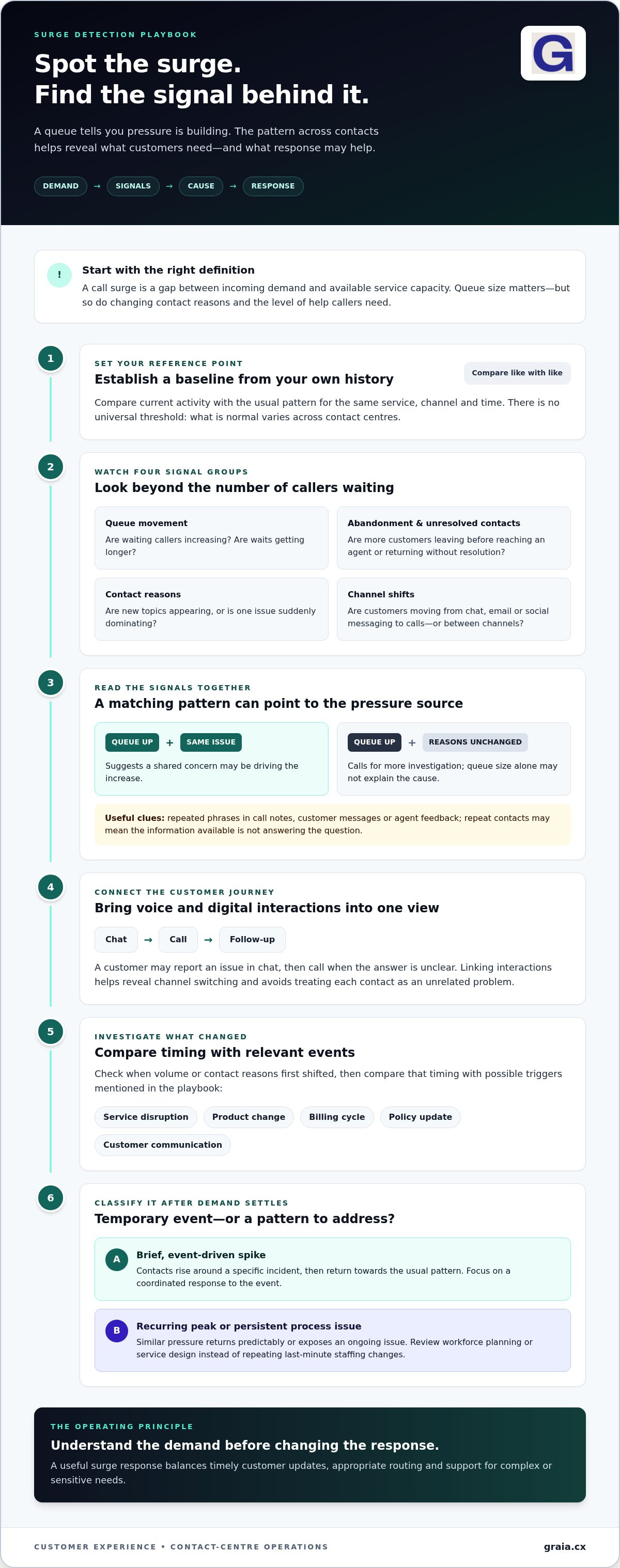
To decide whether a spike is a one-off event or a pattern that needs a lasting change, review what happened after demand settles:
- Brief, event-driven spike: Contacts rise around a specific incident, then return towards the usual pattern.
- Recurring peak: Similar pressure returns predictably or exposes a persistent process issue, suggesting workforce planning or service design may need attention.
The distinction matters. A temporary spike calls for a coordinated response; a recurring one calls for learning and adjustment, not simply repeated last-minute staffing.
How to spot an incoming call surge and understand its cause
Early warning rarely comes from one metric. A growing queue may signal rising demand, but repeat contacts or a sudden shift in call reasons can reveal why pressure is building. To handle unexpected call surges effectively, leaders need to read these signals together, compare them with normal patterns for the same period and investigate before changing routing or customer messages.
Set a baseline using your own contact-centre history rather than relying on a universal threshold. Normal patterns vary by service, channel and time. Watch for meaningful changes in:
- Queue movement: Is the number of waiting callers rising, and are waits lengthening?
- Abandonment and unresolved contacts: Are more customers leaving before reaching an agent, or returning without a resolution?
- Contact reasons: Are new topics emerging, or is one issue suddenly dominating conversations?
- Channel shifts: Are customers who started in chat, email or social messaging now calling, or moving between channels to get an answer?
Which signals can warn contact-centre leaders early?
Look for signals that reinforce one another. A queue increase alongside more callers asking about the same service issue suggests a different response from a queue increase with no change in contact reasons. Repeated phrases in call notes, customer messages or agent feedback can reveal a shared concern. Repeat contacts may indicate that the information available to customers isn’t answering their question.
Bring voice and digital interactions into the same view where possible. A customer may report an issue through chat, then call when the answer is unclear. Viewed separately, those contacts can look like unrelated demand. Linking the journey helps teams recognise channel switching, avoid treating each contact as a new problem and build a clearer picture of customer need.
How can teams distinguish a symptom from the cause?
Start with timing. Compare the first change in volume or call reasons with relevant events, such as a service disruption, product change, billing cycle, policy update or customer communication. Timing can suggest a connection, but it doesn’t prove one. Ask supervisors to compare the pattern with what agents are hearing: Are customers describing the same obstacle? Are they confused by a message, unable to complete a process or seeking updates about an incident?
Before adjusting routing or publishing new messages, assemble related evidence into a concise incident picture. Record what changed, when it began, which channels and contact reasons are affected, and what customers say they need. This gives decision-makers a shared basis for action and reduces the risk of solving a visible queue problem while missing its underlying cause.
Once the immediate picture is clear, assign an owner to keep the signal review moving and share confirmed updates with the teams responding to customers. For more perspectives on connected contact-centre experiences, explore contact-centre insights and guidance.
Automation or live agents: choosing the right surge response
During a surge, the decision isn’t simply whether to automate or add people. The stronger approach is to match each customer need to the right kind of support. Self-service can make clear information available for straightforward questions; a Conversational Agent can understand intent and handle routine enquiries; live agents can focus on judgement, reassurance and complex problem-solving. A coordinated mix gives customers options while protecting human attention for conversations that need it.
AI doesn’t mean removing the human option. It should help manage repeatable demand and give agents more room to support customers who need personal care. GraiaCX’s Conversational Agent can resolve up to 80% of routine inquiries autonomously. That figure applies to routine inquiries, not every contact or situation. Clear escalation paths matter just as much as automated resolution.
Which inquiries are suited to automated resolution?
Automation is best suited to requests with a clear intent, reliable answer or defined action. Customers might need information about a routine process or help completing a straightforward account task. Where connected customer systems support it, a Conversational Agent can also take defined actions, such as updating account details or processing a refund. Set boundaries around what it can do, and route exceptions, uncertainty or unusual circumstances to a person.
Use a practical test: can the request be understood consistently, answered from approved information and resolved through a known process? If yes, it may be appropriate for self-service or a Conversational Agent. If not, avoid forcing the interaction through automation. A customer who has already tried a self-service route should have a clear way forward rather than being asked to repeat the same steps.
When should a conversation move to a person?
Escalate when a customer’s need is sensitive, complex, unclear or outside the defined process. Human support is also important when the customer requests it or when an automated interaction hasn’t resolved the issue. That judgement protects the relationship: efficiency should never come at the cost of making someone feel trapped in a system that can’t help.
A useful handoff carries context with it. A structured summary of the customer’s intent, steps already taken and unresolved question helps the live agent continue without asking the customer to start again. This reduces friction for the customer and gives the agent a clearer starting point. During a surge, it also helps distinguish a new enquiry from an unresolved one.
For a closer look at how real-time guidance and summaries can support agents, explore the AI agent assist tools guide. The principle is straightforward: automate where the process is clear, escalate where human judgement matters, and keep the transition between the two coherent. That balance makes handling unexpected call surges more responsive without treating every customer interaction as a task to contain.
A practical playbook for handling unexpected call surges
A surge response works best when people know what to do before pressure rises. Set clear ownership, act on verified signals, keep customer updates aligned across channels, then review what the event revealed. This turns a fast-moving situation into a coordinated response rather than a series of disconnected decisions.
What should teams do before and during a surge?
Use this sequence to prepare, respond and recover. Assign named roles in your operating plan so monitoring, customer messaging, routing and agent support don’t compete for attention or fall between teams.
- Prepare the response. Document likely triggers, who leads the incident, who can approve routing changes and who owns customer communications. Agree which customer needs take priority and prepare concise message templates that can be updated with confirmed facts. Reviewing the evolution of AI customer service platforms can help frame how automation and human support fit into a modern response.
- Detect and assess. The monitoring owner watches queue movement, waiting trends, unresolved contacts and changes in contact reasons. Share a brief operational picture with the response team: what is increasing, which customers are affected and what remains uncertain. Avoid treating one metric as the full story.
- Respond with care. The routing lead directs suitable, repeatable requests to automation while keeping a visible route to a person for complex or sensitive needs. The communications owner shares concise, accurate updates through the channels customers are using, including voice, chat, email or social messaging. Explain what is known and what customers can do next. Don’t promise a resolution time unless it’s confirmed.
- Support the live team. Supervisors share confirmed updates and relevant process changes with agents, gather what they’re hearing from customers and flag unclear or emerging issues. This feedback helps leaders refine routing and messaging without making rapid changes based on assumptions.
- Review and improve. Once demand settles, compare what happened with the plan. Identify which contact reasons drove demand, where customers switched channels, which needs remain unresolved and whether the response reduced confusion or created extra steps.
How should leaders review performance after demand settles?
Look beyond queue metrics. Review repeat contacts, handoff quality, agent observations and the clarity of customer-facing messages. Ask whether the right requests reached automation, whether customers could reach human support when needed and whether teams had the information to respond consistently. Update knowledge, workflows and ownership based on evidence, not assumptions. The guide to contact centre ROI with AI offers further context for assessing automation’s operational value.
Every surge can strengthen the next response. Explore GraiaCX’s contact-centre insights to build on your playbook with practical perspectives on AI and customer experience.
Build surge resilience with GraiaCX’s agentic contact-centre platform
Resilience depends on more than handling a sudden increase in calls. Customers may seek help through voice, video, chat, email or social messaging, and fragmented responses can add friction when they move between channels. GraiaCX’s agentic contact-centre platform brings these channels into a coordinated service experience, helping teams respond to demand while keeping the customer’s need at the centre.
How can GraiaCX support flexible capacity across channels?
GraiaCX’s Conversational Agent understands customer intent, takes actions through customer systems and escalates to a human when support is appropriate. It can resolve up to 80% of routine inquiries autonomously, helping manage repeatable demand while agents focus on conversations that call for judgement or personal attention. With GraiaCX’s Agentic CCaaS in production, teams can achieve 60%+ call containment.
That flexibility matters across channels. A customer might begin with a digital interaction and then call for help. Coordinating voice, video, chat, email and social messaging can help teams respond more consistently rather than treating every touchpoint as an isolated request. Automation can support clear, routine needs, while an escalation path keeps human assistance available for complex, sensitive or unresolved situations.
GraiaCX integrates with major contact-centre systems, with no rip-and-replace. This helps organisations build on their existing contact-centre environment while adding agentic capabilities to the surge response. The goal isn’t to automate every interaction. It’s to make capacity more adaptable and customer journeys more coherent.
How does the platform keep human support central?
When a conversation reaches an agent, context matters. Agent Assist provides real-time next-best-action suggestions, live coaching, AI-generated summaries and quick actions sourced from a knowledge base. These tools can help agents understand what has happened so far and consider a relevant next step, while leaving human judgement with the person handling the conversation.
During a surge, this distinction is important. Routine demand can be handled through automation where the request and process are clear; people can give their attention to nuanced needs that benefit from listening, explanation and care. Contextual escalation can also help customers continue from the point they reached, rather than repeating information after a handoff. That’s how technology can extend service capacity without making interactions feel impersonal.
For teams focused on handling unexpected call surges, the opportunity is to connect automation, channel coordination and agent support into one deliberate operating model. GraiaCX brings these capabilities together to help contact centres adapt their response as demand changes, while preserving a meaningful role for human expertise.
Empower the Human. Elevate the Experience.
Explore GraiaCX’s customer experience articles for practical guidance on building more connected, resilient service.
Make surge readiness part of everyday service
The next step is to turn your surge plan into a capability the team can use with confidence. Set a regular rhythm for reviewing contact patterns, updating response ownership and practising decisions across automation and live support. Each incident can reveal where customers need clearer information or agents need better context. Apply those lessons before the next pressure point arrives.
For organisations ready to put that approach into practice, the typical deployment timeline is 4-6 weeks. A more connected operating model can help teams adapt to changing demand while keeping thoughtful customer care at its centre. That’s the opportunity in handling unexpected call surges: not merely to absorb volume, but to build a service that stays responsive when circumstances change.
Explore GraiaCX’s customer experience articles for practical ideas to keep strengthening your approach. Resilience grows with every improvement, and your next step can start today.
Frequently Asked Questions
What causes unexpected call surges in a contact centre?
Unexpected surges can follow service interruptions, product or billing changes, confusing customer communications, promotional activity or seasonal deadlines. A single event may prompt enquiries across several teams: for example, a change to a delivery process could trigger questions about orders, account details and refunds. Some increases are short-lived; others expose a recurring source of customer confusion. Categorising the first wave of contacts helps leaders distinguish an isolated event from a problem that needs a lasting fix.
How can a contact centre predict a sudden increase in call volume?
No forecast can identify every surprise, but handling unexpected call surges becomes more proactive when teams combine historical patterns with a calendar of planned changes, campaigns and known service events. Compare current demand with the usual pattern for the same day and time, then watch for early movement in queue growth, repeat contacts or enquiry topics. Treat these as prompts to investigate, not proof of a surge. Agent observations can help confirm whether customers are reacting to the same issue.
Can AI handle a sudden call-volume spike without replacing human agents?
Yes. AI can take on clearly defined, repeatable tasks while human agents remain available for judgement, reassurance and exceptions. For instance, an automated agent might answer a routine question using approved information, then pass an unusual account problem to a person. Design the experience so customers can reach human support when automation can’t resolve their need. The goal is to distribute work appropriately, not remove people from the service journey.
What should agents do when call queues become overwhelmed?
Agents should follow the agreed incident guidance, focus on understanding each customer’s need and use approved information rather than improvising an answer. If an enquiry relates to a shared issue, they can record the relevant category or details so supervisors can identify patterns. They should explain available next steps clearly, avoid unsupported promises about timing and flag cases that need escalation. Supervisors can then share consistent updates and clarify priorities as the situation develops.
How can contact centres maintain customer experience during a call surge?
Give customers clear, consistent information and a useful next step, even if the underlying issue is still being investigated. Keep messages aligned across phone greetings, digital channels and agent guidance, and update them when facts change. Where a suitable self-service option exists, explain what it can resolve and how to reach a person if it doesn’t fit. A calm acknowledgement of the disruption can help customers feel heard, rather than left to guess what is happening.
Can an omnichannel contact centre help manage unexpected call surges?
Yes. An omnichannel approach helps teams understand how customers move between channels and avoid treating each interaction as unrelated. Someone might first send a message, then call because they need clarification. If agents can see the relevant context, they can respond without making the customer repeat the full story. Coordinated channels also help leaders share consistent information, while giving customers another suitable route to support when voice queues are under pressure.
How should leaders measure whether their surge response worked?
Compare the event with normal operating patterns and assess both service outcomes and customer effort. Review how queues and waiting trends changed, whether customers contacted the centre again about the same issue, and which enquiries remained unresolved. Add agent feedback and customer comments to explain what the numbers can’t show, such as confusing messages or difficult handoffs. Use the findings to refine guidance, routing and ownership, then check whether those changes address the cause of the disruption.
Schedule a consultation with GraiaCX to discuss how an agentic contact-centre platform can support your surge response.