
Evaluating Conversational AI Platforms: A Practical 2026 Guide
What if the most impressive conversational AI demo is the least reliable choice for your customers? When you’re evaluating conversational ai platforms, polished presentations can make fair comparisons difficult. The real test is whether a system can handle the workflows your team depends on.
That uncertainty is understandable. Feature lists don’t show how accurately a platform answers using approved information, when it should hand a conversation to a person, or whether its actions and integrations fit your requirements. Those details shape both customer experience and operational confidence.
This practical 2026 guide gives you a repeatable scorecard for comparing platforms against your workflows, governance needs and service goals. You’ll learn how to test accuracy, context, human handoffs and action-taking, then use the evidence to narrow your shortlist and plan a focused pilot. The aim is simple: choose based on demonstrated outcomes, not demo-day promises.
Key Takeaways
- Start by defining the service outcomes, contact reasons, channels and user groups your platform must support.
- When evaluating conversational ai platforms, compare how each handles grounded answers, permitted actions, fallback behaviour and human handoffs.
- Test reliability with realistic conversations, including edge cases and policy-sensitive scenarios, rather than relying on fluent demo responses.
- Verify integration support, privacy controls, audit trails and access requirements with the relevant technical and governance teams.
- Use a bounded pilot and agreed scorecard to turn test evidence into a defensible shortlist and a clear next-step decision.
Evaluating conversational AI platforms starts with the service outcomes you need
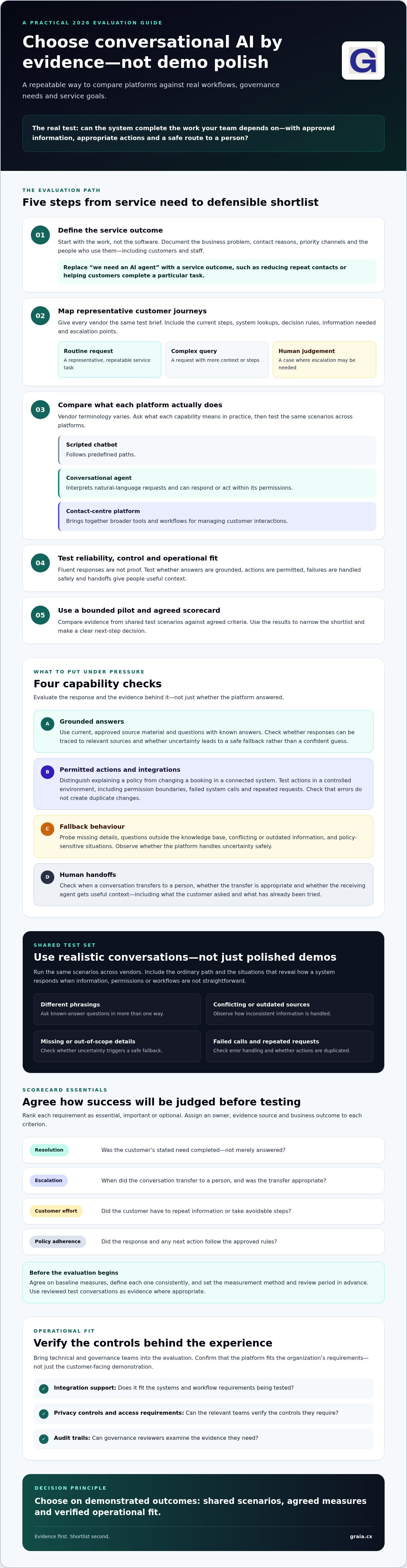
Start with the work, not the software. Evaluating conversational ai platforms means testing each platform against real service workflows and agreed measures of success, rather than treating a feature list or polished demonstration as proof. For useful background on the category, see this overview of Conversational AI.
Separate the technology request from the business problem. “We need an AI agent” is not an outcome. Reducing repeat contacts or helping customers complete a particular task may be. Document the contact reasons behind the request, the channels that matter and the people who use them, including customers and staff. This keeps a broad platform pitch focused on the service need it must meet.
A scripted chatbot follows predefined paths; a conversational agent interprets natural-language requests and can respond or act within its permissions; a contact-centre platform brings together broader tools and workflows for managing customer interactions. Vendors may use these terms differently, so ask what each capability means in practice.
Map the customer journeys before comparing vendors
Choose representative journeys: a routine request, a complex query and a case that needs human judgement. For each, record the current steps, system lookups, decision rules, customer information required and escalation points. Include voice or digital channels when they reflect actual service priorities. This map gives every vendor the same test brief, rather than letting each demonstrate unrelated strengths.
Turn goals into evaluation criteria
Before demonstrations, rank requirements as essential, important or optional. Give each criterion an owner, an evidence source and a business outcome. For example, the service lead may own resolution measurement, using reviewed test conversations as evidence; a policy owner may assess whether responses follow approved rules. For broader category context, read the AI customer service platform evolution guide.
Agree on baseline measures before testing, and define each one consistently so vendors can be compared fairly:
- Resolution: whether the customer’s stated need was completed, not merely answered.
- Escalation: when a conversation transfers to a person, and whether the transfer was appropriate.
- Customer effort: whether the customer had to repeat information or take avoidable steps.
- Policy adherence: whether the response and any next action followed the approved rules.
Set the measurement method and review period in advance. This turns the evaluation into a decision about service performance, risk and customer experience, not a contest between demonstrations.
Compare conversational AI architecture through grounding, actions and handoffs
Architecture matters when it changes what a customer experiences. A platform may produce a fluent response yet lack reliable grounding, appropriate permissions or a safe way to recover when a workflow fails. When evaluating conversational ai platforms, run the same scenarios across each vendor. Record not just whether the system responds, but what information and actions support that response.
Test knowledge retrieval and answer grounding
Prepare current, approved source material and questions with known answers. Include different phrasings, conflicting documents, missing details and questions outside the knowledge base. Check whether answers can be traced to relevant approved sources, whether outdated or contradictory information is handled sensibly, and whether uncertainty triggers a safe fallback instead of a confident guess. A vendor’s description of its retrieval approach is not a substitute for test evidence.
Assess integrations, actions and human handoffs
Separate an answer from an action. Explaining a booking policy is different from changing a booking through a connected system. Test actions in a controlled environment, including permission boundaries, failed system calls and repeated requests. Confirm that errors don’t create duplicate changes. Then test escalation: the receiving agent should have useful context, such as what the customer asked and what has already been tried. For a wider view of contact-centre scope, see the agentic CCaaS platform buying guide.
Check whether hybrid workflows combine natural-language interaction with deterministic steps where a process needs tighter control. The NIST best practices for AI evaluation provide context for building structured tests. Adapt your evaluation to your own service requirements and risk controls.
| Capability | Test evidence | Operational dependency | Unresolved risk |
|---|---|---|---|
| Grounded answers | Correct responses trace to approved sources | Maintained, accessible knowledge | Conflicting or missing content |
| Connected actions | Permitted changes succeed; failures are handled | Integration access and defined permissions | Duplicate or unintended changes |
| Human handoff | Context and interaction summary reach the agent | Configured escalation route | Lost context or unclear ownership |
| Hybrid workflow | Flexible dialogue follows required process steps | Clear rules and exception handling | Inconsistent handling of edge cases |
Use the unresolved-risk column to flag questions for technical and service owners, not to assume a vendor has solved them. For more practical perspectives on conversational AI and customer-service technology, explore the GraiaCX blog.
Can you trust a conversational AI platform? Test reliability and control
A fluent answer can still be wrong, unsafe or irrelevant to the customer’s request. Trust comes from how the platform performs in normal use and difficult exceptions, not from how confident it sounds. Reliability must be demonstrated across defined scenarios, not inferred from a live demo.
When evaluating conversational ai platforms, agree on acceptance criteria before testing. Score each scenario for correctness, task completion, policy adherence, escalation quality and consistency. Set risk-based thresholds with service and governance owners. A minor wording issue may be tolerable, while an unauthorised account change or missed escalation may be a stop condition. Record the criteria in advance so the same result is judged consistently across vendors.
Run repeatable tests beyond the vendor demonstration
Build a test set from representative service conversations. Remove personal information or protect it appropriately before use, and document the expected outcome for each case. Re-run scenarios with varied wording, incomplete details and changes in context to see whether behaviour holds. For every failure, capture the response, severity and whether it can be reproduced. This turns a one-off surprise into evidence the evaluation team can investigate and compare.
Verify guardrails, privacy and human fallback
Ask each vendor to explain how data is handled, whether it is used by models, how access and retention are controlled, and what audit records are available. Verify the answers against current product documentation and your organisation’s requirements. In a controlled environment, test attempts to override instructions, obtain prohibited information or trigger unsafe actions. Check that the system declines, asks for clarification or escalates appropriately rather than continuing as if the request were safe.
Include both straightforward and challenging conversations in the test set:
- Normal: Does the platform complete an in-scope request accurately?
- Edge case: Does it recognise missing or conflicting details and seek clarification?
- Adversarial: Does it resist instructions that conflict with its permitted role?
- Policy-sensitive: Does it follow the approved response, decline or route the case to a person?
Review results at conversation level, not just as an overall pass rate. A strong average can conceal a serious failure in a sensitive journey. Define which errors require a retest, which require a control change and which disqualify a platform from the shortlist. After adjustments, rerun the same scenarios to confirm the fix. Also verify that the receiving agent gets enough context to continue without asking the customer to start again.
Evaluate integration, governance and operational fit before shortlisting
A platform can perform well in a test and still be a poor fit if it can’t connect safely to the systems or processes your service relies on. Before shortlisting, map the required CRM, CCaaS, knowledge and workflow connections, then verify each integration’s current support status with the vendor. Treat compatibility as something to demonstrate, not assume.
Check the platform against your existing technology
Document the systems involved, the data that must move between them, how users and services authenticate, and which connections are essential to the journey. Ask the vendor to demonstrate a relevant integration in a representative test environment. Then test less convenient conditions: what happens if a connected service responds slowly, returns an error or becomes unavailable? Look for clear recovery behaviour and a safe route to human support.
Make governance and ownership explicit
Ask for current documentation on data handling, security controls, audit records and regional hosting. Have your security, privacy, legal and technology specialists assess it against your organisation’s requirements and applicable obligations. Also agree who approves knowledge content, monitors quality, manages workflow changes, handles incidents and owns human escalation. These responsibilities affect ongoing effort as much as technical setup.
Use a readiness checklist to surface gaps before a vendor makes the shortlist:
- Integration: Are required systems supported, and has the connection been tested with representative data and permissions?
- Resilience: Is the expected behaviour clear when a dependency is delayed or unavailable?
- Governance: Can the relevant teams review data handling, access controls, auditability and hosting details?
- Operations: Are owners identified for content updates, monitoring, incident response and escalation?
- Adoption: What training, change management and human oversight will the workflow require?
Record each answer as confirmed, unverified or unresolved, with an owner and next step. This prevents an attractive demo from concealing integration work, governance questions or operational responsibilities that would surface later. For wider deployment considerations, consult the enterprise AI contact centre solutions guide.
As you’re evaluating conversational ai platforms, use the same readiness questions for every supplier, and confirm capabilities and integration availability against current documentation. Explore Graia’s conversational AI articles for further perspectives on platform evaluation and deployment.
Use a scored pilot to choose a conversational AI platform with confidence
A pilot should answer a decision, not simply create another demonstration. Set a bounded scope around agreed customer journeys, a representative group of users, a review period and named business and technical owners. Define acceptance criteria before testing, including what counts as a serious failure and when a human must take over. This keeps the evaluation focused and makes the result easier to defend.
Design a pilot that produces decision-grade evidence
Choose journeys that reflect the service priorities already identified, then document what the pilot will and won’t test. Capture representative interactions and compare observed outcomes with the agreed baseline. Record dependencies, limitations and unresolved risks alongside results. A pilot that depends on an unverified integration or incomplete knowledge content shouldn’t be treated as proof of production readiness.
Use a scorecard that links evidence to operational impact. For each criterion, record the test result, its evidence source, the owner’s assessment and any open issue:
- Customer outcomes: Did the interaction resolve the need and meet the agreed experience measures?
- Accuracy and policy: Were responses correct, grounded and consistent with approved guidance?
- Actions and handoffs: Did permitted actions work as intended, and could a person take over effectively?
- Governance and integration: Were controls and connections verified, with known dependencies documented?
- Operational effort: What work is needed to maintain content, monitor quality, manage changes and support staff?
Make the shortlist decision and plan the next step
Compare pilot results with the baseline, separating verified outcomes from vendor projections, assumptions or results that depend on untested conditions. Weight criteria by business importance rather than letting one headline score decide the outcome. A critical governance gap, for example, may disqualify a platform even if other areas score well. Review the trade-offs with customer experience, IT, security, compliance and frontline teams, and agree what evidence is still needed before moving forward.
Use a consistent method for outcome measures and assumptions. The contact centre AI ROI evaluation guide can help frame that review. The result should be a shortlist grounded in tested workflows, explicit risks and accountable owners, not a promise of future performance.
For further perspectives as you’re evaluating conversational ai platforms, explore Graia’s conversational AI insights.
Choose with evidence, then move forward with confidence
The strongest platform choice starts with the service outcomes your organisation needs, then tests whether each option can deliver them in realistic workflows. A consistent scorecard helps your team compare accuracy, safe actions, useful handoffs, governance and operational fit without letting a polished demo decide.
Look for architecture that supports both flexibility and control. For example, conversational agents may connect to business systems through integrations, combine natural-language interactions with rule-based process logic, and pass context to a human when a conversation needs personal judgement. Treat these as capabilities to verify against your requirements, not assumptions.
Ultimately, evaluating conversational ai platforms is about building confidence through evidence: a bounded pilot, agreed acceptance criteria and clear ownership of unresolved risks. That approach gives your teams a grounded basis for shortlisting and planning what comes next.
GraiaCX’s Conversational Agent is designed to understand customer intent, use connected systems to take permitted actions, and escalate conversations with context when human support is needed. Explore Graia’s conversational AI insights to learn more and shape your evaluation around practical tests and clear priorities.
Frequently Asked Questions
What should you evaluate when choosing a conversational AI platform?
Evaluate the platform against your real service workflows, customer experience goals and risk requirements. Identify priority journeys, channels and user groups, then compare accuracy, task completion, policy adherence, integrations, action permissions and human handoffs. Check security, privacy, governance and the operational effort needed to maintain the system. A practical approach to evaluating conversational ai platforms uses the same scenarios and acceptance criteria across vendors, so you can compare evidence fairly.
How can you test whether conversational AI answers are accurate?
Test responses against current, approved source material and questions with known correct answers. Include different phrasings, incomplete requests, conflicting information and questions the knowledge base cannot answer. Check whether responses are supported by relevant sources and whether the system acknowledges uncertainty or uses an appropriate fallback. Record expected and observed outcomes, then repeat tests to see whether results remain consistent. Fluent wording alone isn’t evidence that an answer is correct.
Can conversational AI platforms take actions in business systems?
Yes, some platforms can use integrations to take permitted actions in connected business systems, but you should verify the exact capabilities and permissions. Test a representative task, such as updating a record, in a controlled environment. Check what happens if the connection fails, the request is repeated or the user lacks permission. Distinguish actions that change data from responses that only explain information, and confirm how each action is logged and controlled.
What happens if a conversational AI platform cannot resolve a customer request?
A well-designed workflow should have a clear fallback, such as asking the customer to clarify, explaining that it can’t help with the request or escalating to a person. Test when each response is triggered and whether the handoff gives the receiving agent useful context, including the customer’s request and steps already taken. This helps prevent dead ends and reduces the need for customers to repeat themselves. Agree which requests must always reach a human.
How do you evaluate conversational AI platform security and privacy?
Ask for current documentation covering data handling, model use, retention, access controls, audit records and hosting locations. Map the information that enters the platform and where it flows, then have your security, privacy and compliance specialists assess it against organisational requirements. Verify claims rather than relying on sales statements. Also test how the system handles sensitive requests and unauthorised actions, and clarify who can access conversation records and how incidents are managed.
How long should a conversational AI platform pilot run?
There’s no single suitable duration for every pilot. Run it long enough to test agreed journeys with representative users, gather meaningful evidence and investigate failures, while keeping the scope bounded. Set the review period around the complexity of the workflows, access to test systems and volume of interactions needed for assessment. Define acceptance criteria, risk thresholds and decision owners before the pilot begins. Extend it only when a specific evidence gap remains.