
Enterprise Contact Centre Security Requirements: The 2026 Compliance Checklist
With one in four malicious data breaches now involving artificial intelligence, the traditional perimeter around customer conversations has collapsed. You already know the immense pressure of protecting sensitive customer records while your teams deploy automated workflows and real-time translation tools. Balancing rapid resolution times with stringent GDPR oversight, Ofcom regulations, and mandatory PCI DSS v4.0 controls often feels like an impossible compromise. As scrutiny intensifies across fragmented voice and digital channels, meeting enterprise contact centre security requirements demands moving beyond static defences toward active, real-time data governance.
You don't have to sacrifice operational speed to secure your infrastructure. In this guide, you will learn how to evaluate and enforce modern security protocols across AI agents, cloud telephony, and customer data streams without disrupting everyday workflows. We'll examine the complete 2026 compliance checklist every enterprise leader needs, covering multi-tenant isolation, prompt injection shielding, and sovereign architectures built to satisfy the most demanding audit committees.
Key Takeaways
- Master the evolving enterprise contact centre security requirements needed to shield omnichannel journeys against sophisticated, AI-amplified attack vectors.
- Align operations with non-negotiable regulatory frameworks, including PCI DSS v4.0, GDPR, and Ofcom rules, preventing severe financial penalties and service disruptions.
- Safeguard conversational AI deployments using runtime prompt shields, automated PII redaction, and binding zero-training guarantees for customer data.
- Execute a systematic audit checklist covering multi-tenant cloud partitioning, cryptographic baselines, and continuous monitoring to satisfy enterprise governance committees.
- Architect a resilient, zero-trust contact centre foundation that preserves lightning-fast resolution speeds while maintaining absolute data sovereignty.
Understanding Enterprise Contact Centre Security Requirements in 2026
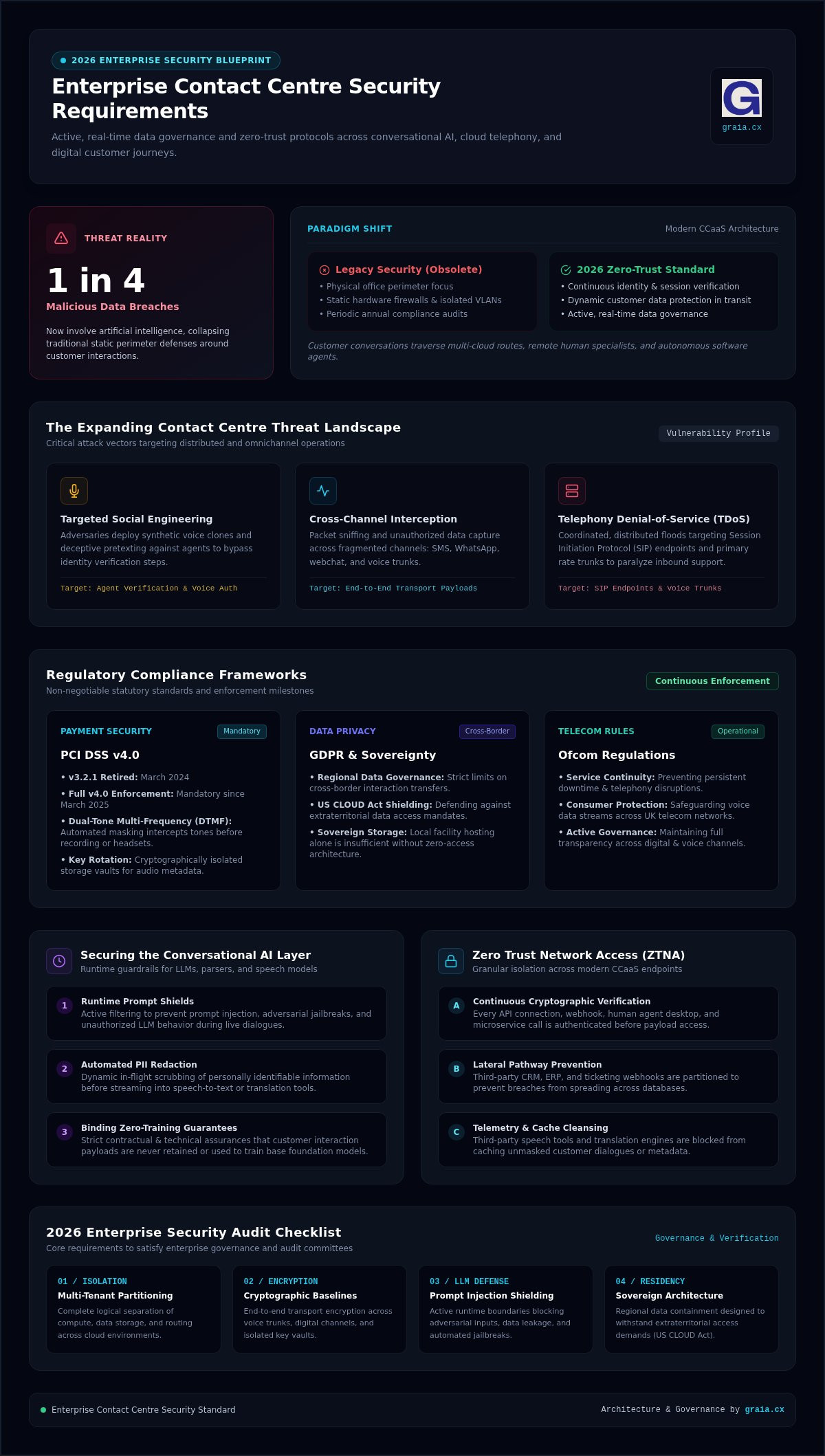
Enterprise customer service no longer lives inside four brick walls. When Understanding Enterprise Contact Centre architecture today, one finds that distributed operations, remote human specialists, and autonomous software agents have permanently dissolved the physical edge. Legacy perimeter defences, like static hardware firewalls or isolated VLANs, cannot protect conversations traversing modern multi-cloud routes. Today, modern enterprise contact centre security requirements focus on protecting identity, session state, and dynamic customer data wherever interactions happen.
Every conversation carries deep personal trust. If you compromise that data stream, customer trust vanishes overnight. Achieving customer experience excellence now means weaving robust zero-trust controls into the customer journey without frustrating callers or slowing down response times.
The Expanding Contact Centre Threat Landscape
Distributed environments create multiple attack vectors across everyday operations:
- Targeted social engineering: Malicious actors deploy synthetic voice clones and deceptive pretexting against agents, seeking to bypass traditional identity verification steps.
- Cross-channel interception: Interactions across SMS, WhatsApp, webchat, and voice trunks face packet sniffing and unauthorized interception if end-to-end transport encryption falters.
- Telephony denial-of-service (TDoS): Coordinated, distributed floods target Session Initiation Protocol (SIP) endpoints and primary rate trunks, threatening to cut off critical inbound customer support.
The Interconnected Nature of Modern CCaaS Platforms
Modern contact platforms rely on constant data exchange across back-office infrastructure. Cloud platforms connect continuously to CRMs, enterprise resource planning databases, and support ticketing environments through webhooks and REST APIs. An unsecured endpoint in any third-party app creates an immediate lateral pathway into private customer databases.
Real-time speech-to-text parsers and translation engines introduce additional security risks. If dynamic customer dialogues stream into third-party speech tools that retain telemetry or cache unmasked PII, compliance collapses. Securing these touchpoints requires comprehensive Zero Trust Network Access (ZTNA). Every API connection, human desktop, and microservice call must undergo continuous cryptographic verification before accessing sensitive conversation payloads.
This architectural shift redefines contemporary enterprise contact centre security requirements. Leading enterprises no longer trust host certifications alone; they demand active, granular isolation at every layer of the conversational workflow.
Regulatory Compliance Standards Every Global Contact Centre Must Satisfy
Regulatory frameworks are no longer static checkboxes reviewed during an annual audit. Today, international compliance bodies enforce active, continuous oversight across every digital interaction. Fulfilling modern enterprise contact centre security requirements means constructing defensive data pipelines that actively prevent sensitive leaks across live voice, chat, and automated channels, safeguarding your organisation against devastating statutory penalties and severe brand damage.
Payment Card Industry Data Security Standard (PCI-DSS) in Voice and Chat
Version 3.2.1 was officially retired in March 2024, making full PCI DSS v4.0 compliance mandatory since March 2025. Contact centres cannot allow human agents or LLM prompts to view, process, or store unencrypted primary account numbers. Meeting these rules requires automated Dual-Tone Multi-Frequency (DTMF) masking, which intercepts payment tones before they reach recording tools or agent headsets. Any surviving audio metadata must live within cryptographically isolated storage vaults with enforced key rotation, ensuring card data never touches operational workflows.
Data Sovereignty, GDPR, and Cross-Border Interaction Governance
Global privacy laws penalise improper cross-border transfers. Simply hosting workloads in a local facility does not guarantee sovereignty, especially when the US CLOUD Act allows foreign authorities to compel data access from overseas cloud providers. True regional governance requires strict multi-tenant software partitioning and local hosting architectures. Leading systems deploy automated masking routines at the ingestion stage, scrubbing customer PII before sending text to external microservices or live translation tools. Every data access or deletion request under GDPR must align with comprehensive frameworks, such as the Enterprise Contact Centre Security Audit Checklist, to ensure end-to-end auditability.
Managing multilingual operations complicates this balance. If your team relies on real-time transcription or conversational translation, you must scrub names, national insurance identifiers, and addresses in flight before processing. You can explore advanced CCaaS compliance strategies to see how enterprise architectures manage real-time redaction without introducing call latency.
Outbound Dialler and Telephony Regulatory Mandates
Telecommunications compliance demands equal engineering rigour across voice campaigns:
- Calling windows and CLI: Outbound campaigns must present valid Calling Line Identification. Under UK Ofcom rules tightened in January 2025, systems automatically block calls from abroad spoofing domestic numbers.
- Drop rate restrictions: Diallers must keep abandoned calls below 3% over any 24-hour cycle, respecting a minimum 15-second ring duration before disconnecting.
- Quarantine rules: Abandoned numbers require a mandatory 72-hour quarantine, paired with immediate opt-out synchronisation across every connected digital channel.
Securing the AI Layer: Guardrails, Prompt Shields, and Data Sovereignty
Deploying generative models transforms contact centre productivity, but it introduces an entirely new threat profile. Autonomous systems operate on fluid natural language, rendering standard API firewalls obsolete against contextual manipulation. Securing modern operations requires extending your enterprise contact centre security requirements to encompass the generative AI runtime itself, defending every conversational turn from adversarial exploitation and intellectual property theft.
Prompt Shields and Adversarial Attack Prevention
Direct prompt injections and subtle jailbreak attempts target large language models by disguising malicious instructions as regular customer queries. A robust defence uses dedicated runtime prompt shields that evaluate inbound strings before the language model parses them. These shields neutralize system override commands, while semantic guardrails prevent bots from discussing unvetted topics, disclosing system prompts, or referencing competitor policies. Real-time toxic sentiment and safety classifiers continuously monitor outbound generations, preserving brand trust across every automated voice or chat interaction.
Data Privacy and Zero-Training Architectures
Enterprises cannot afford to leak proprietary data into public AI ecosystems. Contractual enterprise agreements must guarantee that customer interactions remain strictly ephemeral. Under these controls, user prompts and enterprise knowledge snippets are never retained or repurposed to train public or commercial foundation models. In retrieval-augmented generation (RAG) frameworks, contextual document boundaries ensure conversational agents only retrieve files the specific user is authorised to view. Read how an agentic ccaas platform isolates data tenants within sovereign cloud environments, executing real-time token scoring to suppress ungrounded claims before output generation.
Deterministic Logic via Hybrid Flows
Unchecked generative flexibility is dangerous in regulated environments. That is why enterprise CX architectures pair the contextual empathy of LLMs with deterministic, rule-based workflows. Sensitive actions, such as funds transfers, account changes, or identity verification, execute exclusively within rigid decision trees where deviation is mathematically impossible. The conversational agent manages natural language dialogue and context, while deterministic state machines handle transactional execution. When human escalation occurs, the system compiles automated, structured interaction summaries, giving human specialists instant context while enforcing strict enterprise contact centre security requirements across the entire engagement lifecycle.
The Enterprise Contact Centre Security Audit Checklist
Vulnerabilities rarely announce themselves before an incident occurs. They hide within unmonitored API handshakes, misconfigured database permissions, and stale session tokens. Conducting a methodical review across technical and administrative layers ensures your stack satisfies modern enterprise contact centre security requirements. Use this operational checklist to evaluate your platform's resilience.
Step 1: Cryptographic and Infrastructure Hardening
Begin by validating encryption standards across all transit corridors and resting storage clusters:
- Transit encryption: Verify mandatory TLS 1.2 or TLS 1.3 across all SIP trunks, WebRTC streams, and external REST API webhooks.
- Storage encryption: Enforce AES-256 cryptographic algorithms across call recordings, digital chat logs, and reporting databases using dedicated key management services like Azure Key Vault.
- Multi-tenant isolation: Validate logical software partitioning to confirm that data layers remain segregated with zero possibility of cross-tenant data exposure.
Step 2: Identity, Authentication, and Access Governance
Compromised credentials remain a primary attack vector against enterprise networks. Centralise access governance by integrating enterprise identity providers like Microsoft Entra ID for unified Single Sign-On (SSO). Enforce mandatory multi-factor authentication (MFA) across every agent, supervisor, and administrator console. Complement this with granular role-based access control (RBAC), restricting raw recording exports and customer PII access strictly to approved personnel while recording tamper-evident audit logs for every system event.
Step 3: Incident Response and High Availability Protocols
True operational resilience requires concrete disaster recovery guarantees. Audit vendor service level agreements to confirm rapid recovery benchmarks, including a Category 1 full system failure restoration target within 4 business hours. Ensure platform architecture deploys across geographically distinct, redundant availability zones to absorb major network outages without data corruption.
Discover how modern enterprise ai contact center solutions maintain automated compliance during regional disruptions. If you're ready to stress-test your defensive posture against current enterprise contact centre security requirements, explore our technical compliance resources to inspect your operational workflows today.
Deploying Compliant, Resilient CX Architecture with GraiaCX
Modern enterprises cannot allow security compliance to throttle customer experience. GraiaCX unifies voice, chat, email, and social messaging into an Agentic Omni-Channel Platform engineered specifically for strictly regulated environments. Operating on Buzzeasy technology and built natively on Microsoft Azure, the platform converts rigid governance mandates into practical, automated operational guardrails. Organisations resolve customer inquiries rapidly while fulfilling modern enterprise contact centre security requirements at scale.
Customer self-service achieves high accuracy through Conversational Agent technology. By pairing hybrid RAG retrieval with rigid business guardrails, the platform answers complex requests using enterprise knowledge without risking data leakage or conversational hallucinations. When interactions require human intervention, supervisors guide agents using script-locked recommendations from ai agent assist tools, ensuring frontline staff follow approved compliance protocols on every call.
Enterprise-Grade Security Foundations and Tenant Isolation
Architectural integrity forms the baseline of the GraiaCX ecosystem:
- Cryptographic protection: All communications leverage TLS 1.2 in transit and AES-256 resting encryption governed by dedicated Azure Key Vault instances.
- Guaranteed model isolation: Customer interaction data is never shared or used to train public or proprietary AI models, providing ironclad data ownership.
- Sovereign multi-tenancy: Multi-tenant software orchestration enforces total isolation between corporate tenants, aligning with ISO standards and SOC 2 criteria.
- Resilient availability: Infrastructure maintains continuous monitoring with a Category 1 full system failure restoration SLA target within 4 business hours.
Compliant Omnichannel Automation and Real-Time Translations
Global organisations routinely encounter complex data boundary issues when serving multilingual audiences. GraiaCX solves this vulnerability through native Live Call Translation across more than 100 languages. Spoken customer dialogue translates bi-directionally in real time without passing unprotected payloads to third-party consumer endpoints.
Automated PII masking scrubs credit card digits, national identification numbers, and contact records before processing. This eliminates exposure risks for remote human agents and AI models alike, transforming the customer journey into a defensible asset. By balancing human empathy with technical authority, the architecture satisfies modern enterprise contact centre security requirements without sacrificing resolution velocity. Read more about deploying these frameworks on the GraiaCX blog.
Transforming Compliance into Your Enterprise Advantage
Enterprise protection is no longer about reacting to breaches; it's about engineering active resilience into every conversational touchpoint. Meeting rigorous enterprise contact centre security requirements shouldn't hold back customer satisfaction or slow your teams down. When you replace fragile perimeters with automated guardrails, end-to-end encryption, and sovereign cloud isolation, regulatory compliance becomes a powerful catalyst for customer trust.
GraiaCX delivers this peace of mind through a SOC 2-aligned architecture built on Microsoft Azure enterprise cloud. Your customer records remain protected under a strict privacy-first AI guarantee ensuring enterprise data never trains public models, backed by a Category 1 incident recovery SLA targeting full restoration within 4 business hours. Building an ironclad fortress around your customer conversations doesn't mean compromising on innovation. Take the next step toward defensible, agile customer engagement and explore enterprise security insights on the Graia CX blog today.
Frequently Asked Questions
How do enterprise contact centres ensure customer data is not used to train public AI models?
Enterprise platforms establish contractual zero-retention agreements and deploy private tenant instances within isolated enterprise clouds like Microsoft Azure. Under these frameworks, customer prompts, voice inputs, and RAG retrieval snippets process ephemerally without being logged for model refinement. Fulfilling strict enterprise contact centre security requirements means validating that foundation model providers and middleware partners legally and cryptographically isolate conversational tokens from public training sets.
What is the role of automated PII masking in modern omnichannel contact centres?
Automated PII masking detects and redacts sensitive entities in real time before dialogue data enters analytics tools, external translation engines, or agent screens. The system intercepts names, payment numbers, and national insurance identifiers across voice, webchat, and messaging streams using contextual entity extraction. Redacting data at ingestion stops accidental GDPR violations, restricts agent exposure to private records, and guarantees that downstream reporting databases remain clean and auditable.
How does PCI-DSS compliance apply to remote or hybrid contact centre agents?
PCI DSS v4.0 mandates strict isolation of cardholder data across all environments, making home and hybrid workspaces subject to the exact same rigorous controls as physical facilities. Contact centres satisfy this requirement by implementing automated DTMF tone masking and pause-and-resume recording features. Because remote agents cannot see or hear primary account numbers during payment entry, home networks and personal agent workstations remain entirely out of PCI scope.
What are Prompt Shields, and why are they necessary in an AI-powered contact centre?
Prompt Shields are active input-filtering mechanisms that inspect incoming customer messages for adversarial manipulation, jailbreaks, and indirect injection payloads before an LLM parses the request. Malicious users frequently attempt to manipulate conversational bots into bypassing security policies, revealing confidential system instructions, or executing unauthorised account commands. Integrating runtime prompt shields creates a defensive perimeter, neutralising malicious inputs instantly while keeping the conversational agent grounded and brand-aligned.
How do hybrid flows prevent conversational AI agents from hallucinating sensitive policy details?
Hybrid flows split customer interactions between natural language processing and rigid, deterministic state logic. While large language models interpret intent, tone, and unstructured conversation, transactional actions and critical policy lookups occur within strictly defined, rule-based workflows. The model cannot improvise refunds, policy terms, or identity verification steps. This separation enforces zero process deviation, ensuring that every sensitive customer transaction satisfies modern enterprise contact centre security requirements without sacrificing conversational empathy.
What encryption standards should be enforced for contact centre call recordings and transcripts?
Contact centres must enforce TLS 1.2 or TLS 1.3 for all data in transit and AES-256 for data at rest. In-transit encryption secures WebRTC streams, SIP audio, and webchat transcripts against packet interception. Resting data, including historical call recordings and transcripts, requires AES-256 cryptographic keys managed via dedicated vaults like Azure Key Vault. Enforcing automated key rotation and role-based decryption permissions ensures archived customer data remains unreadable if storage volumes face unauthorised access.