
Conversational AI Self-Service and Contact Centre Agent Workload
Self-service should remove effort, not put a wall between customers and help. Conversational AI self-service for contact centres lets customers use chat or voice to resolve routine enquiries, while routing complex or sensitive conversations to a human agent. Its value depends on how well it understands a request and carries context into a handoff.
Customers value convenient ways to get help, but automation works only when it suits the task and offers a clear route to an agent. A bot that repeats questions or cannot resolve an enquiry can increase frustration instead of reducing it.
This article explains how AI-enabled self-service works, which channels customers may prefer and how contact centres can choose suitable requests to automate. It also covers context-preserving handoffs and how resolving routine enquiries can free agent time and help manage operational costs.
Key Takeaways
- Match chat and voice self-service to the enquiries customers want to resolve, and make human help easy to reach.
- Design handoffs to carry the conversation context forward, so customers don’t have to start again with an agent.
- Measure successful resolutions, completion and escalation quality, not just how many contacts automation contains.
- Start with suitable routine enquiries and use performance insights to refine what the system handles.
- See how the UK Government reported chatbot handling time falling from 8 minutes to 2 minutes 30 seconds.
Customer preferences for chatbot and voice-bot support
Customers value convenient, immediate support, but their preferred channel depends on the task. Contact centres need to match automation to real enquiries and test whether it resolves them.
Always-on support and instant responses
Always-on support lets customers access automated help outside staffed contact-centre hours. An immediate response can help someone check a routine account detail without waiting for an agent. Around-the-clock access is useful when customers need information outside normal business hours or want to resolve an enquiry while doing something else.
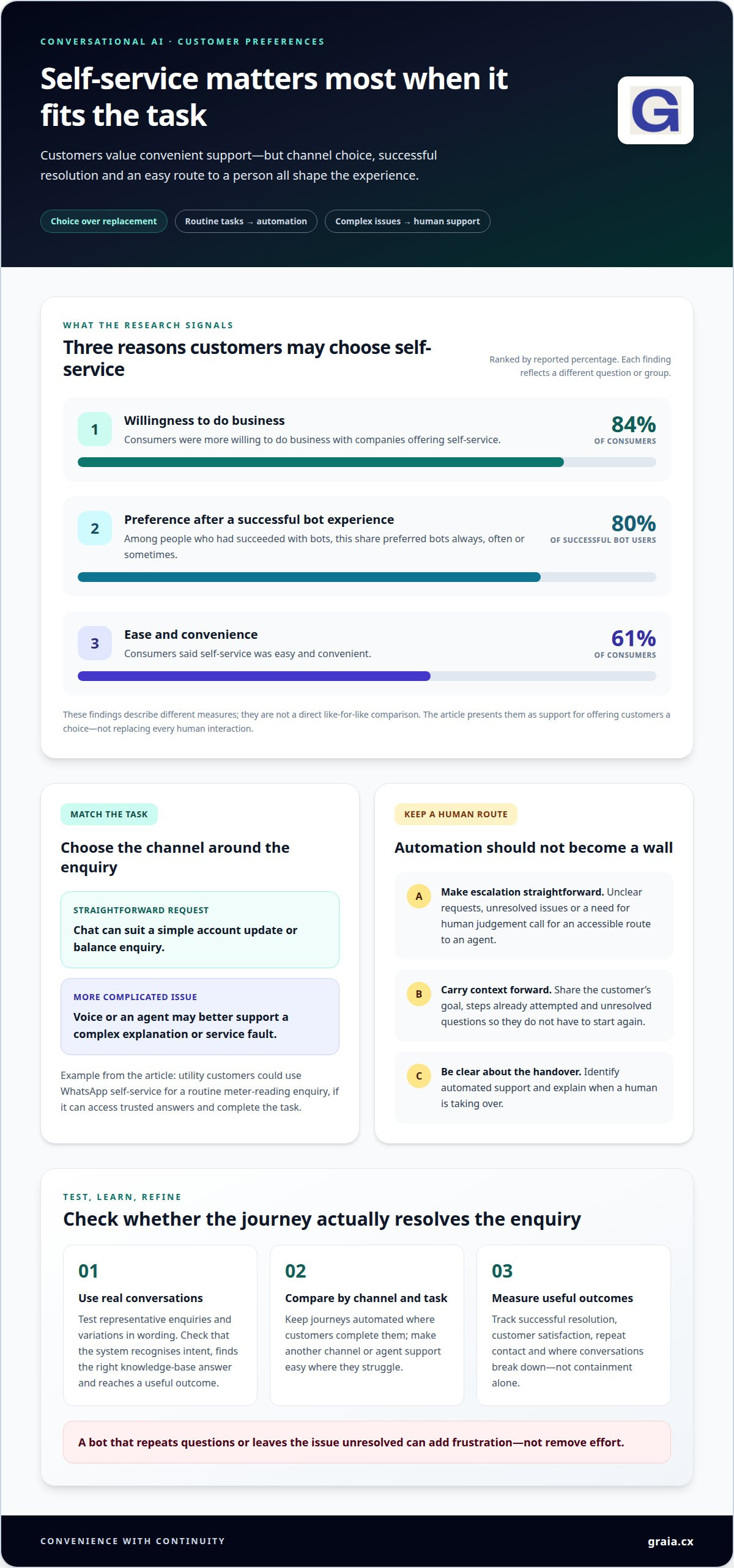
Preference depends on whether the automated conversation actually helps. In market research, 84% of consumers were more willing to do business with companies offering self-service, while 61% said self-service was easy and convenient. These figures support offering a choice, not replacing every human interaction with a bot.
Successful experiences can also influence future channel choices. Among people who had succeeded with bots, 80% preferred bots always, often or sometimes. A contact centre can use that insight to offer a chatbot for a straightforward balance enquiry, while keeping agent support accessible for a disputed charge or complex account issue.
Matching channels to customer use cases
Channel matching means offering a communication method that suits the enquiry and the customer’s circumstances. Someone asking for a simple update may choose chat, while a customer explaining a complicated issue may prefer voice. For example, utility customers could use WhatsApp self-service for a routine meter-reading enquiry, provided the channel can access trusted answers and complete the task.
Conversational AI has limits: it may misunderstand an unclear request, lack the information to resolve it or frustrate someone who needs human judgement. Make escalation straightforward, and do not treat containment as success if the customer’s issue remains open.
Testing with real customer conversations shows where automated support works and where it falls short. Review representative enquiries, including variations in wording, to see whether the system recognises intent, retrieves the right knowledge-base answer and reaches a useful outcome. For example, testing different ways customers ask about a missed energy bill payment can reveal gaps a single scripted question would miss.
After testing, compare results by channel and enquiry type. If customers complete account checks in chat but struggle to explain a service fault, keep the first journey automated and make voice escalation easy for the second. Track customer satisfaction alongside successful resolution, repeat contact and points where conversations break down. These signals help refine channel choices without assuming every customer wants the same experience.
Human escalation and conversation context transfer
Effective escalation moves a customer from automated support to a person without losing the thread. Clear rules protect the customer experience and help agents address the actual issue.
For UK GDPR and data protection, contact-centre AI should handle personal information transparently, securely and only for clear purposes. Accessible journeys should reflect the W3C Web Content Accessibility Guidelines, with straightforward alternatives for customers who cannot use a particular interface.
Human touch during escalation
Human escalation transfers an automated conversation to an agent when the customer or issue needs personal assistance. It matters because a well-designed platform supports human judgement instead of making customers repeat automated prompts.
For example, a customer disputing a payment may need an agent to understand the circumstances and explain next steps. Make the route to a person visible, acknowledge the reason for the transfer and avoid asking customers to repeat details they have already provided. This small design choice makes the handover feel like continued support, not the start of a new queue.
Context transfer and handover rules
Context transfer gives the agent relevant details from the automated conversation before they take over. Useful information includes the customer’s goal, steps already attempted and any unresolved questions.
Define what information transfers, who can access it and when the system should escalate. If a customer has already supplied an account reference and described a failed payment, for instance, the agent should receive those details rather than ask again. Clear boundaries also help the system recognise when a request is outside its scope, frustration is rising or human oversight is needed.
Urgent housing hazards show why escalation rules must reflect the issue’s seriousness. In England, Awaab’s Law has required social landlords to investigate and make safe emergency hazards within 24 hours since 27 October 2025. It also requires investigation of significant damp and mould hazards within 10 working days of becoming aware of them. A contact-centre journey reporting such a hazard should capture the relevant details and provide an effective route to human handling, rather than leaving the customer in an automated loop.
Good handover design balances speed with continuity. The system should identify itself as automated, explain when a human is taking over and pass along enough context for the agent to act. A customer reporting a recurring heating fault, for example, should not have to repeat the address, symptoms and earlier troubleshooting at every transfer. Teams can review conversations where customers repeat information or abandon a journey, then refine escalation triggers and the details passed to agents.
These principles can guide the design of contact-centre escalation journeys, from the first automated response to the agent’s next action.
What is AI-enabled self-service?
AI-enabled self-service uses conversational systems to understand enquiries and help customers complete tasks. For example, a customer might ask about a direct debit, receive an answer and update payment details without an agent.
Resolution versus containment
Containment measures whether a customer stays within an automated channel; resolution measures whether their issue is actually addressed. The distinction matters: a customer who abandons a chat has been contained, but their payment query remains unresolved.
Providers should assess whether the requested outcome was completed, not just whether an agent avoided the contact. For a delivery enquiry, that could mean confirming the parcel’s status and answering the customer’s follow-up, rather than ending the chat after displaying a tracking link.
Useful measures include resolution accuracy, conversation completion, customer sentiment and the quality of escalations to agents. If a password reset flow ends without confirming access, completion alone can overstate success. Comparing these signals by enquiry type shows which routine journeys genuinely improve service and customer satisfaction.
Live-agent handoff
A live-agent handoff transfers a conversation to a person when AI cannot resolve the request or a human response is more suitable. An unresolved enquiry should lead to useful assistance, not another automated loop.
For example, an AI system may answer a question about a standard account change, then escalate when the customer reports an unexpected charge. A well-designed handoff gives the agent the issue and the actions already taken, so the conversation can move forward.
Teams can evaluate each handoff by asking whether the agent received enough context to act and whether the customer had to repeat key details. If an agent must ask again for the account reference or reason for contact, the transfer has added friction rather than supporting the customer experience.
First-contact resolution
First-contact resolution means completing the customer’s issue during the initial interaction, whether AI resolves it or an agent takes over. A successful first response can prevent avoidable repeat contacts.
Improving it starts with clear use cases and accurate, accessible answers. For example, a billing chatbot needs current guidance on payment dates and a way to handle an account whose details do not match the expected pattern. Without that route, a simple enquiry can lead to a second contact.
Review unresolved conversations alongside completed ones. If customers repeatedly ask for clarification about a billing term, improve the relevant knowledge-base content. If a request regularly needs judgement, route it to an agent earlier. This helps teams refine automated journeys while keeping agents available for complex service needs.
Use resolution data to guide ongoing improvements. Track completion, accuracy, sentiment and escalation quality for each journey, then apply the findings to the next interaction. For instance, if a service-change flow completes but customers contact the centre again to confirm the change, the journey needs a clearer confirmation step.
Reducing agent dependency and operational costs
Automation can handle suitable routine requests, reducing avoidable interactions and giving agents more capacity for complex work. Its operational value depends on successful resolutions, not simply fewer calls.
For UK contact centres, conversational AI can ease pressure from repetitive enquiries, support faster service and help manage operating costs. The greatest benefit comes when automated journeys resolve customer needs and leave human support available for situations requiring judgement.
Contact volume and agent workload
Contact-volume reduction means resolving routine requests through self-service instead of routing every interaction to an agent. This matters because repetitive work can consume capacity needed for complex customer needs.
Routine tasks, including password resets, order tracking and appointment scheduling, represent up to 70% of customer contacts at many organisations. Automating suitable requests can reduce queues and repeat work, while giving agents more time for cases needing empathy or investigation. Low-effort customer experiences can decrease repeat calls by up to 40%, helping teams manage demand without treating every enquiry as an automation candidate.
Virtual agents for high call volumes
AI virtual agents can handle defined customer requests through conversational channels when call demand rises. They offer another route to service instead of leaving every customer waiting for a live agent.
The DVLA’s AI-enabled contact centre handles 300,000 web chats each month and resolves 30% of web chat sessions through self-service. It also automates responses to 50,000 emails each month. These examples show how digital interactions can support high-volume operations across more than one channel, while people remain available for issues automation does not resolve.
Organisations can start with a high-volume request that has a clear outcome, such as tracking an order. Then assess completion and unresolved demand before extending automation to other journeys.
Agent productivity and cost savings
Agent productivity can improve when automated systems handle suitable routine interactions and people focus on work requiring human judgement. Reducing handling effort can support faster service and a more effective use of agent capacity.
Organisations implementing conversational AI self-service report cost reductions of 30-60% per automated interaction compared with agent-handled contacts. According to UK Government, the chatbot reduced average handling time from 8 minutes to 2 minutes 30 seconds. These figures illustrate potential operational benefits, while results depend on what each journey can resolve.
Connect efficiency measures with customer outcomes. For example, compare resolved requests, repeat contacts and agent handling time before and after automating an appointment-booking journey. Measure each use case, refine it and scale only when service quality remains strong.
Self-service options, including knowledge bases, guided journeys, chatbots and live chat
A provider typically starts by identifying common enquiries, then designs suitable self-service journeys and tests them against customer conversations. It can refine content, channel choices and escalation paths using resolution data and customer feedback.
Knowledge bases and guided journeys
A knowledge base gives automated systems trusted information, while a guided journey leads customers through a defined task. Both matter: accurate content and clear steps help customers complete requests without unnecessary agent involvement.
For example, a council knowledge base might explain how residents report missed bin collections. A guided journey can then collect the service address and collection date, helping direct the request to the right process. The provider should organise and maintain source content so answers stay consistent across customer-facing channels.
For conversational AI, a well-structured, current knowledge base is essential. Restricting generated answers to approved sources can reduce the risk of unsupported responses. Also check whether each journey can complete the relevant transaction, such as updating contact details, rather than merely displaying instructions.
Start implementation with frequent, clearly defined enquiries the system can resolve using accessible information. Review contact data, select a suitable use case and build its journey around trusted content. Then assess completion and unresolved enquiries to establish a focused starting point before expanding coverage.
Chatbots and live chat
A chatbot handles customer conversations automatically, while live chat connects a customer with a person through messaging. Offering both matters because routine requests may suit automation, while unusual council-service questions may need human judgement.
A local government chatbot could answer questions about council tax payment methods or explain how to request a replacement recycling container. If a resident’s circumstances make the standard answer unsuitable, offer a clear route to live assistance. This keeps automation useful without making it the only way to get help.
Make these journeys accessible and give customers meaningful channel choice. A utility customer might use messaging for a routine account enquiry, while a live agent handles a complex billing dispute. The chatbot’s knowledge base and escalation route should reflect the difference between these tasks.
Creating chatbots for use across channels with a provider
An omnichannel chatbot applies consistent knowledge and service logic across channels such as web chat, email and social messaging. This lets customers choose a convenient channel without receiving conflicting answers.
Map the customer journey, connect relevant knowledge and workflows, then adapt the conversation for each channel. For instance, web chat can present a guided form, while a messaging channel can use concise prompts. Test real customer conversations across these experiences and improve flows when intent is misunderstood or requests remain unresolved.
Explore how a provider can develop conversational self-service around your contact centre’s channels, knowledge and customer journeys.
GraiaCX: Conversational Agent
GraiaCX helps contact centres apply conversational AI to routine enquiries while preserving agent support for more complex needs. Its Conversational Agent understands customer intent and emotion, resolves routine enquiries autonomously and supports conversations across contact-centre channels.
The Agentic Omni-Channel Platform brings voice, chat, email and social messaging together. Agent Assist can provide agents with real-time next-best-action suggestions, while Live Call Translation supports multilingual conversations in over 100 languages without requiring bilingual staff.
For organisations planning self-service, these capabilities connect automated resolution with human assistance in a coordinated customer experience. They can help when routine interactions put pressure on agents or customers need support across different channels and languages.
Contact GraiaCX to discuss conversational AI self-service for your contact centre.
Turn your next service challenge into a focused AI opportunity
The strongest next step is not to automate everything at once. Choose a customer journey with a clear outcome, then define what success means for customers and agents before expanding its scope. This gives your team a practical way to shape conversational AI self-service for contact centres around real service needs, rather than technology for its own sake.
Consider how an automated journey should respond when a request changes direction, information is incomplete or a customer needs a person. These decisions align the experience with your service standards and clarify the role of agents in the future operating model. GraiaCX can help you explore how AI-enabled customer interactions fit your contact-centre priorities.
Contact GraiaCX to discuss self-service and identify a useful next step for your organisation. With a focused starting point, your team can move forward with clarity and purpose.
Frequently Asked Questions
How does it work?
Conversational AI processes a customer’s message or spoken request, identifies the intent and responds using relevant information or connected systems. For example, someone asking to reschedule a delivery could receive guidance or have the request passed into a connected workflow. If the system cannot complete the task, route the interaction to an agent with useful context so the customer’s next step is clear.
What is conversational AI self-service in a contact centre?
It’s an automated way for customers to communicate with a contact centre in natural language, rather than selecting only from fixed menu options. A customer might type an account question or speak a request over the phone. The AI interprets the enquiry and responds using its knowledge and available workflows. Contact centres use it to make selected services available through digital or voice interactions.
How do conversational AI chatbots and voicebots handle customer enquiries?
Chatbots interpret written messages, while voicebots process spoken requests. Both identify what the customer wants, use relevant knowledge or system connections, and respond or take an available action. For example, a customer could ask about an account update through chat or voice. If the request is unclear, outside the system’s scope or requires human judgement, route the interaction to an agent.
How does conversational AI compare with IVR, live chat and human agents?
Traditional IVR usually guides callers through predefined menus, while conversational AI lets customers express requests in natural language. Live chat is a text-based channel that may connect customers to automation or a person. Human agents bring judgement and interpersonal understanding to complex situations. A contact centre can combine these approaches, automating suitable tasks and providing agent support when personal handling is needed.
What customer service tasks can conversational AI automate effectively?
It works best for routine requests with clear outcomes and accessible information. Examples include password resets, order tracking and appointment scheduling. A connected system may also support actions such as updating an account or rescheduling a delivery. Suitability depends on whether the AI can access the required information and complete the workflow reliably. Requests involving exceptions, ambiguity or sensitive judgement may need an agent.
How can a provider measure conversational AI self-service performance and ROI?
Track resolution accuracy, completed conversations, customer sentiment and the quality of transfers to agents. Add operational measures such as repeat contacts, handling time and requests resolved without agent intervention. To assess ROI, compare the value of resolved interactions and released agent capacity with implementation and operating costs. Review results by enquiry type to see where automation contributes value and where journeys need refinement.