
Conversational AI for Customer Self-Service: Practical Guide
What if customers could resolve routine requests without fighting their way through a bot? Conversational AI for customer self-service can ease pressure on support teams, but only when it understands what people need, gives grounded answers and offers a clear route to human help. Rigid scripts can turn one unexpected question into a frustrating dead end.
The answer isn’t to automate every conversation. Design self-service around suitable requests, set clear boundaries and make handoff straightforward when a person needs to step in. This guide explains how to identify tasks for automation, support service across digital and voice channels, and measure outcomes without losing sight of customer experience.
Grounded knowledge, defined workflows and integrations can help conversational agents take supported actions, then pass context to human agents when a case becomes complex or sensitive. GraiaCX’s agents support voice, chat and email, and customer data is never used to train GraiaCX or third-party AI models. The goal is practical: more useful self-service, fewer avoidable barriers and clearer evidence of what’s working.
Key Takeaways
- Use conversational AI for customer self-service to resolve well-defined routine requests, while keeping complex or sensitive cases easy to escalate.
- Map how an agent identifies intent, finds relevant knowledge and completes only authorised actions before deciding when to hand off.
- Compare conversational AI with IVR, basic chatbots and live agents to match each approach to the customer task.
- Start implementation with contact analysis, a focused use case and testing, then refine the experience using real interactions.
- Track resolution, repeat contacts, transfers, customer effort and service quality to understand whether self-service is helping.
What conversational AI for customer self-service should actually resolve
Self-service should meet the customer’s need, not simply end the conversation. Conversational AI for customer self-service is a dialogue-based service that interprets a request and helps complete an appropriate task, using reliable information and escalating when needed. Unlike menu-based IVR, which routes callers through fixed options, it can interpret different ways of expressing the same need. Unlike a scripted decision tree, it can respond to natural language while following defined workflows and safeguards. For background on the technology, see this overview of the Chatbot.
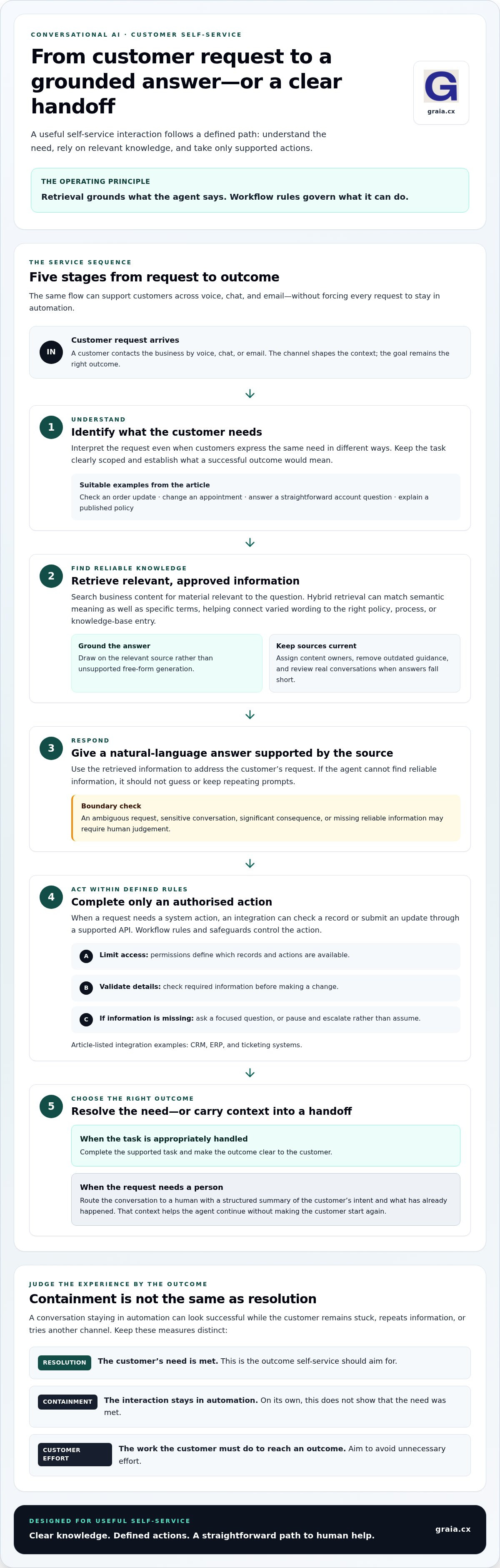
Measure the outcome carefully: resolution means the customer’s need is met; containment means the interaction stays in automation; customer effort is the work the customer must do to reach an outcome. Containment alone can look successful in a dashboard while leaving someone stuck, repeating information or trying another channel. The goal is a useful resolution with as little unnecessary effort as possible.
Which customer requests belong in self-service?
Start with frequent, clearly scoped requests that have accurate supporting information and a defined process. Examples include checking an order update, changing an appointment, answering a straightforward account question or explaining a published policy. Each task should have a clear purpose and a recognisable outcome for the customer.
Set boundaries just as deliberately. An ambiguous request, a sensitive conversation or an issue with significant consequences may need human judgement. The agent should recognise when it lacks reliable information or authority to proceed, then make escalation straightforward instead of guessing or repeating prompts.
Where conversational AI fits in the service journey
Customers may contact a business by voice, chat or email, depending on their needs and the support journey available. Design for each channel’s context: someone calling may want to speak naturally, while chat or email can make it easier to share written details. The aim isn’t to force every request into automation, but to give customers a clear route to the right outcome.
If self-service cannot resolve the issue, the transition to a human agent should carry the conversation forward. Passing relevant details and a structured summary can reduce the need for customers to explain everything again. This continuity is part of a broader service design, explored in Graia’s guide to the AI customer service platform. Graia’s conversational agents support voice, chat and email, and customer data is never used to train Graia or third-party AI models.
How conversational AI understands, answers, and acts
A useful self-service interaction follows a clear sequence: understand what the customer wants, find information that supports the answer, respond in natural language, then complete an authorised action or escalate. This is more than generating a plausible reply. As IBM explains in its overview of Conversational AI for customer service, the technology combines conversational interaction with service capabilities. For customer self-service, each step needs a defined role and a safe route forward if the request can’t be handled.
Retrieval grounds what the agent says; workflow rules govern what it can do. Keeping these roles distinct lets an agent respond flexibly to a customer’s wording while following predictable controls for consequential steps. For example, it might understand a request to change a booking in different ways, but still follow defined checks before submitting an update.
How knowledge retrieval keeps answers grounded
Rather than relying only on a model’s general language ability, retrieval searches approved business content for material relevant to the customer’s question. Hybrid retrieval can match semantic meaning as well as specific terms, helping connect varied phrasing to the right policy, process or knowledge-base entry. The answer can then draw on that source instead of unsupported free-form generation.
Technology alone won’t keep knowledge reliable. Assign owners to source content, remove outdated guidance and make key information clear and consistent. Retrieval can still surface an imperfect match or miss relevant material, so review real conversations, correct source content and refine retrieval when answers fall short.
How integrations and human handoffs complete the task
When a response requires a system action, integrations can let an agent check a record or submit a booking update through a supported API. Scope access to the task: permissions should limit which records and actions are available, while validation checks required details before a change is made. If essential information is missing, ask a focused question or pause and escalate rather than assume.
Not every conversation should end with automation. When a request falls outside the agent’s knowledge or authority, route it to a human with a structured summary of the customer’s intent and what has already happened. That context helps the agent continue without making the customer start again. Graia’s conversational agents combine hybrid knowledge retrieval with rule-based workflows and can connect with CRM, ERP and ticketing systems through integrations. Customer data is never used to train Graia or third-party AI models. Explore Graia’s customer experience insights for more perspectives on designing connected service journeys.
Conversational AI versus IVR, live agents, and basic chatbots
Each service approach has a role. IVR routes callers through predictable options; basic chatbots follow menus or scripted paths; conversational AI can interpret varied phrasing and use connected information or authorised actions. Human agents bring judgement and empathy to exceptions, sensitive cases and conversations where the relationship matters. Conversational AI for customer self-service isn’t about removing human support. It’s about making routine help easier to reach while keeping a clear path to a person.
| Approach | Natural-language handling | Task execution | Context and escalation |
|---|---|---|---|
| IVR | Limited; callers select from set options | Routes calls or supports defined steps | Usually captures limited context before transfer |
| Basic chatbot | Often relies on keywords, menus or scripts | Answers FAQs or follows pre-set flows | May pass limited details to an agent |
| Conversational AI | Interprets different ways of expressing a request | Can use knowledge and perform supported actions | Can pass conversation context during escalation |
| Live agent | Adapts through human listening and judgement | Handles varied requests within role and process | Can investigate exceptions and build rapport |
When does conversational AI outperform a basic chatbot?
It can help when customers describe the same need in different words, or when a useful answer depends on approved knowledge and an action in a connected system. A customer might ask to amend a booking without using the exact menu wording; conversational AI can interpret the intent, then follow the required process. But a conversational interface alone doesn’t guarantee a better outcome. Poorly scoped workflows or outdated source content can undermine both AI and scripted bots. For broader market context, see the Forrester Wave report on Conversational AI.
When should a customer reach a human agent?
Make escalation available when the system lacks confidence, policy calls for review, or the customer asks for a person. Urgent, emotionally charged, disputed or unusually complex cases also benefit from human judgement. Automation should widen access to help, not obstruct it with repeated prompts or a hidden route to support.
Assess the handoff by what happens next: does the agent receive the customer’s intent and relevant interaction history, and can they continue without asking the customer to repeat everything? That’s a stronger measure of service continuity than simply counting transfers. Human support remains essential. Thoughtful automation gives agents more room to focus where their expertise makes the greatest difference.
How to implement conversational AI for customer self-service
Successful implementation starts with service evidence, not technology. Review contact reasons, volumes and repeat enquiries to find where conversational AI for customer self-service can solve a clear customer need without adding friction. Establish a baseline before launch so you can compare results with the service customers experience today.
Choose and design the first self-service journeys
Prioritise candidate requests by frequency, repeatability, knowledge quality and the risk of taking action. A common question supported by current, approved information may be a stronger starting point than a rare case involving a consequential decision. For each journey, map what the customer is trying to do, what information the agent needs, which checks must happen and what outcome the customer is authorising.
Design the fallback before the main journey is complete. Define what happens if information is missing, an integration fails or the request falls outside the agent’s authority. Set clear triggers for human escalation and assign owners to review content and workflows as policies or processes change.
Lead qualification can sit alongside service journeys as a separate workflow: answer initial questions, capture the person’s intent and route the enquiry to the appropriate team. Keep its purpose clear so it complements, rather than distracts from, customer support.
Test, launch, and improve with evidence
Before launch, test the way customers really communicate. Include common phrasings and typos, ambiguous requests, unusual edge cases, unsafe prompts, missing information and integration failures. Check not only whether the answer sounds right, but whether the system follows the intended workflow, validates actions and escalates when it should.
Review transcripts and outcomes with operations, compliance and customer experience stakeholders. Agree on baseline measures such as resolution, repeat contact, transfer rate, customer effort and service quality. Interpret them together: fewer transfers aren’t an improvement if customers abandon the journey or call back because their issue remains unresolved. The contact centre ROI guide offers a framework for connecting operational measures with value.
Launch with a focused scope, monitor performance and expand only when the experience meets agreed quality measures. Investigate repeat contacts, failed actions and abandonment as signals to revise the content, dialogue or escalation path. Keep monitoring after expansion because customer needs and business information change.
For more practical ideas on designing and measuring connected customer experiences, explore Graia’s customer experience guidance. Customer data is never used to train Graia or third-party AI models.
How Graia supports conversational AI for customer self-service
Self-service works best as part of the wider customer experience, not as an isolated chatbot. Graia’s conversational agent supports journeys across voice, chat and email, interpreting customer intent, finding relevant information and helping complete supported tasks. Teams can design conversational AI for customer self-service around the requests they’re ready to resolve, while preserving a route to human support.
Answers draw on hybrid knowledge retrieval, combining semantic search with keyword matching to find relevant material in approved content. Rule-based workflows guide important process steps, while integrations connect the agent with CRM, ERP and ticketing systems. Together, these capabilities can support a journey from an initial question to an appropriate response or authorised action, without relying on unsupported answers or open-ended processes.
Connect self-service with people and existing systems
Integrations can bring relevant records into a service journey or support an action in a connected system. Keep the task clearly bounded: the agent works within its defined permissions and workflow, and cases outside that scope can be escalated. This focuses automation on appropriate resolutions rather than implying every customer request can be completed independently.
When a person needs to take over, context matters. Graia’s human handoffs can include a structured summary of the preceding interaction, helping an agent see the customer’s intent and what has already been discussed. This gives the conversation a better chance of continuing smoothly instead of making the customer start again. For a related perspective on supporting human teams, read the AI agent assist tools guide.
Trust also depends on how customer information is handled. Customer data is never used to train Graia or third-party AI models.
Plan a practical next step for your service operation
Start by identifying one high-volume, low-risk request with clear supporting information and a defined outcome. Map what the customer needs, what the agent must know, where an authorised action might fit and when a human should step in. This gives you a practical candidate to assess before expanding to other service journeys.
Review the journey against your operational priorities, then explore more guidance on conversational AI and customer experience in Graia’s customer experience insights.
Build self-service around better customer outcomes
Effective conversational AI for customer self-service isn’t measured by how many conversations automation contains. It’s measured by whether customers resolve suitable requests with less friction, while complex or sensitive cases reach a person smoothly.
Start with a focused, well-supported service journey. Ground answers in reliable knowledge, use rule-based workflows to guide important steps, and track resolution, repeat contact, transfers and customer effort. These foundations help teams improve the experience with evidence rather than assumptions.
Graia supports customer journeys across voice, chat and email. Grounded knowledge retrieval and controlled workflows can support appropriate self-service tasks, while context-rich human handoffs help agents continue the conversation. Customer data is never used to train Graia or third-party AI models.
Choose one routine request to assess, then refine the journey as you learn from real customer interactions. For more practical guidance, explore insights on conversational AI and customer experience. With a clear use case and a reliable route to human support, your next step can make service simpler for customers and more focused for your team.
Frequently Asked Questions
What is conversational AI for customer self-service?
It’s technology that interprets customers’ natural-language requests, retrieves relevant business information and can complete supported tasks without an agent. Unlike fixed IVR menus or simple FAQ bots limited to scripted replies, it can handle varied wording and follow a defined service process. Effective conversational AI for customer self-service also makes human support easy to reach when a request is unsuitable, unclear or unresolved.
How can conversational AI resolve customer service enquiries?
It can resolve an enquiry by identifying the customer’s intent, retrieving relevant information from approved sources, and collecting or validating details needed for the task. If connected to an authorised system, it may then take a supported action and confirm the outcome. If the request is uncertain, exceptional or outside its scope, it should escalate with useful context. Not every enquiry is appropriate for automation.
Can conversational AI take actions for customers?
Yes, if it’s connected to approved systems and given appropriately limited permissions. Depending on the configured workflow, it could check a customer record, reschedule a delivery or update a booking. Actions with consequences should include safeguards: validate the details, check that the action is permitted, and confirm the intended outcome with the customer. Clear fallback rules help prevent the system from proceeding when information is incomplete or a process fails.
What happens if conversational AI cannot answer a customer?
A well-designed service recognises uncertainty or an unsuitable request and offers a clear route to a human agent. The handoff can include a concise summary of the customer’s intent, relevant details and the conversation so far, where appropriate. This helps the receiving agent continue without asking the customer to start again. Sensitive, complex or unresolved needs should reach a person rather than being trapped in repeated prompts.
Is conversational AI better than IVR for customer self-service?
It depends on the interaction. IVR can route predictable calls through structured options, while conversational AI can interpret varied phrasing and support a more flexible dialogue. Neither approach removes the need for human agents. Compare them using resolution quality, accessibility, customer effort and the clarity of escalation routes. The strongest choice is the one that helps customers complete the task reliably and reach a person when needed.
How do businesses measure conversational AI self-service success?
Measure resolved requests alongside repeat contact, escalation, abandonment, customer effort and service quality. Define resolution consistently, then review results by enquiry type and channel to see where the experience works or breaks down. Containment alone can mislead: a conversation may end without a solution, or the customer may contact the business again. Strong measurement checks whether the need was genuinely met, not merely whether automation ended the interaction.
Is customer data used to train conversational AI models?
Data practices vary by provider and deployment terms, so organisations should understand how customer information is processed and governed. Graia does not use client data to train Graia or third-party AI models. This statement applies to Graia and shouldn’t be assumed to describe other providers. Clear internal processes for data access, use and oversight also help teams make informed decisions about how conversational AI fits their service operation.