
Contact Centre Agent Burnout Solutions: The 2026 UK Strategy Guide
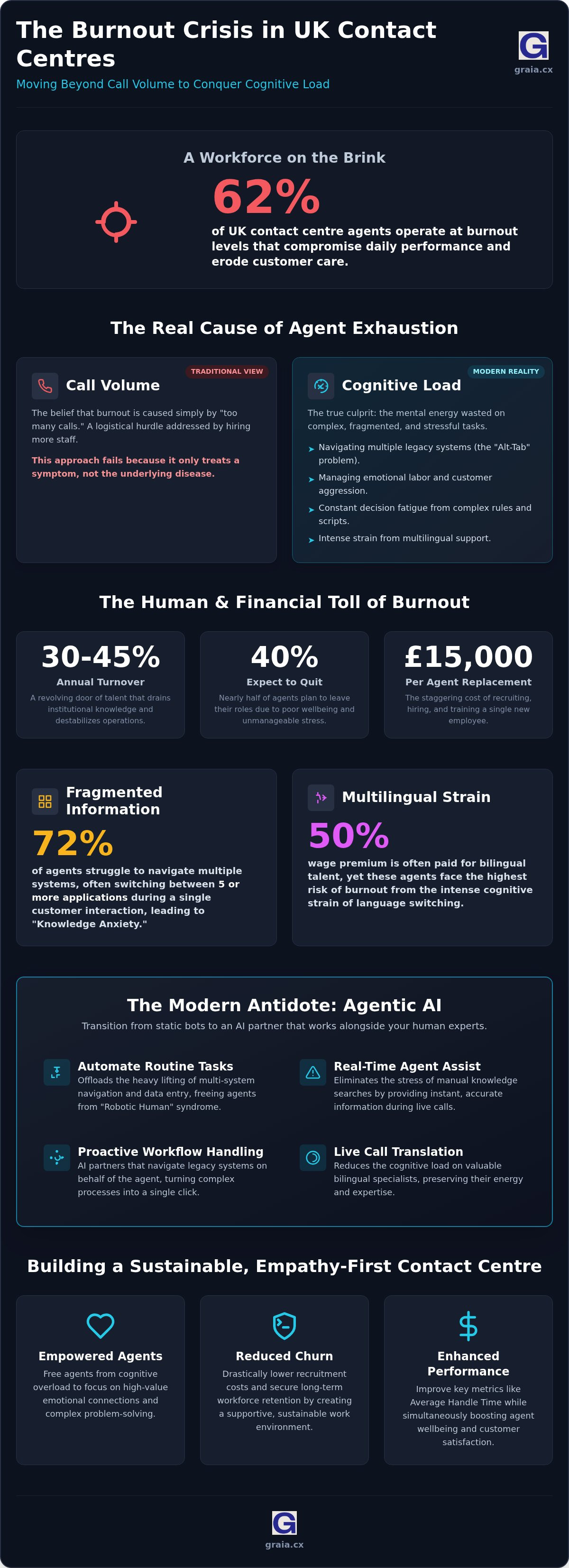
62% of UK contact centre agents are currently operating at burnout levels that compromise their daily performance. It's a staggering figure. It reveals a fundamental flaw in how we support our frontline talent. While you've likely explored traditional contact centre agent burnout solutions uk to address high recruitment costs and constant churn, the reality is that burnout is a cognitive load crisis rather than a simple volume issue. You're watching your best people buckle under the weight of fragmented workflows and the emotional tax of customer aggression.
We recognize the frustration of losing skilled staff to preventable fatigue. This guide shows you how to eliminate agent exhaustion and secure your workforce by deploying agentic AI solutions that offload the heavy lifting of multi-system navigation. We'll examine how tools like Live Call Translation and AI Agent Assist transform the agent experience, moving from a state of constant survival to one of high-performance empathy and technical precision.
Key Takeaways
- Redefine burnout as a crisis of cognitive load rather than simple call volume to address the systemic friction draining your team's energy.
- Deploy modern contact centre agent burnout solutions uk to automate routine tasks, allowing your human specialists to focus on high-value emotional connections.
- Transition from static deflection bots to Agentic AI partners that proactively handle complex workflows and navigate legacy systems on behalf of the agent.
- Leverage real-time Agent Assist and Live Call Translation to reduce Average Handle Time while eliminating the stress of manual knowledge searches.
- Build a sustainable, empathy-first operational model that drastically lowers recruitment costs and secures long-term workforce retention.
The State of Contact Centre Agent Burnout in the UK
Burnout is not a temporary dip in morale. It is a systemic collapse. Within the UK's high-pressure enterprise environments, we define it as a state of emotional and physical exhaustion triggered by unrelenting systemic friction. The World Health Organization's definition of burnout highlights how chronic workplace stress, when left unmanaged, erodes an individual's capacity to function. For contact centres, this erosion creates a dangerous "empathy gap" where agents no longer have the emotional bandwidth to provide genuine care. They aren't just tired; they're depleted.
Traditional leadership mandates often demand that teams "do more with less," yet this approach is failing. In 2026, the sheer volume of inquiries is only part of the problem. The real culprit is "Cognitive Load." This is the silent killer of productivity. It represents the mental energy agents waste navigating legacy systems, memorizing complex scripts, and managing hostile interactions. When agents spend 70% of their energy fighting their own tools, they have nothing left for the customer. Implementing effective contact centre agent burnout solutions uk requires moving beyond surface-level wellness programs and addressing these structural failures directly.
Why UK Attrition Rates Remain Stubbornly High
Attrition in the UK remains a persistent threat to operational stability. Research shows that 40% of contact centre workers expect to quit their roles due to poor wellbeing. Annual turnover rates continue to hover between 30% and 45%, creating a revolving door that drains institutional knowledge. The financial impact is severe. Replacing a single experienced agent can cost between £8,000 and £15,000 in recruitment and training. Beyond the balance sheet, high churn makes it nearly impossible to maintain the quality and compliance standards aligned with Ofcom expectations, as new hires struggle to master complex regulatory requirements under pressure.
The Hidden Stress of Multilingual Support
The UK market faces a unique challenge in the scarcity of bilingual talent. Companies often pay a 25% to 50% wage premium for agents capable of handling multiple languages, yet these individuals are at the highest risk of exhaustion. Switching languages mid-shift creates an intense cognitive strain that accelerates mental fatigue. Without a technological safety net, these specialists are forced to perform high-stakes translation and emotional labor simultaneously. This dual burden is unsustainable. Leaders must look toward automation that supports these agents, ensuring that language barriers don't become the breaking point for their most valuable human assets.
Identifying the Root Causes: Volume vs. Cognitive Load
Volume is a number. Cognitive load is a weight. While many leaders focus on reducing call queues, they often overlook the mental tax of the calls themselves. High volume is a logistical hurdle; high cognitive load is a psychological drain. When an agent must balance a frustrated customer, complex compliance rules, and five separate software interfaces, their brain enters a state of high-intensity friction. This is why standard contact centre agent burnout solutions uk often fail. They treat the symptom of "too many calls" rather than the disease of "too much complexity."
Decision fatigue is the primary driver of this exhaustion. Every time an agent has to decide which legacy system holds the right data or how to phrase a sensitive rejection, they spend finite mental currency. By mid-afternoon, that currency is spent. This leads to what we call "Robotic Human" syndrome. It's the moment an agent stops being an empathetic problem-solver and starts performing repetitive data entry just to survive the shift. To manage this effectively, organizations should consult the HSE guidance on work-related stress, which provides a framework for identifying these structural pressures before they lead to total burnout.
The Friction of Fragmented Information
The "Alt-Tab" problem is a silent productivity killer. Research indicates that 72% of agents struggle to navigate multiple systems, often switching between five or more applications during a single interaction. This fragmentation creates "Knowledge Anxiety." It's the persistent fear of providing incorrect or non-compliant information because the data is buried under layers of outdated CRM and ERP systems. When an outdated IVR fails to provide context, the agent begins every call on the defensive, forced to absorb the frustration of a customer who has already repeated their story three times.
Emotional Labour and Customer Aggression
Agents are frequently treated as mere extensions of the business rather than human beings. Handling back-to-back interactions with aggressive or distressed customers requires immense emotional labour. Without a buffer, agents quickly lose their capacity for genuine connection. We believe in restoring empathy through automation by offloading the mechanical tasks that cause fatigue. When technology handles the data retrieval and process accuracy, the human agent is finally free to be human again. You can explore more about how this shift impacts long-term retention in our latest industry insights.
Agentic AI: The Modern Antidote to Burnout
Stop thinking of AI as a way to avoid your customers. For too long, the industry has relied on "deflection bots" designed to keep people away from human agents. These tools often fail, leaving frustrated customers and exhausted agents to pick up the pieces. Agentic AI represents a fundamental shift in strategy. It moves from defensive deflection to offensive empowerment. These are autonomous systems that don't just chat; they take action. By integrating these technologies, you provide the most robust contact centre agent burnout solutions uk enterprises can deploy today. You aren't replacing the human; you're finally giving them the support they deserve.
The technical backbone of this evolution is Retrieval-Augmented Generation (RAG). This ensures that the AI stays factually grounded in your specific knowledge base, eliminating the risk of hallucinations. We take this further with an "Agentic Swarm" architecture. Imagine a team of specialized AI experts working silently in the background. One handles technical documentation, another manages legal compliance, and a third tracks CRM updates. They feed the human agent precise information exactly when it's needed. This partnership transforms the agent's role from a stressed multi-tasker to a confident conductor of a high-tech orchestra.
AI Agent Assist: A Real-Time Co-Pilot
AI Agent Assist acts as a sophisticated co-pilot that never tires. It provides real-time transcription and "next-best-action" suggestions, removing the need for agents to memorize every complex policy. The impact on daily workflow is immediate. Automated wrap-ups and summaries save between 2 and 3 minutes of post-call work for every single interaction. This isn't just a productivity gain; it's a mental reprieve. By ensuring 100% process accuracy, you remove the persistent fear of compliance breaches, allowing agents to focus entirely on the human connection rather than the administrative burden.
Live Call Translation: Removing the Language Burden
Language barriers are a significant source of cognitive strain in the UK's diverse market. Our live call translation software allows agents to speak in their native tongue while the customer hears theirs. This technology uses "Formality Tuning" and "Partial Translation" to ensure the conversation feels natural and professional. It eliminates the "language queue" stress that often forces supervisors to scramble for specific bilingual talent. When agents can communicate effortlessly without the mental gymnastics of mid-shift language switching, their stamina and job satisfaction increase dramatically.
How to Implement Burnout Solutions: A 5-Step Guide
Implementing effective contact centre agent burnout solutions uk requires moving beyond vague wellness initiatives and toward a structured technical roadmap. You must dismantle the systemic friction that drains your team. This process isn't about working harder; it's about building a digital environment that protects your human capital. By following a methodical 5-step approach, you can transform your contact centre from a source of stress into a hub of high-value engagement. The goal is to offload the mechanical and protect the emotional.
The first priority is auditing friction points. You need to identify exactly where agents spend the most time on tasks that don't require human empathy. Once these are identified, you can deploy Conversational Agents to handle the "robotic" 60% of your volume. For the remaining complex cases, integrate Agent Assist to provide a real-time safety net of knowledge. To truly eliminate the "Alt-Tab" problem, you must unify the desktop experience by moving toward an agentic CCaaS platform. Finally, you must shift your KPIs. Move away from purely Average Handle Time and begin measuring the Agent Effort Score to prioritize well-being and resolution quality.
Step 1 & 2: Identifying and Deflecting the Mundane
Success begins with visibility. Use AI "Judges" to analyze call transcripts and identify repetitive, low-value tasks that frustrate your staff. This data allows you to set up "Zonal" automation for specific workflows like billing inquiries, returns, or simple status checks. By offloading these routine interactions to an autonomous Conversational Agent, you ensure that your human team only handles calls that actually require their expertise. When a handoff is necessary, the system preserves full context. The agent steps in with all the information they need, eliminating the need for the customer to repeat themselves.
Step 3, 4 & 5: Empowering and Measuring the Human
Your agents need a shield as much as they need a tool. Configure "Prompt Shields" to filter out toxic customer inputs and protect your team from the psychological toll of aggression. By integrating these systems with Power BI, you can track how AI assistance directly correlates with lower attrition and higher job satisfaction. This data-driven approach proves that reducing cognitive load is the most effective way to retain talent. Agent Effort Score is the primary metric for 2026 burnout prevention, quantifying the perceived mental and emotional energy required by an agent to resolve a customer interaction successfully. To stay ahead of these trends, explore our latest strategic guides on workforce optimization.
Conclusion: Building the Empathy-First Contact Centre
The evolution we have charted moves beyond simple software updates. It represents a fundamental reorganization of the human-machine partnership within the enterprise. By integrating sophisticated contact centre agent burnout solutions uk, you elevate the role of your staff from transactional operators to empathetic specialists. The ROI of this shift is visible in every metric that matters: lower churn, higher First Contact Resolution, and the kind of brand loyalty that only genuine human connection can forge. When technology manages the procedural complexity, your people are finally free to perform the high-value emotional labor that machines cannot replicate.
This vision of the future is one where operational efficiency and human well-being are no longer in conflict. It is a state where the "Empathy Engine" of your workforce is protected from the friction that leads to depletion. By adopting an agentic strategy, you secure your operational stability against the rising tides of customer aggression and system complexity. You aren't just reducing costs; you're building a sustainable culture of excellence that values the person behind the headset as much as the customer on the other end of the line.
The GraiaCX Difference: Agentic CX
GraiaCX brings 25 years of industry-specific intellectual property and seasoned expertise to this transformation. We understand that enterprise stability requires a "No-Code" approach that integrates with your existing Genesys, NICE, or Avaya stacks without the risk or expense of a "rip-and-replace" failure. Our platform acts as a catalyst for growth, ensuring that AI manages the data silos so your people can manage the customer relationship. Modernise your legacy contact centre with GraiaCX and establish a sophisticated foundation for your future operations.
Securing Your Workforce for the Future of CX
The path to a resilient, high-performing team begins by acknowledging that traditional methods have reached their limit. We've explored how burnout is fundamentally a crisis of cognitive load rather than simple volume. By transitioning to an agentic model, you move your staff away from the "Robotic Human" syndrome and back into roles that value their unique emotional intelligence. This shift isn't just about morale; it's about measurable enterprise results. Organizations deploying these contact centre agent burnout solutions uk see a 25% improvement in agent productivity while maintaining total process accuracy.
Our platform offers seamless integration with Genesys, NICE, and Avaya; all built on SOC2-aligned Azure security to ensure your data remains protected. You've seen the roadmap for implementation. Now, it's time to take the first step toward a frictionless environment where your agents can thrive. Book a demo of the GraiaCX Agentic CCaaS platform to see how we reduce agent friction. The evolution of your contact centre is within reach, and we're ready to act as your partner in this transformation.
Frequently Asked Questions
What is the primary cause of contact centre agent burnout in the UK?
The primary driver of burnout is a combination of high cognitive load and systemic friction rather than simple call volume. Agents are often overwhelmed by the mental energy required to navigate fragmented legacy tools while managing increasing customer aggression. Implementing technical contact centre agent burnout solutions uk enterprises need involves addressing these structural stressors to restore the human capacity for empathy and problem-solving.
How can AI actually reduce agent stress instead of increasing it?
AI reduces stress by serving as a real-time co-pilot that offloads repetitive administrative burdens and data retrieval tasks. By automating post-call summaries and surfacing the "next-best-action," it eliminates the need for agents to memorize every complex policy or compliance rule. This technical safety net reduces the fear of making errors, allowing your team to focus on meaningful human connection instead of mechanical data entry.
Does live call translation sound natural enough for high-stakes CX?
Modern live call translation sounds remarkably natural because it utilizes advanced features like Formality Tuning and Partial Translation. These technologies ensure the tone matches the brand’s voice and the customer's cultural expectations while minimizing latency. The result is a fluid conversation that feels like a direct human connection, allowing agents to communicate effortlessly in their native tongue without the mental strain of mid-shift language switching.
What are the first signs of burnout that UK team leaders should look for?
UK team leaders should monitor for rising Average Handle Time (AHT) and a noticeable increase in short-term absenteeism or "lateness" patterns. These are often the first quantifiable indicators of emotional withdrawal and "repetitive inquiry fatigue." When agents start to lose their capacity for empathy or struggle to navigate systems they previously mastered, it’s a clear signal that their cognitive load has become unsustainable.
Can agentic AI work with our existing legacy systems like Avaya or Genesys?
Agentic AI is designed to integrate seamlessly with legacy infrastructures including Avaya, Genesys, and NICE. You don't need to perform a costly "rip-and-replace" of your existing tech stack to modernize your environment. Our platform uses no-code setup processes to bridge the gap between your current systems and modern automation, providing a unified desktop experience that reduces the need for constant app-switching.
How much can we expect to save by reducing agent attrition with AI?
Reducing attrition can save your organization between £8,000 and £15,000 for every single agent you retain, based on current UK recruitment and training costs. These savings come from avoiding the expense of job postings, background checks, and the three to six months it takes for a new hire to reach full proficiency. Beyond the financial impact, retention preserves the institutional knowledge critical for meeting Ofcom-aligned quality standards.
Is my customer data safe when using generative AI for agent assistance?
Your customer data is entirely secure when utilizing generative AI built on enterprise-grade, SOC2-aligned frameworks. We host our solutions on Azure infrastructure, ensuring that sensitive information is never used to train public models or exposed to external threats. This protective layer allows you to deploy contact centre agent burnout solutions uk with the confidence that your data remains private and fully compliant with UK data protection regulations.
What is the difference between a chatbot and an agentic AI agent?
A traditional chatbot is a defensive tool meant to deflect customers, while an agentic AI agent is an offensive partner that takes autonomous action. Chatbots are generally limited to scripted responses within a single channel. In contrast, agentic systems can navigate your CRM, update records, and provide real-time assistance to human agents, acting as a specialized expert that supports the entire customer journey across all channels.