Choosing an AI Partner for Your CCaaS: The 2026 Enterprise Evaluation Framework
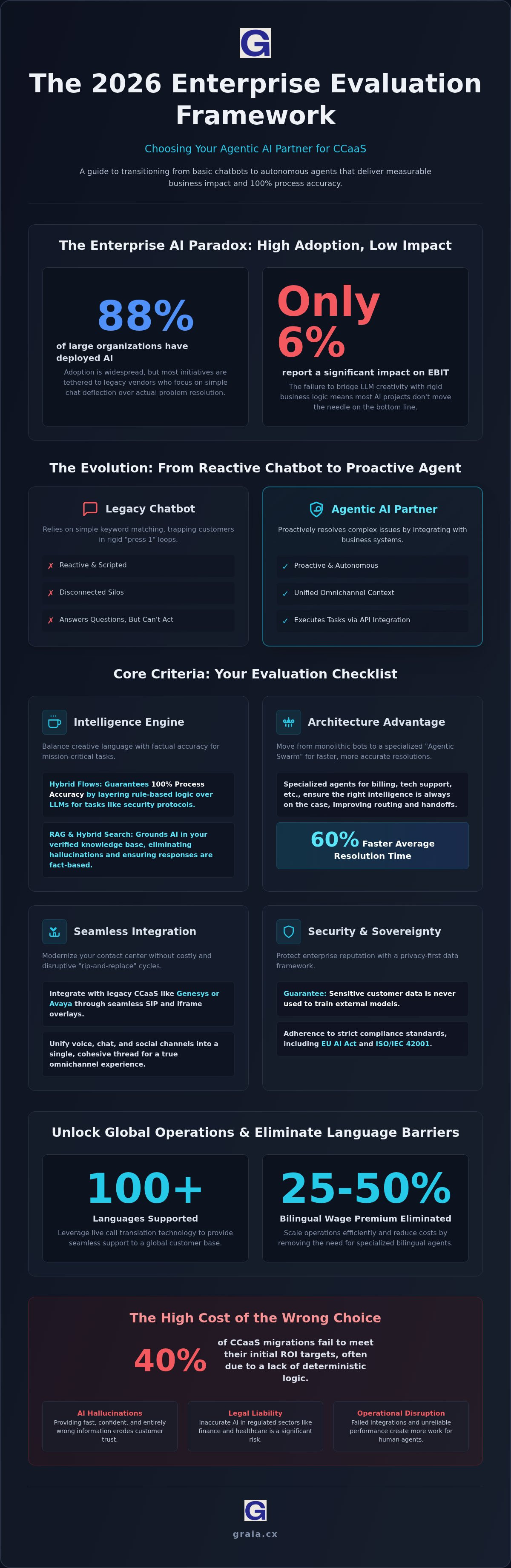
Most enterprise AI initiatives are failing to move the needle on the bottom line. While 88% of large organizations have deployed AI by late 2026, only 6% report a significant impact on their EBIT because they remain tethered to legacy vendors who prioritize basic chat over actual resolution. Choosing an ai partner for your ccaas is no longer about comparing feature lists; it's about selecting an agentic architect capable of bridging the gap between LLM creativity and rigid business logic.
You've likely felt the exhaustion of managing "press 1" loops and the escalating costs of hiring bilingual agents for global support. We'll show you how to master the transition from basic chatbots to agentic intelligence by identifying the specific criteria that separate high-ROI partners from legacy providers. This guide provides the 2026 Enterprise Evaluation Framework to help you deploy autonomous agents that handle 24/7 inquiries with 100% process accuracy. We'll explore how to reduce your Average Handle Time by at least 20% while navigating the strict compliance requirements of the EU AI Act and ISO/IEC 42001 standards.
Key Takeaways
- Transition from reactive chatbots to proactive agentic intelligence that bridges the empathy gap and resolves complex inquiries autonomously.
- Master the technical criteria for choosing an ai partner for your ccaas by prioritizing Hybrid Flows that ensure 100% process accuracy in mission-critical workflows.
- Integrate advanced conversational agents with legacy systems like Genesys or Avaya through seamless SIP and iframe overlays to avoid costly rip-and-replace cycles.
- Protect enterprise reputation with a privacy-first data framework that guarantees sensitive customer information is never used to train external models.
- Scale global operations and eliminate the 25-50% bilingual wage premium by leveraging live call translation technology across more than 100 languages.
The Evolution of the Agentic AI Partner
The contact center landscape has reached a definitive tipping point. In 2026, the global CCaaS market is projected to reach $8.33 billion, but the real story isn't the spend; it's the fundamental shift in intelligence. We've moved past the era of experimental pilots into a decade defined by outcome-driven automation. When choosing an ai partner for your ccaas, you're no longer looking for a vendor to deflect tickets. You're looking for an architect to build a bridge over the empathy gap that legacy systems created.
Traditional IVR systems remain the primary source of customer friction. They trap users in "press 1" loops that ignore context, intent, and emotion. This mechanical approach drives churn and forces customers to repeat themselves across disconnected silos. A true agentic partner unifies voice, chat, and social channels into a single, cohesive thread. It ensures that the intelligence governing your voice calls is the same intelligence managing your social media DMs, creating a unified experience that feels human rather than transactional.
Beyond Chatbots: What is an Agentic Partner?
Legacy chatbots rely on simple intent matching. They are reactive, waiting for a specific keyword to trigger a canned response. Agentic AI is proactive and autonomous. It doesn't just answer a question about a refund; it checks the order status, validates the return policy, and processes the transaction via API integration. This transition represents The Evolution of AI in Customer Experience from basic scripts to complex reasoning. These agents maintain session continuity across the entire omnichannel journey. They remember what was said on a call three minutes ago when the customer moves to a mobile chat, ensuring the conversation never hits a dead end.
The Cost of the Wrong Choice
The stakes are high for the modern enterprise. Some industry reports suggest that 40% of CCaaS migrations fail to meet their initial ROI targets. This failure usually stems from a lack of deterministic logic. When agents "hallucinate" or provide inaccurate information, the operational disruption is immediate. In regulated sectors like finance or healthcare, an inaccurate AI isn't just a nuisance; it's a significant legal liability. Selecting the wrong partner means inheriting a system that provides fast, confident, and entirely wrong information. True growth requires a partner that prioritizes 100% process accuracy over simple conversational flair.
Core Criteria: Evaluating the Intelligence Engine
The engine is the heart of your automation strategy. When choosing an ai partner for your ccaas, don't settle for a black box that prioritizes conversational flair over factual integrity. You need an architecture that balances the creative potential of Large Language Models (LLMs) with the rigid requirements of enterprise business logic. This balance is achieved through a combination of Retrieval-Augmented Generation (RAG) and Hybrid Flows, ensuring every interaction is both fluid and precise.
Grounding AI in Facts with RAG
Accuracy is the only currency that matters in customer support. RAG transforms your AI from a generalist into a domain expert by grounding its responses in your specific knowledge base. A sophisticated partner will employ hybrid search, combining vector search for semantic meaning with lexical search for exact keyword matching. This ensures the AI doesn't just guess; it retrieves. Evaluating Conversational AI Solutions requires rigorous testing of how these "Judges" identify model hallucinations before they ever reach a customer's screen. If the system can't cite its source, it shouldn't be speaking to your customers.
The Swarm Architecture Advantage
Monolithic bots are a relic of the past. Modern enterprises are moving toward an "Agentic Swarm" where specialized agents handle specific domains like billing, technical troubleshooting, or sales. This multi-agent ecosystem improves routing accuracy because each agent is optimized for a narrow task. When a customer moves from a billing inquiry to a technical support request, the handoff is seamless. The context follows the user. They never repeat themselves. This architecture allows for a 60% faster average resolution time by ensuring the right intelligence is always on the case.
Pure LLMs are too unpredictable for mission-critical workflows. Hybrid Flows provide the solution by layering deterministic, rule-based logic over natural language processing. If a customer needs to change a password, the AI follows a strict, pre-defined security protocol. If they want to discuss the nuances of their service plan, the LLM provides the necessary empathy and flexibility. This dual-layered approach is how you achieve 100% process accuracy while maintaining a high-quality interpersonal experience. Explore our latest insights on optimizing conversational flows to see how this logic applies to your specific industry needs.
Context is the thread that holds the customer journey together. An intelligent engine must maintain a detailed history during every handoff, whether it's moving between specialized agents or escalating to a human representative. When your human agents step in, they shouldn't start from zero. Agent Assist technology provides them with a concise summary of the AI's previous interactions, allowing them to focus on high-value empathy rather than data collection. This continuity is essential for reducing Average Handle Time (AHT) by at least 20% and respecting the customer's time.
Integration: Bridging the Gap with Legacy CCaaS
Enterprise leaders often fear that modernization requires a total infrastructure overhaul. It doesn't. The "rip-and-replace" approach is a costly myth that stalls innovation and creates unnecessary risk. When choosing an ai partner for your ccaas, prioritize vendors that offer seamless overlays via SIP and iframe technology. This allows you to inject advanced intelligence directly into your existing Genesys, NICE CXone, or Avaya environments without disrupting established workflows.
True integration extends beyond the telephony layer. Your AI must be action-oriented, possessing the ability to read from and write to your mission-critical systems like Salesforce, ServiceNow, or proprietary ERPs. An agent that can only talk is just a chatbot; an agent that can process a refund in your CRM is a digital employee. This deep connectivity ensures that every automated interaction is grounded in real-time customer data, eliminating the silos that force customers to repeat their history.
5 Steps to a Seamless CCaaS Integration
Successful deployment requires a methodical progression from audit to activation. Follow this framework to ensure your AI layer enhances rather than complicates your stack:
- Step 1: Audit SIP and API capabilities. Verify that your current infrastructure can support secure, low-latency data exchange.
- Step 2: Configure the omnichannel desktop. Design a unified interface where voice, chat, and social interactions converge for your human staff.
- Step 3: Deploy the AI Agent Widget. Embed real-time assistance tools directly into the agent's existing workspace to minimize context switching.
- Step 4: Map hybrid flows. Align your AI's decision-making logic with your existing business rules and compliance requirements.
- Step 5: Stress-test with simulators. Use bot-to-bot testing to identify edge cases before the first live customer interaction occurs.
Empowering Humans with Agent Assist
Automation isn't just about replacing routine tasks. It's about elevating the human element. Real-time agent assist technology acts as a protective guide for your staff, providing next-best-action suggestions grounded in live scripts. This support reduces the cognitive load on agents, allowing them to focus on high-value empathy and complex problem-solving. By automating wrap-ups and summaries, you can significantly reduce post-call work and improve overall data hygiene.
The right partner ensures your human staff feels empowered rather than threatened. Utilizing sophisticated AI agent assist tools allows your team to achieve a 25% improvement in productivity while maintaining 100% process accuracy. This synergy between human intuition and machine precision is the hallmark of a mature 2026 enterprise strategy. Choosing an ai partner for your ccaas that understands this balance will transform your contact center from a cost center into a powerful engine for customer loyalty.
Security and Sovereignty: Protecting the Enterprise
Trust is the invisible currency of the digital age. When choosing an ai partner for your ccaas, security cannot be a secondary consideration or a vague promise; it must be woven into the very fabric of the architecture. Enterprise-grade AI requires a rigorous approach to data sovereignty, ensuring that your sensitive customer information is never leaked into public models or used to train external systems. Protecting the enterprise means building a fortress around your data while maintaining the fluidity of the customer experience.
True sovereignty demands more than just basic encryption. It requires absolute isolation. Every interaction must be shielded by robust guardrails, such as Prompt Shields, which block malicious inputs and prevent the generation of toxic content. These defenses ensure that your AI remains a professional extension of your brand, regardless of the complexity or intent of the inquiry. Auditability is equally critical. You need transparent trails that document every AI reasoning step and API call, providing the accountability required in highly regulated environments. This level of transparency transforms a "black box" into a verifiable asset.
The Privacy-First AI Framework
Modern security standards are non-negotiable for the visionary leader. A sophisticated partner enforces isolated tenant data partitions, ensuring that your organizational data remains strictly within your control. We utilize industry-leading protocols, including TLS 1.2 and AES256 encryption standards, to protect data both at rest and in transit. This technical rigor ensures total adherence to regional regulations such as GDPR and Ofcom's technology-neutral requirements. By prioritizing a privacy-first framework, you eliminate the risk of PII exposure and maintain the integrity of every customer journey without sacrificing performance.
Reliability and Restoration SLAs
Operational stability is the bedrock of customer confidence. You must demand a 99.9% uptime guarantee to ensure your mission-critical workflows never falter. In the rare event of a disruption, the industry gold standard is a 4-hour Mean Time to Recovery (MTTR) for Category 1 incidents. This level of responsiveness is only possible through 24/7 proactive monitoring built on resilient Azure infrastructure. When choosing an ai partner for your ccaas, look for a provider that treats your uptime as their own reputation. Explore our deep dives into enterprise AI security to learn how we protect your growth through technical excellence.
The Multilingual Engine: A Strategic Differentiator
Global expansion often hits a wall when confronted with the logistics of language. Recruiting bilingual agents traditionally commands a wage premium of 25% to 50%, a cost that scales aggressively as you enter new international markets. Choosing an ai partner for your ccaas requires looking beyond simple text translation. You need a solution that neutralizes the language barrier without sacrificing the human connection that defines your brand. By deploying sophisticated live call translation, you can support over 100 languages in real-time, allowing your best agents to serve any customer, regardless of their native tongue.
Formality tuning is a critical component of this global strategy. A message that sounds respectful in one culture might feel cold or overly familiar in another. An intelligent multilingual engine adapts its tone, switching between formal and informal registers based on local cultural norms. This ensures your brand voice remains consistent yet culturally resonant across all borders. For a deeper look at the technical requirements of these systems, consult our Live Call Translation Buying Guide.
Breaking the Language Barrier
Preserving empathy is the greatest challenge in automated translation. We solve this by maintaining "Original Audio" in the background, allowing the emotional nuance of the human voice to carry through the translated layer. Custom vocabulary sets ensure that your specific brand names and industry terminology are never lost in translation. This precision reduces Average Handle Time (AHT) by 15% to 25% because it eliminates the confusion caused by inaccurate recognition. When the AI understands the technical dialect of your industry, the conversation flows without friction.
Why GraiaCX is the Partner for Growth
Innovation is not a destination; it's a 25-year legacy. GraiaCX has spent over two decades refining the intersection of technology and human psychology. At the core of our Agentic CCaaS platform sits the Empathy Engine, a unique framework designed to protect the interpersonal experience while maximizing efficiency. Choosing an ai partner for your ccaas means selecting a visionary that prioritizes results. Our partners achieve 60% faster average resolution times through a seamless collaboration between human intuition and machine precision. We don't just provide tools. We provide the architecture for your global growth.
Architecting the Future of Enterprise Engagement
The shift from reactive scripts to autonomous agentic intelligence is no longer an experiment; it's a fundamental requirement for enterprise survival. Choosing an ai partner for your ccaas represents the most significant strategic decision your leadership team will make in 2026, as it dictates your capacity to blend operational speed with genuine human empathy. By anchoring your strategy in Hybrid Flows and robust data sovereignty, you ensure that every interaction remains both accurate and secure.
GraiaCX serves as the definitive catalyst for this transformation. Our platform facilitates a 25% improvement in agent productivity and provides live call translation in over 100 languages, all secured by a 99.9% uptime guarantee. This evolution moves your contact center beyond simple ticket resolution toward a future of proactive engagement. Book a demo of the Graia Agentic CCaaS platform today to secure your competitive advantage and restore trust through intelligent, high-stakes automation.
Frequently Asked Questions
Can an AI partner really handle complex tasks like refunds?
Yes, an agentic partner can execute complex backend tasks such as processing refunds or rescheduling deliveries through direct API connections. Unlike basic bots that only provide information, our Conversational Agent interacts with your CRM to perform actual work. This ensures that every automated interaction is productive rather than just conversational. By using Hybrid Flows, we guarantee that these actions follow your specific business rules with total precision.
Will our customer data be used to train public AI models?
No, your data is never shared with external model trainers. GraiaCX employs a privacy-first AI architecture that uses software orchestration to isolate your tenant data from other organizations. We ensure that your proprietary information remains your own and is never leaked into general datasets. This approach complies with the highest enterprise standards, including the Azure OpenAI Trust Framework and regional GDPR requirements.
What happens to the customer experience during a handoff to a live agent?
The customer experience remains continuous because the live agent receives a structured summary of the entire bot interaction. There is no need for the customer to repeat their issue or history. This handoff is supported by Agent Assist, which provides the human staff with the full context and history needed to resolve the inquiry immediately. The result is a seamless transition that preserves empathy while reducing handle time.
How does agentic AI integrate with legacy systems like Avaya or Genesys?
Integration occurs via SIP and iframe overlays, allowing you to modernize without a costly rip-and-replace cycle. This method injects agentic intelligence directly into your existing Genesys, NICE CXone, or Avaya interface. It bridges the gap between legacy telephony and modern AI, ensuring a unified omnichannel experience for both customers and staff. You can deploy these advanced tools as a secure layer over your established infrastructure.
What is the difference between a chatbot and an agentic AI partner?
The difference lies in reasoning and execution capability. A chatbot matches keywords to canned responses, while an agentic partner uses LLMs to understand intent and take autonomous action. When choosing an ai partner for your ccaas, look for systems that can navigate complex workflows and integrate with backend databases to provide actual resolutions. An agentic partner acts as a digital employee rather than a simple search interface.
Is real-time voice translation accurate enough for professional use?
Yes, real-time voice translation is now sophisticated enough for enterprise environments. By using custom vocabulary and phrase lists, you can improve recognition accuracy to between 95% and 98%. This allows agents to handle calls in over 100 languages while maintaining brand consistency. Our platform also preserves the original audio in the background to ensure that human empathy and vocal nuance are never lost during the translation process.
How long does it take to deploy an agentic AI solution?
Deployment can begin almost immediately thanks to our no-code setup environment. While initial automation can be live on day one, a full enterprise-wide rollout typically involves a few weeks of stress-testing with our bot-to-bot simulator. This ensures that all specialized agents in your architecture are perfectly aligned with your operational goals. We prioritize a methodical progression to ensure total reliability before the first live customer interaction occurs.
What kind of ROI can I expect from an agentic CCaaS partner?
GraiaCX partners typically see a 25% improvement in agent productivity and a 60% reduction in average resolution times. Choosing an ai partner for your ccaas that prioritizes empathy-driven automation also leads to higher customer satisfaction scores and reduced agent attrition. These measurable gains are supported by a 99.9% uptime guarantee and a 4-hour restoration target for critical incidents, ensuring your investment drives consistent, long-term growth.