
CCaaS Platform Security Checklist for Risk Reviews
A security certificate alone can’t show whether a contact centre platform is ready for your risk review. A practical CCaaS platform security checklist should cover privacy and data processing, identity and access, incident response, security controls, and independent audits. Where GDPR applies, organisations must notify the relevant supervisory authority of a data breach within 72 hours, according to the European Union.
That’s why a thorough assessment looks beyond reassuring claims to the processes and evidence behind them. Understand how personal data is handled, who can access it, how incidents are managed, and how safeguards are tested.
This guide offers practical checks for UK organisations assessing a CCaaS platform. It covers data processing arrangements, access controls, incident plans, technical and operational safeguards, certifications, and audit evidence. Each point explains why it matters, helping you structure a review and identify key questions before procurement moves forward.
Key Takeaways
- Map the personal data a CCaaS platform processes to applicable privacy requirements, and review its data-processing terms, personnel safeguards and sub-processors.
- Assess access controls by reviewing authentication, permissions, user lifecycle processes and third-party integrations, not just password rules.
- Look for a documented incident process that covers containment, communications, recovery and lessons learned, with responsibilities clearly assigned.
- Review preventive, detective and corrective safeguards together to spot configuration gaps, exposed data and weaknesses in monitoring.
- Use current certification and independent audit evidence to understand which controls were assessed, over what period, and whether the scope fits your use case.
Privacy law compliance and data processing agreements
Start with a data map: identify every call recording, transcript, customer profile, and contact-centre system that handles personal data. Map personal-data flows to the privacy requirements that apply before assessing controls.
Set a retention schedule for recordings, transcripts, and other contact-centre data based on purpose and business need. Securely delete records when that purpose ends, including copies in backups and archives, and document how deletion is carried out.
Use this part of a CCaaS platform security checklist to connect contractual commitments with technical safeguards. For each check, identify the evidence your review needs and the risk it addresses.
- Document data roles and processing purposes in the agreement. Specify which party decides why data is processed, what the platform processes, and how it supports your instructions; this makes responsibilities easier to assess.
- Request a current list of third-party sub-processors. Record each sub-processor’s role and the data it can access, then assess whether those relationships fit your data map and obligations under GDPR.
- Check personnel safeguards and confidentiality commitments. Ask whether staff with access to company information sign the supplier’s non-disclosure agreement, and whether security training occurs at onboarding and is refreshed annually.
- Confirm encryption for stored and transmitted information. Check whether contact-centre data, including backups and archives, uses AES-256 at rest and TLS 1.2+ in transit; encryption limits exposure if storage or communications are intercepted.
- Map cloud infrastructure and data locations. Identify where production data, backups and support access are handled, then compare those locations with your organisation’s data-residency requirements and applicable GDPR obligations.
- Look for sensitive data exposure and overshared links. Review whether sensitive data is accessible only to intended users, and identify links shared too widely; SaaS security posture management (SSPM) can help expose oversharing within SaaS applications.
- Review separation between customers and supplier information. Ask how the platform logically separates your information from other customers’ data, and how that separation is tested; this helps reveal risks from misconfigured access.
- Check monitoring and deletion evidence. Review whether access and changes to sensitive records are logged, and how deletion is confirmed across active systems, backups and archives; monitoring can help identify unexpected access or retention.
Close the review by recording each answer, its supporting evidence, and any unresolved risks. This creates a practical privacy record for procurement and future reassessment.
Identity and access management
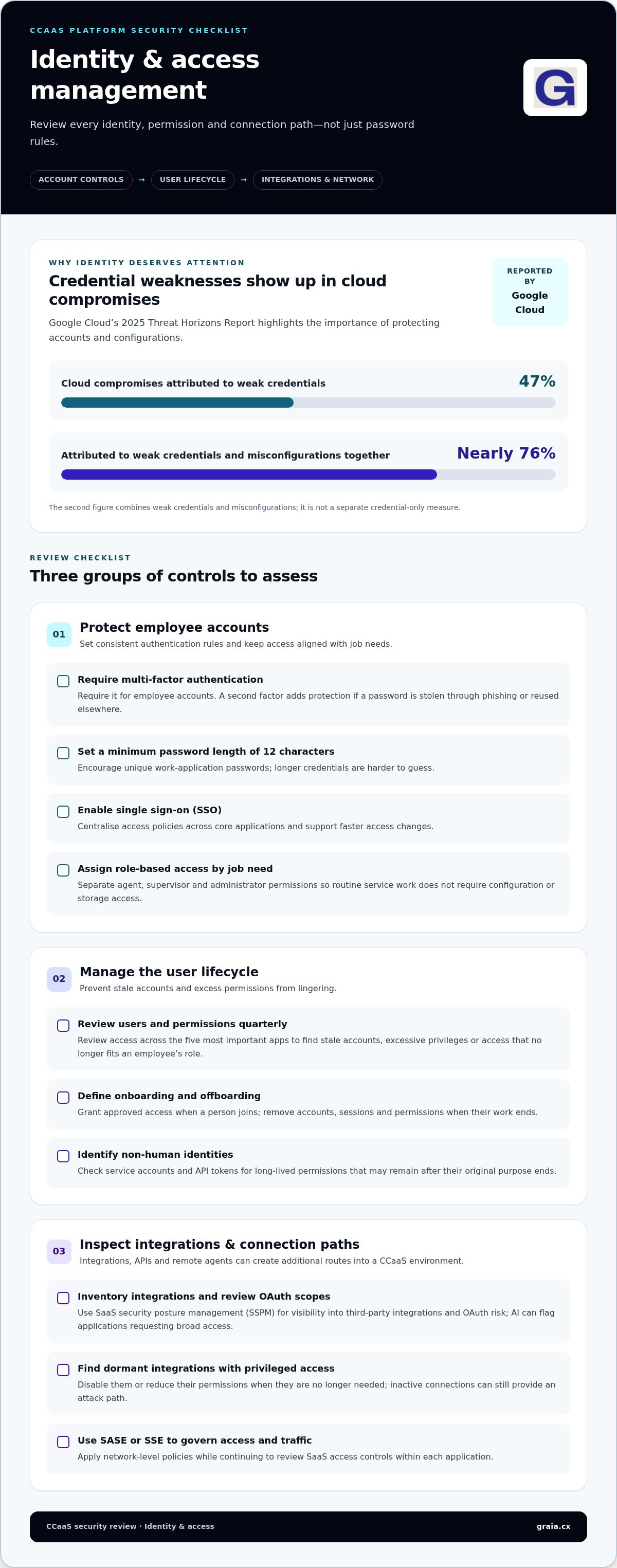
Integrations, APIs, and remote agents can create additional routes into a CCaaS environment. Overly broad tokens, unattended connections, and weak remote sign-ins can expose customer records or privileged functions. Review every identity, permission, and connection path.
Start with account controls. Google Cloud’s 2025 Threat Horizons Report attributes 47% of cloud compromises to weak credentials, and nearly 76% to weak credentials and misconfigurations together. These findings make identity protection a core part of a CCaaS platform security checklist, not an administrative afterthought.
- Require multi-factor authentication for employee accounts. A second factor adds protection if a password is stolen through phishing or reused elsewhere.
- Set a minimum password length of 12 characters. Longer credentials are harder to guess, especially when staff use unique passwords for work applications.
- Enable single sign-on and centralise access policies. SSO gives teams a consistent way to apply authentication rules across core applications and supports faster access changes.
- Assign role-based access by job need. Separate agent, supervisor and administrator permissions so routine customer-service work does not require access to configuration or storage controls.
- Review active users and permissions across the five most important apps quarterly. This review can reveal stale accounts, excessive privileges and access that no longer matches an employee’s role.
- Apply a defined onboarding and offboarding process. Grant approved access when a person joins, then remove accounts, sessions and permissions when their work ends to avoid leftover access.
- Identify non-human identities with long-lived permissions. Service accounts and API tokens can retain access after their original purpose ends, creating a less visible route for attack.
- Inventory integrations and review OAuth scopes. SSPM can provide visibility into third-party integrations and OAuth risk, while AI can flag applications requesting broad access.
- Find dormant integrations that retain privileged access. Disable or reduce permissions when a connection is no longer needed, because an inactive integration can still provide an attack path.
- Use SASE or SSE to govern access and traffic. These tools help apply network-level policies, while SaaS access controls still need review within each application.
For remote agents, assess how identity checks, device access, and application permissions work together. A managed connection alone doesn’t justify broad access; restrict each session to the systems and data needed for its task.
Map these checks across application, network, identity and access layers. For additional context on contact-centre security considerations, explore related guidance.
Incident response planning and breach communications
A written incident process turns detection into coordinated action. Under GDPR, organisations must notify the relevant supervisory authority of a data breach within 72 hours, according to the European Union. A CCaaS risk review should therefore establish who assesses an incident, who makes notification decisions, and how evidence reaches the people responsible.
Use this part of the checklist to test the plan against realistic contact-centre scenarios, not just policy language. A compromised agent account, exposed call recording, ransomware event, or failed integration can each affect customer data and service continuity in different ways.
- Obtain the documented security incident management process. It should explain how the supplier detects, assesses, escalates and handles incidents, so responsibilities don’t depend on informal conversations.
- Ask for disclosure of material service events or incidents from the previous 12 months. Review the event type, impact, response and remediation to understand how the written process worked in practice.
- Check the playbook covers phishing, ransomware and unauthorised access. Step-by-step instructions help responders contain familiar threats without improvising during a high-pressure event.
- Confirm the response plan covers cause, containment and affected-party notification. These steps help limit further exposure while teams assess who may be affected and what communications are needed.
- Look for root cause analysis, remediation and post-incident evaluation. These activities help identify why controls failed, address the weakness and feed lessons into updated procedures.
- Verify that the plan assigns decision-makers and escalation paths. Name the roles responsible for technical investigation, legal assessment, customer communications and executive decisions, including their hand-off points.
- Review the documented Business Continuity Plan and Disaster Recovery Plan. The plans should describe how contact-centre operations continue during disruption and how systems and data are restored.
- Test scenarios involving integrations and dependencies. For example, simulate a compromised connected application and establish how access is isolated without losing visibility of the incident.
- Check how evidence and incident records are preserved. Logs, timestamps, affected systems and response actions support investigation, accountability and later control improvements.
Exercise the playbook with operational, security, and communications teams. A tabletop scenario involving an exposed transcript can reveal unclear authority, missing contact routes, or delays in restricting access.
Align the supplier’s escalation process with your own breach response procedure. Record how incident facts will be shared, who evaluates regulatory obligations, and how updates reach affected parties. Clear responsibilities make a coordinated response more effective.
Preventive, detective, corrective, deterrent and compensating controls
A balanced control programme must prevent incidents, detect weaknesses, correct failures, deter misuse and compensate when safeguards cannot fully address risk. Misconfigurations accounted for 29% of cloud compromises in the 2025 Google Cloud Threat Horizons Report. Include SaaS configuration in the assessment, not infrastructure alone.
- Classify each safeguard by its control purpose. For example, access restrictions prevent unauthorised actions, monitoring detects them, and remediation corrects the weakness.
- Inventory every new cloud account, subscription, project, cluster and SaaS workspace within 24 hours. Assign ownership, enable logging and apply baseline policies before untracked assets create blind spots.
- Monitor configurations continuously for drift. SSPM can detect changes to SaaS settings, while CSPM tools protect cloud infrastructure; each covers a different layer.
- Use CASB monitoring to understand SaaS usage. Pair it with SSPM visibility and control inside SaaS applications, where exposed data, excessive permissions and misconfigurations may persist despite infrastructure controls.
- Schedule a quarterly AI sweep for SaaS security risk patterns. Security teams can use contextual rules and automation to prioritise meaningful alerts and reduce alert fatigue.
- Apply zero-trust principles to each access request. Evaluate identity, permissions and context instead of assuming that a user or device is safe because it has connected before.
- Assess biometric authentication where it is used. Review how biometric access is protected, what fallback method applies, and whether the control fits the system’s threat model.
- Use AI threat detection to flag unusual activity for review. For example, repeated access to unrelated customer records can prompt investigation, while a human analyst assesses context before action.
- Define corrective actions for each detected vulnerability. Assign an owner, record the change and retest the affected setting so teams can show whether remediation worked.
- Document compensating controls for gaps that remain. If a setting cannot be changed immediately, restricted permissions and enhanced monitoring can reduce exposure while the fix is planned.
- Use deterrent controls with clear enforcement. Communicate acceptable-use policies and apply consistent consequences for misuse, so staff understand that access activity is monitored.
Review controls across the full CCaaS environment, including integrations and connected services. Misconfigurations, overprivileged users, and exposed data in SaaS can remain unaddressed even when infrastructure is secured, access is controlled, and activity is monitored. Record each finding, its owner, and evidence of resolution. This turns continuous monitoring into a repeatable security programme rather than a one-off assessment.
Security certifications and independent audits
A certificate is a starting point, not a complete risk assessment. Review its scope, assessment period, and evidence against the contact-centre services, data flows, and integrations your organisation uses. A relevant report should help you judge whether documented practices address real threats.
For a CCaaS platform security checklist, map each requirement to a specific control and supporting evidence. For example, encryption at rest can map to SOC 2 CC6, NIST 800-53 SC-28, PCI DSS 3.5 or HIPAA §164.312(a)(2)(iv), depending on applicable obligations.
Payment card handling needs specific scrutiny. PCI DSS compliance is mandatory for contact centres that handle credit card payments. Ask for a current PCI DSS attestation certificate, then map payment-data flows, access permissions, encryption, and audit trails to the controls in scope.
- Review the SOC 2 report type and assessment period. SOC 2 Type I assesses controls at a single point in time, while Type II assesses security, availability and confidentiality over a sustained period, typically six to twelve months.
- Check the scope and boundaries of each certificate. Confirm that the assessed services, locations, systems and relevant subcontractors align with the platform functions your enterprise will use.
- Request recent external security audit evidence. Review available independent security audit evidence and consider whether it aligns with your organisation’s risk requirements.
- Review application and network-level penetration testing. Assess whether tests cover the relevant environments, how findings are prioritised, and whether remediation evidence addresses identified vulnerabilities.
- Map requirements to recognised frameworks. ISO 27001 is an internationally recognised standard for information security management systems; SOC 2 and GDPR can also inform control mapping where applicable.
- Inspect role-based permissions and audit trails. Check that records show who accessed sensitive systems, what actions they took and whether privileged activity receives appropriate review.
- Assess subcontractor security evidence. Identify sub-processors, their roles and access to data, then trace how their controls and audit findings are covered by the supplier’s assurance process.
- Record each finding and its owner. A control register linking evidence, gaps, remediation and accountable teams helps organizations track decisions beyond procurement.
Build a clear evidence trail before approval: record the control, the report or certificate supporting it, its scope and any open finding. Explore security review guidance to support your assessment process.
Broader mapping can also use the CSA Cloud Controls Matrix v4, which contains 197 cloud-specific control objectives across 17 domains, alongside NIST CSF 2.0.
GraiaCX: Conversational Agent
GraiaCX’s Conversational Agent helps organisations automate routine customer enquiries while keeping more complex interactions available for human support. Its Agentic Omni-Channel Platform brings voice, chat, email, and social messaging together, helping teams coordinate customer conversations across channels.
For live interactions, Agent Assist provides real-time suggestions such as next-best actions, while Live Call Translation supports multilingual conversations in over 100 languages. These capabilities can be relevant when your security review is complete and you’re assessing how automation, agent support and channel integration fit your contact-centre needs. Evaluate those functions alongside the privacy, access and assurance controls covered in this checklist.
Contact GraiaCX to discuss how its contact-centre capabilities can support your organisation’s requirements.
Turn your security review into a confident next step
A CCaaS platform security checklist is most valuable when it informs decisions beyond procurement. Use its findings to shape ongoing governance, clarify ownership across teams, and set a review cadence that reflects changes to your contact-centre environment. This makes a point-in-time assessment a practical part of operational planning.
When considering how customer conversations should work across channels, discuss security alongside service design. GraiaCX offers a Conversational Agent, Live Call Translation, and Agent Assist for automated interactions, multilingual conversations, and real-time agent assistance. Assess these capabilities alongside your organisation’s requirements for oversight, access, and data handling.
Bring your priorities and review findings into the next conversation. Contact GraiaCX to discuss security and explore how your contact-centre needs can guide the next step. A clear, deliberate review gives your teams a stronger foundation for progress.
Frequently Asked Questions
What security features should a CCaaS platform provide?
Look for controls that protect customer information and service operations. A CCaaS platform security checklist can help assess tenant separation, encryption, role-based permissions, audit logs, vulnerability testing, and configuration monitoring. Match each feature to a real workflow, then identify who reviews alerts and acts on findings. For example, check who can access call recordings and whether changes to call-routing rules are logged.
What should a CCaaS security assessment checklist include?
Include data flows, integrations, identity controls, incident procedures, recovery arrangements, and independent assurance. A useful CCaaS platform security checklist links each risk to evidence, an owner, and a decision. Record unresolved findings, compensating safeguards, and approval status. For example, document whether customer-record exports are restricted, logged, and reviewed, rather than noting only that access control exists.
How do CCaaS providers protect customer data in transit and at rest?
Providers protect data in transit through encrypted connections and stored information through encryption at rest, including relevant backup copies. Examine key management: who can access keys, how access is restricted, and how key changes are controlled. For a voice interaction, trace a recording from capture through storage, retrieval, and deletion to identify where protections must apply.
What access controls and identity management should a CCaaS platform support?
A platform should support individual accounts, role-based permissions, and strong authentication, with access limited to each person’s duties. Assess controls for API credentials and connected applications as well as employee logins. For example, an integration that reads customer records may not need permission to change account details. Check how access is granted, reviewed, revoked, and recorded when responsibilities change.
Which UK GDPR and Data Protection Act 2018 requirements apply to CCaaS platforms?
UK GDPR and the Data Protection Act 2018 are central when assessing CCaaS processing of personal data in the UK. Map what information the platform handles, why it is processed, who determines those purposes, and which parties process it on another organisation’s behalf. Assess how arrangements address data subject rights, retention, security, transfers and processor terms for each relevant data flow.
How should organisations assess CCaaS disaster recovery, incident response and business continuity?
Assess whether recovery plans are documented, assigned to responsible roles, and tested against realistic disruptions. Ask how teams restore service and data, communicate during an outage, and prioritise essential contact-centre functions. Define your recovery time and data-loss tolerances, then compare them with the plan’s capabilities. An exercise involving the loss of a key integration can reveal dependencies that written procedures overlook.
What PCI DSS controls are needed when handling payment card details in a CCaaS contact centre?
PCI DSS compliance is mandatory for contact centres handling credit card payments. Request a current PCI DSS attestation certificate and verify payment data, including backups and archives, is encrypted at rest with AES-256 and in transit with TLS 1.2+; the checklist maps encryption at rest to PCI DSS 3.5.