
Calculating ROI After AI Implementation: A Practical 2026 Guide
A forecast is not proof of value. The real test begins after launch, when leaders need to separate AI’s contribution from shifts in demand, staffing or processes. That’s the challenge of calculating roi after ai implementation: turning measured operational changes into credible financial outcomes.
If projected benefits don’t match what teams see in practice, you’re not alone. Contact-centre improvements such as faster handling, fewer repeat contacts or more resolved interactions can be difficult to translate into business value. Implementation and ongoing costs are also easy to overlook. A reliable calculation makes its assumptions visible and accounts for the full cost of ownership.
This guide explains how to connect measures such as cost per resolution, autonomous resolution, agent handling time and first-contact resolution to financial impact. It also covers customer experience, human handoffs and ways to distinguish AI’s impact from other operational changes. You’ll learn how to build a baseline, evaluate results and decide whether to optimise, expand or redesign a deployment. GraiaCX’s conversational agents, Agent Assist and reporting integrations can help organisations examine value across automated interactions and human support.
Key Takeaways
- Separate forecast benefits from post-launch results by comparing measured outcomes with a clear pre-implementation baseline.
- When calculating roi after ai implementation, include attributable benefits and the full costs of deployment and ongoing operation.
- Connect contact-centre measures such as resolution, repeat contacts and handling time to financial value using evidence, not assumptions.
- Track service quality, customer experience, adoption and human handoffs alongside financial outcomes to build a balanced view of performance.
- Use the results to decide whether to optimise, expand or redesign the AI workflow, and keep reviewing its value over time.
Why calculate ROI after AI implementation instead of relying on forecasts?
A business case is a hypothesis, not a result. Before launch, a contact-centre forecast may assume that an AI system will handle a certain share of interactions or give agents more time for complex enquiries. After launch, realised value depends on what customers use, how well the AI performs in real workflows and whether the organisation converts released capacity into a financial benefit.
Projected ROI estimates the value an AI deployment could deliver; measured post-launch ROI compares evidenced benefits with the full costs incurred during the same assessment period. A rise in automated interactions is an operational observation, not proof of savings. Leaders need a documented baseline, agreed assumptions and evidence linking observed changes to financial outcomes before claiming impact.
The Return on Investment (ROI) concept provides a general framework for comparing gains with investment. Applied to AI, the comparison must reflect the whole deployment, not just a headline performance metric or an initial business-case estimate.
What does post-implementation AI ROI actually measure?
ROI is a financial comparison, not a synonym for containment, faster handling or agent productivity. Assess it by separating three things: attributable and valued benefits, the full costs of deployment and operation, and the period being measured. Include applicable implementation, integration, training, monitoring and optimisation costs, alongside recurring platform and infrastructure costs. Use consistent boundaries so benefits and costs relate to the same workflow and timeframe.
Not every valuable outcome has an immediate, defensible cash figure. Better customer experience, clearer human handoffs or improved agent confidence may support long-term performance, even when finance can’t assign them a reliable monetary value. Record these outcomes alongside financial ROI rather than inflating the return with speculative estimates.
Why can an AI business case look different after launch?
Actual adoption rarely matches a forecast perfectly. Customers may use AI for different reasons than expected, some interaction types may be harder to resolve, and agents may adapt their workflows over time. These factors affect realised outcomes. For example, reduced handling time creates potential capacity, but it becomes a recognised financial benefit only if the organisation can show how that capacity was used, such as handling more demand or reducing paid overtime.
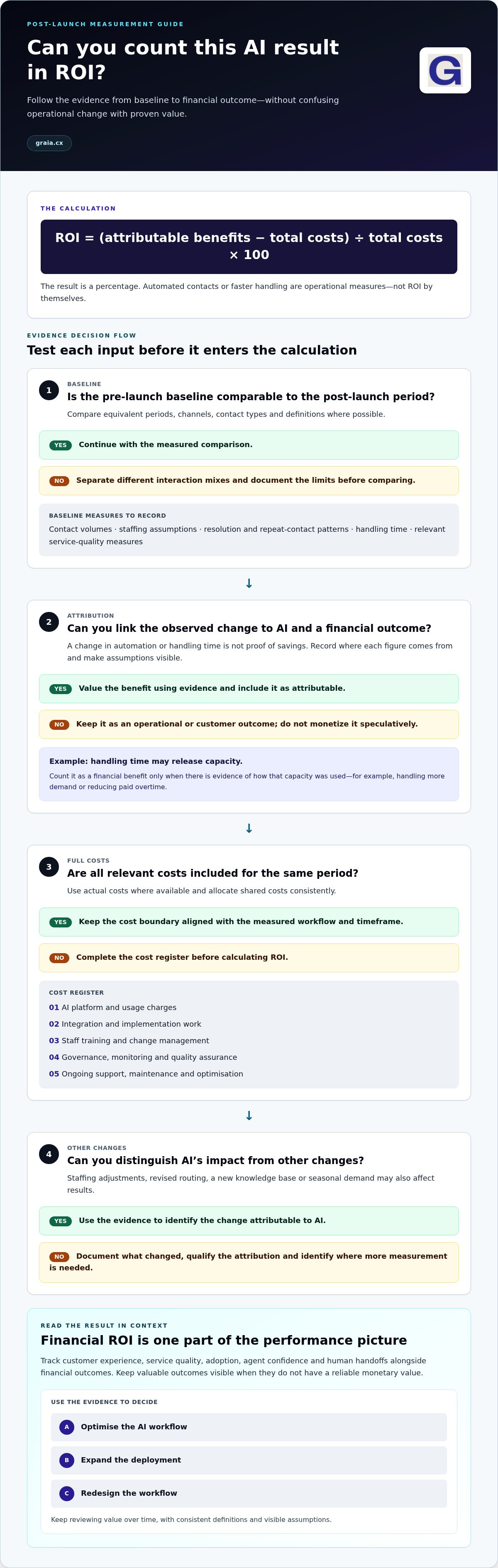
Attribution matters when other changes happen at the same time. A new knowledge base, staffing adjustment, revised routing or seasonal shift in contact volumes could also affect results. Compare like-for-like periods and interaction groups where possible, document assumptions, and note what changed beyond the AI deployment. This gives finance and operational teams a more credible basis for deciding what value to count, what to report separately and where further measurement is needed.
How to calculate ROI after AI implementation: a transparent method
Use one formula, then make every input traceable:
ROI = (attributable benefits minus total costs) divided by total costs, multiplied by 100.
A credible ROI calculation needs evidenced benefits, all relevant costs and a defined measurement period. The result is a percentage, not a count of automated contacts or a change in handling time. When calculating roi after ai implementation, keep assumptions visible so operational leaders and finance teams can understand, challenge and reproduce the calculation.
Set the baseline and define the measurement period
Start with a pre-launch baseline that describes the operation the AI is intended to affect. Record contact volumes, staffing assumptions, resolution and repeat-contact patterns, handling time, and relevant service-quality measures. Compare these figures with a post-launch period of the same length where possible, using equivalent channels, contact types and definitions. Note seasonal peaks, unusual events, policy changes or shifts in demand that could distort the comparison.
Document where each figure comes from, what it includes or excludes, and who validates it. If the AI handles a different mix of enquiries after launch, separate those interactions rather than treating the overall change as directly comparable. Clear definitions now can prevent avoidable disputes later.
Separate realised benefits from full implementation costs
Count a benefit in pounds only when there’s a defensible link between the observed change and a financial outcome. For example, reduced handling time may create available capacity; value it as a saving only if the organisation can show how that capacity affected costs or output. Keep customer and employee outcomes visible as important measures, but separate them from monetised benefits unless a reliable valuation method exists.
Build a cost register for the same period. Include applicable costs such as:
- AI platform and usage charges
- Integration and implementation work
- Staff training and change management
- Governance, monitoring and quality assurance
- Ongoing support, maintenance and optimisation
Use actual costs where available, allocate shared costs consistently, and avoid counting an expense in more than one category. Distinguish one-off implementation costs from recurring costs, while ensuring the ROI period includes the costs relevant to it.
For a simple illustrative calculation, label validated benefits as B and total costs as C. Then ROI = ((B − C) ÷ C) × 100. If benefits and costs are equal, ROI is 0%; if benefits are lower, the result is negative. Replace the variables with your organisation’s evidence, not an industry average.
Keep the calculation auditable by retaining source reports, agreed metric definitions and notes explaining attribution. Graia’s conversational agents can take actions through system integrations and escalate to human agents, while reporting integrations help teams examine workflow evidence alongside business data. For further practical perspectives on AI and contact-centre measurement, explore Graia’s contact-centre insights.
Which AI outcomes create financial value, and which metrics are only signals?
Operational metrics show what changed. They don’t automatically show what that change was worth or prove that AI caused it. For credible ROI, connect each measure to a financial outcome through evidence of avoided work, demonstrable capacity use or another validated business effect. The table offers a starting point for that analysis.
| Operational measure | Possible financial value | Evidence to support the link |
|---|---|---|
| AI containment or resolution | Potentially less human-agent work per fully resolved enquiry | Confirmed resolution, no repeat contact for the same issue within the defined period, and a supported estimate of the work that would otherwise have occurred |
| Repeat contacts | Reduced handling effort if avoidable follow-ups decline | Consistent contact reason and repeat-contact definitions, plus comparison of equivalent interaction groups |
| Agent handling time | Capacity that may support more work or lower costs | Comparable workload and quality data, with evidence showing how released time was used |
| Agent productivity | More resolved work from available staffing capacity | Issues resolved per paid hour, interpreted alongside complexity, quality and escalation levels |
| Customer experience | Potential longer-term value, if a defensible valuation method exists | Consistent satisfaction measures linked to retention, reduced complaints or another evidenced business outcome |
These are possible links, not automatic savings. A containment rate can rise while customers still contact the centre again, and shorter handling time can reflect rushed interactions rather than improved efficiency. Check resolution quality, repeat contacts and escalations before assigning financial value. Customer satisfaction and agent experience also matter, but keep them distinct from monetised returns unless the organisation can explain and substantiate the valuation.
Connect contact-centre measures to defensible business outcomes
For each metric, define the counterfactual: what work, cost or outcome would likely have occurred without AI? Attribute avoided work only where contact records, workflow evidence or a suitable comparison supports that conclusion. Assess time saved alongside quality and subsequent demand. If an AI interaction escalates to an agent, measure the complete journey rather than treating the handoff itself as a successful resolution. This reflects customer outcomes as well as operational efficiency.
How can teams test whether AI caused the change?
Compare similar workflows or customer cohorts before and after launch where the data allows, and record differences in staffing, policies, channels, demand and processes. A control group or phased rollout can strengthen the comparison when practical, but no method removes every uncertainty. Document limitations and confidence in the findings. For teams calculating roi after ai implementation, a clearly qualified estimate is more credible than presenting correlation as proven causation.
How to track AI ROI over time and improve the measurement
AI value isn’t a one-off calculation. Adoption, workflows and costs evolve after launch, so set a recurring review rhythm that follows implementation stages and fits existing business reporting. Early reviews can surface operational issues; later reviews can test whether financial outcomes are sustained. Keep measures consistent between reviews so leaders can see progress rather than changes in how results are counted.
Use a shared dashboard or reporting pack to bring financial outcomes together with service quality, safety, adoption and human-handoff indicators. Assign owners for source data, metric definitions, cost inputs and executive review. Record assumptions and changes so the calculation remains traceable and useful for decisions.
Create a practical post-launch measurement plan
During rollout, review adoption, interaction outcomes and handoffs often enough to spot workflow friction. Assess financial outcomes on a cadence aligned with finance reporting, allowing enough time for results to stabilise. Keep a change log alongside the measures, noting adjustments to workflows, prompts, integrations, knowledge content and staffing. Reviewers can then assess whether a change in results reflects AI performance, an operational change or both.
Make accountability explicit. Data owners should validate source reports, operational leads should confirm metric definitions, finance should review cost and benefit assumptions, and an executive sponsor should act on findings. A dashboard is useful only when people trust what it shows.
Use ROI findings to choose the next improvement
Weak results don’t always mean the AI itself is the problem. Examine the operating conditions behind them: low adoption may call for workflow or training changes; unresolved enquiries may point to knowledge gaps or integration limits; rising escalations may show where human support needs refinement. Test targeted adjustments against agreed service and financial measures before expanding automation. Avoid scaling based on one headline metric alone.
For teams calculating roi after ai implementation, an integrated view can make patterns easier to investigate. Graia’s Power BI integration supports custom enterprise reporting, helping organisations bring operational measures into business reviews. Use that visibility to identify a specific improvement, assign an owner and assess the result before deciding what to change next.
Keep reporting useful to decision-makers. A compact review can show the period assessed, financial results, service and safety indicators, adoption, handoffs, material assumptions and agreed actions. If a result is uncertain, label it and explain what evidence would strengthen the next review. This protects credibility while giving teams a practical route to better performance.
For broader value-planning context, explore Graia’s Contact Centre ROI with AI guide. To continue exploring measurement and contact-centre AI, browse Graia’s AI insights.
How Graia helps teams make AI value measurable and actionable
AI value becomes clearer when teams can trace what happened across a complete customer-service workflow, not just count automated interactions. Graia’s agentic contact-centre platform includes conversational agents that understand customer intent, take actions through integrations and escalate to human agents. These capabilities create distinct measures, but they don’t guarantee a financial result. ROI still depends on implementation, adoption, costs and the organisation’s ability to validate outcomes.
For a conversational agent, teams can examine whether an enquiry was resolved, whether the customer returned about the same issue, and whether an escalation reached an agent with useful context. For Agent Assist, they can assess whether staff use real-time guidance and next-best-action suggestions, then test for validated changes in agent work, quality or customer outcomes. Omnichannel engagement also calls for channel-specific analysis: a change in one channel may not represent the full service operation.
Measure automation and human collaboration as one operating model
Count completed resolutions alongside escalations, repeat contacts and the quality of information passed to agents. A handoff isn’t automatically a failure; it may be the right response to a complex need. Assess Agent Assist through observed adoption and evidence of changed work, not availability alone. Keep customer satisfaction and agent experience visible beside financial measures, even when a credible monetary valuation isn’t available.
Turn reporting into a confident next-step decision
Consistent reporting depends on linking interaction evidence to relevant operational and business data. Graia integrates with contact-centre platforms and business systems, and its Power BI integration supports custom enterprise reporting. Teams can use these connections to examine workflow measures together, apply agreed definitions and clarify data ownership, then decide whether to optimise, expand or redesign a deployment.
Measurement should also account for responsible operation. Set out how data is handled, who can access reporting, how changes are governed and when human review or fallback is appropriate. These considerations help teams interpret results in context and assess service quality alongside financial outcomes. For organisations calculating roi after ai implementation, this broader view helps turn evidence into a decision rather than a dashboard of disconnected metrics.
To explore how platform capabilities have developed from chatbots towards agentic intelligence, read Graia’s AI customer service platform evolution. Then explore Graia’s AI and CX insights to identify which workflows and measures deserve attention in your next review.
Make your next AI review a decision point
Use calculating roi after ai implementation as a prompt to choose what your organisation should learn next, not simply to defend an earlier forecast. Select a workflow where the evidence is incomplete or the outcome matters most. Before making changes, agree what success should look like for customers, agents and the business. That gives the next review a clear purpose.
For example, a measurement plan can follow a conversational agent from an action taken through an integration to either resolution or human escalation. It can assess whether Agent Assist guidance and next-best-action suggestions are used in practice, then identify validated changes. Graia’s Power BI integration supports custom enterprise reporting, helping bring measures into a shared review without treating a dashboard as proof of impact.
The next step is practical: identify the workflow, evidence gap and decision owner for your next review. Use what you learn to refine the measurement plan and guide responsible improvement.
Explore Graia’s AI and customer experience insights to shape your next review. Clear priorities and honest evidence can help your team move forward with confidence.
Frequently Asked Questions
What is the formula for calculating ROI after AI implementation?
Use this formula: ROI = ((attributable benefits − total costs) ÷ total costs) × 100. For calculating roi after ai implementation, apply it to measured results, not the original forecast. Define which interactions count, how benefits are valued and which expenses belong to the same period. The percentage is meaningful only when the inputs, baseline and assessment window are clear.
When should a business measure ROI after implementing AI?
Start before launch by recording the baseline, then continue measuring after deployment rather than relying on an immediate snapshot. Early reviews can reveal whether staff and customers are using the workflow as intended; later reviews can show whether results persist under ordinary operating conditions. Align review points with rollout stages and finance reporting. If a seasonal peak or major policy change affects a period, flag it so decision-makers can interpret the comparison in context.
Which costs should be included when calculating AI ROI?
Include costs that apply to the deployment and the period being assessed. Depending on the project, these may include platform access, implementation, integration, training, governance and ongoing operation. Use actual project records, such as invoices, internal time allocations and operational budgets, and document how shared expenses are apportioned. Assign each cost to one category only. A visible assumptions log helps reviewers understand exclusions and prevents estimates from being mistaken for recorded expenditure.
Can AI ROI be positive without reducing headcount?
Yes. AI may help a team handle more demand with existing capacity, improve service outcomes or let agents focus on complex cases without reducing headcount. Report released capacity separately from labour savings unless there’s evidence of a financial change, such as reduced overtime or avoided additional staffing. If agents use saved time to resolve a growing queue, measure the extra completed work and its business value rather than labelling all time saved as cash savings.
How do you prove that AI caused an improvement in contact-centre performance?
A before-and-after difference alone can’t prove causation. Record the baseline, then compare similar workflows or customer groups where practical, taking account of changes such as staffing, channel mix, demand, policies or processes. Compare like-for-like enquiry types rather than overall averages if the contact mix has shifted. State what the data can and can’t establish, note assumptions, and describe confidence plainly so leaders can distinguish observed change from supported attribution.
Which metrics should be included in an AI implementation ROI analysis?
Choose measures that match the use case, such as automated resolution, repeat contacts, handling time, escalations, service quality, adoption and customer experience. Define each consistently; for example, specify what counts as a resolved interaction and how a repeat contact is identified. Treat metric changes as evidence to investigate, not financial value by themselves. Link each measure to a supported business outcome, and check that related effects, such as saved time and reduced workload, aren’t counted twice.
How often should a company review AI ROI?
Set review frequency around the organisation’s reporting cycle and the maturity of the deployment, rather than applying one timetable to every project. Review operational signals often enough to catch adoption or workflow problems, then assess business outcomes over a period suitable for the use case. Keep definitions stable between reviews, and record material changes to staffing, integrations, workflows or demand. This makes each comparison more useful and gives teams a clearer basis for adjusting the next measurement cycle.