
Automating After Call Work: A 2026 Guide to Reducing Burnout and Boosting Efficiency
Your most talented agents aren't leaving because the customers are difficult; they're leaving because the administrative burden is soul-crushing. While the global contact centre market scales toward £380 billion in 2026, the average advisor still spends a significant portion of their shift trapped in a cycle of manual data entry and summary drafting. It's a systemic failure that drains morale and inflates operational costs. We know the traditional wrap-up process is a relic of a slower era. By automating after call work, you can finally bridge the gap between technical precision and human empathy, transforming a tedious chore into an invisible, background process.
You deserve a contact centre where documentation is flawless and your team is free to focus on high-value human connection. This guide reveals how to leverage agentic AI to recover thousands of hours, reduce Average Handle Time by up to 70 per cent, and eliminate the administrative fatigue that drives attrition. We'll explore the transition from simple automation to intelligent, hybrid workflows that ensure total process accuracy while protecting your most valuable asset: your people.
Key Takeaways
- Identify the three pillars of the "administrative tax" and learn how to reclaim thousands of hours currently lost to manual wrap-up tasks.
- Master a structured five-step framework for automating after call work that uses real-time transcription to ensure total documentation accuracy.
- Evolve from passive AI summaries to agentic execution, allowing your system to proactively trigger follow-up actions and CRM updates without human intervention.
- Close the "empathy gap" and reduce agent turnover by replacing repetitive admin work with high-value, complex problem-solving opportunities.
- Discover how to stress-test your automated workflows using advanced simulation tools to guarantee seamless performance across every customer interaction.
What is After Call Work and why is it the silent killer of CX?
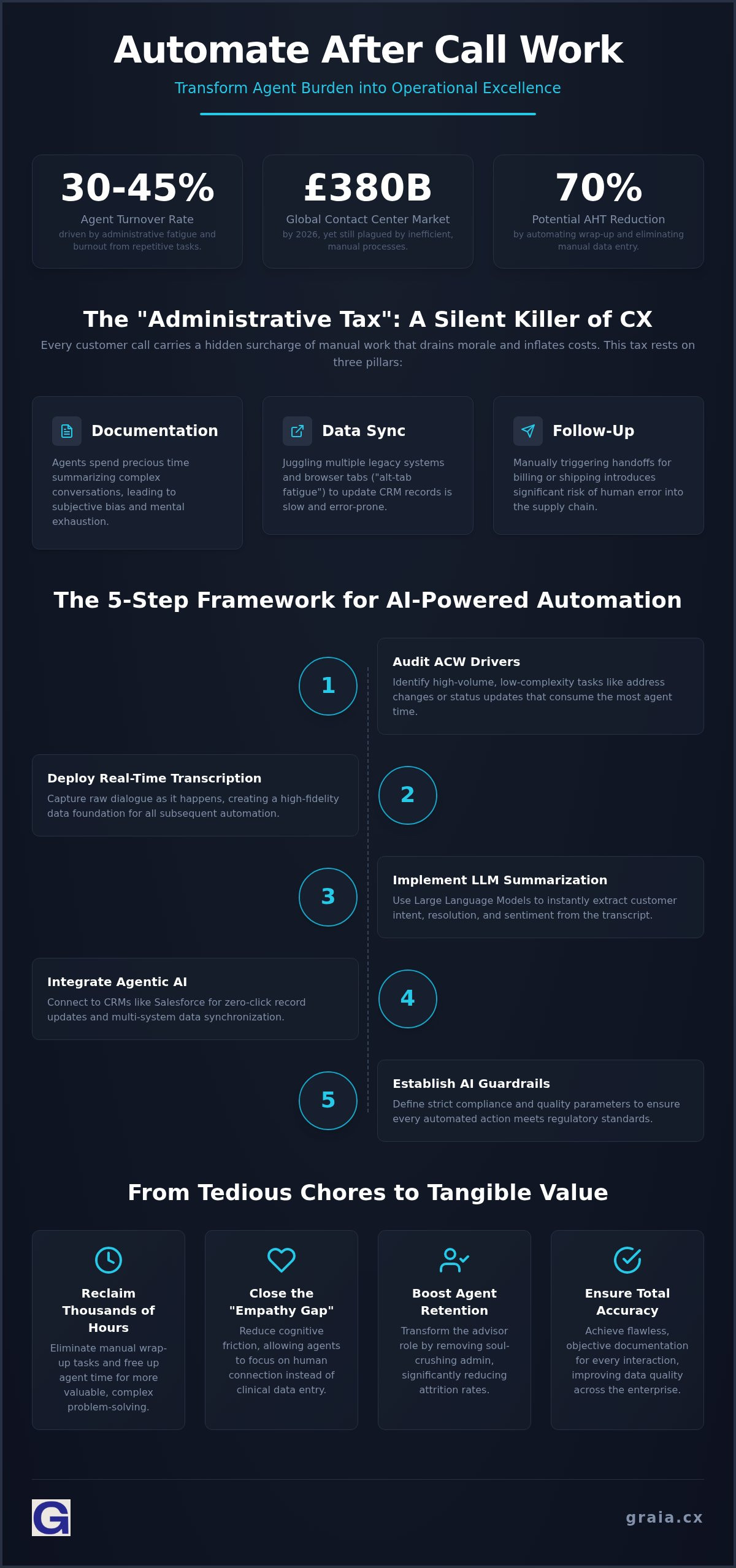
Every interaction in a modern call centre carries a hidden surcharge. We call this After Call Work (ACW), but it's more accurately described as an administrative tax paid after every customer conversation. This post-call phase is where the momentum of a successful resolution often dies, buried under the weight of manual data entry and system updates. It rests on three foundational pillars: the documentation of the interaction, the synchronisation of CRM data, and the activation of various follow-up triggers across the business.
The mental toll of this process is often overlooked by leadership. Agents must pivot instantly from deep emotional empathy to cold, clinical data entry. This cognitive friction doesn't just slow things down; it actively erodes the emotional reserves of your best people. In 2026, manual wrap-up has transitioned from a minor inefficiency to a massive enterprise liability. With agent turnover rates persisting between 30% and 45%, forcing humans to perform robotic tasks is a recipe for attrition. Automating after call work is no longer a luxury for the innovative; it's a survival strategy for the resilient.
The components of manual wrap-up
- Summarising complex intent: Distilling a ten-minute emotional grievance into a concise, accurate three-sentence summary is mentally taxing and prone to subjective bias.
- Navigating legacy systems: Agents often juggle multiple browser tabs and disconnected databases to update customer records, leading to what we identify as "alt-tab fatigue."
- Manual handoffs: Triggering departmental requests for billing adjustments or shipping updates manually introduces significant risk of human error into the corporate supply chain.
The true cost of inefficiency
Excessive ACW doesn't just inflate Average Handle Time (AHT); it bleeds operational spend through extended queue times and increased staffing requirements. There's a direct, measurable correlation between wrap-up fatigue and a decline in First Contact Resolution (FCR) as exhausted agents rush their notes to reach the next caller. By automating after call work, enterprises don't just save time; they restore the human dignity of the advisor role and ensure that every data point captured is precise and actionable.
After Call Work is the primary barrier to contact centre scalability.
How to automate after call work: A 5-step implementation framework
Transformation requires a blueprint. Moving beyond the "administrative tax" of manual entry involves a structured transition from human-led documentation to AI-orchestrated execution. Modern Conversational AI for Customer Service has evolved into a sophisticated engine capable of managing complex post-call requirements across diverse enterprise ecosystems. To begin automating after call work effectively, follow this five-step architecture:
- Step 1: Audit ACW drivers. Identify high-volume, low-complexity tasks such as address verification or refund status updates that consume the most time.
- Step 2: Deploy real-time transcription. Capture raw dialogue as it happens, creating a high-fidelity data foundation for subsequent automation.
- Step 3: Implement LLM summarisation. Utilise Large Language Models to instantly extract customer intent, resolution status, and emotional sentiment from the transcript.
- Step 4: Integrate Agentic AI. Connect your automation layer with CRMs like Salesforce or Dynamics 365 to enable zero-click record updates and multi-system synchronisation.
- Step 5: Establish AI guardrails. Define strict compliance parameters to ensure every automated note meets regulatory and internal quality standards.
Capturing the context in real-time
The foundation of any wrap-up automation is the quality of the live data stream. By utilising Live Call Translation, enterprises can capture multilingual interactions and convert them into a standardised language for analysis, removing barriers for global teams. Speech-to-Text (STT) technology acts as the essential bridge, but the real intelligence lies in original audio sentiment detection. This captures the nuances of a customer's tone, ensuring the final summary reflects the emotional reality of the call rather than just the literal words spoken. For more insights on building these intelligent foundations, explore our latest guides on the Graia blog.
Refining the output with Hybrid RAG
Precision is the antidote to AI hallucinations. We employ Retrieval-Augmented Generation (RAG) to ensure that every automated summary is grounded in the specific facts of the interaction and the company's internal knowledge base. This "swarm" of specialised AI agents works in parallel to verify data against multiple sources before committing it to the CRM. Hybrid search improves documentation accuracy by 95%. This methodology guarantees that follow-up emails and internal logs maintain a consistent brand voice while eliminating the factual drift often found in manual note-taking.
By automating after call work through this multi-layered approach, you aren't just saving seconds; you're engineering a more reliable, data-driven future for your entire operation.
Beyond summaries: Triggering action-driven automation
Traditional automation often stops at the summary. It records what happened but leaves the "what happens next" to the human advisor. We distinguish between Passive AI, which merely documents, and Agentic AI, which executes. Automating after call work reaches its full potential when the system takes the lead in resolving the customer's request. It's the difference between reading a transcript of a problem and watching that problem dissolve in real-time through automated execution.
Graia’s "Swarm" architecture is the engine behind this shift. Instead of a single, overstretched model, we deploy a network of specialised agents to handle specific post-call tasks in parallel. One agent updates the CRM, another verifies shipping status via API, and a third calculates a pro-rata refund. This modular approach removes the friction of departmental handoffs. It ensures customers never have to repeat their story to a billing specialist after already explaining it to a support advisor, as the data has already been processed and shared across the enterprise ecosystem.
Seamless CRM and ERP synchronisation
Action-oriented AI doesn't just log a case; it interacts with your core business systems to complete the job. By integrating directly with Microsoft Dynamics 365, ServiceNow, or bespoke ERPs, the system can initiate transaction processing, refund initiation, and booking updates instantly. We utilise deterministic hybrid flows to ensure these actions are governed by strict business logic. This eliminates the "fat-finger" errors common in high-pressure environments, providing a level of data integrity that manual entry simply cannot match. It transforms the CRM from a passive graveyard of notes into a dynamic, living record of resolution.
Intelligent follow-up orchestration
The wrap-up process frequently includes the promise of a follow-up. Our platform automates this by entering "Email Draft Mode," where a personalised, context-aware response is generated for the agent to review and send with a single click. Beyond email, the system can schedule multi-channel callbacks across SMS, WhatsApp, and Voice based on the customer's stated preference. By linking this rich ACW data to ai agent assist tools, the context of every interaction is immediately available for future engagements. This ensures a continuous, frictionless customer journey where the system remembers every detail, freeing the agent to focus on the human connection. Automating after call work in this way allows advisors to remain in a state of flow, unburdened by the lingering weight of unfinished admin.
Reducing agent turnover in customer service through automation
High turnover isn't an inevitability; it's a symptom of a misaligned workflow. When we force brilliant communicators to spend thirty per cent of their day acting as data entry clerks, we create an "Empathy Gap." This gap exists in the jarring transition between resolving a customer's crisis and the clinical, repetitive task of logging that interaction. It's in this space that burnout takes root. By automating after call work, we protect the emotional reserves of our staff, allowing them to remain in the "human" zone where they provide the most value.
Empowering your team with AI co-pilots does more than just speed up the clock. It reduces the cognitive load that leads to fatigue. When an agent knows their documentation is being handled by a reliable digital partner, they can focus entirely on the person on the other end of the line. This shift is fundamental to the ROI of retention. Replacing a departed advisor in the UK can cost an enterprise thousands of pounds in recruitment and lost productivity. Investing in automation is a fraction of that cost, providing a stable environment where your best talent actually wants to stay.
Restoring the human element to CX
We believe in transforming the agent's identity. Instead of being measured by how quickly they can type a summary, they become empathy specialists. This strategic pivot in reducing agent turnover in customer service has a profound impact on long-term brand perception. Customers feel the difference when an advisor isn't distracted by pending admin. Our real-time coaching tools further support this by providing in-the-moment guidance, which significantly lowers the stress associated with high-stakes or complex interactions.
Measuring the impact on morale
Traditional metrics like AHT only tell half the story. To truly understand the health of your operation, you must track the "Agent Effort Score." This metric reveals how much friction your team encounters during their shift. Automating after call work ensures session continuity, where the context of a conversation is preserved without the agent needing to manually reconstruct it. Research indicates that enterprise AI contact centres see 25% higher agent productivity. This isn't just about doing more; it's about doing better while feeling less drained at the end of the day. To learn more about elevating your team's performance, visit our resource hub.
Future-proofing your wrap-up with GraiaCX’s Agentic CCaaS
The evolution of the contact centre demands more than incremental updates; it requires a fundamental architectural shift. Legacy platforms often treat wrap-up as a fragmented afterthought, forcing agents to navigate separate workflows for voice, chat, and email. GraiaCX dissolves these silos. By unifying every channel into a single, intelligent wrap-up flow, we ensure that the customer's journey remains coherent across every touchpoint. This isn't just about automating after call work; it's about creating a unified intelligence that understands the context of every interaction, regardless of the medium.
To guarantee reliability, we've introduced the 'Simulator' and 'Judges' tools. These allow enterprise leaders to stress-test their ACW automation against thousands of historical interactions before going live. The 'Judges' act as an automated quality assurance layer, scoring every AI-generated summary and action against your specific business rules. This rigorous validation ensures 100% process accuracy through our unique hybrid flows, where AI handles the heavy lifting while humans retain the final oversight on complex exceptions. Transitioning from restrictive legacy setups to a modern agentic ccaas platform is the definitive step toward operational maturity in 2026.
The GraiaCX advantage: Empathy at scale
Our approach is built on the principle that AI should support, not replace, the human element. By grounding our models in Retrieval-Augmented Generation (RAG), we ensure that every wrap-up is based on verified facts rather than probabilistic guesses. The 'Agentic Swarm' provides specialised expertise for every industry vertical, from UK financial services to healthcare, ensuring that the automation understands the specific regulatory language of your sector. We maintain strict data sovereignty. Your customer data is yours alone; it's protected within your environment and is never used to train external models, ensuring total compliance with UK data protection standards.
Next steps for enterprise CX leaders
The path to transformation begins with an assessment of your current infrastructure. Whether you utilise Genesys, Avaya, or NICE, our platform is designed for seamless integration, allowing you to layer agentic intelligence over your existing CCaaS stack. We recommend starting with a focused pilot for automated knowledge extraction from complex documents to prove immediate value. Automating after call work is the catalyst that will redefine your operational efficiency and agent satisfaction. Ready to reclaim your agents' time? Explore the GraiaCX Agentic CCaaS platform today.
Reclaiming the Human Heart of the Contact Centre
The administrative tax of manual wrap-up is no longer a sustainable cost of doing business. By automating after call work, you move beyond mere documentation and enter a new era of agentic execution where systems proactively resolve tasks. This transition isn't just about efficiency; it's about protecting your people. You can restore the dignity of the advisor role by removing soul-crushing admin, allowing your team to focus on the high-value human connections that define your brand.
Graia provides the technical foundation for this evolution. With native integration for Salesforce and Microsoft Dynamics, our platform delivers a 25% improvement in agent productivity while maintaining a 99.9% uptime guarantee. We've identified the systemic flaw in traditional CX and built the visionary solution required to rectify it. It's time to evolve your operations and empower your workforce with a partner that values both technical precision and genuine human connection. The path toward a resilient, efficient, and empathetic operation is now clear.
Transform your wrap-up process with Graia's Agentic AI and build a future where your best talent stays, grows, and thrives.
Frequently Asked Questions
How does automating after call work impact Average Handle Time (AHT)?
Automating after call work drastically reduces AHT by eliminating the manual documentation phase that follows every conversation. Organizations utilizing these intelligent workflows often see a 40% to 70% reduction in time spent on post-call tasks. By removing the burden of typing summaries and updating records, you compress the total interaction cycle. This allows agents to transition immediately to the next customer while maintaining 100% process accuracy through hybrid flows.
Can AI accurately summarize calls in multiple languages?
Yes, modern agentic platforms utilize live call translation to capture and summarize interactions in over 100 languages. The system processes the original audio, detects the nuance of foreign dialects, and distills the intent into a standardized English summary for your UK operations. This capability ensures that multilingual teams can maintain consistent documentation quality without requiring the advisor to be fluent in every customer's native tongue.
Is automated wrap-up compliant with GDPR and industry-specific regulations?
Automated systems are designed with high-stakes compliance as a core priority, ensuring every interaction adheres to GDPR and UK data protection standards. By automating after call work, you ground every summary in factual data rather than probabilistic guesses. This provides a clear, auditable trail of every interaction. Data sovereignty is strictly maintained, meaning your sensitive customer information is never used to train external models or shared outside your secure environment.
Does the agent still have control over the final CRM entry?
The advisor remains the final arbiter of truth through an "Agent-in-the-loop" model. While the AI drafts the summary and prepares the CRM fields, the agent reviews and approves the data before it's committed to the record. This partnership reduces cognitive load while preserving human oversight. It ensures that any complex emotional context or unique resolution details are captured accurately before the system completes the final synchronization.
What is the difference between a basic AI summary and an agentic wrap-up?
A basic AI summary is passive; it merely transcribes and distills what was said during the conversation. In contrast, an agentic wrap-up is action-oriented and capable of executing multi-step tasks across your enterprise ecosystem. It doesn't just record a refund request; it interacts with your ERP to initiate the payment. This move toward agentic AI represents a shift from simple observation to proactive, intelligent problem-solving within the digital framework.
How long does it take to integrate ACW automation with existing CRMs like Salesforce?
Integration timelines vary based on architectural complexity, but native connectors for Salesforce, Microsoft Dynamics, and NICE CX allow for rapid deployment. A focused pilot can often be operational within a few weeks, targeting specific high-volume call types first. This methodical progression ensures that your team builds trust in the system's accuracy before you scale the automating after call work initiative across the entire enterprise contact centre.
Can AI trigger actual business actions like refunds during the wrap-up phase?
Yes, agentic platforms are specifically engineered to trigger deterministic business actions via secure API connections. Whether it's initiating a refund, updating a booking, or scheduling an SMS callback, the system executes these tasks instantly based on the resolution reached during the call. This eliminates the risk of human error during departmental handoffs and ensures that promised actions are fulfilled without the advisor needing to navigate multiple legacy tabs.