
Alternatives to Hiring Bilingual Agents for Contact Centres
Hiring bilingual agents isn’t the only way to support customers in multiple languages. Alternatives to hiring bilingual agents include freelance or remote bilingual talent, temporary or project-based staffing, interpreting and contact-centre technology such as live call translation and conversational AI. Each option balances human expertise, flexibility and automation differently.
In-house bilingual staff can bring valuable language skills and customer knowledge to a team. But recruiting for every language need can complicate coverage and staffing. The right approach depends on the conversations customers need to have, how often those needs arise and how much human support each interaction requires.
This guide explains the main options available to UK contact centres, from talent marketplaces and flexible recruitment arrangements to AI-enabled support. It also explores how to weigh service quality, communication, retention and cost goals, so you can identify a model that fits your operation rather than defaulting to one hiring approach.
Key Takeaways
- Explore freelance and remote talent, temporary recruitment and project-based support as ways to add language coverage with flexibility.
- Match the staffing model to the type of customer interactions, the languages required and how consistently demand arises.
- Consider how onboarding and ongoing support can influence agent retention, communication quality and team performance.
- Separate outsourced staffing from technology-led support: each addresses multilingual service needs in a different way.
- See how translation, conversational AI and agent assistance can help extend multilingual support without relying solely on bilingual recruitment.
Freelance and remote bilingual talent marketplaces
Whether a UK business has a legal duty to provide language support or an interpreter depends on the requirements that apply to its service and the customer’s circumstances. Consider those obligations alongside the role requirements when deciding whether to recruit bilingual employees, use freelance talent or arrange another form of language support.
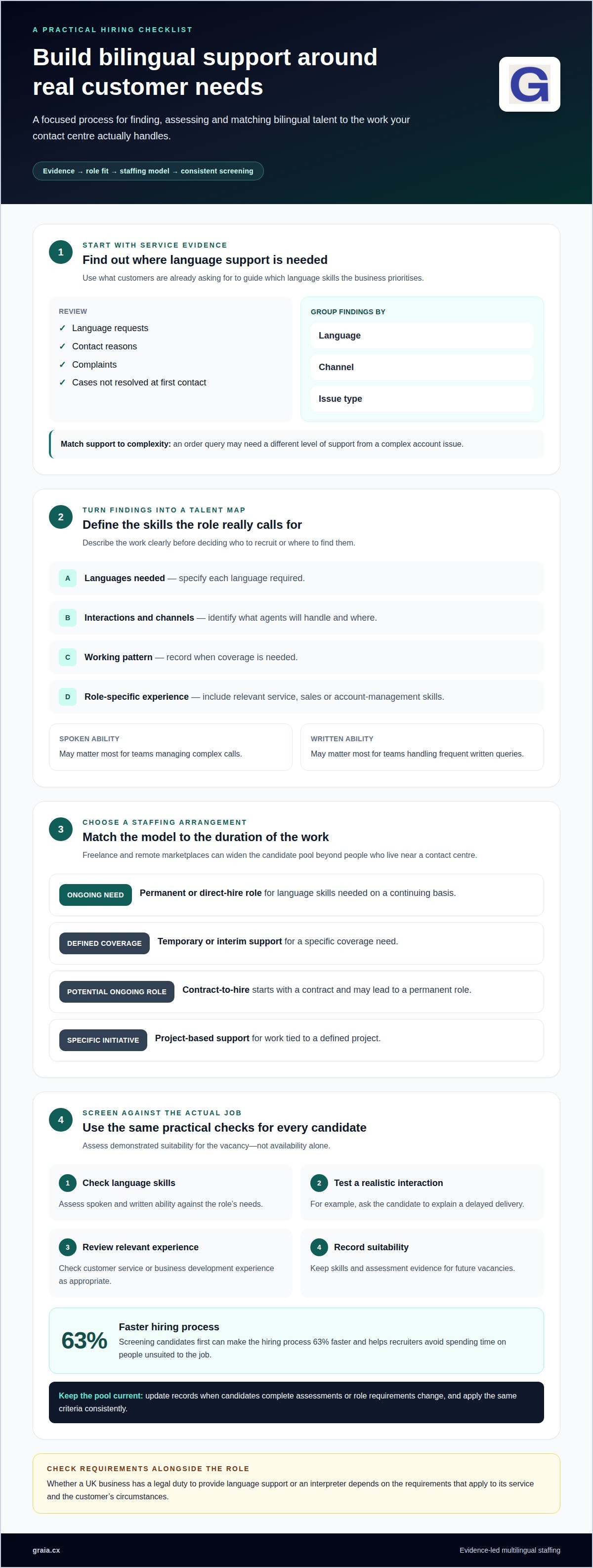
Use service evidence to assess customers’ language needs. Review language requests, contact reasons, complaints and cases that weren’t resolved at first contact. Group the findings by language, channel and issue type. For example, an order query may require a different level of support from a complex account issue.
Turn that evidence into a talent map. Record the languages needed, the interactions candidates will handle, the channels involved and the working pattern. Distinguish spoken fluency from written ability, then add role-specific skills. A German-speaking candidate handling business development calls, for example, may need different experience from someone writing customer service responses.
Freelance and remote marketplaces can expand the candidate pool beyond people who live near a contact centre. Recruitment options include permanent, temporary and interim roles. Match the arrangement to the work: ongoing demand may suit a permanent role, while a defined coverage need may call for temporary or interim support.
Screen candidates against the work before adding them to the pool. Use a consistent process:
- Assess spoken and written language skills against the role’s needs.
- Test a realistic interaction, such as explaining a delayed delivery.
- Review relevant customer service or business development experience.
- Record each candidate’s skills and suitability for future vacancies.
Screening candidates first can make the hiring process 63% faster and helps recruiters avoid spending time on people unsuited to the job. A practical assessment also reveals whether candidates can explain information clearly, rather than simply hold a conversation in another language.
Customer evidence should guide which language skills the business prioritises. A contact centre handling frequent written queries may need strong written communication; a team managing complex calls may value spoken fluency and service experience. Use the talent map to identify suitable candidate pools, then assess each person against realistic customer scenarios. This makes recruitment more focused and aligns bilingual support with actual customer needs.
Keep screening tied to each vacancy’s requirements. Before inviting candidates to further recruitment stages, compare their assessed language abilities and role-related experience with the skills the job calls for. Record the evidence behind each decision, including performance in a realistic task, so the pool reflects demonstrated suitability, not availability alone. When a vacancy arises, assess candidates against its actual duties rather than assuming everyone in the pool fits every role.
This approach helps employers identify candidates who meet job requirements and focus further recruitment on any remaining gaps. Update records when candidates complete assessments or role requirements change, and apply the same criteria consistently. Screening candidates before recruitment progresses helps build a qualified pool with the skills each job requires.
Contact centre hiring landscape
UK employers can recruit bilingual talent through temporary, contract-to-hire, direct-hire and project-based arrangements. Each model affects how a business responds to demand and how long language skills remain available. A defined customer-service project, for example, may call for a different approach from an ongoing role handling regular multilingual enquiries.
Advertised vacancies show the range of work and pay structures. These examples illustrate how language skills feature in service, sales and account-management careers.
That variety matters when defining a vacancy. A customer-service agent may need to explain an order update clearly, while a business development representative may guide a prospect through a sales conversation. Using the same language requirement for both roles without distinguishing their day-to-day tasks can lead to a poor match.
Choose an arrangement based on the work’s duration and continuity. Temporary recruitment can meet a defined coverage need. Contract-to-hire starts with a contract and may lead to a permanent role. Direct-hire recruitment suits an ongoing position, while project-based arrangements can support a specific initiative. Bilingual staffing agencies commonly offer these models, giving employers options for different kinds of coverage.
Before recruiting, write a role brief that specifies:
- The language skills needed for speaking, writing or both.
- The customer interactions and channels the role will handle.
- The relevant service, sales or account-management experience.
- Whether the need is ongoing, temporary or tied to a project.
Assess candidates with a realistic scenario. For example, ask them to explain a delayed order or respond to a customer seeking clarification about a service. This tests language skills alongside listening, judgement and the ability to provide a useful next step.
For teams recruiting across the UK, remote hiring can expand access to bilingual talent beyond the area around a workplace. It also makes clear onboarding and handovers essential: agents need shared guidance on customer processes, terminology and escalation. Teams handling enquiries across several channels can use consistent case notes so colleagues can continue support without losing context.
Match the recruitment model to the work, then evaluate candidates against actual customer needs. To explore contact-centre approaches alongside staffing decisions, browse contact centre hiring insights.
Multilingual customer service and contact-centre staff
UK contact centres can combine people, interpreting and translation technology to support multilingual conversations. The right setup depends on the channel, the complexity of each issue and the sensitivity of the information shared.
Outsourced Multilingual Support
Outsourced multilingual customer support gives a business access to language capability without recruiting every specialist as an employee. It may suit seasonal demand, a defined contract or a language used infrequently by customers. Assess how the service handles routine enquiries, complex cases and handovers, then define how it connects with your existing team.
For example, a business could route German-speaking enquiries to a specialist support team while in-house staff manage other contacts. Set clear service boundaries: which team owns each case, how customer context is transferred and who handles escalation. A consistent process helps prevent customers from repeating account details when a conversation moves between teams.
Plan the operating model around real interactions. Decide which channels need multilingual coverage, what guidance agents use and how they record outcomes. A coherent customer journey should work whether the first contact arrives by phone or chat. Match the contract to the work and the integration it requires.
Translation App Tradeoffs
Translation apps can help staff understand straightforward messages quickly, such as a basic delivery query or appointment request. They can also make written communication more accessible when a bilingual colleague isn’t immediately involved. However, automated translation may miss tone, context or specialist terminology, potentially distorting a complaint, financial explanation or nuanced instruction.
Use translation tools selectively. For routine requests, translated text may help an agent identify the customer’s need; for complex or sensitive discussions, human interpretation can provide more context. Keep the customer’s intent central, and give agents a clear escalation route when wording is ambiguous or a response could affect an important decision.
For phone support, build an interpreter or live call translation into the call flow so agents can continue conversations with language support. For chat, a workflow can translate incoming and outgoing messages, with human review for complex cases. For video, include interpreting in the appointment or meeting process and establish clear turn-taking between the customer, interpreter and agent.
AI translation and interpreting can expose personal or commercially sensitive information if conversations are processed or stored beyond the intended service. Risks include inappropriate access, unclear retention practices and information being shared with systems outside the organisation’s controls. Limit data to what the interaction needs, control staff access and set clear handling expectations in service agreements.
Match each channel to the right support method: a simple written request may suit translation, while a detailed phone conversation may call for an interpreter. This helps keep multilingual service responsive without treating every customer interaction as the same.
Retention, communication, and cost benefits
Compare multilingual support options on three measures: total operating cost, time to usable coverage and accuracy in representative customer interactions. Include recruitment, onboarding and ongoing support in cost comparisons. Test response speed and meaning using examples such as a billing query or complaint.
Retention matters because contact centre industry average bilingual hiring turnover is 30-45%. Frequent departures can disrupt customer relationships and require repeated recruiting and training. For example, a permanent German-speaking agent may build detailed knowledge of repeat account issues, while temporary cover can help address a defined period of demand.
Strong onboarding supports continuity. Organisations with a strong onboarding process improve new-hire retention by 82% and productivity by over 70%. A practical programme should explain service standards, escalation routes and the language-specific terms agents use. A new professional handling a global customer base needs more than a language handover; they need clear guidance for delivering consistent answers.
Communication quality also depends on how teams share customer context. Contact centres supporting customers across the UK can use consistent case notes, agreed terminology and clear handover ownership. For instance, when a temporary colleague passes a complex query to a permanent specialist, both need a shared record of the customer’s issue and next step.
Compare options using the same customer scenarios. Record whether each approach delivers an accurate response, how quickly the customer gets a useful answer and what operational work supports the result. Translation may suit a straightforward delivery question, while a specialist agent may be better placed to handle a complex account explanation.
- Retention: Review turnover, onboarding quality and the knowledge lost when experienced professionals leave.
- Communication: Assess accuracy, customer effort and handovers using realistic examples.
- Cost: Include recruitment, training, management and the support required to maintain coverage.
- Flexibility: Match permanent, temporary or partner-based support to the duration and pattern of demand.
Development can also support retention. Give agents clear coaching on service scenarios, language-specific terminology and escalation decisions. For example, a team member handling German enquiries can practise explaining a delayed order before taking live cases. Consistent development can build confidence while keeping customer guidance aligned across the team.
No single model leads on every measure. A permanent team can build familiarity, temporary support can meet a defined need, and a specialist partner can provide another route to language capability. Compare each option against the interactions customers actually have, then choose a balance that supports reliable communication and sustainable staffing.
Can UK businesses use outsourced multilingual customer support instead of hiring bilingual staff?
Yes. A UK business can use outsourced multilingual customer support instead of directly employing bilingual staff. For example, a retailer could use an external team for German-language delivery enquiries while its own agents handle other contacts. Since this changes how support is staffed, define its scope and handovers clearly.
Start by identifying which interactions need external support. A travel company might receive occasional Italian booking enquiries, while a financial services team may handle complex account questions. The first need could suit a defined support arrangement; the second may require specialist knowledge and close coordination with internal teams. Match the model to the conversation, not just the language.
Next, map how an external team would fit into your customer journey. Decide how enquiries are routed, what case information is transferred and which team owns follow-up. If an outsourced agent cannot resolve a delivery complaint, for example, the customer needs a clear route to the team that can act. A named escalation path helps prevent avoidable handovers.
Set service boundaries before work begins. Describe the enquiry types covered, the channels involved and the information agents need to answer accurately. A UK retailer could separate order-status questions from refund decisions that require internal approval. Clear boundaries help external staff deliver consistent guidance without making commitments beyond their role.
Compare outsourced support with direct recruitment using practical criteria:
- Coverage: Identify the languages, channels and customer scenarios included.
- Knowledge: Determine how agents learn product terms, processes and escalation routes.
- Continuity: Plan how customer context and unresolved cases pass between teams.
- Control: Set ownership for quality reviews, updates and complex decisions.
A pilot can reveal operational gaps before a wider rollout. For example, route one defined category of German-language enquiries through the proposed model. Review whether answers are accurate, customers have to repeat information and internal teams receive complete case notes. Use the findings to refine scripts, routing and escalation processes.
Outsourcing may suit a business that needs specific language coverage without building every capability in-house. Direct employees may fit better when language expertise is central to daily work or closely tied to specialist decisions. A blended arrangement can separate routine enquiries from cases that need internal knowledge. Consider interaction complexity, continuity and how closely support must connect with internal operations.
To explore technology-led approaches to multilingual customer interactions, discover contact-centre support options and consider how they fit alongside your staffing model.
A blended arrangement can also pair external language coverage with internal expertise and clear senior oversight. In the BNY Alternatives Transfer Agency role, responsibilities involve client meetings and calls, operational updates and relationship-management support, alongside collaboration with internal teams and external partners to support operational execution. The role includes supporting issue investigation, escalation and resolution while maintaining clear communication; its senior contact is expected to guide junior staff and provide support when needed. For recruitment, The Law Support Group was founded in 1997 and recruits legal and professional services staff in the UK and internationally. Employers recruiting bilingual staff should make retention a priority.
GraiaCX
GraiaCX helps contact centres extend multilingual support without relying solely on bilingual recruitment. Its Agentic Omni-Channel Platform brings voice, chat, email and social messaging together. Conversational Agent can handle routine enquiries autonomously, Live Call Translation supports multilingual conversations, and Agent Assist provides real-time guidance to agents.
This approach can suit teams balancing language coverage with consistent customer communication across channels. Businesses can combine automation with human support, directing routine requests differently from interactions that need an agent’s judgement. The right mix depends on the enquiries customers make and how your contact centre handles them.
Build multilingual support around the customer experience
Start by designing coverage around the conversations your customers need to have. Map where language affects understanding, then decide whether human judgement, automation or a combination best supports each interaction. This makes alternatives to hiring bilingual agents part of a service strategy, not just a staffing decision.
For contact centres balancing multilingual access with consistent service, GraiaCX brings together Conversational Agent for routine enquiries, Live Call Translation for multilingual calls and Agent Assist for real-time agent guidance. These capabilities support different points in the customer journey, with human agents involved where their judgement matters.
Start by identifying one customer interaction where language creates friction, and define what a successful resolution looks like. That gives your team a practical basis for shaping the next step. Contact GraiaCX about multilingual support and explore an approach that fits your contact centre. Better communication starts with a clear, customer-led decision.
Frequently Asked Questions
What are alternatives to hiring bilingual customer service agents?
Alternatives to hiring bilingual agents include freelance specialists, outsourced multilingual support, interpreting and AI-enabled translation. For instance, a chatbot could guide customers through a straightforward returns process, with a clear route to human help if the case becomes unusual. Choose an approach based on how much context the interaction requires and whether customers need a person to resolve the issue.
How do AI translation and multilingual chatbots compare with human interpreters?
AI translation and multilingual chatbots can help with routine requests, while human interpreters can convey nuance in complex discussions. These alternatives to hiring bilingual agents serve different purposes: a chatbot may handle a simple account query, while an interpreter can support a sensitive conversation. GraiaCX offers Conversational Agent and Live Call Translation for contact centres considering technology-enabled language support.