
AI Voice Agents for Contact Centres: Uses and Integration
A voice agent should do more than answer the phone. AI voice agents for contact centres use conversational AI to understand callers, handle routine enquiries and pass complex issues to a human when needed. They extend self-service while helping contact-centre teams focus on conversations that require human judgement.
That distinction matters: callers want quick, useful help, while agents need the context to resolve issues rather than repeat questions. This article explains what voice agents do, how they differ from traditional call-centre operations and where they fit across self-service and customer support. You’ll also see how use cases such as answering common questions, routing calls and supporting human agents can connect into a wider contact-centre operation.
Key Takeaways
- Match voice automation to routine enquiries, and keep human support available for complex or sensitive conversations.
- Connect conversation history and customer data so a human handover feels continuous rather than starting over.
- Measure resolution, customer satisfaction and self-service success to understand whether automation is helping.
- Explore use cases such as answering common questions, routing calls and supporting agents with timely information.
- Choose an integrated approach that brings voice automation and human assistance together across customer-service channels.
Unified platforms, quality assurance and data integration
Integration determines whether a voice agent can resolve an enquiry or merely collect details. A connected platform brings telephony, customer records and agent workflows together in one conversational service.
Business-System and Telephony Integration
Business-system and telephony integrations connect the phone channel to customer records, service tools and systems that carry out actions. For UK contact centres, look for a platform that links these systems and manages smooth handovers, rather than operating as a standalone voice interface.
For example, an agent handling a delivery enquiry can retrieve the customer’s order, provide an update and send an exception to a human. When the call transfers, the next agent should receive the conversation history, customer preferences and issue details. This gives them useful context without making the caller explain everything again.
Telephony integration also determines how calls enter the system and reach the right workflow. Map routing, transfers and concurrent calls to real contact-centre operations, then test how the platform handles several callers at once. Its orchestration should keep the issue and relevant records together as responsibility moves between automated and human support.
Conversation Quality and Context
Conversation quality depends on how accurately a voice agent understands callers and how well integrations preserve context. Access to customer records can help the agent respond to the right account or issue; limited or unreliable access may lead to generic or inaccurate replies.
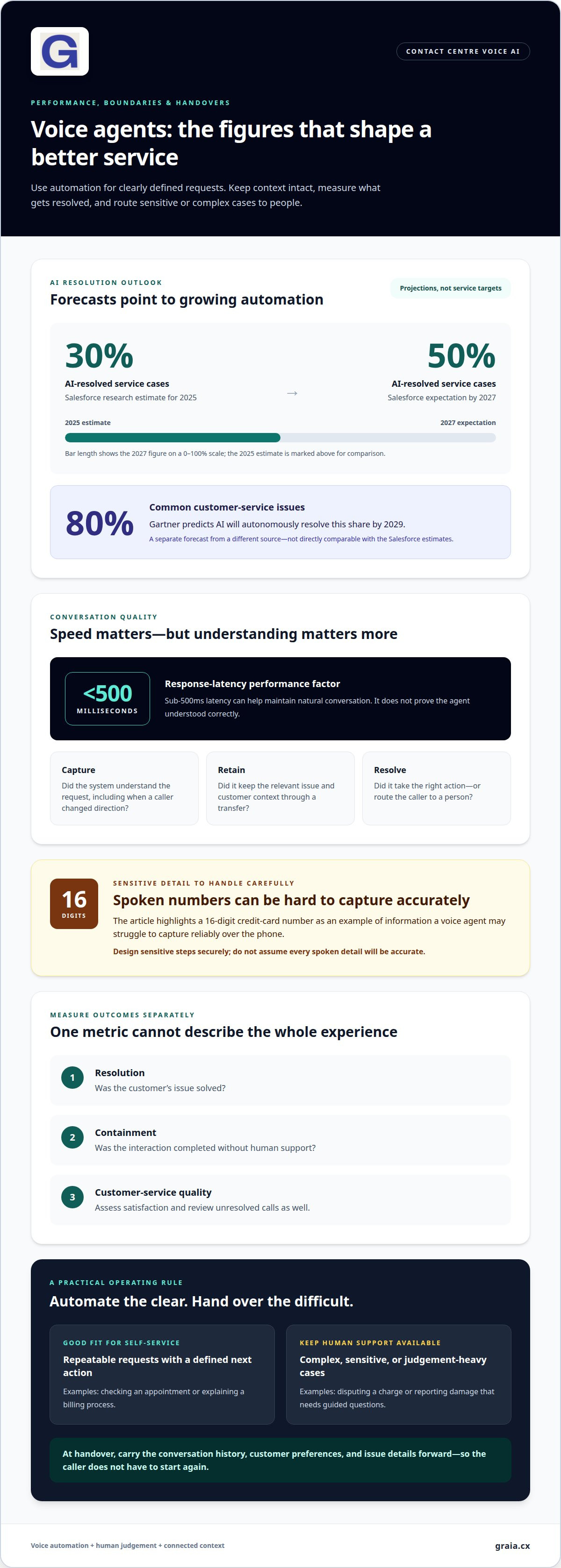
Test conversations under real conditions, including background noise, varied accents and callers who change direction mid-sentence. Assess whether the system captures the request, responds appropriately and retains information through a transfer. A voice agent may struggle to capture a 16-digit credit card number accurately over the phone, so design sensitive processes around suitable secure steps rather than assuming every spoken detail will be reliable.
Response speed affects the conversational flow. Sub-500ms response latency is a performance factor for maintaining natural conversation, but speed alone cannot show whether the agent understood correctly. Review recordings and transcripts against resolution quality, context retention and the action taken. Include failure cases, such as a caller correcting an account detail, to see whether the agent updates its understanding.
Platform Features and Risks
Useful platform features include telephony connectivity, system integrations, context-aware responses, clear handovers and tools for monitoring conversation quality. Compare how well each option connects customer data to service workflows, not just how naturally it generates speech. For sensitive information, assess GDPR support, data retention policies and how conversation data is stored, used and protected.
Risks include inaccurate responses, missing context and exposure of personal data. Set guardrails to define what the agent can answer or do, and when it must transfer the caller to a human. Review test conversations for errors and unclear responses before expanding use. Keep human oversight in the workflow, especially when an incorrect action could affect a customer’s account or service.
What is an AI Voice Agent?
An AI voice agent uses conversational AI to understand spoken requests, respond and complete defined service tasks. Its value depends on matching each caller’s intent to the right answer, channel or human handover.
For UK contact centres, UK GDPR considerations include how personal data from calls is accessed, stored, retained and used. Consider relevant Ofcom requirements for the phone service, and make the agent’s role and routes to human support clear in your service design.
Routine Enquiries and Industry Use Cases
Routine enquiry automation lets a voice agent handle repeatable requests, such as checking an appointment or explaining a billing process. Straightforward requests can then be resolved without taking an agent away from cases that need human judgement.
Use automation where the request and next action are clearly defined. A utility customer asking how to understand a bill may need a concise explanation; someone disputing a charge may need a human to review the account. In insurance, a caller reporting damage may need guided questions before a claim can proceed. These examples show why intent and risk should determine when to hand over.
Measure resolution, containment and customer-service quality separately. Resolution tracks whether the issue was solved; containment tracks whether the agent completed the interaction without human support. Neither metric describes the whole experience, so assess customer satisfaction and review unresolved calls as well.
Gartner predicts that AI will autonomously resolve 80% of common customer-service issues by 2029. Salesforce research estimates AI resolved 30% of service cases in 2025 and expects it to resolve 50% by 2027. These projections make clear why teams should track actual outcomes against their own service goals.
Consistent Omnichannel Service
Omnichannel consistency means carrying useful context and service logic across voice, chat, email and social messaging. This matters when customers switch channels: they should not have to restart an enquiry just because they contact the business another way.
For example, a caller who needs a written explanation can move to email with the issue summary intact. A customer who starts in chat can call later and continue with the same context. Keep service information and escalation paths aligned across channels, while matching the channel to the task: voice for conversational help, and text for complex issues that need documentation or precise details.
To evaluate performance, compare resolution and satisfaction across channels, then examine cases where customers changed channel or needed a handoff. This reveals whether the solution connects service journeys or simply automates separate touchpoints. For more perspectives on customer-service automation and channel design, explore contact-centre AI insights.
How AI call centres differ from traditional call centres
Traditional call centres route enquiries to people, while AI-enabled operations can automate routine tasks and give agents timely information. The practical difference is how work is divided: AI handles defined tasks, while people focus on judgement, empathy and exceptions.
Call Volumes and Query Distribution
Call-volume and query analysis groups incoming calls by demand, intent and outcome, helping teams decide what to automate. McKinsey analysis estimates routine tier-1 support issues make up 50 to 60 percent of contact-centre volume.
Use call records to identify recurring requests, such as questions about opening hours, account processes or delivery updates. Then distinguish predictable enquiries from complaints or complex cases that need investigation. This helps prioritise deployment and prevents automation from treating every caller alike.
Call volume alone is not enough. Compare the reasons for calls during busy and quieter periods, then map each intent to an action, response or human handover. A frequent question with a clear answer may suit automation; a less common but sensitive issue may need direct human support.
Routine and After-Hours Call Handling
AI call handling uses an automated agent for defined enquiries, including calls received outside staffed hours. Customers can get an initial response without requiring an overnight team for every routine request.
Voice agents can provide customer-service coverage 24 hours a day, seven days a week without requiring overnight staffing. For example, an agent could explain a standard billing process, capture a service request or direct an urgent issue through an appropriate route. The task must have clear boundaries and a reliable next action.
Make the route to a person clear for callers whose needs fall outside the agent’s remit. A useful design records the caller’s intent and details, then passes that context to the next person. Review missed intents and abandoned calls so teams can improve responses instead of expanding automation blindly.
Agent Assistance and Post-Call Summaries
Agent assistance gives human representatives relevant information during calls, while post-call summaries capture key details afterwards. These tools can help agents focus on the customer instead of searching across systems or reconstructing the conversation.
For example, an assist tool could surface a relevant process or next-best-action suggestion when a caller describes a billing problem. After the call, a summary can record the issue, action taken and outstanding points for follow-up. Representatives should review the summary before relying on it as a record.
Evaluate both tools against real interactions. Compare summaries with call recordings and check whether suggested actions match the customer’s intent. Track resolution time, customer satisfaction and self-service success, then use the findings to refine the model and its boundaries.
Unlike a traditional call centre built around manual routing and handling, an AI-supported operation can combine automated responses, human oversight and ongoing evaluation. Start with one clearly defined enquiry type, measure the results and expand only when the model handles it accurately and provides a useful customer experience.
AI agents and routine enquiry self-service
Routine self-service works best when callers can describe a clear need and the system can complete a defined action. AI agents can automate 60-80% of routine enquiries without increasing headcount, but that depends on matching speech recognition, customer records and service workflows to the request.
For a utility, a customer asking about a bill could receive an explanation or an account update by voice. A leading energy company reduced billing call volume by around 20% after integrating an AI voice assistant into its workflow. The useful lesson is to connect automation to a real service task, not simply add a spoken menu.
Voice-enabled self-service starts by interpreting the caller’s speech, identifying their intent and responding with relevant information. If a customer needs an account change, the agent should capture the required details and complete the permitted action. If it cannot understand the request or the issue requires judgement, it should hand the conversation to a human with the caller’s context intact.
IT helpdesks can use the same approach for routine triage. An employee reporting a locked account, for example, can describe the issue by phone; the agent can identify the request, offer approved self-service guidance or route it to the right support queue. Keep troubleshooting within the organisation’s documented process and make escalation clear if the first response does not solve the problem.
Outbound service needs a different path. If a customer does not answer a service call, send a text so they can continue through a written channel. SMS can provide a concise update or next step; WhatsApp can support a conversation when it fits the service design. Keep the message consistent with the original call and do not ask customers to repeat details they have already provided.
Channel choice should follow the task. A spoken interaction can suit a quick status request, while text gives customers a written reference for an update or troubleshooting instruction. Gartner predicts that AI will help automate 1 in 10 customer interactions by 2026, placing self-service within a broader mix of customer-service channels rather than making voice the only route.
Measure whether each interaction reaches a useful outcome. Track completed tasks, transfers to human agents and repeat contacts for the same issue. An AI-agent conversation resolution rate of 28% offers one reported reference point, but teams should also inspect failed speech recognition and abandoned journeys to identify what needs improvement.
For contact centres handling high demand, self-service can absorb repeatable requests while human agents focus on cases requiring care or investigation. A business described as handling over 2,000 calls per day used intelligent automation alongside staff, illustrating the role of automation as part of a supported operation, not a replacement for human service.
Contact-centre voice agent use cases
The strongest use cases connect a caller’s intent to a clear action, from arranging a callback to progressing a service request. These examples show how voice automation can support a complete customer journey, not simply answer questions.
For business support, an illustrative call could end with an AI agent booking a 15-minute adviser callback for the following day. The caller explains the issue, the agent captures relevant details and schedules the next step. This works best when callback availability and requests can be handled through a connected workflow.
Local government can use a similar approach for service bookings. In an illustrative bulky-waste call, the agent books a collection slot for 20 August from 08:00 to 10:00. The interaction needs to capture the collection details accurately, confirm the time and provide a clear response if the requested slot cannot be booked.
Insurance calls show how automation can support a complex journey without replacing human judgement. A voice agent could gather initial information about damage, record the caller’s needs and arrange a repair appointment through a connected system. A specialist can handle claim decisions or unusual circumstances, with the conversation context available for the handover.
Payment support is another potential use. One reported figure is that 58% of customers set up payment plans with an AI agent. For this type of interaction, the design should make available options understandable and capture the customer’s chosen arrangement correctly. Clear confirmation helps both the caller and the team handling any later query.
Authentication can also shape the caller experience. A leading energy company shaved up to 60 seconds off customer authentication after integrating an AI voice assistant into its workflow. This illustrates how a focused technical integration can reduce friction before the main enquiry, without making authentication itself the whole conversation.
How much do AI voice agents cost for contact centres in the UK? The price depends on the case and is given after a quote request; cost factors include integration depth, call volumes, required workflows and the complexity of service tasks.
To prioritise use cases, map each caller intent to its required data, action and escalation route. Start with a task such as booking a callback, then assess completion, accuracy and handoffs before extending automation to more complex interactions. Explore contact-centre voice automation use cases to inform your planning.
GraiaCX: Conversational Agent
GraiaCX’s Conversational Agent helps contact centres automate routine enquiries while keeping human support available for more complex calls. It understands customer intent and emotion, resolves routine requests autonomously and connects voice service with chat, email and social messaging through an Agentic Omni-Channel Platform.
For teams supporting multilingual callers, Live Call Translation enables conversations in over 100 languages without requiring bilingual staff. Agent Assist can also provide representatives with real-time next-best-action suggestions, supporting a more informed response when a conversation needs human judgement.
These capabilities are useful when you want to connect self-service, agent support and customer interactions across channels. Contact GraiaCX to discuss how its conversational AI can fit your contact-centre operations.
Shape the next stage of customer service
Start by deciding what a better customer interaction should feel like, then align technology with that standard. For AI voice agents for contact centres, progress depends on a focused operational goal, clear human oversight and a plan to learn from real conversations. This keeps automation connected to customer needs rather than treating implementation as a technology project alone.
GraiaCX offers a Conversational Agent for automated customer interactions, Live Call Translation for multilingual conversations and Agent Assist for human representatives. These capabilities help teams build a more connected service without losing the human element.
Consider which customer journey would benefit most from a more coherent experience, and what role your team should retain in delivering it. Then take the next step at a pace that suits your organisation. Explore how GraiaCX can support your contact-centre plans and move towards a service model that works better for customers and agents alike.
Frequently Asked Questions
How is voice AI technology being used today?
Voice AI interprets callers’ spoken requests and supports service tasks during phone interactions. A caller might ask to change a contact preference, check an existing case or find the right department. The system can identify the request, retrieve relevant information and respond aloud. Contact centres can also review speech transcripts to see how calls progress and where callers need clearer help.
Will AI kill the contact centre?
No. AI changes how contact-centre work is handled, but people remain essential for decisions requiring empathy, investigation or discretion. A caller disputing a complex account decision, for example, may need someone to understand the circumstances and explain available options. AI can support the representative by organising information, while supervisors oversee service quality, escalation patterns and the customer experience.
What are AI call centres?
AI call centres are contact-centre operations that use artificial intelligence to support or automate parts of customer service. They can combine voice interactions with tools for routing requests, surfacing relevant information or assisting representatives. The term does not mean every call is handled by AI: businesses can automate defined tasks while keeping human agents involved in more complex conversations.
What does good look like?
Good performance is evident when the system understands corrections, gives relevant answers and offers a clear route to human help. If a caller corrects a postcode, for example, the agent should use the corrected detail rather than repeat the earlier mistake. Contact-centre teams should also be able to review transcripts, identify misunderstandings and improve the service based on real interactions.
What’s changing?
Customer service is moving beyond fixed phone menus towards systems that interpret natural speech and respond to callers’ requests. This also changes how teams work: representatives can receive information or suggested actions during a conversation, rather than relying only on post-call notes. When these capabilities connect across channels, organisations can shape service journeys around customer needs rather than individual communication tools.
What are AI voice agents for contact centres and how do they work?
AI voice agents for contact centres listen to spoken requests, interpret their meaning and generate spoken replies or take actions. A typical interaction converts speech into text, identifies the caller’s intent, then uses a knowledge source or connected business system to determine a response. The agent can speak an answer, perform an allowed task or route the conversation to a human representative.
How do AI voice agents compare with IVR systems and human agents?
Traditional IVR systems usually guide callers through set menu options, while a voice agent can interpret a spoken request without requiring a numbered selection. Human agents bring judgement and interpersonal understanding when a scripted answer is not enough. For example, an IVR can direct a billing call, an AI agent can answer a defined account question, and a person can handle a dispute.
How can a contact centre integrate an AI voice agent with its CRM and telephony systems?
Start by mapping the call journey: how calls enter, which customer details the agent needs and what CRM actions it may take. Connect telephony events and approved CRM functions through the platform’s integrations or APIs. For example, an agent handling a case-status enquiry might retrieve a record using an identifier and return the current status without changing the case. Test access, call transfers and records before expanding workflows.