AI Translation for Customer Service: The Enterprise Guide to Multilingual Support in 2026
By the end of 2026, the traditional bilingual hiring model will be a significant enterprise liability. You've likely felt the strain of watching non-English queues swell while specialized agents command steep wage premiums for skills that often remain underutilized. It's a systemic bottleneck that forces a choice between prohibitive operational costs and degraded customer experiences. Basic chatbots have failed to bridge this gap, often trading efficiency for a cold, mechanical tone that alienates global callers.
Modern ai translation for customer service has evolved into a sophisticated engine of empathy and intelligence. We understand that your goal isn't just to translate words, but to preserve the human connection that defines your brand. This guide demonstrates how real-time AI translation eliminates the need for language-specific hiring while simultaneously slashing average handle times by 15% to 25%. We'll explore the shift toward privacy-first, agentic platforms that empower your existing team to support over 100 languages with native-level precision. You'll discover how to integrate these visionary tools into your current infrastructure to build a truly borderless support ecosystem.
Key Takeaways
- Move beyond unsustainable 25-50% wage premiums by transitioning from language-specific hiring to a centralized, AI-powered multilingual workforce.
- Master the mechanics of real-time ai translation for customer service to maintain human empathy through sentiment detection and low-latency voice-to-voice bridges.
- Discover how custom vocabulary and phrase lists ensure 98% accuracy for complex brand terms, protecting your professional reputation in every dialect.
- Implement a "no-rip-and-replace" strategy by leveraging SIP and iframe integrations that embed translation directly into your existing CRM and CCaaS stack.
- Quantify the impact of a multilingual engine through specific metrics, including a 5-10 point increase in First Call Resolution (FCR) across global markets.
Beyond Bilingual Hiring: The Strategic Shift to AI Translation for Customer Service
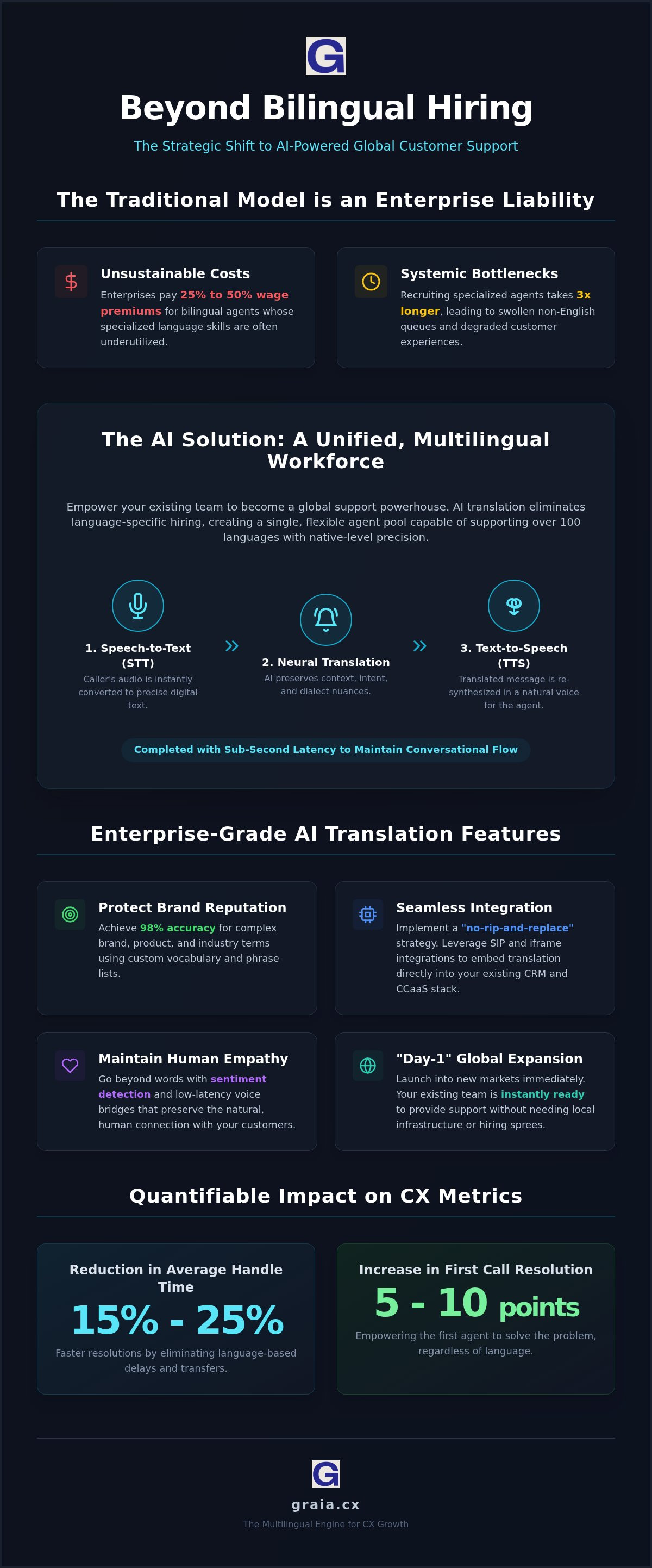
The traditional model of bilingual hiring has hit a fiscal and operational ceiling. For decades, enterprises relied on specialized talent to bridge the gap between global brands and local customers. This approach is now a liability. Modern ai translation for customer service acts as a real-time, high-fidelity bridge for both voice and text interactions, rendering the old "hiring for language" paradigm obsolete. By 2026, the imperative is clear. You must scale global support without inflating headcount or compromising the quality of the customer experience.
This transformation is powered by the evolution of Machine translation from simple text-swapping tools into sophisticated, neural-driven engines. These systems don't just translate words; they preserve context and intent. The unsustainable cost of 25% to 50% wage premiums for bilingual staff has forced a reevaluation of the contact center's DNA. Instead of paying for a language skill that may only be used for a fraction of a shift, leaders are investing in technology that makes every agent a polyglot.
The Hidden Costs of Traditional Multilingual Support
The recruitment bottleneck is real. Finding specialized agents takes three times longer than hiring for standard roles, creating a persistent drag on operational agility. This delay results in long wait times for non-primary language queues, which directly destroys CSAT scores and brand loyalty. Attrition presents another challenge. Multilingual agents are in high demand, leading to frequent poaching and a constant cycle of expensive retraining. When your support strategy hinges on a small pool of specialized talent, your entire global operation remains fragile and prone to disruption.
Solving the 'Language Queue' Bottleneck
Strategic flexibility is the new currency of the contact center. When you implement a multilingual engine, you move from rigid, language-specific queues to a unified, flexible agent pool. Any agent can handle any language request. This shift dramatically reduces the complexity of workforce management (WFM) scheduling. You no longer need to worry about coverage for a specific dialect during a graveyard shift or a sudden spike in tickets. It enables a "Day-1" global expansion strategy. You can launch into new markets immediately, confident that your existing team can deliver empathetic, accurate ai translation for customer service without the need for local infrastructure or specialized hiring sprees.
How Real-Time AI Voice Translation Powers Modern Contact Centers
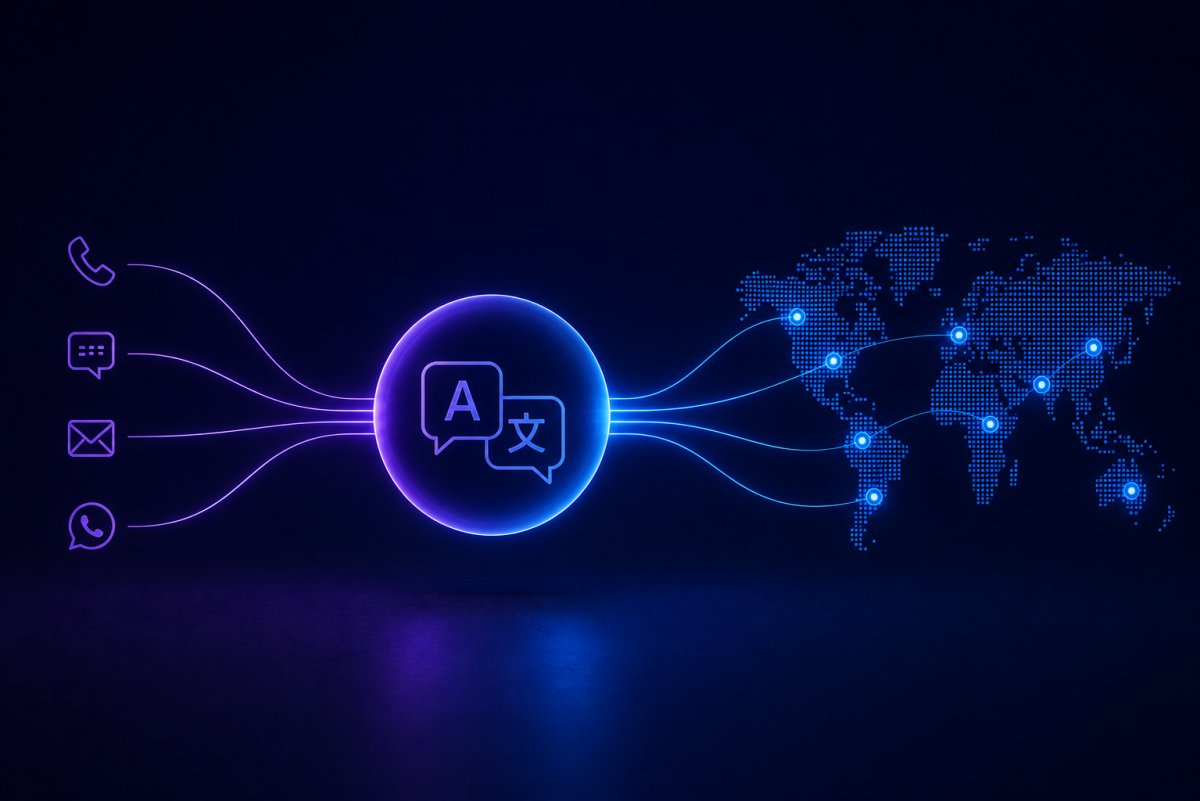
Live Call Translation is a SIP-integrated bridge for enterprise voice that enables seamless multilingual communication without the need for hardware overhauls or rip-and-replace strategies. While text-based chat has long utilized basic translation, the voice channel remains the most critical touchpoint for high-stakes resolutions. Modern ai translation for customer service has evolved into a synchronized sequence of high-performance technologies that work in concert to maintain the pace of natural conversation.
The workflow follows a rigorous three-step architecture designed for the high-pressure contact center environment. First, Speech-to-Text (STT) engines convert the caller's audio into digital text with extreme precision. Next, Neural Translation layers process this text, accounting for regional dialects and intent. Finally, Text-to-Speech (TTS) re-synthesizes the translated message into the agent's ear. This entire loop must occur with sub-second latency to prevent the awkward pauses that destroy conversational flow and customer trust.
The Anatomy of a Translated Interaction
Precision in the STT phase is non-negotiable. Enterprise support often involves complex industry-specific jargon that generic translation tools fail to recognize. High-fidelity engines must be trained on custom vocabularies to ensure technical terms are captured accurately. To deliver a professional experience, leading TTS providers like ElevenLabs now offer brand-consistent voices that mirror human prosody. This prevents the interaction from sounding like a legacy automated system, ensuring the customer feels they're engaging with a sophisticated, attentive professional. You can explore our latest technical insights on how these integrations are reshaping the global service floor.
Maintaining Human Empathy Through Original Audio
Technology should empower the human element, not mask it. One of the most significant breakthroughs in 2026 is the "Original Audio" feature, which allows agents to hear the customer's raw voice at a lowered volume behind the translation. This is vital because words alone don't convey the full story. Hearing a customer's sigh of relief or a slight tremor of frustration provides the agent with the emotional intelligence needed to pivot their approach.
We combine this audio transparency with real-time sentiment and emotion detection. These algorithms act as a "mood map" for the agent, highlighting shifts in the customer's temperament that might be lost in translation. By balancing linguistic clarity with the nuances of human speech, organizations can foster genuine connection across language barriers. This approach reduces the robotic feel of traditional automated services and transforms the ai translation for customer service experience into a catalyst for deeper customer loyalty.
Critical Features: What Defines Enterprise-Grade AI Translation?
Generic translation is a gamble that enterprise leaders can't afford to take. While consumer-grade apps might suffice for basic travel queries, ai translation for customer service in a corporate environment demands a higher tier of architectural integrity. You need a system that doesn't just swap words, but understands the weight of your brand's reputation. This requires a focus on security, linguistic precision, and the cultural nuances that define professional trust. Choosing the wrong partner leads to more than just typos; it leads to lost revenue and compromised data.
Accuracy vs. Latency: Finding the Enterprise Sweet Spot
Speed is the heartbeat of the contact center, yet it's often the enemy of linguistic depth. Finding the enterprise sweet spot requires a balance where latency doesn't sacrifice context. We utilize partial translation displays to solve this challenge. These displays allow agents to see the translation form in real-time, even before the customer finishes their sentence. It provides a vital head start that reduces total handle time. By using specific STT and TTS language profiles, we optimize for regional dialects, ensuring that a caller in Madrid and one in Mexico City receive equally precise service without the lag that frustrates users.
Formality and Custom Vocabulary: Speaking the Brand's Language
Generic engines fail when they encounter regulated industries. A technical error in an insurance claim or a financial transaction isn't just a typo; it's a compliance risk. We implement custom vocabulary and phrase lists to ensure 98% accuracy for brand-specific terms and technical jargon. This level of control allows you to define exactly how account numbers or proprietary product names are read and translated, preventing embarrassing hallucinations. A bank is not a boutique, and your translation engine must reflect that professional distinction.
Cultural alignment is equally critical. In languages like German, Japanese, and Korean, the wrong level of formality can be perceived as an insult. Enterprise-grade systems offer formality tuning to ensure your brand voice remains respectful and consistent with local norms. We pair this with script-locked suggestions, which guarantee that mandatory compliance disclosures are delivered perfectly every time. This technical rigor is shielded by SOC2 compliance, PII masking, and strict data sovereignty protocols. Your data is never used to train external models, ensuring that ai translation for customer service remains a secure asset rather than a liability.
Integrating AI Translation into Your Existing CCaaS Stack
Enterprise leaders often fear that adopting ai translation for customer service requires a massive, disruptive overhaul of their current infrastructure. It doesn't. We prioritize seamless connectivity through SIP and iframe integrations, ensuring that your core technology stack remains intact. This "no-rip-and-replace" philosophy allows you to layer advanced intelligence over your current environment, protecting your existing investments while immediately unlocking global support capabilities. By treating translation as a modular engine rather than a platform replacement, you can achieve technical evolution without operational chaos.
Empowering Agents with Real-Time Translation Widgets
The agent experience is the frontline of your brand's reputation. We deliver this through an intuitive Agent Widget that lives directly within your CRM, whether you utilize Salesforce, Zendesk, or a proprietary interface. This tool provides a side-by-side visualization of the live transcript and its translation, giving agents complete situational awareness during every interaction. It eliminates the need for toggling between windows, which directly contributes to a more focused and empathetic conversation.
Control is essential for maintaining quality. The "Cancel and Edit" window acts as a critical safety net, allowing agents to pause and refine a translation before it reaches the customer. This human-in-the-loop approach prevents linguistic hallucinations and ensures brand-specific accuracy. To further elevate performance, our Agent Assist tool provides smart response suggestions grounded in your specific knowledge base. It transforms every agent into a high-performing subject matter expert, regardless of the language being spoken.
Modernizing Legacy Centers (Avaya, Genesys, NICE CX)
Legacy systems shouldn't be an anchor for your global ambitions. We drop our multilingual engine into existing SIP-enabled architectures, supporting established platforms like Avaya, Genesys, and NICE CX. This approach significantly reduces technical debt. You don't need a total cloud migration to access 2026-level AI capabilities. Instead, you can modernize your legacy center by integrating real-time voice translation directly into the existing call flow, ensuring that your global expansion isn't delayed by hardware limitations.
Continuity is the final piece of the digital puzzle. Our Agentic Omni-Channel Platform ensures that session context is never lost as a customer moves from voice to chat or email. This unified data flow allows for seamless handoffs between human agents and AI, maintaining a consistent narrative across every touchpoint. If you're ready to see how these integrations function in a live environment, you can view our integration documentation to start your modernization journey. We combine LLM flexibility with deterministic business rules to ensure that ai translation for customer service remains both innovative and reliable.
The Graia Advantage: A Multilingual Engine Built for CX Growth
Graia represents the next evolution of the contact center. We don't just provide a tool; we offer an Agentic Omni-Channel Platform that redefines how enterprises engage with a global audience. Our approach centers on empowering your existing workforce to become a universal service force. By integrating ai translation for customer service into every touchpoint, from voice calls to social media interactions, we ensure that your brand speaks the language of every customer with absolute clarity. This isn't a mere translation layer. It's a catalyst for global expansion that remains grounded in practical, measurable results.
Security and Data Sovereignty in Regulated Industries
Trust is the foundation of any enterprise partnership. We recognize that in regulated sectors like finance and healthcare, data privacy is a non-negotiable requirement. Graia operates on a privacy-first architecture where your sensitive client data is never used to train external models. We implement rigorous PII masking and encryption protocols to protect every interaction, ensuring that sensitive information stays within your control. This technical fortress provides you with audit-ready transcripts, allowing your team to maintain compliance with global regulations while delivering a seamless multilingual experience.
Measurable Impact: ROI and Operational Efficiency
Transformation must be backed by results. Our partners consistently see a typical AHT reduction of 15% to 25%, alongside a 5 to 10 point increase in First Call Resolution (FCR). These metrics represent a fundamental shift in how you allocate resources. By eliminating the need for specialized bilingual hiring and its associated wage premiums, you can redirect capital toward strategic growth. The financial drain of specialized queues disappears, replaced by a streamlined, unified workforce.
Agent productivity often climbs by 25% when teams are supported by our Agent Assist tools. These features provide real-time guidance, ensuring that every response is grounded in your specific knowledge base and brand voice. If you're ready to evaluate how these capabilities fit into your procurement strategy, our live call translation software guide provides the framework needed for a sophisticated evaluation. We act as your protective guide in this digital transition, ensuring your evolution into a multilingual powerhouse is both rapid and stable. Modern ai translation for customer service is no longer a future goal; it's the current standard for leaders who refuse to let language barriers limit their reach.
The Future of Global Connection: Empowering Your Universal Workforce
The era of the siloed, language-locked contact center is over. You've seen how a sophisticated approach to ai translation for customer service transforms operational bottlenecks into competitive advantages. By shifting from high-premium bilingual hiring to a unified, AI-supported workforce, enterprises can now support over 100 languages with native-level precision. This isn't just about efficiency. It's about preserving the human element through features like Original Audio and real-time sentiment detection, ensuring your brand remains empathetic in every dialect.
Integrating these tools shouldn't feel like a technical burden. Our SIP-enabled architecture allows you to modernize legacy systems without a disruptive rip-and-replace process. This technical agility delivers immediate, measurable impact, including a typical AHT reduction of 15% to 25%. As you scale into new markets, your existing team becomes your most powerful global asset, shielded by privacy-first protocols and enterprise-grade security. The choice is no longer between cost and quality; it's about how fast you choose to evolve.
The path to a truly borderless customer experience is clear. Explore our latest insights on Agentic AI and translation in the Graia Blog to stay ahead of the curve. Your global growth starts with a single, perfectly translated conversation.
Frequently Asked Questions
Does AI translation for customer service sound like a robot?
Modern neural synthesis engines eliminate the mechanical cadence of legacy systems by mimicking human prosody and emotional inflection. We utilize advanced providers to ensure that translated voices sound professional and brand-consistent. By preserving the original caller's audio at a lower volume, the agent maintains a connection to the customer's true emotional state. This combination ensures the interaction remains deeply human rather than purely transactional and robotic.
How accurate is real-time voice translation for technical support?
Real-time translation achieves up to 98% accuracy when utilizing custom vocabulary and phrase lists tailored to your specific industry jargon. Generic engines often struggle with technical terms, but enterprise-grade solutions allow you to lock in precise definitions for proprietary products. This technical rigor ensures that complex support resolutions are delivered with the same linguistic integrity as your primary language interactions, protecting your brand's reputation in every market.
Can AI translation integrate with my existing Genesys or Avaya system?
Our Live Call Translation tools integrate natively with Genesys, Avaya, and NICE CX through SIP-enabled architectures and iframe widgets. This avoids the need for a costly rip-and-replace of your existing infrastructure. You can deploy multilingual capabilities directly into your current agent desktop, allowing your team to manage global interactions without leaving their familiar CRM or CCaaS interface, ensuring a seamless transition for IT teams.
Is my customer data safe when using AI translation services?
Data sovereignty is a core pillar of our architecture, ensuring that your sensitive customer information is never used to train external models. We implement privacy-first protocols, including PII masking and SOC2 compliance, to shield financial or medical data. Your interactions remain secure and audit-ready, providing the transparency required for regulated enterprise environments while protecting individual privacy. We treat your data as a protected asset, not a commodity.
How does AI translation handle different dialects and accents?
The platform utilizes specialized Speech-to-Text (STT) language profiles to accurately capture regional dialects and varying accents. Whether a customer is calling from Singapore or Switzerland, the engine adapts to specific linguistic nuances to prevent transcription errors. This granular approach to ai translation for customer service ensures that every caller feels heard and understood, regardless of their local speech patterns, which significantly improves the overall customer experience.
What happens if the AI makes a mistake during a live call?
We empower agents with a "Cancel and Edit" safety net within the translation widget to catch and correct potential errors before they reach the customer. This human-in-the-loop control ensures that linguistic hallucinations don't compromise the resolution. Agents can also rely on Agent Assist to pull verified information from the knowledge base, providing a second layer of accuracy for critical disclosures and ensuring that mistakes are rectified immediately.
Does AI translation work for both voice and digital chat channels?
Yes, our Agentic Omni-Channel Platform delivers consistent translation across voice, digital chat, email, and social media. This unified approach ensures that context is never lost as a customer transitions between different support touchpoints. By centralizing your ai translation for customer service, you maintain a single, high-fidelity brand voice across every communication channel in your stack, creating a cohesive experience for your global customer base.
How much can I save by using AI translation instead of bilingual agents?
You can eliminate the 25% to 50% wage premiums typically required for specialized bilingual talent. Beyond direct payroll savings, our partners see a typical AHT reduction of 15% to 25% by removing the need for language-specific queues and transfers. This operational efficiency allows you to scale your global support capacity without the linear cost of increasing headcount in expensive labor markets, significantly improving your bottom line.