
Scalable CCaaS Platforms for Growth: A 2026 Buying Guide
What if contact centre growth depended less on adding seats and more on scaling the workflows behind every customer conversation? As queues, channels and handoffs multiply, disconnected tools can fragment customer context and reporting. Teams then work harder just to maintain a consistent experience. The right scalable ccaas platforms for growth help increase capacity without sacrificing control, continuity or customer trust.
That means looking beyond automation features or cloud migration. A growth-ready approach should connect voice, chat, email and messaging, integrate with the systems teams rely on, and make it straightforward to bring a person into a conversation with the right context. Automation should resolve suitable interactions and support agents, not become a barrier to human help.
This guide offers a practical framework for comparing platforms against your growth requirements. You’ll learn what to assess across integrations, workflows, governance and measurement, and how to plan a lower-disruption path forward. We’ll also explore how Conversational Agents, Agent Assist and Live Call Translation can work alongside human support to help your contact centre scale.
Key Takeaways
- Evaluate scalable ccaas platforms for growth by looking beyond seat capacity to channel continuity, workflows, governance and customer context.
- Compare what each platform provides natively with what depends on integrations or configurable workflows.
- Map how automation can handle suitable routine tasks while preserving smooth, context-rich handoffs to human agents.
- Plan growth in stages, from reviewing current workflows and integrations to piloting changes and setting governance measures.
- Consider how an agentic layer can extend existing contact-centre environments, including those using Genesys, NICE CX or Avaya.
What Makes a CCaaS Platform Scalable as Your Business Grows?
Adding agents can increase capacity, but it won’t fix a process that sends customers between disconnected channels, makes them repeat information or leaves supervisors without a clear view of demand. Growth can expose these weak points quickly: higher interaction volumes create more pressure on queues, while separate voice, chat, email and messaging histories make consistent resolution harder.
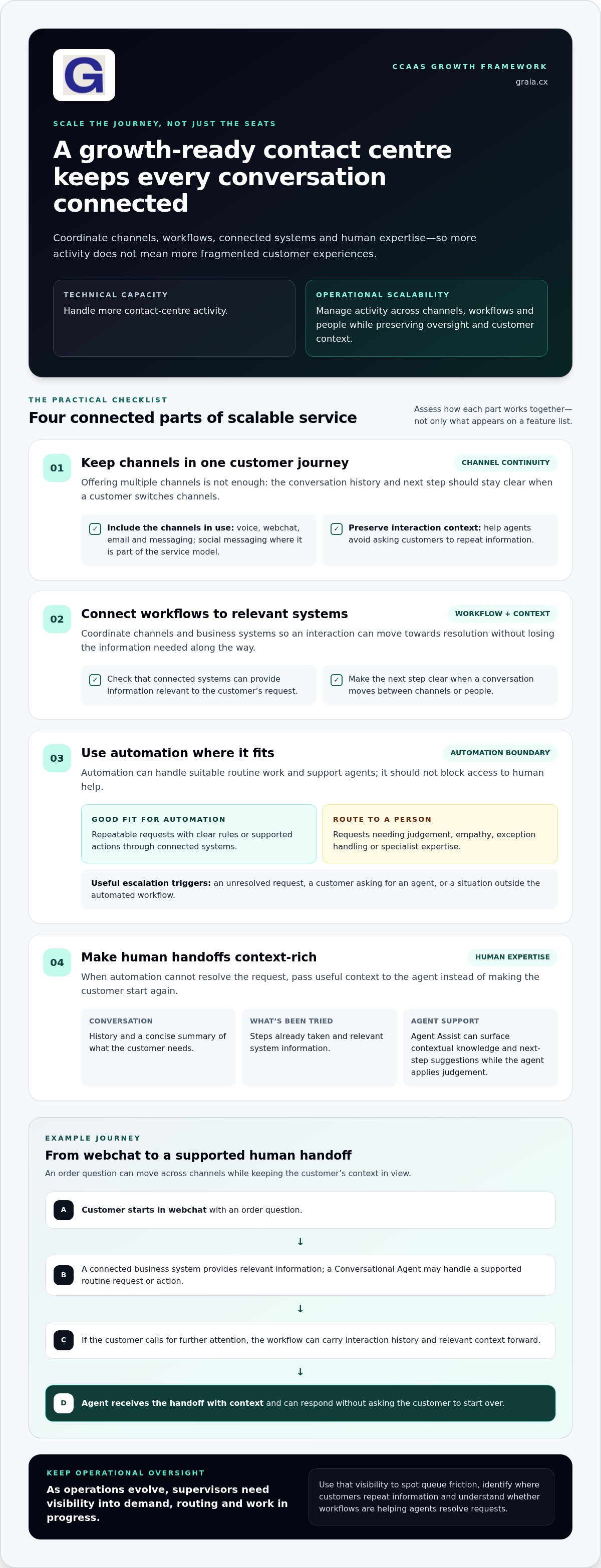
Scalable CCaaS is cloud-based contact-centre capability that adapts to changing demand and operational complexity while preserving oversight and customer context. Technical capacity is the ability to handle more activity. Operational scalability is the ability to manage that activity across channels, workflows and people without fragmenting the customer experience. That distinction matters when assessing scalable ccaas platforms for growth.
What does CCaaS scalability mean beyond adding agents?
Cloud delivery can help an organisation adjust its contact-centre capabilities as needs change, but it doesn’t mean capacity is unlimited or that every operational constraint disappears. Interaction volumes, channel mix and workflow complexity may grow at different rates. A new messaging channel, for example, can create additional work even if voice calls and agent numbers stay the same.
As queues and processes expand, supervisors need visibility into demand, routing and work in progress. Without useful oversight, it’s harder to spot queue friction, find where customers are repeating information or see whether a workflow is helping agents resolve requests. Scalability should give leaders practical ways to maintain control as operations evolve.
Which growth pressures should a platform absorb?
Demand peaks, new service channels, wider operating hours and changing customer expectations can all put pressure on contact-centre operations. The strain increases when channel histories sit in separate systems: customers may have to explain an issue again, and agents may lack the context to resolve it efficiently. Continuity matters because every interaction contributes to the broader customer experience (CX).
Automation and human support can address different parts of this pressure. A Conversational Agent can handle suitable routine requests or take supported actions through connected systems, while escalating more complex interactions to an agent with relevant context. This can help manage changing demand without treating every new interaction as a reason to add seats. The goal isn’t automation at any cost. It’s a coherent journey with an appropriate route to human expertise.
How Scalable CCaaS Connects Channels, Automation, and Human Expertise
As interaction volumes and channel choices expand, the platform’s architecture matters as much as its feature list. Scalable ccaas platforms for growth coordinate channels, workflows and connected business systems so each interaction can move towards resolution without losing context. IBM also identifies scalability as a benefit of CCaaS. In practice, scale depends on how well that capability fits the organisation’s operating model.
How do omnichannel workflows support growth?
Omnichannel working means more than offering voice, webchat, email and messaging. It means organising channels around a consistent customer journey, so the conversation history and next step stay clear when a customer switches channels. Where social messaging is part of the service model, it can be included in that journey too. A unified interaction view helps agents avoid asking customers to repeat information and gives teams a clearer basis for managing handoffs.
Consider a customer who starts in webchat to ask about an order, then calls because the issue needs further attention. An orchestrated workflow can connect the interaction history to relevant information in a connected business system. A Conversational Agent can handle a supported routine request or action. If the customer needs human help, the interaction can be escalated with its context instead of starting over. For more on how these capabilities fit together, read this agentic CCaaS platform reference.
Where should automation stop and human support begin?
Automation is best suited to repeatable requests with clear rules and supported actions. Requests that need judgement, empathy, exception handling or specialist expertise should have a straightforward path to a person. Define escalation triggers based on the interaction, such as an unresolved request, a customer asking for an agent or a situation that falls outside the automated workflow.
A useful handoff carries the conversation history and a concise summary of what the customer needs, what has already been tried and any relevant system information. That context helps the agent respond with understanding instead of making the customer start over. Agent Assist can surface contextual knowledge and support agents with next-step suggestions, while leaving the agent responsible for applying judgement.
Strong orchestration makes these parts work together: the customer chooses a channel, the platform routes the request through the appropriate workflow, connected systems provide relevant information, and automation either resolves the request or passes it to an agent with context. Explore more CCaaS platform insights as you consider how this model could fit your contact centre.
How to Compare Scalable CCaaS Platforms for Growth
A feature list can make two platforms look similar while hiding major differences in how they support your operation. Compare scalable ccaas platforms for growth by tracing a real customer journey: which channels are connected, what information moves between systems, where automation acts, and how a person takes over when needed. DMG Consulting’s discussion of how vendors must reassess and modernize their go-to-market strategies is a reminder that the market is evolving. Focus your shortlist on the operating model each platform enables, not feature counts alone.
| Capability | What to compare | Clarify in your evaluation |
|---|---|---|
| Channels and routing | Voice, chat, email and messaging coverage; routing flexibility | Are journeys connected, or managed in separate channel tools? |
| Integration fit | CCaaS, CRM, ERP and service-management connections | Which functions are native, integrated or configured? |
| Automation | Routine request handling, supported actions and escalation | Can workflows combine natural-language interaction with process rules? |
| Governance | Knowledge grounding, controls, auditability and data practices | Can teams review how interactions are handled and escalated? |
| Reporting | Operational views and access to relevant measures | Can teams track progress against their service goals? |
| Administration | Workflow configuration and day-to-day management | Who can make changes, and how are they managed? |
Which platform capabilities matter most for expansion?
Match channel coverage and routing to your service model, then test how customer context follows an interaction across channels. Map integrations against the systems your teams rely on, distinguishing built-in functions from connected-system dependencies or configuration work. If you serve customers across languages, include Live Call Translation in your assessment. GraiaCX supports live call translation in more than 100 languages.
How should buyers assess AI governance and operational visibility?
Examine how knowledge is retrieved, where rule-based controls apply, how an interaction can be escalated and what records are available for review. Assess data-protection practices against your organisation’s requirements rather than assuming governance from an AI feature label. For reporting, define the operational measures you need to monitor and determine whether the platform or connected tools provide them.
Test both sides of the operating model: automation for suitable repeatable tasks and reliable human intervention supported by relevant context. Agent Assist can help agents access contextual knowledge and suggested next steps. Explore the AI agent assist tools guide for more on agent enablement. For further platform perspectives, browse CCaaS growth insights.
How to Plan CCaaS Growth Without Disrupting Existing Operations
Scaling doesn’t automatically mean replacing every contact-centre system. A lower-disruption approach is to identify where existing tools work well, then extend the operating model around specific growth needs. An agentic layer can connect automation and customer journeys to an existing environment, helping teams evolve capabilities without making a full replacement the default starting point.
What should a CCaaS growth-readiness assessment include?
Start with the work as it happens today. Map channels, queues, customer journeys, integrations and recurring bottlenecks, including where information gets re-entered or requests stall. Then separate stable, repeatable workflows from interactions that need judgement, empathy or specialist handling. This gives you a practical view of where automation could help and where people should remain central.
Set a baseline before changing anything. Choose measures that reflect your goals, such as resolution, customer effort, service levels and agent workload. Define how each measure is gathered and reviewed, so you can assess a pilot against the current operation rather than impressions alone.
How can teams phase adoption and validate results?
Choose a bounded use case with a defined customer group, clear ownership and explicit escalation criteria. A contained pilot might focus on one repeatable enquiry type, while keeping exceptions and requests for human help on an established route. This gives teams a controlled way to learn before widening the scope.
Before launch, test the full path, not just the automated response. Check that integrations pass the information needed, knowledge retrieval provides relevant material, workflow rules behave as intended, and handoff summaries give agents usable context. Make the human fallback route clear to customers and frontline teams.
Review the evidence with operations, IT, security and frontline colleagues. Compare results with the baseline, investigate unexpected outcomes, and decide whether to refine the workflow, expand it or pause. Document how changes are governed and monitored as use grows. This staged method helps leaders evaluate scalable ccaas platforms for growth while keeping operational risk visible.
- Assess: Map workflows, systems and pressure points.
- Baseline: Agree on measures tied to customer and team outcomes.
- Pilot: Test a contained use case with defined human escalation.
- Review: Use cross-functional evidence to guide the next step.
Build your rollout around the journeys and capabilities that matter most. Explore more CX growth guidance to support your planning.
How Graia Supports Scalable CCaaS Growth Across Customer Journeys
Growth doesn’t have to mean starting again with a new contact-centre environment. GraiaCX’s agentic CCaaS platform combines omnichannel engagement with Conversational Agents, Agent Assist and Live Call Translation. It also integrates with established CCaaS environments such as Genesys, NICE CX and Avaya. This makes scalable ccaas platforms for growth about extending workflows and support, not simply increasing seat numbers.
How does GraiaCX combine automation with human collaboration?
Conversational Agents can handle suitable interactions and take supported actions through connected business systems. Their workflows can combine natural-language interaction with rule-based process logic, keeping conversations responsive while applying defined steps where consistency matters. Contextual knowledge retrieval helps ground responses in relevant information.
Automation needs a clear route to human expertise. When a request requires judgement, falls outside the workflow or needs further assistance, the interaction can be escalated with its context. Preserving conversation details and providing a structured summary helps the agent understand what the customer needs and what has already happened, reducing the chance of a frustrating restart.
Agent Assist supports the person handling the conversation by bringing contextual knowledge and next-best-action suggestions into the agent’s workflow. It can help agents make informed decisions while they remain responsible for the interaction. The result is a model where automation handles suitable tasks and people focus on situations that benefit from human understanding.
How can multilingual and integrated service support broader growth?
Customers may move between voice, chat, email and messaging as they seek help. Connecting these channels into a service journey can help teams maintain continuity as interactions move through different workflows. GraiaCX’s Live Call Translation supports conversations in more than 100 languages, extending multilingual support within the contact-centre environment.
Consider a customer who calls in a different language and needs an issue checked in a connected system. Live Call Translation can support the conversation, while the workflow connects the interaction to relevant information and routes it for further assistance if needed. Integrations with existing CCaaS environments let organisations build on their technology foundation instead of treating every new capability as a reason for wholesale replacement.
For a broader view of how AI can support connected contact-centre operations, read this enterprise AI contact centre guide. To explore how GraiaCX can help connect automation, channels and human expertise across customer journeys, explore GraiaCX insights and solutions.
Build a Contact Centre That’s Ready for What’s Next
Growth-ready CCaaS is about more than adding capacity. The strongest approach connects channels and workflows, measures outcomes against clear goals, and introduces change in stages so teams can adapt without unnecessary disruption. That’s the practical test for scalable ccaas platforms for growth: can the operating model evolve while customers retain a clear path to support?
As you compare options, look for ways to extend existing systems and keep automation accountable. GraiaCX integrates with Genesys, NICE CX and Avaya to connect its capabilities to established environments. Conversational Agents can take supported actions through connected business systems, while human handoffs preserve interaction context for live agents. Together, these capabilities support growth without losing sight of the people behind each conversation.
Your next step can be focused: identify one customer journey where connected workflows could make a meaningful difference, then assess how to improve it. Explore GraiaCX insights and solutions to consider what that future could look like for your contact centre. With a clear plan and the right balance of automation and human expertise, you can scale with confidence.
Frequently Asked Questions
What makes a CCaaS platform scalable?
A scalable CCaaS platform can adapt as interaction volumes, channels and workflows change. Look beyond the ability to add users: assess routing, integrations, automation, reporting, governance and how customer context is preserved. For example, adding webchat should not leave agents working from a separate interaction history. The right fit supports your growth requirements while giving operational teams the visibility and control they need.
Can a CCaaS platform scale without replacing existing systems?
Yes. A CCaaS platform can extend existing systems when its integrations fit your architecture and requirements. Map how it will connect with your contact-centre, CRM, ERP and service-management tools, then identify a workflow to extend first. A phased pilot can reveal integration gaps and test operational fit before wider adoption. Growth doesn’t automatically require replacing every part of your contact-centre environment.
How do I compare CCaaS platforms for business growth?
Compare platforms against your growth priorities, including channel coverage, routing, integration fit, automation, governance, reporting and administrative control. Separate functions provided within the platform from those that rely on connected systems or configured workflows. Then walk through representative customer journeys to see how information and work move from one step to the next. This makes your shortlist more useful than comparing feature counts in isolation.
Can CCaaS platforms support both AI automation and human agents?
Yes. CCaaS platforms can combine automation for suitable routine requests with human help for complex, sensitive or uncertain situations. Assess how escalation is triggered and whether the agent receives the conversation history and a clear summary. Agent Assist can also provide contextual knowledge and next-step suggestions to support live interactions. The goal is a considered division of work, with a reliable route to human expertise when a customer needs it.
How should a business introduce a scalable CCaaS platform?
Start by documenting growth goals, customer journeys, channels, integrations and operational bottlenecks. Choose a contained use case for a pilot, set baseline measures and define escalation and governance requirements. Test the workflow with operations, IT, security and frontline teams before expanding it. This phased approach helps expose process or integration issues early, while giving decision-makers evidence to guide the next step.
Can CCaaS platforms support multilingual customer service?
Yes. Some CCaaS platforms support multilingual service through translation and multilingual conversational automation. Assess language support across the channels you use, along with how the platform handles customer context and escalation to a human agent. GraiaCX’s Live Call Translation supports more than 100 languages. Consider how translated conversations fit your service workflows, rather than using language coverage alone to judge suitability.
What should I measure after deploying scalable CCaaS?
Measure results against customer and operational goals set before deployment. Depending on the use case, track resolution, repeat contacts, customer effort, service-level performance, agent workload and automation outcomes. Review performance by channel and workflow to see where changes are helping or creating friction. Pair these measures with feedback from agents and customers, so efficiency improvements don’t obscure a decline in service quality or customer confidence.