
Reducing Agent Turnover in Customer Service: A Practical 2026 Guide
Pay rises can help, but they can’t fix a job designed to exhaust people. Reducing agent turnover in customer service starts with finding out why experienced agents leave: repeated customer interactions, pressure from tight targets, difficult tools or a workload that keeps growing. When people go, the remaining team may have to carry more of that strain.
If you want to improve retention without relying only on higher pay or generic wellbeing advice, start with the work itself. Identify the operational causes behind departures, then prioritise practical changes to workload, coaching, onboarding and employee support.
Assess whether technology is easing pressure or adding complexity. Conversational AI can handle routine enquiries, while real-time agent assistance and contextual handoffs can support people through more complex interactions without replacing human judgement. Track workforce and customer measures together to see whether changes are making the day-to-day experience more sustainable.
Key Takeaways
- Make reducing agent turnover in customer service an operational priority by identifying which parts of the work are driving departures.
- Use consistent turnover definitions and reporting periods to establish a reliable baseline before choosing an intervention.
- Compare retention options by how they change agents’ daily experience, then monitor whether the intended improvement is taking hold.
- Turn insights into a focused plan with clear priorities, frontline input, accountable owners and review dates.
- Consider conversational automation and real-time agent support as part of a people-first approach, with a clear path to human help for complex needs.
Why reducing agent turnover in customer service starts with the work itself
Reducing agent turnover in customer service means looking beyond the number of people who leave. Turnover usually describes employee departures over a defined period. Voluntary exits are initiated by agents, while involuntary departures result from an employer’s decision, such as dismissal. Separating the two helps leaders distinguish retention challenges from other workforce changes. The distinction is similar to the one made in discussions of customer attrition, where the circumstances of an exit shape how it should be understood.
A company-wide rate can hide very different team experiences. One team may have stable staffing while another sees repeated departures because its contact types, leadership, tools or scheduling demands differ. Compare turnover across teams and roles, then listen to agents’ reasons for leaving. “When avoidable friction becomes part of the daily job, preventable voluntary departures become more likely.” Retention work therefore starts with examining how work is designed, not simply counting exits.
Which working conditions push customer service agents toward leaving?
Customer service can demand sustained emotional effort. Agents may need to respond calmly to frustrated customers while handling back-to-back contacts. Repetition can add to the strain, especially when targets leave little time to resolve complex issues properly. Rigid schedules or limited input into shift patterns can also make it harder to balance work with life outside the contact centre.
Other pressures are less visible but just as persistent. If guidance is hard to find, agents may spend time searching for answers or risk giving inconsistent information. Cumbersome systems can force them to switch between tools or repeat steps, turning simple interactions into frustrating ones. Pay and career prospects matter too, but they aren’t the only drivers, and no single explanation fits every departure. Use exit feedback and regular conversations with current agents to find patterns. Check whether concerns cluster around a particular workflow, manager, contact type or stage of employment.
What does high turnover change for customers and remaining agents?
Each vacancy can leave fewer experienced people available to handle demand. Depending on staffing and contact volumes, this may increase queue pressure or require remaining agents to take on additional work. Newer colleagues may need more support, while managers spend time recruiting and onboarding instead of observing interactions, coaching skills or addressing recurring process problems.
Repeated onboarding can also affect service consistency. New starters need time to learn systems, policies and the judgement involved in resolving customer needs. When experienced colleagues leave, practical knowledge about unusual cases and effective ways to navigate processes can leave with them. Customers may then need to explain an issue again or experience a less seamless handover. These are possible operational effects, not guaranteed outcomes. Track customer feedback and service indicators alongside workforce data to understand what is happening in your teams, rather than assuming every change is caused by turnover.
Measure customer service turnover before choosing a retention intervention
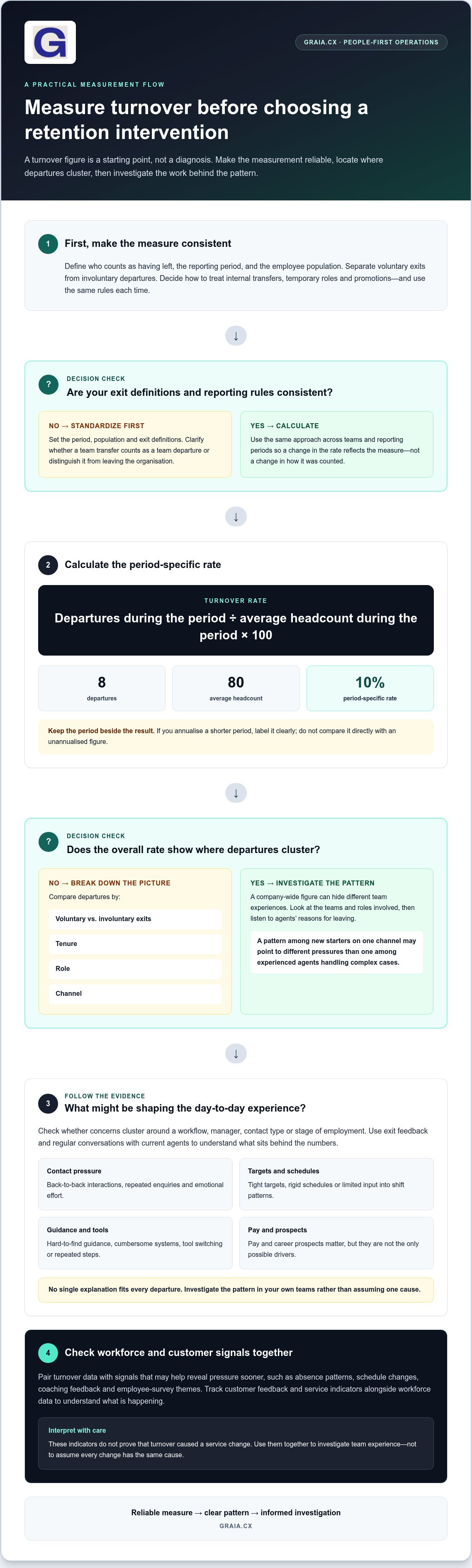
A turnover figure is a starting point, not a diagnosis. Before changing schedules, coaching or systems, define who counts as having left, which period you’re measuring and how you’ll calculate the rate. Without consistent definitions, a change in the figure could reflect a reporting change rather than a real shift in agent experience.
Turnover rate = departures during the period ÷ average headcount during the period × 100. For example, if a team records eight departures and had an average headcount of 80, its period-specific turnover rate is 10%. State the period beside the result. If you annualise a shorter period, label it clearly and don’t compare it directly with an unannualised figure.
For reducing agent turnover in customer service, the useful question isn’t simply whether the overall rate is high. It’s where departures cluster and what those agents experienced. Separate voluntary exits from involuntary departures, then segment results by tenure, role and channel. A pattern among new starters on one channel may point to different pressures than a pattern among experienced agents handling complex cases.
How should leaders interpret an agent turnover rate?
Compare like with like: use the same reporting period, employee population and exit definitions. Decide how you’ll treat internal transfers, temporary roles and promotions, then apply that approach consistently. If a transfer out of one team counts as a departure, distinguish it from leaving the organisation altogether. Otherwise, a team-level figure could look like employee attrition even though the person is still working elsewhere in the business.
External benchmarks can provide context, but they aren’t universal targets. Contact centres differ in role design, customer demand and workforce composition, so an industry average won’t explain what is happening in your teams. “An internal trend tied to a clear team or work pattern is more actionable than an unqualified industry average.”
Which early indicators help identify retention risks?
Turnover data looks backwards. Combine it with signals that can help leaders notice pressure sooner, such as absence patterns, schedule changes, coaching feedback and themes in employee surveys. These indicators don’t prove that someone intends to leave. They can prompt a timely conversation about workload, support or access to development.
Read the signals together, not in isolation. A rise in absence within one channel may mean something different if that team is also handling more complex contacts or facing persistent workload pressure. Pair workforce trends with channel, workload and contact-complexity data, and use customer service metrics alongside employee measures to build a fuller operational picture.
Keep the purpose supportive. Don’t use individual indicators to label or surveil agents. Look for shared conditions managers can address, then invite frontline perspectives before acting. Teams reviewing how service performance connects with employee experience can explore GraiaCX’s customer service insights as part of that wider assessment.
Compare retention strategies by how they change the agent’s daily experience
Retention measures work best when they address a specific source of friction. A recognition scheme won’t fix a confusing workflow, and new software won’t compensate for coaching that focuses only on speed. Match each intervention to the problem agents experience, then check whether the work changes in the intended way. This makes reducing agent turnover in customer service a practical design challenge, not a list of disconnected perks.
| Root cause | People-led response | Technology support | Outcome to monitor |
|---|---|---|---|
| Low confidence or limited feedback | Use regular coaching to build skills and discuss complex cases. | Offer real-time guidance with relevant next steps. | Agent feedback, coaching themes and quality trends. |
| Unpredictable schedules | Share schedules clearly and give agents a meaningful way to express preferences. | Use workforce tools to make schedule information accessible. | Schedule-change requests and agent feedback on predictability. |
| Few visible growth opportunities | Make progression routes clear and discuss development goals. | Use learning resources that support new skills and responsibilities. | Development participation and internal progression. |
| Repetitive contacts or cumbersome workflows | Review processes with frontline agents and remove unnecessary steps. | Automate suitable routine inquiries and support agents with knowledge access. | Repeat effort, process feedback and customer-resolution measures. |
| Effort goes unnoticed | Recognise specific contributions consistently and fairly. | Use service insights to help managers identify meaningful contributions. | Agent feedback on recognition and team engagement themes. |
Which management practices address pressure and disengagement?
Coaching should help agents strengthen judgement, communication and confidence, not simply remind them to handle contacts faster. Discuss a real interaction, identify what went well and agree on one useful next step. Pair this with targets that recognise resolution quality alongside efficiency, so agents aren’t pushed to rush interactions that need care.
Predictable schedules give people more control over their working lives. Where operationally practical, communicate changes early and invite agent input. Recognition should be specific rather than occasional or generic, while visible progression routes show how developing skills can lead to new responsibilities. These are ongoing management practices, not one-off retention campaigns.
Where can automation and agent assistance reduce avoidable effort?
Responsible AI should remove repetitive effort while preserving a clear route to human help. Conversational agents can resolve routine enquiries, while complex, sensitive or unresolved needs should be escalated to a person. A contextual handoff can give the agent relevant information about what has already happened, helping preserve continuity and reduce the need for customers to repeat themselves.
For agents, assistance is useful when it provides relevant guidance, draws on reliable knowledge and leaves room for professional judgement. Real-time next-best-action suggestions can surface information or possible steps, but agents need to assess whether those suggestions fit the customer’s situation. Monitor whether guidance is accurate and usable, and ask agents where it saves effort or creates extra steps. Technology is one form of support within a broader people-first approach, not a substitute for listening, coaching or sound job design.
Build a practical customer service agent retention plan in measurable stages
A retention plan should be small enough to act on and structured enough to learn from. Start with a baseline using consistent turnover definitions, then pair the figures with agent feedback to understand what the numbers can’t explain. Choose a limited number of priorities. Trying to fix scheduling, coaching, tools and progression all at once makes it difficult to see which changes are helping.
Give every intervention a clear owner, frontline input and a review date. The owner coordinates the work and reports progress, while agents help shape changes that affect their day-to-day experience. Set measures before implementation, including workforce indicators, workload signals, customer outcomes and agent feedback. This keeps reducing agent turnover in customer service grounded in observable changes rather than good intentions alone.
What should the first retention improvement cycle include?
Choose a high-impact friction point by combining segmented turnover patterns with what agents say about the work. If feedback points to unclear guidance during a particular contact type, for example, define a focused change to improve access to answers. This is more useful than launching a broad technology or training programme without a clear hypothesis.
Record the teams involved, the change being tested, the measures you’ll review and the date you’ll assess progress. Use a comparable period or team where possible, while noting differences that could affect results. Explain to agents what will change, what will stay the same and how they can share feedback during the cycle. Clarity builds trust, especially when the intervention is still being refined.
How can managers tell whether an intervention is helping?
Review a balanced set of signals, not turnover alone. Depending on the intervention, this could include voluntary departures, absence patterns, training completion, quality results, customer feedback and agent views of workload or support. A scheduling change, for instance, should be assessed against schedule-related feedback as well as relevant workforce and customer measures.
Compare like-for-like teams or periods, and record operational changes that could influence the result, such as shifts in contact volumes, channel mix or training arrangements. A change in turnover alone doesn’t prove that an intervention caused the outcome. Share findings with agents, ask whether the change addressed the original friction and adjust the approach if it hasn’t. Don’t declare success prematurely. A useful review may show that the solution needs more time or a different design.
Over successive cycles, build a practical learning loop: identify a pressure point, test a proportionate response, review the evidence and adapt. Keep priorities visible and make ownership explicit so follow-through doesn’t disappear into routine operations. Explore more customer experience insights from GraiaCX to inform how workforce improvements connect with the service customers receive.
Use GraiaCX’s agentic customer service tools to support a more sustainable team
Technology can support retention when it changes the work agents experience, not just the systems they use. GraiaCX’s agentic contact-centre platform combines voice and digital channels with conversational automation and real-time agent assistance. It can form one part of a broader, people-first approach to reducing agent turnover in customer service, alongside sound scheduling, coaching, development and manager support.
The aim isn’t to remove human judgement. It’s to reduce avoidable effort and give agents more room to focus on interactions that benefit from empathy, context and skilled decision-making. Start with a defined source of friction, then assess whether a technology change improves the workflow for both customers and agents.
How can conversational automation change routine service work?
GraiaCX’s Conversational Agent can resolve routine enquiries autonomously across voice and digital service channels. This can redirect suitable, repeatable requests away from live agents, giving people more capacity for conversations that require investigation or a more individual response. The benefit depends on how well the automated journey fits the service process, so monitor whether customers reach the right resolution without unnecessary effort.
Escalation must remain clear. A customer with a complex or sensitive need should have a route to a human agent, rather than being forced through automation that can’t address the situation. When an interaction is escalated, relevant context from the AI conversation can pass to the agent. This helps preserve continuity and can reduce the need for customers to repeat information. Automation should simplify the journey, not create another hurdle.
How can AI assistance support agents without removing human judgement?
GraiaCX’s Agent Assist can provide real-time next-best-action suggestions to support an agent during an interaction. These suggestions can surface potential next steps, but the agent remains responsible for applying their expertise to the customer’s circumstances. Useful assistance should fit the workflow, draw on relevant knowledge and leave room for agents to question or adapt guidance when needed.
Context matters at handoff, too. When a customer moves from an automated conversation to a live agent, carrying forward interaction details can help the agent understand what has already happened and continue from there. The result is a more connected exchange, not a replacement for attentive listening.
Introduce these capabilities with frontline input. Ask agents where routine work consumes time, which information is hard to access and where suggestions would genuinely help. Then evaluate the change using agent feedback, workflow measures and customer outcomes. If guidance adds steps or automation leads to avoidable handoffs, refine the design. No tool can guarantee lower turnover; its value lies in whether it supports better-designed work and strengthens the wider retention programme.
Explore GraiaCX’s customer experience insights to consider how agentic technology can support more connected service and a more sustainable team.
Make the next improvement count
A more stable customer service team is built through consistent choices, not a one-off initiative. Make the next step specific: pick one source of friction agents have identified, agree how you’ll know whether a change helps, and give the team a genuine voice in shaping it. That creates a practical foundation for reducing agent turnover in customer service while improving the conditions people need to do their best work.
Technology can reinforce that effort when it is designed around people. Conversational agents can resolve routine enquiries autonomously, real-time Agent Assist can suggest next-best actions, and contextual handoffs can help a human agent continue without losing the thread. These capabilities support agents; they don’t replace their expertise or the leadership commitment that makes change stick.
Choose an improvement you can learn from, listen to the people closest to the work, and keep adjusting as their needs evolve. Over time, that discipline can help build a more sustainable team and a service experience that feels better for everyone involved.
Explore practical customer experience insights from GraiaCX for fresh ideas to support your next step.
Frequently Asked Questions
Is customer service agent turnover the same as attrition?
Not always. Organisations may use the terms differently, even though both can describe employees leaving. Some use “attrition” for departures where roles aren’t replaced, while “turnover” refers more broadly to departures over a period. There’s no substitute for a clear internal definition. Document how you classify resignations, dismissals, retirements and internal moves, then use the same categories whenever you compare workforce changes.
Can remote or hybrid work help reduce customer service agent turnover?
It can help some agents by offering more flexibility, but it won’t suit everyone or resolve every reason for leaving. Remote work may also make informal peer support and coaching less accessible, while hybrid arrangements can introduce commuting and scheduling pressures. Ask agents which working patterns would help them, then assess a defined trial using their feedback alongside attendance and service quality. Consider team needs as well as individual preferences.
How often should contact centre managers conduct stay interviews?
There’s no universal schedule. Make stay interviews regular enough to identify concerns before someone decides to leave. A practical approach is to include focused conversations in established one-to-ones and add check-ins after a role change, team restructure or demanding period. Don’t save them for agents who appear unhappy. Consistent conversations across the team make it easier to spot shared issues and show that feedback isn’t only sought during a crisis.
What should managers ask agents during a stay interview?
Use open questions that invite specific examples, not a checklist that pressures someone to give a positive answer. Ask, “What part of your work gives you the most satisfaction?” and “What recurring obstacle makes your job harder than it needs to be?” You might also ask what skill they’d like to develop and what one change would improve their week. Listen without becoming defensive, then explain what you can act on and when you’ll follow up.
Can employee assistance programmes help prevent agent burnout?
An employee assistance programme may offer a route to confidential support, such as counselling or guidance, depending on the arrangement provided by the employer. It can be a useful resource, but it shouldn’t stand in for action on persistent workload, difficult processes or insufficient support at work. Make information about available help easy to find, explain how agents can access it, and address workplace pressures alongside individual wellbeing needs.
What should happen when a new customer service agent struggles during onboarding?
First, find out what’s difficult instead of assuming the agent lacks ability. Review a specific task together and distinguish between a knowledge gap, unclear instruction, unfamiliar software or pressure from handling live contacts. Agree on targeted support, such as guided practice, a named colleague for questions or clearer reference material. Set a manageable next step and a check-in date, so the agent can raise concerns early and see progress without feeling singled out.
How can managers respond after an agent handles an abusive customer interaction?
Check in promptly and acknowledge the impact before moving into performance feedback. Give the agent a chance to pause and explain what happened, then follow workplace procedures for documenting and escalating the interaction. Review whether the agent needs further support or a change in the immediate task before returning to customer contact. Later, discuss any learning points without blaming the person for a customer’s abusive behaviour, and consider whether the team needs clearer guidance for similar situations.