
Questions to Ask CCaaS Providers: 2026 Buyer Checklist
A polished demo can make every CCaaS platform look ready. The real test is how it handles your workflows, customer data and service expectations. The questions to ask CCaaS providers should reveal more than a long feature list: they should show whether a platform can improve customer outcomes without creating avoidable disruption.
Comparing providers is difficult when claims about AI, integrations and omnichannel service aren’t backed by consistent evidence. A migration that overlooks existing systems, security requirements or human escalation can put customer service at risk. You need clear answers and demonstrations, not bigger promises.
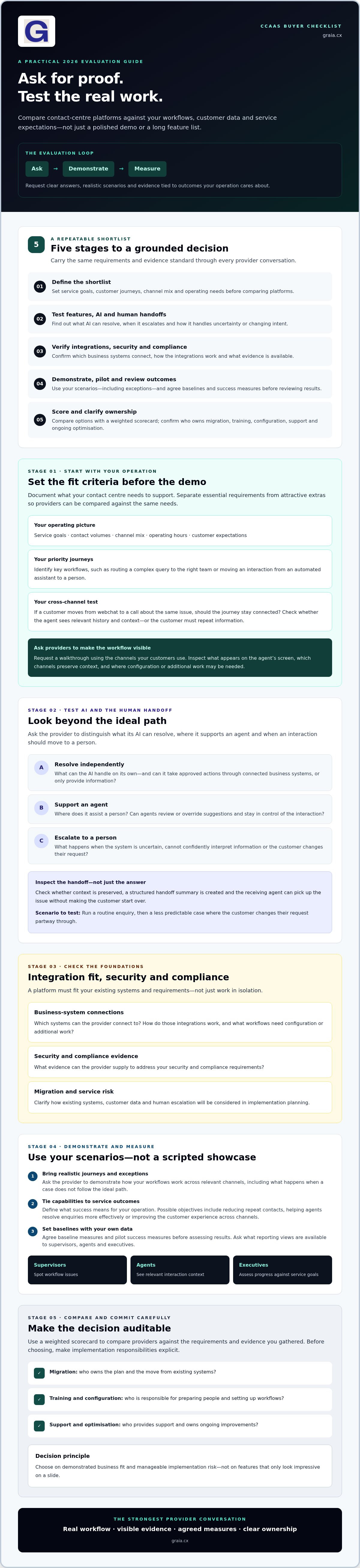
This practical 2026 buyer checklist will help you build a repeatable shortlist and evaluate providers against measurable outcomes. It covers AI performance and safeguards, integration fit, data security, implementation planning and the quality of human handoffs. Use the questions in provider conversations and demos to request proof, test realistic scenarios and uncover gaps before you commit. The goal is a decision grounded in business results and manageable implementation risk, not features that look impressive on a slide.
Key Takeaways
- Set shortlist criteria around service goals, customer journeys, channel mix and operating needs before comparing platforms.
- Use the questions to ask CCaaS providers to test what AI can resolve, when it escalates to a person and how it handles uncertainty or changing customer intent.
- Confirm which business systems each provider can connect to, how those integrations work and what security and compliance evidence they can provide.
- Ask providers to demonstrate your real scenarios, including exceptions, and agree pilot baselines and success measures before assessing results.
- Compare options with a weighted scorecard, then clarify who owns migration, training, configuration, support and ongoing optimisation.
Questions to Ask CCaaS Providers Before Defining Your Shortlist
Start with your operation, not a provider’s feature catalogue. Document your service goals, contact volumes, channel mix, operating hours and customer expectations. Then identify the journeys that matter most. For example, a customer might begin with a webchat and later call about the same issue. Decide whether your teams need to manage that as one connected journey, with context carried between channels, or as separate contacts.
Ask providers which workflows they support now and where configuration, integrations or additional work may be required. Separate essential requirements from attractive extras before booking demonstrations. That makes it easier to compare providers against the same needs and keeps a polished demo from distracting you from practical fit. For broader context on platform capabilities and buying considerations, see this agentic CCaaS platform buying guide.
Which customer journeys and channels must the CCaaS platform support?
Ask how the platform handles voice, chat, email and social interactions across your operation. Then request a walkthrough of a real customer journey using the channels your customers actually use. If someone moves from chat to a call, check whether the receiving agent can see relevant history and context, or whether the customer must repeat information. Ask the provider to demonstrate the transfer, including what appears on the agent’s screen, rather than simply confirming that each channel is available.
Clarify how the platform handles your key workflows, such as routing a complex query to the right team or passing an interaction from an automated assistant to a person. Ask which channels preserve conversation context and which require separate configuration. Verify operating hours, routing rules and handoff arrangements against your service model instead of assuming providers handle them in the same way.
What does success look like for your contact centre?
Define the outcomes you want before discussing projected improvements. These might include reducing repeat contacts, helping agents resolve enquiries more effectively or improving the customer experience across channels. Ask the provider to map each proposed capability to a specific objective and explain what evidence would show progress.
Agree baseline measures using your own operation’s data, then ask which reporting views supervisors, agents and executives can access. Each group needs different insight. Supervisors may need to spot workflow issues, while executives need to assess progress against service goals. A clear baseline makes later results more meaningful. The cloud computing model explains the underlying service-delivery approach, but your evaluation should focus on whether the provider’s actual workflows and reporting fit your operation.
These discovery questions give you a grounded shortlist. Carry the essential requirements into the next stage, where you can test AI capabilities, customer context and human handoffs against realistic scenarios.
Questions to Ask About CCaaS Features, AI, and Human Handoffs
Test AI claims against the work your contact centre actually handles. Ask providers to distinguish between interactions their AI can resolve independently, tasks where it supports an agent, and situations that should move to a person. Run a routine enquiry and a less predictable case, such as a customer changing their request partway through or providing information the system can’t confidently interpret.
Among the most useful questions to ask CCaaS providers are those that reveal what happens beyond the ideal path. Check whether the system preserves context, creates a structured handoff summary and gives agents control to review or override suggestions. Evaluate capabilities such as agent assistance or live call translation only where they address a genuine need. For instance, GraiaCX offers Conversational Agents, Agent Assist and Live Call Translation as part of its contact-centre technology, so buyers can assess whether those capabilities fit their own workflows.
How should a provider prove its AI can do more than answer questions?
Ask whether an AI agent can take approved actions through connected business systems, or whether it only provides information. Choose a workflow relevant to your operation, such as checking an account and carrying out an authorised next step. Ask the provider to show how the system retrieves knowledge, applies business rules and responds when information is missing or an action fails.
Request a clear, reviewable record of the sources searched, actions taken and reasons for escalation. You should be able to assess whether the AI followed the intended workflow, rather than relying on a convincing spoken answer. Ask how the system separates a response grounded in approved information from an action that requires a connected system or human approval.
What happens when automation cannot resolve the customer’s issue?
Ask what triggers a handoff, how a customer can request a person and what happens if intent is unclear. Test a sensitive or unusual query alongside an ordinary exception. Then inspect the receiving agent’s view. Does it include relevant conversation history, the customer’s stated goal and the steps already attempted?
Test failure paths too. Simulate an unavailable integration and see whether the system explains the limitation, avoids claiming an action succeeded and offers an appropriate route to human support. A useful handoff lets the agent continue the conversation without asking the customer to start again.
Use a simple demo scorecard to record what you observed: whether the task was completed accurately, relevant context was retained, escalation was appropriate and the agent could intervene. Ask the provider to repeat the same scenarios across its conversational AI and agent-assist capabilities, where relevant, so you can compare evidence rather than presentation style. For multilingual contact centres, test translation with the languages, terminology and call conditions that matter to your operation. Ask how brand-specific terms are handled and whether agents can review a translation before responding.
These tests turn broad claims into observable behaviours. For more perspectives on evaluating AI and contact-centre technology, explore the CCaaS and customer experience articles.
Questions to Ask About CCaaS Integrations, Security, and Compliance
A CCaaS platform must work with the systems your teams already rely on and handle customer information in ways your organisation can verify. Go beyond asking, “Do you integrate with our CRM?” Ask for the exact connection method, data exchanged, support responsibilities and evidence behind security claims. For broader context on how AI fits into contact-centre operations, see this guide to enterprise AI contact centre solutions.
How will the CCaaS provider connect with your existing technology?
List the CRM, ERP, ticketing, identity and analytics systems involved in your priority customer journeys. For each one, ask whether the connection is native, API-based, partner-delivered or separately scoped. Request documentation showing which functions and data fields are supported. A general compatibility statement won’t tell you whether the integration can support your actual workflow.
Clarify who owns integration design, testing, maintenance and incident resolution. Ask how often data synchronises, what API limits apply, how errors are surfaced and what happens if a connection fails. Then request a proof of concept using representative systems and sample workflows. For example, confirm that a customer record and interaction outcome appear in the intended systems, and see what happens when a required field is missing.
Also confirm which contact-centre platforms are supported and whether an integration is available now. Graia describes integrations with major CCaaS providers, including Genesys, NICE CX and Avaya. As with any provider, verify the specific connection, functions and scope you need rather than treating a platform name as proof that your workflow is covered.
What security and governance evidence should you request?
Ask where customer data is processed and stored, how it is protected in transit and at rest, and which provider personnel or subprocessors can access it. Request current documentation, not only a summary in a sales presentation. Check the scope and validity of any certifications the provider cites, which services they cover, and whether the relevant controls extend to integrations and AI functions.
Make the review specific to your organisation’s obligations and workflows. Confirm contractual commitments for data handling, access controls, retention and deletion, and ask how changes to subprocessors are communicated. If AI processes customer interactions, ask whether data may be used to train or improve models, what controls apply and how human oversight is maintained. Graia states that client data is not used to train its own or third-party AI models; confirm how that commitment applies to the services and terms under consideration.
For regulated workflows, verify that audit records capture the events your team needs to review, such as access, configuration changes and relevant system actions. Establish how long those records and interaction data are retained, who can retrieve them and how they can be exported for internal review. Don’t treat a broad assurance of “compliance” as proof that a specific workflow meets your requirements.
Capture answers in a technical due-diligence record: system, connection type, data involved, accountable owner, failure behaviour and supporting evidence. Resolve gaps before contracting, especially where the provider’s integration or security scope depends on a third party or additional configuration.
Questions to Ask CCaaS Providers During Demos, Pilots, and ROI Reviews
A demonstration is not proof of fit, and a projected return is not a result. Use this stage to validate your shortlist against your operation. Bring representative scenarios, agree how outcomes will be measured and record what the provider actually shows. The strongest questions to ask CCaaS providers connect each capability to evidence, effort and a decision you can act on.
What should a credible CCaaS demo show?
Ask the provider to demonstrate your priority journeys using representative data, not only polished showcase examples. Include a normal interaction and an exception, such as a failed system connection or a request that needs a human handoff. Observe the workflow from both the customer’s and agent’s perspectives, including what information is visible and what action is required next.
Ask the provider to show how an automated interaction moves into the agent’s workflow. Check whether the agent receives a useful summary and can see the customer’s previous steps. Record which capabilities work now, which need configuration and which depend on future development. This distinction helps prevent roadmap statements from being mistaken for ready-to-use functionality.
How can you evaluate a pilot without assuming results?
Before a pilot starts, agree its scope, comparison period, baseline measures and accountable owners. Select a representative workflow and define acceptance criteria in advance, including how exceptions and incomplete interactions will be counted. Ask who will review the data, how results will be attributed and what evidence would support scaling, revising or stopping the test.
Choose measures that reflect your objectives, such as resolution quality, repeat-contact patterns, agent workflow effort or operational handling time. Interpret changes alongside volume, case mix and process adjustments rather than assuming the technology alone caused them.
Assess the full operating impact, not just the headline result. Include implementation effort, time spent configuring workflows, agent training, supervisor oversight and the work needed to maintain knowledge or review automated decisions. A capability that performs well in isolation may still require material changes to daily operations.
For each pilot measure, document the baseline, target, data source, review owner and known limitations. Compare projected benefits with observed results, and separate verified outcomes from assumptions in the business case. The contact-centre ROI with AI guide offers a framework for thinking through value and measurement.
Use your findings to make a disciplined next-step decision: proceed, refine the scope or investigate unresolved risks. For further evaluation guidance, explore Graia’s contact-centre insights.
Questions to Ask Before Choosing a CCaaS Provider and Signing
The final decision should reflect more than which platform made the strongest impression. Use a weighted scorecard to compare providers against the same requirements, evidence, risks and operational-readiness criteria. Give greater weight to what matters most to your contact centre, such as fit with priority workflows, demonstrated outcomes or the resources needed to implement the platform.
Keep the scoring grounded. Label each item as demonstrated, documented, assumed or dependent on future work, and note any conditions attached to the provider’s answer. Before signing, ask for the agreed scope, service commitments, exit terms and each party’s responsibilities to be recorded in the contract. Clarify how changes to scope or integrations will be handled, and check that verbal assurances are reflected in writing.
Which implementation and support questions reduce transition risk?
Request a phased implementation plan that identifies dependencies, owners, decision gates and the conditions for moving between stages. Ask who is responsible for migration, configuration, testing and resolving issues. Clarify how agents and supervisors will be trained, what support is available after launch, and how service issues are escalated and reported.
Also establish who owns change management and post-launch optimisation. Ask how the provider will help your team address issues found during testing and how configuration changes will be managed after launch. A clear division of responsibilities helps your teams prepare for new workflows and know where to turn when adjustments are needed.
How do you make a defensible final provider decision?
Score every shortlisted provider against the same documented requirements and test scenarios. Separate verified capabilities from assumptions, roadmap items and verbal assurances, then review the evidence behind high-weight criteria. Choose the provider with the strongest demonstrated fit for your priority outcomes and constraints, not simply the highest overall score.
Before approval, make sure the contract and implementation plan align with the evaluation record. Confirm the scope being purchased, the commitments the provider has accepted and what happens if responsibilities or agreed service levels aren’t met. These are practical questions to ask CCaaS providers before signing because they turn a promising selection into an accountable working arrangement.
With the comparison complete, document why the chosen option best fits your operation and which risks still need active management. To continue your evaluation, explore Graia’s CX resources for further perspectives on contact-centre technology and customer experience.
Make Your CCaaS Decision With Evidence
The strongest buying decision starts with your service priorities, then tests each provider against the same real-world journeys. Use the questions to ask CCaaS providers to compare demonstrated outcomes, AI behaviour, integration fit and security evidence rather than relying on feature claims or promises. Before signing, make sure responsibilities, service commitments and implementation expectations are clear in writing.
Keep the evaluation grounded in how customers and agents will experience the change. Graia offers Conversational Agents that can handle routine enquiries and escalate interactions to people, as well as Agent Assist and Live Call Translation. Its platform integrates with major CCaaS providers. Verify the current capabilities and integration scope against your own requirements, then test them in the workflows that matter to your operation.
With a consistent scorecard and a clear view of remaining risks, you can move forward with greater confidence. Explore Graia’s customer experience resources to support your evaluation of contact-centre technology and customer experience.
Frequently Asked Questions
What questions should I ask a CCaaS provider first?
Start by asking whether the provider can support your priority customer journeys, channels and service objectives. Then request a walkthrough of a real workflow, including an exception and escalation to a person. Ask how the platform fits your systems, what evidence supports its security claims, and who owns implementation and support. Use the same question set with every shortlisted provider so their answers are genuinely comparable.
How do I compare CCaaS providers objectively?
Build a scorecard from your requirements before provider demonstrations begin. Assess each provider against the same customer scenarios, integration needs, security evidence, implementation responsibilities and support commitments. Mark capabilities as demonstrated, documented, dependent on configuration or planned, and weight them by operational importance. Keep evidence alongside each score so a persuasive presentation or unsupported assurance doesn’t carry the same weight as a tested workflow.
What should I ask about AI in a CCaaS platform?
Ask which enquiries AI can resolve, what actions it can take through connected systems and when it should hand the interaction to a person. Test a routine request and an unclear one, then inspect the response, escalation and interaction record. Ask what knowledge informs answers and how supervisors can review activity. Agree how you’ll measure results against your own baseline rather than relying on general performance claims.
Can a CCaaS provider integrate with our existing CRM and contact-centre systems?
Often, but support and scope vary by provider and system. For each critical connection, ask whether it’s native, API-based, partner-delivered or custom-built. Confirm which records and fields are shared, how updates are synchronised, who maintains the integration and how failures are reported. Test a priority workflow, such as recording an interaction outcome in your CRM, during a technical review or proof of concept before signing.
What security questions should I ask a CCaaS provider?
Ask where customer data is processed and stored, how it’s protected in transit and at rest, and who can access it. Request current documentation on access controls, relevant certifications, subprocessors, retention, deletion, incident handling and audit records. For AI features, clarify whether customer interactions are used for model training and what review controls administrators have. Assess the evidence against your organisation’s requirements rather than relying on a broad compliance statement.
How can I tell whether a CCaaS provider’s AI claims are credible?
Ask the provider to demonstrate your use cases with representative data, realistic exceptions and success criteria agreed in advance. Check what the system does when information is missing, intent changes or an integration fails. Before a pilot, record the baseline, measurement method, review owner and acceptance criteria. Ask which capabilities are available now and which need configuration or further development. Treat outcome figures as claims until their method and relevance are clear.
What should a CCaaS implementation plan include?
A practical plan should set out implementation phases, owners, dependencies, integration and data testing, agent and supervisor training, launch criteria and post-launch support. Ask how risks, delays and service issues will be escalated, and who is responsible for keeping customer operations running through the transition. Confirm which operational measures will be monitored after launch and when teams will review them. Put responsibilities and decision points in writing before work begins.