
Post-Implementation CCaaS Value Assessment Guide 2026
Go-live proves that a CCaaS platform is running. It doesn’t prove it’s delivering value. A credible post-implementation ccaas value assessment starts by comparing the outcomes you intended with the operational and customer results you can actually see, then examining what may have influenced the difference.
If implementation is complete but business impact remains unclear, you’re not alone in facing a measurement challenge. Service, operations and finance teams may track different metrics, while shifts in demand or processes can make it difficult to connect results directly to the platform. The answer isn’t to credit or blame CCaaS for every change. It’s to build an evidence-led view of what happened and why.
This guide shows you how to set a clear baseline, compare targets with actual performance and assess which workflow or platform changes plausibly contributed to the results. You’ll also learn how to turn findings into prioritised improvements with named owners and review dates. From automation and human hand-offs to agent guidance and channel integration, the goal is practical: turn the post-launch value question into a focused plan for better customer and operational outcomes.
Key Takeaways
- Define what your post-implementation ccaas value assessment needs to prove, separating successful deployment from measurable operational and customer outcomes.
- Build an assessment matrix that links each objective to relevant measures, data sources and accountable owners.
- Compare equivalent periods and segment results where changes in channel, customer group or workflow could affect interpretation.
- Classify findings by status, then prioritise improvements according to expected value, effort, risk and dependencies.
- Use the evidence to choose a next step: optimise workflows, expand proven use cases, address gaps or reassess scope.
Post-Implementation CCaaS Value Assessment: What It Should Prove
Go-live marks a delivery milestone, not a verdict on value. A post-implementation ccaas value assessment is a structured comparison of the outcomes agreed before implementation with evidence from the service after launch. It tests whether the change is producing the intended operational and customer results, what may have influenced those results, and where further action is needed.
Keep delivery outputs separate from outcomes. Deploying a new voice or digital channel, configuring a routing flow or launching a system integration shows that work was completed. It doesn’t show that customers are resolving queries more easily or that agents can handle interactions more effectively. For a practical grounding in how contact centres serve customers across channels, see the Contact Centre Overview. Then assess performance using evidence such as resolution, repeat contacts, customer feedback, agent experience and workflow adoption.
The review should give each stakeholder a useful view of the same change. The executive sponsor needs to understand whether strategic objectives are being met; contact-centre operations needs actionable service evidence; technology needs to see how systems and integrations are performing; finance needs measures that support the business case; and customer experience leaders need to understand the effect on customer journeys. Go-live alone establishes none of these outcomes. The assessment must test them.
Set the assessment boundary and decision
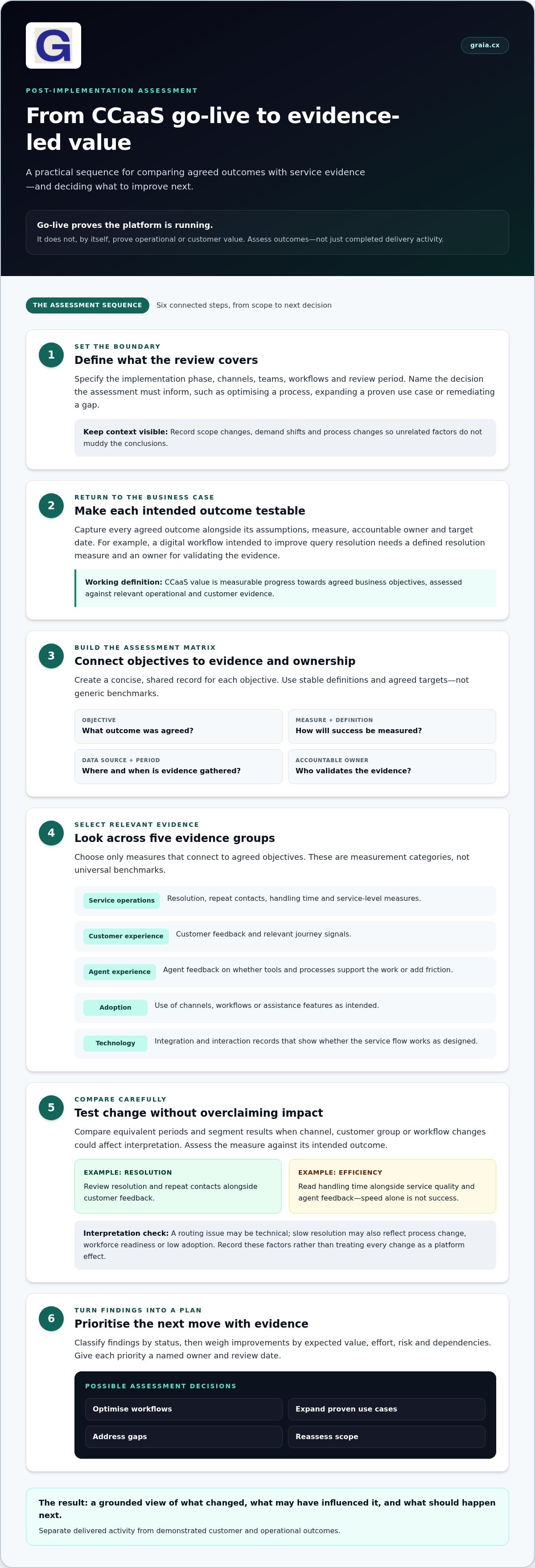
Define what is in scope before interpreting results: the implementation phase, channels, teams, workflows and review period. State the decision the assessment must inform, such as whether to optimise a process, expand a proven use case or remediate a gap. This keeps the review focused and stops unrelated changes from muddying its conclusions.
Separate platform performance from the conditions around it. A routing issue may be technical, while a slow resolution could also reflect a process change, workforce readiness or low adoption. Record these factors alongside the measures rather than treating every movement in performance as a platform effect.
Revisit the original business case
Return to the approved case and capture each expected outcome with its assumptions, measure, accountable owner and target date. For example, if the objective was to improve query resolution through a new digital workflow, specify how resolution will be measured and who owns that evidence. Note material scope changes, demand shifts or process changes since approval so the comparison reflects the service that actually exists.
Use a clear definition to align the review team: CCaaS value is the measurable progress made towards agreed business objectives, assessed against relevant operational and customer evidence. This keeps the discussion grounded in outcomes while making room to distinguish demonstrated impact from results that remain uncertain.
Build a CCaaS Assessment Around Outcomes, Not Activity
A useful assessment connects business objectives to evidence, not just a catalogue of platform activity. Build a concise matrix for each objective, recording the measure, data source, reporting period, definition and accountable owner. For example, an objective to improve first-contact resolution could be linked to a clearly defined resolution measure, interaction records and the team responsible for validating the data. This gives operations, technology, finance and customer experience teams a shared view of what success means and where the evidence comes from.
Organise measures into five evidence groups, selecting only those that connect to the agreed objectives:
- Service operations: Contact resolution, repeat contacts, handling time and service-level measures can show how workflows perform.
- Customer experience: Customer feedback and relevant journey signals add context to operational changes.
- Agent experience: Agent feedback can reveal whether new tools and processes support the work or add friction.
- Adoption: Usage of channels, workflows or assistance features helps distinguish an ineffective design from one that is not yet being used as intended.
- Technology: Integration and interaction records help show whether the underlying service flow is functioning as designed.
These are measurement categories, not universal benchmarks. Use definitions and targets your organisation already agreed, and avoid introducing industry averages that may not fit your contact mix, customer needs or operating model. A metric is useful when its meaning is stable and its relationship to the objective is clear.
Choose measures that reflect the intended outcomes
Match each measure to the change being tested. If the aim is to resolve customer queries more effectively, examine resolution and repeat contacts alongside customer feedback. If the goal is to improve efficiency, handling time may help, but interpret it alongside service quality and agent feedback so speed alone doesn’t become the definition of success.
For automation, look beyond the number of interactions contained. Assess whether the customer completed the intended task, whether an escalation carried useful interaction context and what happened after hand-off. A high containment figure is not meaningful if customers need to repeat themselves or the task remains unresolved.
Connect measures to credible evidence
For every measure, name its source system and data owner, set the reporting period and document the calculation. Check that interaction, case and channel records use consistent identifiers and definitions before comparing results. If one system counts transfers as new contacts while another treats them as part of the same interaction, reconcile that difference first.
When exploring financial interpretation, connect operational evidence to the assumptions in the business case rather than treating a single metric as ROI. Related perspectives on AI and contact-centre ROI can help frame that analysis. For further measurement ideas, explore GraiaCX’s CX insights as you develop an evidence-led assessment.
Compare Before and After Without Overclaiming CCaaS Impact
A before-and-after comparison can show what changed. By itself, it can’t establish why. Contact-centre performance shifts with demand, staffing, policy, seasonality and process design, so a credible post-implementation ccaas value assessment must account for these influences rather than crediting every improvement or setback to the platform.
Start with equivalent pre- and post-implementation periods, using the same metric definitions and inclusion rules. If the earlier measure counted transferred calls differently, or the later reporting includes a newly introduced channel, the figures may not be directly comparable. Document any definition changes and explain how they affect interpretation.
Then segment the results wherever the service itself has changed. A blended average may conceal important differences between voice and digital interactions, customer groups, query intents or workflows. For example, an overall handling-time shift could reflect a higher share of straightforward enquiries rather than a change in how the new workflow performs. Compare like with like wherever the available data supports it.
Keep a change log alongside the results. Record staffing changes, policy updates, demand patterns, seasonal effects and process redesigns that occurred during the measurement period. This creates a visible context for interpreting trends and helps stakeholders distinguish an observed change from a plausible platform contribution.
Choose a realistic comparison when baselines are incomplete
Use the strongest historical evidence available, but label gaps plainly. Note missing periods, altered definitions or incomplete channel records, and explain how each limitation narrows the conclusion. If the service was introduced in phases, rollout groups or comparable workflows may offer useful reference points, provided their customer mix and operating conditions are sufficiently similar.
Don’t fill gaps with precise-looking estimates based on assumptions or vendor projections. A qualified comparison is more useful than false precision.
Interpret results with operational context
Investigate what changed in the workflow as well as what changed in the metric. Check adoption, routing rules, knowledge content and human hand-offs. A Conversational Agent may handle a routine enquiry before escalating it with context; the result depends not only on containment, but also on whether the hand-off supports a smooth resolution. Pair trend data with structured feedback from agents, supervisors and customers to understand friction or improvements that numbers alone may miss.
For each finding, state the evidence and its strength. A practical confidence label can distinguish a clear, consistent pattern from a directional signal or an inconclusive result. Describe the evidence behind the label, including data completeness, comparability and relevant operational changes. This gives executives a sound basis for action without presenting uncertainty as failure.
Use this caveat in the review: “A before-and-after difference shows that performance changed during the period, but correlation alone cannot prove CCaaS caused the change; concurrent operational factors and evidence quality must also be considered.”
That discipline makes the assessment more credible. It also identifies where further observation or a better comparison is needed before expanding a workflow or attributing value with confidence.
Turn Assessment Findings Into a Prioritised CCaaS Improvement Plan
An assessment creates value when it changes what happens next. Convert findings into decisions the team can own, not a long list of observations with no clear route to action. Start by classifying each outcome:
- Achieved: Evidence supports the intended result, so decide whether to sustain or extend the approach.
- At risk: Progress is visible, but a dependency or emerging issue could undermine it.
- Unresolved: The result is below expectation or the evidence is insufficient to judge it.
- Opportunity: Findings point to a workflow or use case that could deliver further customer or operational value.
Then rank proposed actions against expected value, effort, risk and dependencies. A high-value change that depends on an integration fix may need a different sequence from a straightforward knowledge update. Make the trade-offs explicit, and prioritise actions that address customer friction or operational risk before lower-impact refinements.
Convert evidence into decisions
Match each finding to the type of intervention it needs: configuration changes, process changes, training or integration work. For example, if agents receive incomplete context after an automated interaction, investigate the hand-off and data flow before assuming that additional training will solve the problem. Record the evidence behind the action and any uncertainty that could affect the decision.
Route material security, compliance or service-continuity concerns through the organisation’s existing governance. Keep these issues visible in the improvement plan, with an accountable owner and the appropriate decision path.
For agent workflow findings, distinguish between a tool configuration issue and a guidance or adoption need. A review of GraiaCX’s CX insights can help teams explore how Agent Assist and agent workflows fit into a broader improvement cycle.
Create a repeatable value-review cadence
Give every action an owner, decision date, success measure and review checkpoint. Set the follow-up date to match the action and the organisation’s reporting cycle, allowing enough time for a meaningful signal without leaving an unresolved issue unattended. One shared action log should preserve the finding, supporting evidence, decision, dependency, owner and next review date.
Measure impact, not just completion. Closing a configuration task confirms that the change was made; it doesn’t show whether the selected customer or operational measure moved. At the checkpoint, compare the result with the expected effect, note relevant changes in conditions, and decide whether to continue, adjust or stop the action.
Use the log to keep decisions connected over time. If evidence remains weak, record what data or observation is needed before drawing a firmer conclusion. This makes the post-implementation ccaas value assessment a repeatable management practice, not a one-off report, and gives leaders a clear line from evidence to accountable action.
Use the CCaaS Value Assessment to Decide What Comes Next
The final assessment should make the next decision clearer, not force a positive or negative verdict. Summarise which outcomes the evidence supports, what remains uncertain and which results need more observation. Then choose a proportionate response: optimise a current workflow, expand a use case with credible evidence, remediate a gap or reassess the original scope.
Before deciding, consider the whole operating context. A platform capability creates value only when it fits the workflow, connects with the required systems, supports appropriate human escalation and produces evidence the organisation can review. Governance matters too: proposed changes should have clear decision rights, risk oversight and a defined route for resolving dependencies.
Assess platform contribution without confusing it with the whole operating model
Map each capability to an objective and workflow already included in the assessment. For example, a Conversational Agent may support routine enquiries, while Agent Assist may provide agents with real-time guidance. Assess whether the relevant workflow is suitable, whether escalation preserves useful context and whether integrations support the required information flow. These are contribution questions, not proof that technology alone produced an outcome.
Broader evaluation of an agentic CCaaS platform should also consider how voice and digital channels, human hand-offs, integrations and reporting work together. Keep the review anchored to identified needs rather than expanding scope simply because another capability is available.
Present a decision-ready value report
Lead with the decision required. Follow with the evidence, limitations and recommended action so executives can see both the rationale and the uncertainty. A concise report helps stakeholders move from analysis to an informed choice without obscuring what the data can and cannot show.
For each objective, include the baseline, observed result, confidence, accountable owner and next review date. Add a short note on evidence quality or relevant operating changes where these affect interpretation. Close with a roadmap that sequences actions according to value, risk, effort and dependencies, without presenting projected savings or outcomes as guaranteed.
A practical decision summary can answer four questions:
- Continue: Which results are sufficiently supported to sustain the current approach?
- Improve: Which workflow or integration needs a targeted adjustment?
- Extend: Which proven use case could be applied to another suitable channel or team?
- Reassess: Which objective, assumption or scope decision needs revisiting?
This keeps the post-implementation ccaas value assessment focused on evidence and accountable decisions. For further ideas on connecting customer experience priorities with platform choices, explore GraiaCX’s CX insights.
Make Your Next CCaaS Decision Evidence-Led
A value review shouldn’t close the conversation. It should give your organisation a clearer basis for the next one: what to strengthen, where to proceed carefully and which questions need better evidence. Treat the post-implementation ccaas value assessment as a continuing decision practice, adapting priorities as customer needs and operating conditions evolve.
As you consider future changes, keep the intended customer and agent experience at the centre. GraiaCX brings conversational automation, agent assistance and omnichannel capabilities together, and integrates with major CCaaS providers including Genesys, NICE CX and Avaya. Those capabilities can inform a potential improvement path, but the case for any change should still come from your objectives, operational context and assessment evidence.
Turn the next review into a deliberate step forward. Explore GraiaCX’s customer experience insights for perspectives to support your ongoing planning. With clear evidence and focused priorities, your team can keep improving the service while staying grounded in what matters to customers and agents.
Frequently Asked Questions
When should we conduct a post-implementation CCaaS value assessment?
Schedule the first review once the live service has generated enough relevant evidence to assess the outcomes, rather than using the launch date as a success measure. The right timing depends on interaction volumes, rollout scope, reporting cycles and whether the objective needs time to emerge. For example, a workflow adoption review may be useful before a longer-term customer outcome review. Record why each review period suits its measures, then schedule follow-ups around completed actions.
What if we did not establish a baseline before our CCaaS implementation?
You can still conduct a useful post-implementation ccaas value assessment, but be transparent about the strength of the comparison. Gather the most reliable historical reports available and check whether definitions, channels, processes or reporting systems changed. If a rollout was phased, a similar workflow may offer context, but don’t label it a measured baseline unless it genuinely is one. Record the data gap as a finding and improve collection for the next review.
How do we separate CCaaS impact from other business changes?
You can’t reliably assign a change to CCaaS without considering other influences. Keep a dated record of relevant events, such as policy revisions, staffing changes, demand shifts or routing updates, then compare equivalent interaction types where possible. Ask operational leads what changed in practice during the period, and check whether those observations align with the data. Report the observed movement, plausible contributors and confidence separately. A before-and-after difference alone doesn’t demonstrate causation.
Which stakeholders should take part in a CCaaS value assessment?
Include the executive sponsor and people accountable for operations, technology, finance, customer experience and data quality. Bring in supervisors and agents who work directly with affected processes, since they can explain how changes land in day-to-day service. Add relevant governance owners if risk or compliance is part of the decision. Name one decision owner, and assign a validator to each measure so shared participation doesn’t blur accountability.
Can we assess CCaaS value if some results are qualitative?
Yes. Qualitative evidence can explain why a metric moved, stayed flat or produced an unexpected result. Gather customer comments, agent feedback or supervisor observations using a consistent prompt, then group recurring themes and note how they were collected. Treat an individual account as an example, not proof of a widespread pattern. Where possible, connect themes to interaction records or operational trends, and clearly distinguish experience insight from measured financial impact.
What should a post-implementation CCaaS value report include?
A decision-ready report should identify the decision required, objectives reviewed, scope, comparison period, metric definitions, evidence sources and limitations. For each objective, show the result and confidence level, then state the action, owner, success measure and review date. Include unresolved questions, such as whether a change in repeat contacts reflects routing or customer behaviour. This helps leaders act on the findings instead of receiving a dashboard without interpretation or a clear next step.
Should we use the CCaaS vendor's reports as the sole source of assessment evidence?
No. Vendor reports can provide valuable detail about platform activity, but they may not show the full customer or business outcome. Compare relevant measures with records from CRM, workforce systems, customer feedback or finance, depending on the objective. Check that periods, definitions and interaction identifiers align before drawing conclusions. For a major investment decision, document who validated the data and any gaps in collection. This balances platform evidence with the wider operating picture.