
On-Premise to Cloud CCaaS: 2026 Migration Cost Guide
What if the cloud subscription is the smallest part of your CCaaS migration bill? The real cost to migrate from on-premise to cloud ccaas is a lifecycle equation, not a licence quote. Looking beyond monthly fees matters because implementation, integrations, data transfer, training and the period when both systems run can all shape the final spend.
That makes a defensible estimate harder to build, especially when one-off project costs sit beside recurring platform and AI fees. Map the full scope before comparing options, then assess costs against the operating value each migration approach could deliver.
This guide breaks down the key cost drivers, helps you build a complete model in pounds, and shows how to compare migration approaches over their full lifecycle. You’ll also see how integration needs, coexistence planning and capabilities such as conversational automation, Agent Assist and live call translation can inform your scope and ongoing cost assessment. The result is clearer assumptions, fewer budget surprises and a stronger basis for choosing your next contact-centre operating model.
Key Takeaways
- See why the cost to migrate from on-premise to cloud ccaas depends on more than seat count, including channels, integrations and project complexity.
- Use a structured checklist to account for costs across discovery, configuration, migration, testing, training and ongoing operations.
- Compare phased migration, parallel operation and concentrated cutover by cost profile, risk, continuity and operational dependencies.
- Build an approval-ready estimate from current contracts, infrastructure, support, staffing and service performance, with assumptions clearly documented.
- Assess the future platform against real workflows, integration and governance needs, and the value of automation and agent support.
Why On-Premise to Cloud CCaaS Migration Costs Vary
Two contact centres with the same number of agents can face very different migration budgets. One may use a single voice channel and straightforward routing. Another may rely on multiple sites, digital channels, custom integrations and legacy systems that must keep working during the transition. Seat count matters, but it cannot reveal the full scope.
Migration cost is the one-off expenditure to prepare and move to cloud CCaaS, plus the ongoing platform, support, integration and change costs of operating and improving the new environment. That is different from the subscription fee alone. A credible estimate separates project spending from recurring operating costs, then considers both across the intended lifecycle.
What does a cloud CCaaS migration cost include?
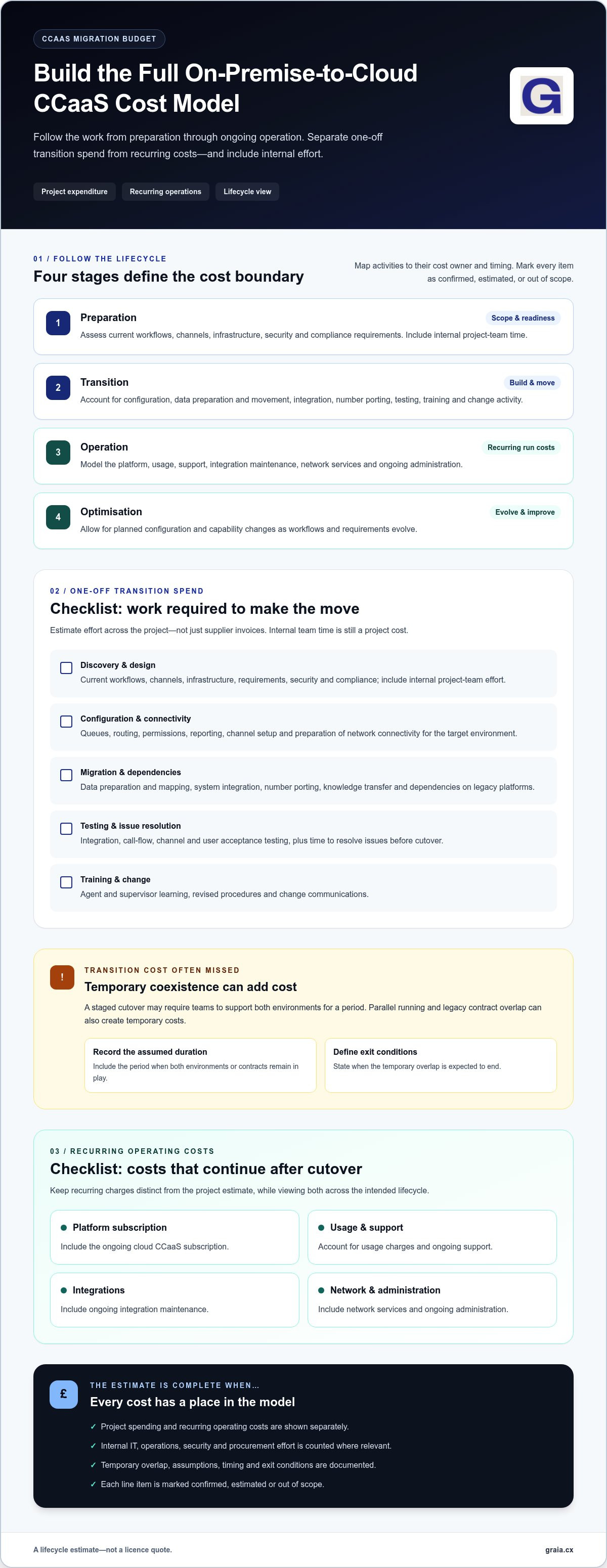
Use four stages to set the cost boundary: preparation, transition, operation and optimisation. Preparation covers discovery and design. Transition includes configuration, data movement, integration, testing and training. Operation accounts for subscriptions, support and ongoing integrations. Optimisation covers planned changes as workflows and capabilities evolve.
These costs may sit in different budgets. A platform subscription, implementation work and internal team time can appear as separate line items, even though all contribute to the total. Include each one in the model rather than treating internal effort as cost-free.
- Preparation: scope, requirements and readiness work.
- Transition: build, migration, testing and change activity.
- Operation: recurring platform, support and integration costs.
- Optimisation: future configuration and capability changes.
CCaaS is positioned as a core solution of the CX industry, but its value depends on how well the chosen environment supports real customer and agent workflows. Assessing that fit keeps the financial model connected to the reason for migrating.
Which starting conditions change the estimate most?
Start with how the contact centre operates today: contact volumes, channels, sites, routing logic and business hours. A voice-only environment with standard queues has a different transition scope from an omnichannel operation with complex skills-based routing or distinct workflows across locations.
Then map the dependencies. Data migration, number porting, security and compliance requirements, custom CRM or other system integrations, and temporary coexistence can each add work. Legacy applications may need redesign or replacement rather than a direct connection. Documenting these needs early makes the estimate more complete and surfaces assumptions that could otherwise become change requests.
An existing cloud CCaaS platform can also change the path. The project may involve extending or reconfiguring an environment rather than moving every capability from on-premise. Existing integrations may be retained, adapted or rebuilt, depending on the target design. That is why the cost to migrate from on-premise to cloud ccaas should be based on a mapped scope, not a per-seat calculation alone.
Build the Full On-Premise-to-Cloud CCaaS Cost Model
A useful budget follows the work from initial assessment through steady-state operation. Map each activity to a cost owner and timing, then separate one-off transition expenditure from recurring charges. This makes it easier to find missing line items and avoid counting the same work twice.
Depending on the project, major cost categories can include discovery, configuration, migration, testing, training, platform subscriptions, usage, support, integrations, network services and ongoing administration. These will not all apply in the same way to every contact centre, so mark each item as confirmed, estimated or out of scope.
- Discovery: assess current workflows, channels, infrastructure, security and compliance requirements. Include internal project-team time.
- Configuration: design queues, routing, permissions, reporting and channel setup. Prepare network connectivity for the target environment.
- Migration: plan data preparation, system integration, number porting and knowledge transfer. Record dependencies on legacy platforms.
- Testing: allow for integration, call-flow, channel and user acceptance testing, plus time to resolve issues before cutover.
- Training: budget for agent and supervisor learning, revised procedures and change communications.
- Ongoing operations: model recurring platform, support, usage, integration maintenance, network services and administration.
One-time migration and transition costs
Build the project estimate around the effort required to assess, design, configure, integrate, test and deploy the solution. Include work to clean or map data, transfer knowledge and train users, as well as the time internal IT, operations, security and procurement teams will spend. Their effort is still a project cost, even if it does not appear on a supplier invoice.
Model the transition method explicitly. A staged cutover may require teams to support both environments for a period. Parallel running and legacy contract overlap can create temporary costs too. Include these where they apply, and state the assumed duration and exit conditions.
Recurring CCaaS costs and operational changes
Break the recurring estimate into its actual pricing units: named or concurrent seats, usage, channels, support level and separately licensed capabilities. SaaS subscriptions and AI modules may appear as distinct charges, so list them separately rather than hiding them in a single platform line. If conversational automation, Agent Assist or live call translation forms part of the future operating model, account for its licensing basis and expected usage without assuming it is included in the core subscription.
Also include ongoing integration maintenance, reporting, network services and platform administration. Compare projected costs with a current baseline covering infrastructure, maintenance and support. Keep assumptions visible, particularly for usage and staffing, so the cost to migrate from on-premise to cloud ccaas can be reviewed and updated as scope changes. For further perspective on contact-centre technology and operating models, explore GraiaCX’s contact-centre insights.
Compare Migration Approaches by Cost, Risk, and Service Continuity
There is no universally cheapest route. A concentrated cutover can limit the time spent running two environments, while a phased transition spreads delivery and learning across groups or channels. Compare project effort, temporary overlap, service continuity and the cost of managing dependencies, not just the initial scope.
| Approach | Cost profile | Risk and continuity | Dependencies and suitable conditions |
|---|---|---|---|
| Phased migration | Work and expenditure are distributed across stages. Repeated testing and transition activity may add effort. | Limits the impact of each move and creates opportunities to learn, though teams may need to support mixed environments. | Works well when channels, sites, teams or workflows can be separated and sequenced with clear dependencies. |
| Parallel operation | Temporary dual-running and support can increase transition costs. | Allows validation and continuity planning before retiring the legacy environment, but requires clear ownership of both systems. | Useful where service resilience and controlled validation are priorities, provided overlap dates and exit criteria are defined. |
| Concentrated cutover | Can reduce the duration of overlap, but concentrates configuration, testing and deployment effort into a narrower window. | More change happens at once, so a defect may affect a wider operation. Rollback planning is essential. | More suitable where workflows are well understood, dependencies are manageable and the organisation can prepare for a coordinated transition. |
Phase the work, not the safeguards
Staging by channel, site, team or workflow can make scope easier to manage. For example, a business might move a well-defined channel first, validate its routing and reporting, then apply lessons to the next stage. That sequence only works if shared systems and customer journeys are mapped. Otherwise, a seemingly separate group may still depend on the legacy platform.
Parallel operation can support continuity and validation, but it has a cost. Set a clear start, exit criteria and retirement plan for the old environment. A lower initial project scope does not necessarily mean a lower lifecycle cost. Repeated deployment work, prolonged overlap or temporary integrations can shift expenditure into later phases.
Map dependencies before choosing a sequence
Trace connections to CRM, ERP, workforce management, call recording, reporting and routing systems. Identify which processes are shared, which must move together and how number porting affects the cutover plan. Existing CCaaS environments, including Genesys, NICE CX and Avaya, can also shape the transition path and integration work.
Decide whether conversational automation or Agent Assist belongs in the first release or a later phase. Including AI capabilities early may expand testing and change scope. Deferring them may require another implementation stage. Compare both paths against service continuity, delivery capacity and full lifecycle cost to make the cost to migrate from on-premise to cloud ccaas decision more defensible.
Estimate Your CCaaS Migration: A Practical Approval-Ready Process
A finance-ready estimate needs more than a supplier quote. It needs a documented scope, a current-cost baseline and assumptions stakeholders can challenge or update. Use this sequence to turn the cost to migrate from on-premise to cloud ccaas into a traceable business case, without disguising uncertainty as precision.
Five steps to produce a defensible estimate
- Inventory the current operation. Record users, channels, sites, contact volumes, integrations, workloads, compliance needs and relevant contract dates. Capture current service performance and note dependencies that could affect transition sequencing.
- Build the baseline. Gather current contracts, infrastructure and maintenance costs, support arrangements, internal staffing effort and service-performance measures. Use the same categories to describe the proposed cloud operating model.
- Classify each cost. Assign every line item to one-time migration, recurring service, internal effort or risk allowance. Separate platform subscription, usage, support and licensed capabilities so they remain visible rather than obscured in a single total.
- Record the evidence. For each estimate, document its assumption, owner, dependency, evidence and confidence level. For example, distinguish a confirmed contract date from an estimated integration effort, and identify who must validate each assumption.
- Build three scenarios. Create low, expected and high cases using different, stated assumptions for scope, sequencing, overlap and usage. Do not invent monetary ranges. Populate each case with your organisation’s evidence and show what would cause the estimate to move between scenarios.
This structure can be copied into a budget worksheet. It gives approvers a clear view of what is known, what remains uncertain and where further discovery could change the decision.
Model value and control cost uncertainty
Compare total lifecycle expenditure over an agreed time horizon, applying consistent assumptions to both the existing environment and the proposed cloud model. Include transition spending and recurring operations. Avoid comparing a one-off migration budget with only a single period of subscription fees.
Test potential benefits as hypotheses, not guaranteed savings. For example, define how you would measure agent productivity, self-service outcomes, multilingual support and service continuity. Then establish a baseline and a review method. If conversational automation, Agent Assist or live call translation is in scope, connect each capability to a specific workflow and measurable outcome. For broader value measurement, see Contact Centre ROI with AI.
Make the next planning conversation more informed: Explore GraiaCX’s CX insights on contact-centre technology and operating models.
Choose a Cloud CCaaS Future State That Justifies the Migration
A migration earns its place when the future operating model delivers more than a change in infrastructure. Use the cost model to test whether the proposed platform fits your channels, workflows, governance needs and service objectives. The cost to migrate from on-premise to cloud ccaas is only one side of the decision. The other is whether the target environment supports the experience you intend to create for customers and agents.
Evaluate the future-state platform beyond its subscription
Assess channel coverage, routing, reporting, APIs, governance, implementation responsibilities and the ability to support expected operational changes. Match each capability to a real contact-centre workflow. Identify where customers need self-service, where agents need contextual assistance and how multilingual calls are handled. This helps show whether a feature addresses a defined need or simply adds complexity to the estimate.
GraiaCX offers Conversational Agent, Agent Assist and Live Call Translation as capabilities to evaluate within a broader cloud CX operating model. GraiaCX integrates with Genesys, NICE CX and Avaya, which can inform transition planning. Include the current integration scope and responsibilities in the solution design, since connections may differ across deployments. Assess licensing and operating implications alongside the value each capability may bring to real workflows.
Make the migration decision with clear gates
Set approval points that connect technical readiness to operational and financial evidence. At each gate, define who owns the decision, what must be demonstrated and what would trigger a pause or change of plan.
- Discovery: agree the scope, baseline, dependencies and success measures.
- Design: approve workflows, integration approach, governance and cost assumptions.
- Pilot: validate representative user journeys, reporting and operational readiness.
- Transition: confirm continuity plans, adoption support, ownership and cost tracking.
- Post-launch review: compare actual costs and service outcomes with the approved case, then address gaps.
Assign clear owners for business continuity, user adoption, integrations, cost control and operational readiness. For a broader platform-level evaluation, explore The Enterprise Agentic CCaaS Platform, a reference and buying guide for assessing platform fit.
Build a future state around measurable workflows and clear ownership. Explore GraiaCX’s CX insights to keep shaping your cloud contact-centre strategy.
Make Your Migration Budget the Start of Better CX
The cost to migrate from on-premise to cloud ccaas depends on the full lifecycle, not just the platform subscription. A defensible estimate accounts for transition work, recurring operations, integration needs and any period of coexistence. Comparing phased and concentrated approaches against continuity requirements helps expose trade-offs before they become budget surprises.
Keep the business case grounded in evidence: document assumptions, model low, expected and high scenarios, and compare future costs with your current baseline over the same time horizon. Then test the intended value against real workflows, including how automation and agent support could improve customer and employee experiences.
GraiaCX offers Conversational Agent, Agent Assist and Live Call Translation, which supports more than 100 languages. GraiaCX integrates with Genesys, NICE CX and Avaya. Include the integration scope in transition planning. These capabilities can inform a future-state assessment alongside financial and operational criteria.
Build the estimate with care, and choose a migration path that supports both financial clarity and better service. Explore GraiaCX’s customer experience insights to keep shaping what comes next.
Frequently Asked Questions
How much does it cost to migrate from on-premise to cloud CCaaS?
There is no dependable single figure without a defined migration scope. The cost to migrate from on-premise to cloud ccaas depends on users, channels, integrations, data, compliance needs, transition strategy and internal effort. Separate one-off discovery, implementation and migration work from recurring subscriptions, usage, support and operating costs. Build low, expected and high scenarios using your current contracts and infrastructure as a baseline, rather than relying on an unsourced market average.
What costs are included in a CCaaS migration?
A CCaaS migration budget can include discovery, solution design, implementation, integrations, data preparation, testing, training, number porting and temporary coexistence where relevant. Keep these project costs distinct from recurring platform subscriptions, usage, support and separately licensed capabilities. Document assumptions and assign each task to one budget category. For example, do not count an integration’s build effort under both implementation and integration costs unless they represent genuinely separate work.
Is cloud CCaaS cheaper than an on-premise contact centre?
Not automatically. Cloud CCaaS can shift the balance from infrastructure investment towards recurring service expenditure, but migration, integration and temporary coexistence can add transition costs. Compare both options over the same defined period, using like-for-like assumptions for internal labour, infrastructure, maintenance, support and operational changes. Include the capabilities the contact centre needs, rather than comparing only a cloud subscription with an on-premise licence or hardware line.
How long does it take to migrate an on-premise contact centre to CCaaS?
There is no standard duration that applies to every migration. Timing depends on scope, channel count, integrations, data readiness, governance and the transition approach. Plan discovery, design, configuration, testing, training and deployment as distinct activities, each with owners and dependencies. A phased plan can spread delivery and learning across stages. Parallel operation may extend the transition and add temporary costs while both environments are supported.
Can a business migrate to cloud CCaaS without disrupting customer service?
Continuity can be planned for, but it is not automatic. Safeguards may include phased transitions, parallel operation, end-to-end testing, rollback plans, user readiness and service monitoring. The right controls depend on service criticality and technical dependencies, such as shared routing or integrations. Include the people, time and temporary operating costs needed for continuity planning in the migration estimate, and define who can pause or reverse a cutover.
What factors make a CCaaS migration more expensive?
Potential cost drivers include legacy customisations, complex routing, multiple channels, numerous integrations, poor data quality, compliance needs, number porting, training requirements and overlapping contracts. Their effect varies by environment, so treat them as items to investigate rather than automatic extra charges. During discovery, record each dependency, its owner and the evidence behind the estimate. Test key assumptions before approval to reduce surprises during implementation.
Should we migrate all contact-centre channels at once or in phases?
Neither approach is best for every organisation. A concentrated cutover keeps the transition focused but brings more change into one period. Phasing by channel, site, team or workflow creates opportunities to validate and apply lessons, though it may require repeated delivery effort. Parallel operation can support continuity while adding temporary costs. Choose based on operational risk, dependencies, readiness and your team’s capacity to manage the transition.