
Improving Agent Morale with Tech: A 2026 Guide
What if the best way to improve contact-centre performance was to give agents less to manage, not more to measure? Repetitive tasks, disconnected systems and constant pressure can drain attention from the conversations that matter. Improving agent morale with technology starts by removing that daily friction, while keeping people in control of their decisions.
That distinction matters. Tools introduced as another layer of monitoring can undermine trust; tools designed to support agents can help them focus, find useful information and respond with confidence. Technology should strengthen human judgement, not replace it.
This guide explains how to choose and introduce technology that makes work more manageable and customer conversations more meaningful. You’ll learn how real-time Agent Assist can offer suggestions, coaching and summaries; how omnichannel workflows can reduce context switching; and how live translation can support multilingual conversations. Just as importantly, you’ll see how to involve agents, communicate clearly and assess employee experience alongside operational outcomes, so progress is measured by more than speed alone.
Key Takeaways
- Improving agent morale with technology starts by identifying everyday friction while recognising that tools cannot replace good management, appropriate staffing or listening.
- Choose support that helps agents access guidance and manage routine tasks while leaving customer-sensitive decisions and empathy in human hands.
- Make the purpose of each tool clear: useful coaching can feel supportive, while measurement without context or agent benefit can feel like surveillance.
- Introduce changes collaboratively: pinpoint a friction point, involve agents, pilot a focused workflow, gather feedback and refine it.
- Explore how GraiaCX’s omnichannel platform and real-time Agent Assist can support agents with suggestions, coaching, summaries and knowledge-base quick actions.
Why improving agent morale with technology starts with everyday work friction
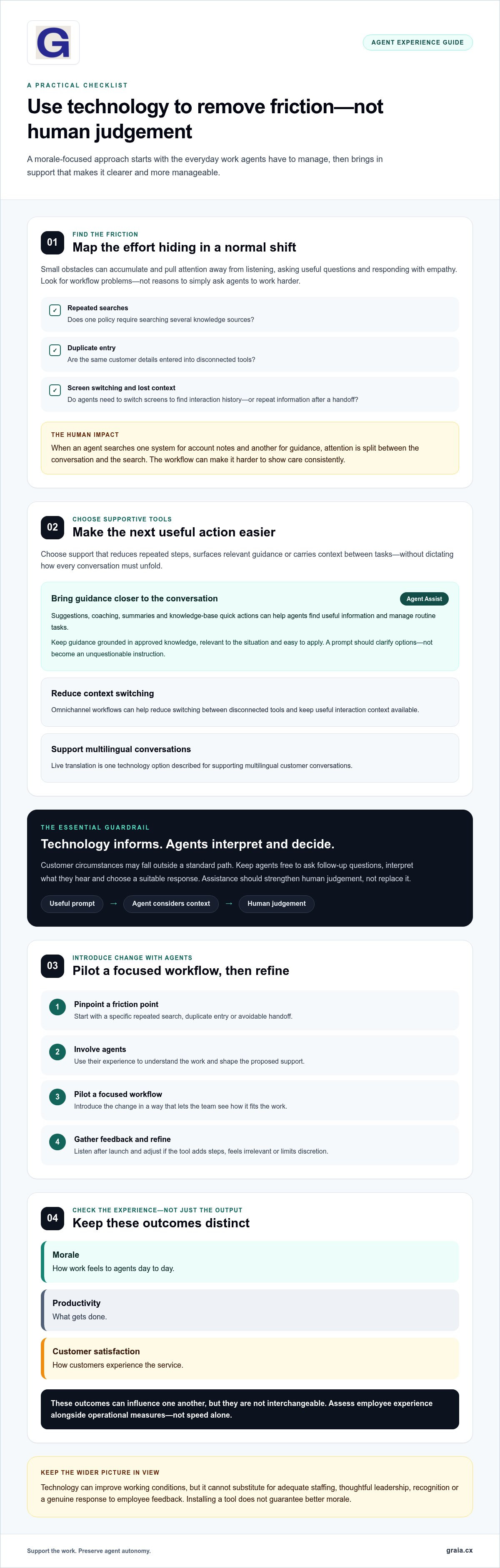
Agent morale is the quality of an agent’s day-to-day experience at work. It is shaped by workload, access to support, autonomy, and whether there is space to have meaningful conversations with customers. A useful distinction: morale describes how work feels; productivity describes what gets done; customer satisfaction reflects how customers experience the service. These outcomes can influence one another, but they are not interchangeable. A team may meet output targets while agents still feel unsupported or unable to use their judgement.
The wider idea of Employee morale includes how people feel about their work and workplace. For contact-centre leaders, that makes the daily experience a practical place to start: improving agent morale with technology means looking beyond speed and asking whether tools make work clearer, more manageable and more rewarding.
How daily friction affects the contact-centre agent experience
Small obstacles can accumulate across a shift. An agent may search several knowledge sources for one policy, enter the same customer details into disconnected tools, then switch screens to find the interaction history. Each step adds effort. More importantly, repeated interruptions can pull attention away from listening, asking useful questions and responding with empathy.
Example: A customer explains a billing issue while the agent searches one system for account notes and another for the relevant guidance. The customer has to repeat a detail, and the agent must divide attention between the conversation and the search. The issue is not a lack of care; the workflow makes it harder to show care consistently.
That distinction matters. Repetitive administration and fragmented information are design problems leaders can investigate, not evidence that agents need to work harder or simply become more resilient. Ask where information is duplicated, where handoffs lose context and which routine steps interrupt customer conversations.
What technology can, and cannot, do for morale
Technology can improve the conditions in which agents work. Connected workflows may reduce unnecessary switching; accessible guidance can make answers easier to find; and tools that handle defined routine tasks can leave agents more room for complex conversations. Assistance should inform decisions, not make every human judgement on an agent’s behalf.
Software cannot substitute for adequate staffing, thoughtful leadership, recognition or a genuine response to employee feedback. Nor does installing a tool guarantee better morale. If a system adds extra steps, makes agents feel watched or limits their discretion, it can intensify the friction it was meant to remove.
- Look at the work: identify repeated searches, duplicate entry and avoidable handoffs.
- Protect agency: keep agents able to interpret context and choose how to respond.
- Listen after launch: assess how the change feels to employees, alongside operational measures.
The principle is straightforward: use technology to clear space for human judgement, not to crowd it out. That is the foundation for evaluating which tools genuinely support the agent experience.
How agent-support technology can reduce friction without removing human judgement
Supportive technology should make the next useful action easier, not dictate how every customer conversation must unfold. It can reduce repeated steps, surface relevant guidance and carry context between tasks, giving agents a clearer path through an interaction. The aim is not to remove responsibility. It is to make that responsibility easier to exercise with accurate information and less administrative distraction.
Effective assistance gives agents useful information while leaving them responsible for context-sensitive judgement. That distinction separates a tool that supports a decision from automation that completes a defined task. Neither approach guarantees lower stress or stronger morale for every team; the outcome depends on whether the technology fits the work and how agents experience its use.
Give agents timely information and practical guidance
An agent shouldn’t have to pause a conversation to search through disconnected documents for a routine policy. Knowledge access and next-best-action suggestions can bring relevant guidance closer to the interaction, helping the agent consider an appropriate response without losing the customer’s context.
Useful guidance needs to be grounded in approved knowledge, relevant to the situation and simple to apply. It should clarify options, not present a suggestion as an unquestionable instruction. A customer’s circumstances may fall outside a standard path, so agents need the freedom to ask follow-up questions, interpret what they hear and choose a suitable response.
That balance builds practical trust: the tool offers a helpful prompt, while the agent remains accountable for how it applies. If guidance feels irrelevant or difficult to challenge, it can become another interruption rather than support.
Reduce repetitive work while preserving meaningful conversations
Some technology can complete defined routine work; other tools assist the agent without taking over the task. For example, an AI-generated summary can capture key points for later use, while an agent reviews and corrects it. A workflow may handle a standard information update, while a complex or sensitive issue remains with a person. The right boundary depends on the task, not on a desire to automate everything.
- Assist: surface knowledge or suggestions for an agent to assess.
- Automate: complete a clearly defined routine step within an agreed workflow.
- Escalate: bring in an agent when the customer’s needs don’t fit the automated path.
Human escalation is not a failure of automation. It is an important route for situations that require interpretation, reassurance or discretion. Clear handoffs also matter: passing relevant context along can prevent customers from having to start again and help agents focus on resolving the actual issue.
For a closer look at how these capabilities work in practice, explore GraiaCX’s AI agent assist tools guide. Its feature examples can help teams assess whether a tool reduces effort while keeping agents in control. You can also explore more contact-centre technology insights as you consider which support mechanisms fit your workflows.
Which technology choices support agent morale, and which risk feeling like surveillance?
No tool is automatically supportive or intrusive. Agents experience technology through its purpose, the way leaders explain it and whether it gives them a meaningful say. Coaching that helps someone handle a difficult interaction can feel very different from a dashboard that scores the same interaction without context or a clear benefit to the person being measured.
For leaders focused on improving agent morale with technology, the distinction is not simply between collecting data and not collecting it. It is whether information is used transparently to improve work or applied in ways that leave agents feeling watched, judged or powerless. Use this comparison to guide discussion with the team.
| Tool category | Agent-supportive purpose | Possible agent experience | Safeguard |
|---|---|---|---|
| Coaching and guidance | Offer relevant prompts or feedback that help agents consider their options. | Useful when it builds confidence; frustrating if it feels like a script agents must follow. | Explain that guidance informs decisions, and leave room for individual judgement. |
| Performance measurement | Identify patterns that may point to workflow obstacles or coaching needs. | Potentially supportive when used in context; unsettling when scores appear without explanation. | Clarify what is measured, who can access it and how it informs decisions. |
| Task automation | Complete defined routine steps and reduce avoidable manual effort. | Helpful when it clears space; disempowering if agents can’t resolve exceptions. | Provide a clear human handoff and a way to challenge or override the automated path. |
Supportive guidance versus performance surveillance
Coaching becomes meaningful when agents understand what a suggestion is based on and can discuss whether it fits the interaction. By contrast, metrics without context can turn a complicated customer conversation into a score that tells only part of the story. Before introducing monitoring or analysis, explain what data is collected, who can access it, why it is used and how it may influence decisions. Invite agents to help define the purpose and boundaries, rather than presenting those choices as settled.
Transparency is not a one-off announcement. Give agents a route to raise concerns, question an interpretation and explain circumstances a metric may miss. That conversation helps leaders distinguish a genuine performance issue from a process that makes good work harder.
Automation versus loss of control
Automation can support morale when it handles a predictable task and leaves agents able to step in if the customer’s situation changes. It risks undermining trust when a rigid workflow blocks exceptions, hides relevant context or makes it difficult to reach a person. Design a clear handoff and override path, then examine whether the tool expands what agents can do or simply adds prompts, checks and pressure. Agent feedback is essential to that assessment.
The deciding test is practical: does the technology give agents more capacity and control, or does it make their work more constrained? Purpose, transparency and agent input determine how a tool is experienced.
How to introduce morale-focused technology with agents, not just for them
A rollout earns trust through the way it is shaped, explained and improved. Involve agents before selecting or configuring tools, not after key decisions have already been made. Agent participation should begin early because the people closest to the work can identify friction, test assumptions and reveal where a proposed change may disrupt good service.
Use a focused process rather than promising a broad transformation. Improving agent morale with technology depends on whether the change helps in real working conditions, and whether agents feel heard throughout adoption.
- Identify friction. Use listening sessions and workflow observation to find recurring effort, such as repeated searches, duplicate steps or difficult handoffs.
- Involve agents. Ask agents and supervisors to help choose a specific workflow and describe what useful support would look like.
- Pilot a focused change. Define what the tool will do, what stays with the agent and how to get help if it behaves unexpectedly.
- Review the experience. Collect agent feedback and relevant operational indicators, considering both together rather than treating one as a substitute for the other.
- Refine the approach. Address issues agents raise, adjust configuration or guidance, then continue reviewing the experience.
Start with agent feedback and a specific workflow
Begin with a clear question: which part of a particular task regularly interrupts service or adds avoidable effort? Observe the workflow and invite agents to describe the workarounds they use. Record baseline feedback in practical terms, such as where guidance is hard to find or which handoff loses context. Don’t imply that these observations represent every agent; use them to frame a bounded pilot and gather further input.
Agree on the use case with agents and supervisors before configuring the tool. A narrowly defined workflow makes it easier to see what changed and to spot unintended complications without asking employees to absorb a sweeping redesign all at once.
Review outcomes and adapt the experience
Pair agent-reported usefulness with suitable operational measures, such as handling time, repeat work or the frequency of a particular handoff. Treat these as signals to investigate, not proof that a tool caused a morale change. Ask whether the guidance is accurate, understandable and appropriate during real interactions, and whether agents can act on it without unnecessary extra steps.
A fuller contact-centre ROI measurement framework can help connect operational evaluation with the value a change is intended to deliver.
Build trust through clear communication
Before launch, explain what will change, what data the tool uses, who can access it and how information will inform decisions. Clarify what remains the agent’s responsibility, provide practical training, and make escalation accessible when guidance is unclear or a customer’s needs fall outside the workflow. Keep inviting feedback after launch, then show agents what their input changed. Visible follow-through turns participation into a working part of adoption.
For more practical perspectives on contact-centre technology, explore more GraiaCX insights.
How GraiaCX technology can empower agents across customer conversations
GraiaCX brings agent support and customer interactions together through an agentic omnichannel contact-centre platform. The aim is to make useful assistance available within the flow of work, while keeping human agents central to conversations that need context, empathy and judgement. Technology can support the conditions for a better agent experience, but it cannot guarantee improved morale on its own.
Support agents with real-time guidance and context
Real-time Agent Assist offers next-best-action suggestions, live coaching, AI-generated summaries and knowledge-base quick actions. These capabilities can help agents find relevant guidance and keep track of important interaction details without treating every customer situation as identical. Suggestions inform the agent; they don’t replace the agent’s responsibility to understand the conversation and decide how to respond.
GraiaCX states a 2× boost in agent productivity. This is a productivity claim, not evidence of a guaranteed improvement in morale or employee retention. To understand whether Agent Assist supports your team, consider how agents experience the guidance in real interactions, alongside operational outcomes. Does it help them act with confidence, or add steps and distractions? Their feedback matters.
Make multilingual and omnichannel work more manageable
Live Call Translation supports 100+ languages & dialects for live voice translation. It can support multilingual conversations without relying solely on agents who speak each customer’s language, while leaving the agent responsible for the human connection and decisions within the interaction.
The platform supports voice, video, chat, email and social messaging. Bringing these channels into an omnichannel approach can help teams work across customer conversations with less context switching. GraiaCX describes integration simplicity with the exact phrase “no rip-and-replace”. The practical value for agents depends on whether connected workflows preserve useful context and make it easier to continue a conversation across channels.
These capabilities work best as part of a considered operating approach: agents should understand what the tools do, where their judgement remains essential and how to raise an issue when support is unclear. A platform can provide the technical foundation, but trust is built through transparent implementation and ongoing attention to the agent experience.
Explore a human-centred path forward
Start with the work agents say is difficult, then shape technology around a focused need. Involve employees in decisions, explain how tools will be used, and make practical support and escalation accessible. Review their feedback as the experience develops, rather than assuming that a deployment alone has solved the underlying friction. That is how contact-centre technology can support people without reducing them to a process or a performance measure.
Empower the Human. Elevate the Experience. To continue exploring ways technology can support customer conversations and agent experience, Explore GraiaCX articles and insights.
Make the next improvement measurable and human
The next step doesn’t need to be a sweeping technology programme. Choose one recurring point of friction, invite agents to help shape a practical response, and agree how you’ll learn whether the change is useful. Keep the conversation open as the workflow evolves. That gives teams a way to improve the experience based on what agents actually encounter, rather than assumptions about what should help.
Improving agent morale with technology is an ongoing commitment to making work more manageable while respecting the expertise people bring to every interaction. Progress means creating conditions where agents can focus, exercise judgement and feel that their feedback influences the tools around them. Operational measures matter, but so does the employee experience behind them.
Keep exploring thoughtful approaches to contact-centre work through GraiaCX articles and insights. With agent voices guiding each step, your next improvement can support both better work and better conversations.
Frequently Asked Questions
Can technology improve agent morale in a contact centre?
Yes, technology can support better morale when it makes everyday work more manageable and gives agents useful support. Improving agent morale with technology isn’t about adding tools for their own sake; it’s about addressing a specific difficulty, such as searching for a policy during a complex customer interaction. Check whether agents find the change genuinely helpful, and consider other workplace factors, including leadership, staffing and recognition.
Will AI agent-assist tools replace human contact-centre agents?
Agent-assist tools are designed to support human agents, not to make context-sensitive decisions on their behalf. For example, an assistant might suggest information relevant to a billing query, while the agent listens for details that change the best response. Leaders should explain how a tool affects roles before introducing it, and make clear which decisions remain with people. That clarity helps teams evaluate AI as workplace support, rather than assume its purpose.
How can managers tell whether a new tool is making agents’ work harder?
Look for signs of extra effort in the workflow, not just changes in headline performance. Ask agents whether the tool creates additional steps, requires corrections or makes it harder to handle unusual requests. Observe how often people leave the workflow to find information or rely on workarounds. Compare these observations with feedback collected before the change, then investigate problems with agents rather than assuming the tool is working as intended.
Should contact-centre agents help choose new technology?
Yes. Agents can help identify whether a proposed tool addresses a real need and whether it fits the way customer conversations unfold. Invite them to review a sample workflow, try relevant tasks and identify exceptions that a design team may overlook. Their input can also help leaders decide what should remain under human control. Participation is most useful when teams explain how feedback shaped the final configuration.
What training do agents need when new customer-service technology is introduced?
Agents need practical training on the tasks they’ll perform, the tool’s limits and how to get help when something goes wrong. Use realistic practice scenarios, including cases where the suggested response doesn’t fit the customer’s circumstances. Give agents time to ask questions and practise escalation routes before relying on the new workflow. Follow-up coaching can address issues that emerge once people use the tool in live work.
How can contact centres protect customer information when using AI?
Protect customer information by setting clear rules for what data an AI tool can access, how it can be used and who can view its outputs. Limit access to what each role needs, review information handling with the relevant technology teams, and train staff not to enter unnecessary personal details. GraiaCX states that client data is confidential and isn’t used to train its own or third-party AI models.