
How Agent Guidance Improves First Call Resolution: A Practical Guide
A customer shouldn’t have to explain the same problem twice. Yet when agents can’t find the right policy or next step during a live interaction, an incomplete answer can lead to another contact, more frustration and extra work. Understanding how agent guidance improves first call resolution starts with a simple principle: give agents relevant, reliable support at the moment they need it, not generic prompts that distract from the customer’s situation.
Agents know that resolving an issue on the first interaction matters. The challenge is balancing attentive service with searches across knowledge bases, customer records and procedures. Real-time, context-aware guidance can bring relevant details together and suggest a useful next action, while leaving the agent responsible for judgement and the conversation.
This guide explains how timely guidance can support first-contact resolution, which capabilities to consider across channels and workflows, and how to pilot changes responsibly. You’ll also learn how to measure FCR alongside customer feedback and operational indicators, so an interaction ending isn’t mistaken for an issue being resolved.
Key Takeaways
- Set clear rules for what counts as first call resolution, then apply them consistently to identify repeat contacts and unresolved needs.
- See how agent guidance improves first call resolution by turning customer context and approved knowledge into relevant next steps.
- Compare scripts, searchable knowledge, real-time agent assist and conversational agents to find an approach suited to your workflows and risk profile.
- Build a baseline and pilot guidance on selected contact reasons, checking knowledge quality and how well recommendations fit agents’ work.
- Measure FCR alongside customer feedback and operational indicators to understand whether issues are genuinely resolved, not just interactions completed.
How agent guidance improves first call resolution: the problem it solves
Customers judge a resolution by whether their issue is actually dealt with, not whether an interaction has ended. First call resolution (FCR) generally means resolving a customer’s issue during the initial interaction, but organisations need to define exactly what counts for their own reporting. The First Call Resolution overview provides a neutral introduction to the metric and its role in contact centre performance.
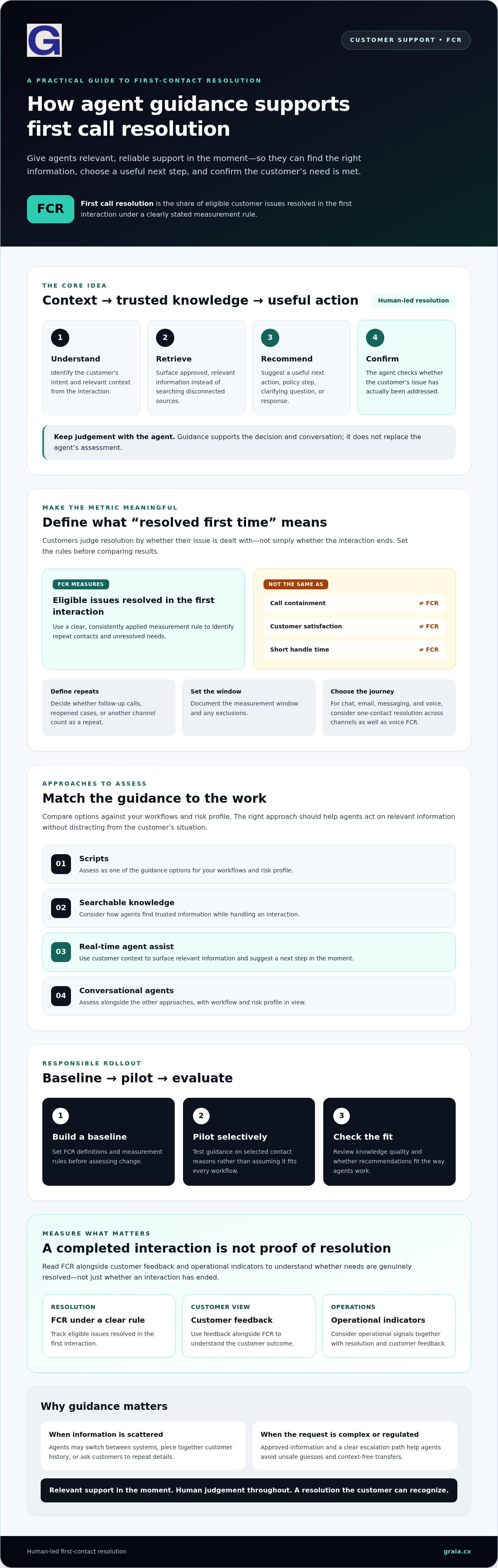
FCR is the share of eligible customer issues resolved in the first interaction under a clearly stated measurement rule. It is not the same as call containment, customer satisfaction or short handle time. A call can end without a repeat contact and still leave the issue unresolved, while a longer conversation can reach a complete resolution.
Agent guidance is timely, context-aware support that helps an agent during or immediately after an interaction. It can surface relevant information or suggest a next step based on the customer’s situation. This is the practical link between how agent guidance improves first call resolution and the customer experience: it helps close the gap between what an agent needs to know and what they can use in the moment, without replacing their judgement.
What counts as first call resolution in a multichannel contact centre?
Set the measurement rules before comparing results. Decide whether a follow-up call, reopened case or contact through another channel counts as a repeat. Document the measurement window and any exclusions, then apply those rules consistently to comparable contact reasons.
“First call” can be misleading when customers use chat, email or messaging. First-call resolution usually refers to a voice interaction; first-contact resolution can include the initial interaction across channels. If a customer starts in chat and completes the same issue on a call, a single-channel FCR measure may not capture the whole journey. Some organisations therefore also track one-contact resolution across channels.
Why do agents miss opportunities to resolve issues first time?
Resolution gaps often point to process or information barriers, not a lack of effort. Guidance may be spread across documents, policies may be unclear, and agents may need to switch between systems to piece together a customer’s history. When context is incomplete, even a capable agent can struggle to identify the right action or explain it consistently.
Complex or regulated requests make accuracy especially important. Agents need access to approved information and a clear escalation path when a request falls outside their authority. Without either, guessing is unsafe, while transferring the customer without context can lead to repeated questions. Relevant guidance can support a sound decision, while leaving the agent responsible for assessing the situation and confirming whether the customer’s need has been met.
How real-time agent guidance turns customer context into resolution
Useful guidance does more than retrieve an answer. It connects what the customer is saying with trusted information and an appropriate next step, helping the agent move the issue towards resolution without leaving the conversation to search across disconnected systems. Resolving a problem in one interaction can also support reducing customer effort, a principle highlighted by Harvard Business Review.
Context-aware guidance uses the interaction and relevant customer information to surface grounded, timely recommendations. It helps an agent decide what to do next while keeping judgement with the human. In practice, the process has four parts: identify intent and context, retrieve approved information, recommend an action, then confirm the customer’s issue has been addressed.
From intent recognition to a useful next-best action
A transcript can help guidance identify the customer’s stated need and details already provided, reducing the need for the agent to ask the same questions again. The system can then surface a relevant policy step, a clarifying question or a suggested response. For example, if a customer queries a charge, guidance might point the agent to the applicable account-checking process before suggesting an explanation or action.
Relevance is essential. Generic prompts can interrupt the conversation or point to steps that don’t fit. Agents should be able to compare a recommendation with what the customer has actually said, correct missing context and decide whether the suggested action is appropriate. The final check is still human: confirm the customer understands the outcome and whether anything remains unresolved.
Ground recommendations in trusted knowledge and workflows
Retrieval-Augmented Generation (RAG) combines language generation with retrieval from an approved knowledge source. Rather than relying only on a model’s general language patterns, the system finds relevant material and uses it to ground a suggested response. Hybrid retrieval, which uses semantic and keyword matching, can help locate knowledge when a customer’s wording differs from the language in a policy document. Knowledge quality still matters: outdated or conflicting guidance can produce unhelpful recommendations.
Flexible language understanding can interpret varied phrasing, while rule-based workflow controls can guide sensitive or sequential processes, such as completing required checks before an account action. CRM, ERP or ticketing integrations may also let an agent carry out an appropriate action, rather than simply share information, subject to permissions and workflow design.
If the system can’t find reliable information, confidence is low or approval is required, it should make that limitation clear and support escalation. GraiaCX Agent Assist is one example of combining transcripts, suggested responses, approved knowledge and next-best-action support, with the agent retaining responsibility for the decision. For more perspectives on contact centre technology, explore GraiaCX contact centre insights.
Which agent guidance approaches are most likely to support FCR?
No single tool fits every contact centre. The right approach depends on the complexity of customer questions, the risk of getting a process wrong, the channels you support and the systems agents already use. The goal isn’t to add technology for its own sake. It’s to make the next appropriate step easier to find and take.
| Approach | Context awareness | Action support | Agent control | Governance | Suitable use cases |
|---|---|---|---|---|---|
| Static scripts | Low | Guides a fixed conversation, usually not system actions | High, agent follows set steps | Easy to standardise, can become outdated | Predictable interactions with tightly controlled wording |
| Searchable knowledge base | Low to moderate, depends on the agent’s search | Provides information; agent completes the action | High | Relies on clear ownership and content review | Varied questions with documented answers |
| Real-time agent assist | Can use live interaction context | May suggest responses or next steps; integrations can support workflows | High when recommendations remain reviewable | Needs grounded knowledge, access controls and oversight | Conversations where relevant context and guidance matter |
| Autonomous conversational agent | Can interpret customer input within its designed scope | May handle defined tasks without an agent | Lower during automated handling; human handoff can be designed | Requires clear boundaries, monitoring and fallback paths | Suitable, repeatable tasks that can be safely automated |
When do scripts, knowledge search, or AI suggestions fit best?
Use scripts or rule-based steps for predictable processes where sequence and wording need tight control. Searchable knowledge suits questions with varied wording but established answers, especially when results appear within the agent’s workflow. AI suggestions can help interpret context and surface relevant options for less predictable conversations, provided agents can review, override or escalate. Lessons learned from federal teams using chatbots also offer useful perspective on setting boundaries and designing customer-facing automation thoughtfully.
What should buyers compare before selecting guidance technology?
Test the fit, not just the feature list. Check how the tool connects with your CRM and contact centre platform, whether it supports the channels agents use, and how it grounds suggestions in approved knowledge. Ask whether it can support authorised actions in connected systems or only draft responses. Also assess auditability, privacy and access controls, fallback behaviour when information is missing, and whether recommendations are clear and usable during realistic interactions.
For a wider view of capabilities and evaluation considerations, read this AI Agent Assist Tools guide. The comparison can help clarify how agent guidance improves first call resolution: the strongest fit gives agents useful context and safe, actionable support without obscuring their judgement.
How to implement and measure agent guidance for better FCR
Start with a baseline, not a target picked in isolation. Define what counts as a resolved issue, which repeat contacts qualify, the measurement window and any exclusions. Then group comparable contact reasons, such as account queries or delivery issues, so changes in case mix don’t distort the comparison. Record current FCR before introducing guidance.
A practical pilot sequence for agent guidance
Choose a focused use case with recurring issues, reliable source information and clear resolution steps. Before enabling guidance broadly, test realistic conversations, edge cases, handoffs and situations where the knowledge base has no suitable answer. Check that recommendations appear at the right point in the workflow and agents can understand, review and act on them without disrupting the conversation.
Gather agent feedback throughout the pilot. Ask where prompts helped, where they were irrelevant and which information was missing. Refine knowledge retrieval, suggested actions and workflows based on these observations, then decide whether the use case is ready to expand. This makes how agent guidance improves first call resolution something to assess in practice, rather than assume from a feature list.
How to interpret results without overstating impact
Compare like with like. Review the same types of interactions and note changes in demand, policies, staffing or processes that could affect results. Track FCR alongside indicators that show the wider experience:
- Repeat contacts and reopened cases: Check whether customers return with the same issue after an apparent resolution.
- Customer feedback: Use survey responses or other feedback to test whether customers believe their issue was resolved.
- Transfers and handle time: Look for changes in escalation patterns and time spent, without pressuring agents to shorten conversations at the expense of accuracy.
- Agent feedback: Ask whether guidance is relevant, trustworthy and easy to use during live interactions.
Interpret FCR alongside service quality and customer outcomes; never treat it as a standalone target. A higher recorded rate may not mean customers are better served if repeat contacts aren’t captured or agents feel pushed to close cases prematurely. Report what changed, which groups were compared and what limitations remain. An observed improvement during a pilot is an association, not proof that guidance alone caused it.
For further practical perspectives on contact centre guidance, explore Graia’s contact centre articles.
How Graia Agent Assist can support human-led first call resolution
Good guidance helps an agent act with confidence without taking ownership of the customer’s issue away from them. Graia Agent Assist is designed to support this human-led approach with real-time transcripts, interaction summaries, suggested responses and next-best-action support. These capabilities can help agents follow the conversation, locate relevant information and consider a suitable next step. They support the resolution process, but don’t guarantee that every issue will be resolved in one interaction.
Where Graia Agent Assist fits in the resolution journey
The flow begins with the conversation. Transcripts provide a record of what the customer has said, while context can help make suggested responses and next actions more relevant. Graia materials describe hybrid retrieval, combining semantic and keyword matching to find information in approved knowledge sources. This can help agents locate applicable guidance instead of relying on a generic answer.
Where workflows and integrations are configured, API connections with systems such as CRM, ERP and ticketing platforms may support appropriate actions as well as information retrieval. The agent still reviews the recommendation, follows the relevant process and confirms the outcome with the customer. If the interaction needs human escalation, a handoff that preserves context can help the next agent continue with the details already gathered, rather than asking the customer to start again.
This approach reflects how agent guidance improves first call resolution: it connects conversation context, trusted knowledge and recommended next steps, while keeping human judgement central. For the wider platform perspective, explore Graia’s AI customer service platform overview.
How to assess whether the approach fits your contact centre
Start with your own service conditions. Identify priority contact reasons, review where repeat contacts occur, and map the systems agents use to resolve those issues. Then assess whether guidance can draw on the right knowledge and context, and whether it fits the channels and workflows involved.
- Knowledge and permissions: Establish which sources are approved, who can access them and how content is kept accurate.
- Actions and auditability: Clarify which recommendations support a response and which can initiate an authorised workflow, and how activity can be reviewed.
- Escalation and handoff: Define when an agent should override a suggestion, request approval or transfer the interaction with its context preserved.
Confirm the specific capabilities, integrations and availability relevant to your intended use case before planning a rollout. To explore possible use cases and evaluation questions, visit Graia’s resource hub.
Turn better guidance into better customer outcomes
First call resolution depends on more than ending an interaction quickly. It requires a clear measure of resolution, relevant support at the right moment and a follow-up check that the customer’s issue was actually addressed. That’s the practical answer to how agent guidance improves first call resolution: connect customer context to trusted information and useful next steps, while keeping agents in control.
Start with a focused pilot, compare like-for-like contact reasons and assess FCR alongside repeat contacts, customer feedback and agent experience. The results will show whether guidance fits your workflows and where knowledge or processes need attention.
Graia describes Agent Assist capabilities including transcripts, summaries, translations and next-best-action support, alongside knowledge-grounded responses and workflow integrations. Confirm the capabilities and integrations relevant to your intended use case, and assess outcomes rather than assuming a particular performance gain.
Explore Graia’s customer experience AI resources to inform your evaluation. With a measured approach and agents’ judgement at the centre, you can make each customer interaction more purposeful and give teams a clearer path to resolution.
Frequently Asked Questions
How does agent guidance improve first call resolution?
Agent guidance can improve first call resolution by giving agents relevant information and next-best actions during the interaction. Real-time transcripts and customer context can help surface approved knowledge or a suitable workflow step, reducing time spent searching and the risk of inconsistent answers. The agent checks whether the suggestion fits the situation, then confirms the issue is resolved. Track repeat contacts too: guidance can support FCR, but doesn’t guarantee it.
What is the difference between agent guidance and agent assist?
Agent guidance describes the timely information, prompts or recommended actions that help an agent handle a customer interaction. Agent Assist is a tool or capability that can deliver that support. Depending on its features, it may also provide transcripts, summaries or translation support. In short, guidance helps inform the next step; Agent Assist is one way to bring relevant support into an agent’s workflow.
Can AI agent guidance resolve customer issues without a human agent?
Guidance for a human agent doesn’t resolve an issue on its own, but a conversational agent can handle some customer requests autonomously when they fall within its capabilities and configured workflows. Graia describes conversational AI that can understand intent, resolve routine enquiries and escalate to a human agent when needed. For complex or unclear issues, a clear fallback and a handoff that preserves interaction context help avoid leaving the customer without a useful next step.
How should a contact centre measure first call resolution?
Define FCR as the proportion of eligible issues resolved in the initial interaction, then document how you count follow-up contacts, reopened cases, channel changes and exclusions. Set a consistent measurement window and compare similar contact types. Combine interaction data, such as repeat contacts, with customer feedback where possible. Report the method alongside the rate: a conversation ending is not proof that the customer’s issue was resolved.
Does real-time agent guidance increase handle time?
It can, particularly while agents learn to use recommendations or when prompts are poorly timed or irrelevant. Well-integrated guidance may also reduce time spent searching across systems, but the overall effect depends on the interaction and workflow. Measure handle time alongside FCR, repeat contacts, customer feedback and agent feedback. Don’t encourage agents to rush through a conversation just to lower handle time if that risks an incomplete resolution.
How can AI recommendations stay accurate and compliant?
Ground suggestions in current, approved knowledge and make the source easy for agents to check. Use defined workflow rules for sensitive or sequential processes, with permissions that limit actions to appropriate users. Test realistic scenarios, including missing information and edge cases, and decide when the system should defer to an agent or escalate. Review recommendations and outcomes regularly so outdated knowledge or unsuitable prompts can be corrected.
How long does it take to see whether agent guidance improves FCR?
There’s no reliable fixed timeframe. It depends on interaction volume, the contact reasons in the pilot, the FCR measurement window and how quickly agents adopt the guidance. Establish a baseline first, then allow enough comparable interactions to assess results under the same measurement rules. Review repeat contacts and reopened cases as well as FCR, and document changes in demand, policies or staffing that could also affect outcomes.