
High Agent Attrition in Call Centres: Causes, Costs and Practical Solutions
What if high agent attrition in call centres isn’t just a recruitment problem, but a signal that the work itself needs to change? Repeated vacancies and hiring cycles can put extra pressure on the people who stay, leaving less time for coaching and making shifts harder to manage. The pressure is real, but another generic retention initiative won’t necessarily address what’s driving agents to leave.
To improve retention, leaders need to understand the everyday experience behind the exit figures. Is workload becoming unsustainable? Are schedules too rigid, support inconsistent or progression unclear? The answers can differ between teams, so effective action starts with evidence from your operation and honest feedback from agents.
This article explains how to identify workplace factors behind departures, choose practical, people-first changes and evaluate whether they’re working. You’ll also learn how to track retention alongside service quality, workload and employee feedback, so progress is visible rather than assumed. Technology can help when it takes repetitive tasks off agents’ hands or supports them through complex interactions, without replacing the human judgement customers need.
Key Takeaways
- Separate voluntary departures from overall workforce turnover to understand what your attrition figures are showing.
- Investigate workload, emotional demands, scheduling, training, tools and manager support before settling on a cause.
- High agent attrition in call centres isn’t inevitable: connect recurring symptoms to workplace factors and gather evidence from agents and supervisors.
- Build a retention plan by listening, diagnosing, prioritising, piloting changes and reviewing the results.
- Consider whether automation and agent assistance can reduce repetitive effort while keeping people central to complex customer interactions.
High agent attrition in call centres: why it signals more than a staffing problem
Recurring vacancies keep recruitment in motion, but the strain doesn’t stop when a new agent starts. Experienced employees may be replaced by colleagues who are still learning systems, policies and customer needs. Managers then have to balance onboarding with the demands of a live operation. High agent attrition in call centres can point to more than a staffing gap: it may also signal pressure on team continuity and the day-to-day employee experience.
Interpret that signal carefully. Departures can prompt more recruitment and training, while the loss of experienced agents may affect knowledge sharing and confidence when handling interactions. These effects aren’t automatic, and attrition alone can’t explain what’s happening. Examine the rate alongside employee feedback and service performance.
What does agent attrition mean in a call centre?
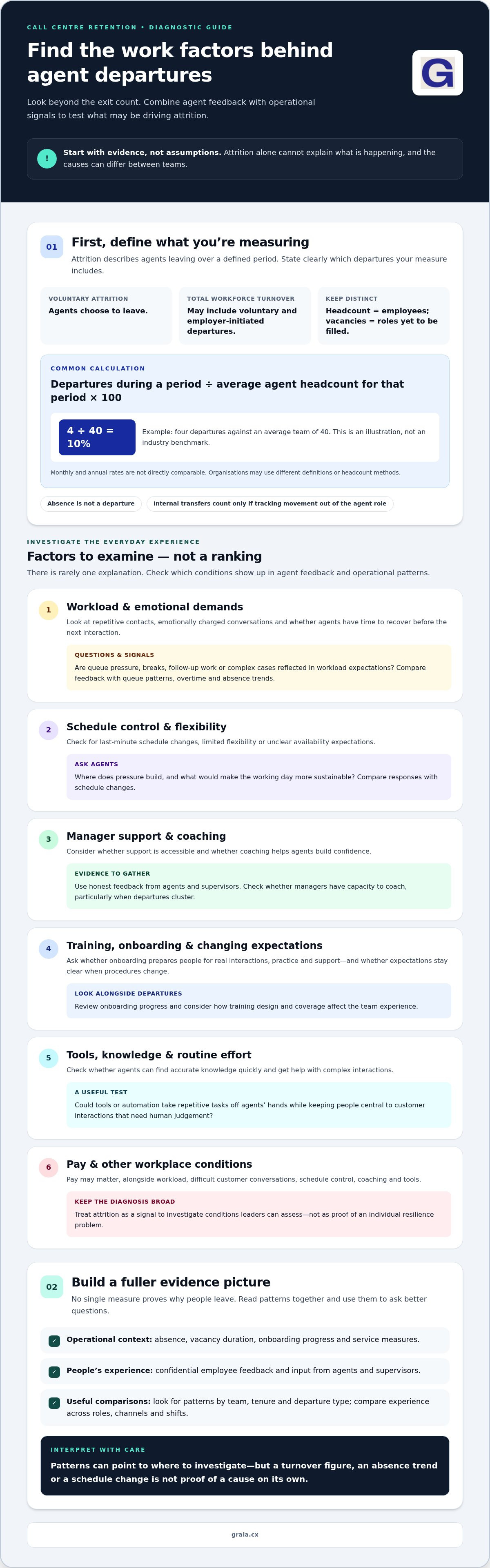
In plain English, agent attrition describes agents leaving an organisation over a defined period. A useful distinction is between voluntary attrition, when agents choose to leave, and total workforce turnover, which may include both voluntary and employer-initiated departures. Organisations sometimes use these terms differently, so state exactly which departures your measure includes.
Attrition rate measures departures against a workforce over time; headcount shows how many people are employed, while vacancies show roles yet to be filled.
A common calculation is the number of agent departures during a period divided by the average agent headcount for that period, multiplied by 100. For example, four departures against an average team of 40 would equal 10% for that period. This is an illustration, not an industry benchmark. Monthly and annual rates aren’t directly comparable, and organisations may use different definitions or headcount methods. Absence isn’t a departure, and neither is an internal transfer unless your reporting specifically tracks movement out of the agent role.
Why repeated agent departures matter to the operation
Each departure can create work beyond filling the role. Recruitment takes time, and new starters need onboarding, practice and support before they’re familiar with the operation. When departures cluster, managers may have less capacity for coaching, and experienced agents may have fewer opportunities to pass on practical knowledge. The effect depends on team size, training design and how well responsibilities are covered.
Remaining agents may also feel the impact. If fewer people are available while vacancies are filled, workloads or schedule pressure could rise. That may affect morale and customer interactions, particularly when less-experienced colleagues need more support. It’s a possibility to investigate, not an assumption to make about every team.
Contact centres combine customer communication with operational processes and technology, as outlined in this Contact Centre overview. That wider context matters: a turnover figure on its own can’t reveal whether departures relate to workload, support, training or other conditions.
Read the rate alongside absence, vacancy duration, onboarding progress, service measures and confidential employee feedback. Comparing patterns by team, tenure and departure type can help leaders ask better questions without treating a single metric as proof of a cause. The aim isn’t simply to count who leaves. It’s to understand what the pattern says about the work and the experience of doing it.
What drives call centre agent attrition? Diagnose the work, not just the person
There’s rarely one explanation for agents leaving. Pay may matter, but so can workload, difficult customer conversations, limited schedule control, inconsistent coaching or tools that make routine tasks harder than they need to be. Treating attrition as a question of individual resilience can obscure conditions leaders have the power to investigate and improve.
Reliable attrition diagnosis combines what employees say with operational signals, so leaders can test possible causes rather than rely on assumptions.
Workload, emotional demands and limited control
Look closely at the shape of the working day. Repetitive contacts can feel draining, while emotionally charged conversations may require time to recover before the next interaction. Queue pressure can compound both, particularly if breaks, follow-up work or complex cases aren’t reflected in workload expectations. These factors won’t affect every agent in the same way, so compare experiences across roles, channels and shifts.
Schedule control matters too. Last-minute changes, limited flexibility or unclear expectations about availability may make work harder to manage alongside life outside the contact centre. Ask agents where pressure builds and what would make their day more sustainable. Then compare their feedback with practical indicators such as queue patterns, overtime, schedule changes and absence trends. None proves a cause alone, but together they can show where to investigate.
Management, training and tools that shape the agent experience
Support is more than a supervisor being available. Consider whether coaching helps agents build confidence, whether onboarding prepares them for real interactions and whether expectations are clear when procedures change. Ask whether people can find accurate knowledge quickly and get help with unfamiliar or complex cases. Gaps in these areas can leave agents feeling exposed rather than equipped.
Technology and workflow deserve the same scrutiny. If agents switch between systems, repeat data entry or search across disconnected sources during a customer conversation, that extra effort may make the work more frustrating. Review what agents actually have to do rather than assuming a tool is helping because it exists. If you introduce AI guidance or automation, assess whether it removes friction and supports human judgement instead of adding another layer of complexity.
Build a rounded diagnosis by combining several sources:
- Exit feedback: Look for recurring themes, while recognising that departing employees may not describe every concern.
- Stay interviews: Ask current agents what helps them do good work and what might make them consider leaving.
- Operational patterns: Compare absence, schedule changes, workload indicators and departures by team, role and shift.
- Direct observation: Review workflows with agents and supervisors to identify effort that reports or dashboards may miss.
Keep evidence separate from interpretation. A rise in absence alongside queue pressure may justify further investigation, but it doesn’t prove that workload caused departures. Share what you’re learning with agents and invite them to challenge your understanding. For more perspectives on contact centre operations and technology, explore GraiaCX contact centre articles.
Is high agent attrition just an unavoidable cost of call centre work?
No. Some movement is a normal part of employment, but high agent attrition in call centres shouldn’t be dismissed as inevitable or addressed with a standard package of perks. A retention response works best when it matches a specific, evidence-backed issue. A pay review won’t resolve unclear coaching, just as extra training won’t give agents more control over inflexible schedules.
Pay still matters. Assess whether compensation is competitive and understood, but consider it alongside workload, management support, progression and job design. Don’t assume a single factor explains departures across every team. Use patterns in feedback and operational data to form a hypothesis, then test it with the people doing the work.
Why one-size-fits-all retention programmes miss the cause
Generic incentives may be welcomed, but they can’t reliably address structural problems. If agents point to limited progression, a workload intervention may miss the mark. If coaching is inconsistent, a bonus won’t necessarily build confidence. Match each proposed change to the issue it’s intended to address, and agree in advance what would indicate progress.
- Repeated overtime or pressure during peaks: Review staffing assumptions, queue patterns and how work is distributed across shifts.
- Agents unsure how to develop: Examine progression routes, access to skill-building and whether career conversations lead to clear next steps.
- Low confidence in difficult interactions: Review onboarding, coaching access and guidance for complex or sensitive cases.
- Frustration with daily processes: Walk through the workflow with agents to find avoidable steps, delays or unclear handovers.
These are starting points, not diagnoses. Check whether employee feedback points to the issue and whether relevant team data supports further investigation. If the signals conflict, ask more questions before committing to a broad intervention.
How to tell supportive technology from added complexity
Technology can improve the design of work, but it can’t replace fair management or a genuine employee voice. Assess a tool by its effect on the agent’s day: does it remove repetitive steps, surface useful guidance and preserve context, or add alerts, duplicated effort and another process to monitor?
Before expanding a tool, involve agents and supervisors in a practical pilot. Ask agents to complete representative tasks, including complex or sensitive interactions. Check whether they understand suggestions, can correct errors and can make or escalate decisions appropriately. Measure workflow friction and employee feedback alongside relevant service measures. If the tool adds effort or narrows agent control, adjust the design before wider adoption.
This is a useful lens for AI agent assist tools: real-time guidance and task support may ease repetitive work, but their value depends on how well they fit the workflow. Treat technology as one possible intervention, not proof that retention will improve. The next step is to connect the strongest evidence to a focused retention plan.
How to reduce call centre attrition: a practical retention plan
Reducing high agent attrition in call centres starts with understanding the work agents experience every day, then making and testing focused changes. A broad retention programme may look decisive, but it’s harder to assess than an intervention tied to a clear problem.
Retention is a continuous cycle of diagnosis, intervention and review, shaped by evidence from agents and the operation. Use this sequence to turn insight into action.
- Listen. Gather confidential employee feedback through stay interviews, exit themes and regular opportunities to raise concerns. Ask specific questions about workload, schedules, coaching, tools and progression. Explain how feedback will be used, then close the loop by sharing themes and next steps.
- Diagnose. Compare what agents report with consistently defined workforce and service data. Review retention, absence, workload, quality measures and customer outcomes together. Segment results by relevant factors, such as team or shift, while protecting privacy. Avoid identifying individuals or drawing firm conclusions from very small groups.
- Prioritise. Choose one evidence-supported issue to address first. Define the group affected, the change you intend to make and what would count as progress. If agents say they struggle to find reliable answers, for example, investigate knowledge access before launching an unrelated incentive scheme.
- Pilot. Work with agents and supervisors to design a small, manageable test. Potential changes might include clearer coaching routines, easier access to practical guidance, improved handovers or a more balanced distribution of tasks. Invite participants to flag unintended friction as the pilot runs.
- Review. Compare results with your baseline over a suitable period. Track retention alongside workload, employee feedback, service quality and customer outcomes. A change that appears positive on one measure but worsens another needs closer examination, not an automatic rollout.
- Adapt. Keep what helps, adjust what creates new problems and stop what doesn’t address the issue. Explain the decision to agents and supervisors, then use what you’ve learned to shape the next cycle.
Improve daily work and evaluate changes responsibly
Make the test specific to the experience you want to improve. If agents spend time repeating routine steps, map the task with them and identify where work can be simplified. Automation may help with repetitive enquiries, but design it to pass relevant context to a person when an interaction needs human attention. Keep agents involved in decisions about escalation and complex cases.
Set expectations before a pilot begins. Decide which measures you’ll monitor, how feedback will be collected and when you’ll review the evidence. Don’t treat a short-term movement in attrition as proof that a change caused it. Consider other operational changes and what agents report. This discipline helps leaders distinguish useful progress from coincidence.
To build your wider customer experience approach, explore GraiaCX customer experience insights.
How GraiaCX supports human agents while contact centres tackle attrition
Once leaders have identified where pressure builds and chosen a focused retention response, technology can help improve parts of the working day. GraiaCX’s agentic contact centre platform combines conversational automation and agent assistance to support routine work and help agents handle more complex conversations. These capabilities may reduce repetitive effort, but they can’t guarantee lower attrition or replace fair management, practical coaching and employee input.
The aim is to make human expertise easier to apply, not to remove it. Start by identifying a specific friction point, involve the agents who experience it and check whether the change improves their workflow as well as customer service.
Where conversational automation can relieve repetitive workload
GraiaCX Conversational Agents can handle routine enquiries and escalate interactions that need human attention. For example, a customer with a complex or unresolved issue can be passed to an agent with the conversation context, helping avoid the frustration of starting again. Clear escalation matters: sensitive, complicated or unusual needs should reach a person who can respond with judgement and empathy.
Automation is most useful when it removes unnecessary repetition without creating extra steps for agents or customers. Map common enquiry journeys, identify which tasks are suitable for automation and define how a person takes over when needed. The evolution of AI customer service platforms reflects this shift towards systems that support connected interactions rather than handle isolated questions.
How agent assistance can strengthen human-AI collaboration
GraiaCX Agent Assist supports live work with real-time guidance and next-best-action suggestions. This may help agents find relevant information or understand the interaction so far, while they retain responsibility for how to respond. When customers move between channels or automation and a person, preserving context can reduce repeated explanations and help agents focus on resolving the issue.
Assess the experience in practice. Ask agents whether guidance is relevant, whether summaries save effort and whether they can confidently correct or override suggestions. Review customer feedback and service quality alongside employee feedback and workload. If a tool adds friction or distracts from the conversation, refine the workflow before expanding its use. That evidence helps distinguish useful support from technology that merely adds another layer to manage.
To explore whether these capabilities fit a specific operational challenge, choose one repetitive task or handoff to assess, involve agents and supervisors, and define how you’ll evaluate the pilot. Explore GraiaCX customer experience insights for ideas on building more connected, human-centred contact centre workflows.
Make the next retention decision a deliberate one
High agent attrition in call centres can feel like a problem that keeps resetting, but your next decision can create a different pattern. Choose one area where agent feedback points to avoidable friction, invite the people closest to the work to help shape a change, and agree how you’ll judge whether it helps. Explain what you’re testing, what you learn and what you’ll adjust. Following through builds trust and gives retention efforts a practical foundation.
Progress doesn’t depend on finding a single perfect fix. It comes from listening consistently, improving the employee experience and learning from each measured step. Explore GraiaCX’s customer experience insights to inform your next move. With a clear focus and genuine involvement from your team, positive change is within reach.
Frequently Asked Questions
How do you calculate agent attrition in a call centre?
Divide the number of agent departures during a chosen period by the average agent headcount for that period, then multiply by 100. Decide first whether you’re counting voluntary departures only or all exits, and apply the same definition each time. For example, compare like-for-like quarters and note changes in team size. Keep internal transfers and absences separate unless your reporting method explicitly includes them.
What is a healthy attrition rate for a call centre?
There isn’t one universally healthy rate that suits every contact centre. The right reference point depends on factors such as role, seasonality, workforce structure and how departures are counted. Establish a reliable baseline, then compare rates over time and across genuinely comparable teams. Review early-tenure departures separately from longer-serving agents, since an overall figure can hide where retention challenges are concentrated.
Is high agent attrition inevitable in contact centres?
No. Some employees will leave any organisation, but high agent attrition in call centres shouldn’t be accepted as an unavoidable feature of the work. Leaders can investigate whether workplace conditions contribute to departures and test changes against clear measures. For example, if new starters leave early, examine whether the role matches recruitment expectations and whether onboarding prepares them for actual customer interactions.
Can AI help reduce call centre agent attrition?
AI may help make some tasks less repetitive, but it can’t guarantee retention or replace effective management. A conversational agent can handle suitable routine enquiries and pass interaction context to a person when escalation is needed. Agent Assist can provide real-time guidance and next-best-action suggestions. Evaluate whether these features make work easier for agents and preserve their judgement, rather than adding friction.
What are the most common reasons call centre agents leave?
Agents may leave for a combination of reasons, including difficult workloads, emotionally demanding conversations, inflexible schedules, limited development, inconsistent support or frustrating tools. Pay and progression can also influence decisions. Look for patterns rather than assuming one explanation applies to everyone. For instance, compare exit feedback from different roles with stay interview themes to see whether current employees share the same concerns.
How can managers identify early signs of agent burnout?
Managers can spot possible signs through regular, private check-ins and changes from an employee’s usual patterns, such as reduced engagement, difficulty recovering after demanding interactions or increased requests for support. These indicators aren’t proof of burnout. Ask open, non-judgemental questions about workload and wellbeing, listen without penalty and agree a practical follow-up. Avoid relying on performance dashboards alone to assess how someone is coping.
How should a contact centre measure whether retention efforts are working?
Set a baseline before making a change, then track voluntary departures using a consistent definition and period. Pair that measure with employee feedback, absence, workload, service quality and customer outcomes to understand possible trade-offs. Where practical, compare the affected team with its own earlier results or a similar group. Note other operational changes too, so a shift in attrition isn’t automatically credited to one intervention.