
Future-Proofing Your Customer Service Department: A Practical 2026 Guide
The next customer service breakthrough may not be another AI tool. It may be an operating model that adapts without making customers repeat themselves or leaving agents to work around disconnected systems. As expectations and contact channels shift, future-proofing your customer service department means preparing to change while protecting the human connection customers value.
You don’t need to disrupt today’s service to prepare for what comes next. Strengthen the people, processes and technology behind it, then improve them continuously. This guide offers a practical framework for identifying operational friction, building flexible workflows and balancing automation with empathy, agent capability and control. It also explains how coordinated channels, contextual handoffs and real-time agent support can help your department respond to new demands, and which customer and operational measures can show whether it’s becoming more resilient.
Key Takeaways
- Understand what makes a service department adaptable over time, beyond adopting the latest technology.
- Use customer journeys, contact patterns and knowledge processes to identify where your foundations need attention.
- Assess service technology by how well it fits customer needs, workflows, integration and governance.
- Make future-proofing your customer service department a measured, phased effort, starting with a focused pilot and clear safeguards.
- Explore how conversational agents and real-time Agent Assist can support routine enquiries while keeping human judgement central.
What Future-Proofing Your Customer Service Department Really Means
Future-proofing isn’t about predicting every new channel or investing in each emerging technology. It’s the ability to adapt service as customer needs, contact volumes and operating conditions change, without sacrificing trust, continuity or quality. For leaders, future-proofing your customer service department starts with how work gets done, not with a technology purchase.
Future-proofing is continuous adaptation anchored in consistent customer outcomes. Build durable capabilities rather than chasing short-lived trends: flexible workflows, reliable knowledge that agents and automated tools can use, and empowered people who can exercise judgement when a situation doesn’t fit a script. The wider evolving landscape of customer service makes this distinction essential. Channels and tools may shift, but customers still need clear, dependable help.
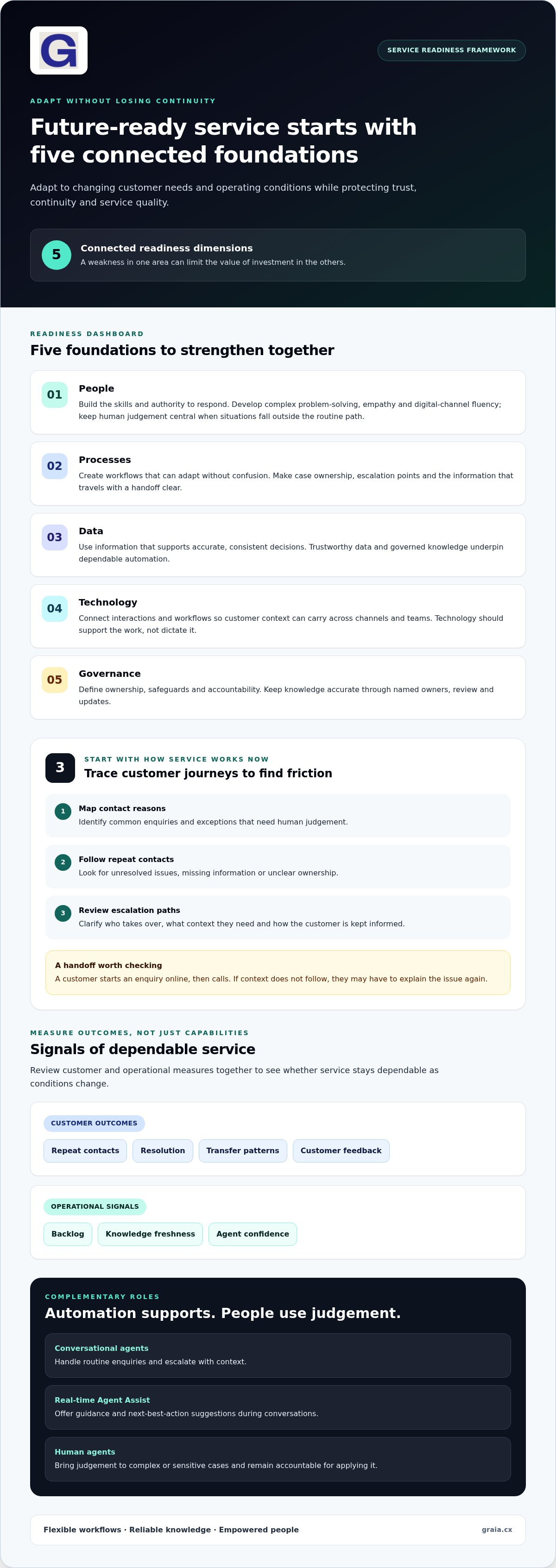
Assess readiness across five connected dimensions: people with the skills and authority to respond; processes that can adapt without creating confusion; data that supports accurate, consistent decisions; technology that connects interactions and workflows; and governance that defines ownership, safeguards and accountability. A weakness in one area can limit the value of investment in the others.
Which customer service pressures are changing fastest?
Customers may move between voice and digital channels, and an issue can involve several teams before it’s resolved. The challenge is to make support timely and coherent across those interactions, rather than treating each channel as a separate queue.
Fixed workflows can struggle when contact reasons or demand patterns change. For example, a customer who starts an enquiry online and then calls may need to explain the issue again if context doesn’t follow them. Identify where handoffs break down, then adjust routing, guidance and escalation paths to reflect real customer needs.
What does a future-ready department look like?
A future-ready team can adapt its channels, workflows and knowledge without losing sight of service quality. People and automation have complementary roles: conversational agents can handle routine enquiries and escalate with context, while human agents bring judgement to complex or sensitive cases. Real-time Agent Assist can offer guidance and next-best-action suggestions during those conversations.
Readiness should show up in measurable outcomes, not just new capabilities. Track repeat contacts, resolution, transfer patterns and customer feedback alongside operational signals such as backlog, knowledge freshness and agent confidence. Reviewing these measures together helps leaders see whether service remains dependable as conditions change.
Build the Foundations: People, Processes, Data, and Service Technology
Before adding tools, understand how service works now. Trace key customer journeys from first contact to resolution. Note why people get in touch, where they repeat information, and how cases move between channels or teams. This exposes practical friction, such as an enquiry that shifts from digital to voice but arrives without useful context. It also helps distinguish a technology gap from a process or knowledge gap.
- Map contact reasons: Identify common enquiries and the exceptions that need human judgement.
- Follow repeat contacts: Look for unresolved issues, missing information or unclear ownership.
- Review escalation paths: Clarify who takes over, what context they need and how the customer is kept informed.
Next, examine the information that supports each interaction. Is there a clear owner for every knowledge item? Can agents find the approved answer quickly? Are updates reviewed and published through a defined process? Trustworthy data and governed knowledge underpin dependable automation. Without them, automated responses can repeat outdated guidance at scale, while agents are left to reconcile conflicting answers.
How can leaders prepare agents for changing service work?
Build capability alongside new workflows. Coach agents in complex problem-solving, empathy and digital-channel fluency, including how to use assistance tools without accepting suggestions uncritically. Frontline staff see where scripts, handoffs and guidance fail in real conversations, so involve them in workflow design and regular feedback. AI can surface information or suggest next steps; people remain accountable for applying judgement and handling exceptions.
Why do process and knowledge design matter?
Document what should happen when an interaction falls outside the routine path: who owns the case, when to escalate, what information must travel with it and which decisions require human review. Keep approved knowledge accessible in the flow of work, with named owners responsible for accuracy, review and updates. These foundations help teams change automation safely rather than hard-coding unclear practices into a new tool. For context on how service platforms have developed, read the AI customer service platform evolution guide.
When people, processes and information are aligned, technology can support the work instead of dictating it. For related perspectives, browse GraiaCX’s customer service technology articles.
Choose Adaptable Customer Service Technology Without Chasing Trends
The right service technology fits the work customers need done. For future-proofing your customer service department, assess tools against customer need, workflow fit, integration, governance and adaptability, rather than choosing them because a capability is attracting attention. A platform should support your service model today and give you room to adjust channels and processes as that model evolves.
Separate interactions that are routine and repeatable from those that need human judgement. An automated agent may suit a straightforward status enquiry, while a sensitive complaint or unusual account issue needs a clear route to a person. In either case, test whether relevant context follows the customer and whether the next step is clear if automation can’t confidently resolve the request.
| Fixed, disconnected tools | Integrated, configurable capabilities |
|---|---|
| Channels operate in separate workflows, so context may need to be repeated. | Voice and digital interactions can be coordinated around customer journeys, with context available for handoffs. |
| Rules are difficult to adjust when contact reasons or processes change. | Workflows can be configured to support defined use cases, escalation criteria and service safeguards. |
| Information and actions are split across systems. | Useful integrations connect service interactions with relevant CCaaS or enterprise systems. |
Which capabilities make a service stack adaptable?
Evaluate how voice and digital channels work together in actual customer journeys, not just in a feature list. Look for responses grounded in approved information, controlled workflows for defined tasks and contextual handoffs when a person needs to take over. Integration matters too: the GraiaCX platform brings voice and digital interactions together and integrates with providers including Genesys, NICE CX and Avaya. Assess whether those connections support the processes your teams rely on.
How can leaders evaluate AI without overcommitting?
Begin with a bounded, repeatable use case and set explicit escalation criteria before introducing automation more broadly. Test whether responses are accurate, follow approved policy and recover safely when a customer’s input is unclear or outside the intended scope. Include frontline agents in testing so they can flag awkward handoffs and missing context. For a deeper look at enterprise approaches, explore this enterprise AI contact centre solutions guide.
This disciplined approach keeps technology accountable to service outcomes. For more perspectives on customer service technology, visit GraiaCX’s customer service insights.
Turn Future-Proofing Into a Phased Plan You Can Measure
Change is easier to manage as a sequence of decisions, not a department-wide switch. A phased approach to future-proofing your customer service department lets you test whether a change works for customers and agents before expanding it. Use this cycle:
- Baseline: Record current performance for the journey you want to improve, including resolution quality, repeat contacts, customer feedback and agent experience.
- Prioritise: Rank opportunities by customer pain, operational friction, feasibility and risk. Choose a use case with accessible knowledge and clear exception paths.
- Pilot: Set a defined scope, accountable owner, service safeguards and agent involvement before introducing the change.
- Learn: Review interaction samples and agent feedback. Identify where the workflow, guidance or escalation criteria need refinement.
- Scale: Expand only when evidence shows the approach is working and the team can support the broader scope.
- Review: Revisit measures and assumptions regularly, adjusting the approach as customer needs and operating conditions change.
A pilot is successful only when customer and operational measures improve together. Faster handling alone isn’t enough if repeat contacts rise or agents struggle to resolve exceptions. Track a balanced set of indicators: customer outcomes and feedback, resolution quality, repeat contacts, agent confidence or experience, and operational impact such as workload or unresolved case volume. Compare results with your own baseline and goals rather than treating them as universal benchmarks.
How should a department prioritise its first changes?
Look for a focused opportunity where customers experience friction and the team can make a controlled change. A clearly defined, repeatable enquiry supported by reliable knowledge may be a stronger starting point than a complex journey with unclear ownership. Before committing, map likely exceptions, confirm who handles them and consider the consequences if the new process fails.
How can teams scale change without disrupting service?
Agree review checkpoints and rollback criteria before the pilot begins. At each checkpoint, compare results with the baseline, review a sample of interactions and gather agent feedback. If quality slips or exceptions aren’t handled safely, pause expansion and refine the workflow. For more measurement considerations, read the AI contact centre ROI guide.
Keep learning practical: explore GraiaCX’s customer service insights for further ideas on assessing and improving service technology.
Make Human-AI Collaboration the Operating Model for Future Service
Automation works best when it gives people more capacity to focus on customers, not when it puts another barrier between them. A human-AI operating model assigns routine, repeatable enquiries to conversational agents while keeping human judgement available for complex or sensitive needs. This is a practical principle for future-proofing your customer service department: let technology support the interaction, while people retain clear responsibility for exceptions and service recovery.
Where should automation stop and human support begin?
Set escalation rules before launching an automated journey. A conversational agent should pass a customer to a person when it's uncertain, when the issue is sensitive, or when resolution requires discretion beyond the defined workflow. The handoff should carry useful context, such as the customer's intent and steps already taken, so the customer doesn't have to start again.
Clarity matters after the transfer, too. Make it clear which agent or team owns the next action, and ensure a human can review or correct automated guidance. If an interaction goes off course, agents need both the authority and the information to recover it. Automation can support consistent handling, but accountability for the customer's experience must remain visible.
What can an adaptable platform enable?
A coordinated service journey can bring together conversational automation, agent assistance and voice or digital channels. For example, an automated agent can resolve a routine enquiry or escalate it with context; the live agent can then receive real-time guidance and next-best-action suggestions through Agent Assist. Live Call Translation can also support multilingual interactions across over 100 languages.
These capabilities aren't a one-size-fits-all prescription. Start with the journeys and customer needs that matter to your organisation, then configure human and automated roles around them. GraiaCX brings voice and digital interactions together and integrates with major CCaaS providers, including Genesys, NICE CX and Avaya. These integrations can extend service capabilities without assuming every part of the existing technology environment must be replaced.
Keep the operating model adaptable by reviewing escalation patterns, agent feedback and customer outcomes as needs change. Human-AI collaboration isn't a fixed destination; it's a way to evolve service while keeping support coherent and accountable. Explore GraiaCX customer service insights for practical perspectives on building that model.
Build Service That’s Ready to Adapt
Future-proofing your customer service department isn’t about guessing which channel or technology will matter next. It’s about building the foundations to adapt: clear processes, reliable knowledge, capable agents and technology you can evolve while keeping service consistent.
Start with customer needs, then make change measurable. Map where journeys break down, prioritise a focused improvement and test it with safeguards before scaling. Keep people central: conversational agents can resolve routine enquiries and escalate more complex conversations with context, while Agent Assist provides real-time support, including next-best-action suggestions. Live Call Translation supports multilingual interactions across over 100 languages.
These capabilities show how automation, agent support and connected channels can work together without requiring every department to follow the same model. The goal is progress that strengthens customer outcomes and operational resilience, one informed step at a time.
Explore GraiaCX’s customer service insights for practical ideas to guide your next steps. With a clear foundation and a willingness to learn, your team can adapt confidently while preserving the human connection that makes service matter.
Frequently Asked Questions
What does future-proofing a customer service department mean?
It means preparing your department to adapt as customer needs, channels and technology change while maintaining dependable service. Future-proofing your customer service department takes more than adopting new tools: it also requires capable people, clear processes, governed knowledge, useful measures and safe escalation paths. With these foundations, teams can improve over time without making each change a disruptive transformation.
How can a customer service department prepare for AI?
Start by identifying repeated customer needs, checking the quality of your knowledge and documenting workflows, rules and exceptions. Choose a bounded use case, define when it should hand a conversation to a person, and involve agents in testing. Then assess response quality and resolution alongside efficiency. This keeps AI connected to real customer outcomes, rather than treating adoption itself as evidence of success.
Will AI replace customer service agents?
AI can handle some routine interactions, but customer service still needs human judgement, empathy and accountability. Agents remain important for complex, sensitive or unusual cases, as well as service recovery when an interaction has gone off course. A well-designed model uses automation for appropriate tasks and gives agents useful context and real-time assistance when a conversation needs human attention.
How can a department future-proof customer service without replacing its existing systems?
Map customer journeys to identify where disconnected workflows create friction, such as a handoff that loses interaction context. Then assess how integration could improve coordination around existing operations and introduce changes in manageable stages, beginning with a contained use case. Define fallback paths so service can continue if the new workflow doesn’t resolve an enquiry. Modernisation can be incremental; a complete technology replacement isn’t the only route.
Which metrics should leaders use to measure future-ready customer service?
Use a balanced set of customer, operational and workforce measures. Depending on your service model, these could include resolution quality, repeat contacts, escalation patterns, response or resolution times, customer feedback and agent experience. Establish a baseline before making a change, then review the measures together. A faster interaction doesn’t necessarily mean a better outcome if the customer still needs to get back in touch.
How do you balance customer service automation with empathy?
Automate predictable tasks when the process and supporting knowledge are clear, while making human support accessible for cases that need judgement. Pass the interaction context to the agent so the customer doesn’t have to repeat information. Review conversations for tone, accuracy and appropriate escalation. Empathy depends on how well the whole journey responds to a person’s needs, not simply on whether a human or an AI responds.
What should a customer service AI pilot include?
A useful pilot has a defined customer problem, a bounded scope, approved knowledge, documented exceptions and a clearly accountable owner. Involve agents in testing, and set explicit criteria for handing conversations to people. Compare customer and operational outcomes with a baseline, review failures, and decide in advance what would prompt you to stop, refine or expand the pilot. Don’t scale based on a convincing demonstration alone.