
Customer Service Automation Proposal Template: The 2026 Enterprise Buying Guide
Deflection is no longer a viable enterprise business case, and your executive board knows it. After years of watching brittle chatbots frustrate customers and collapse into basic routing loops, leadership has zero patience for another speculative AI pitch. You're likely wrestling with how to justify contact centre modernisation to directors who demand hard operational impact; leaders who care about handle times, legacy telephony integration with Genesys or Avaya, and strict data governance rather than vague promises. Securing sign-off requires a pragmatic customer service automation proposal template that shifts the boardroom conversation from passive deflection to autonomous, governed execution.
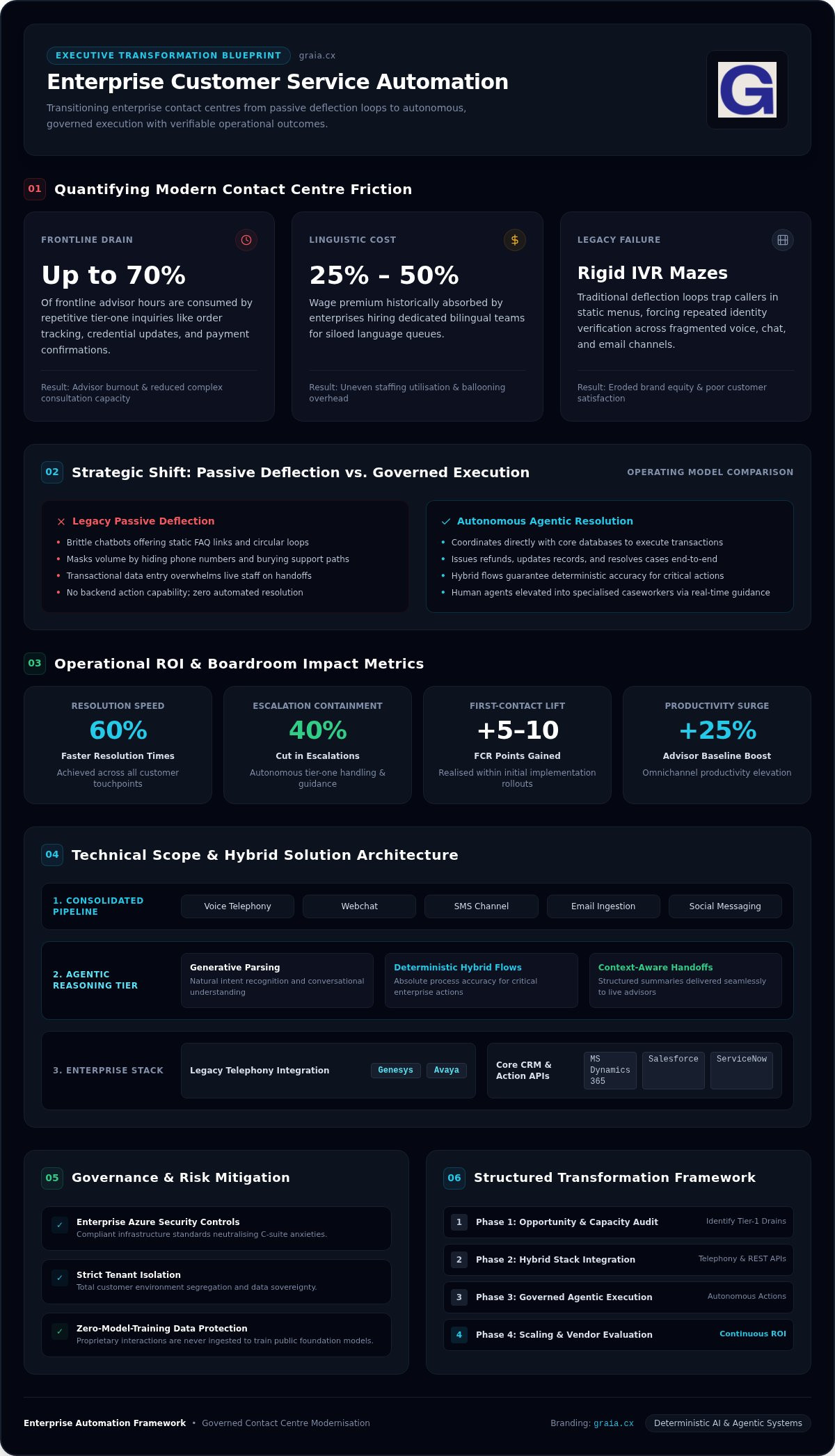
This guide delivers the definitive framework you need to align your executive committee. You'll discover how to structure an agentic business case that demonstrates 60% faster resolution times, cuts escalations by 40%, and eliminates bilingual hiring friction without introducing compliance risk. Ahead, we break down the governance controls, operational formulas, and architectural blueprints required to turn enterprise customer service into a resilient growth engine.
Key Takeaways
- Master a board-ready customer service automation proposal template that replaces unproven deflection promises with verifiable operational outcomes.
- Discover how agentic hybrid architectures seamlessly integrate with legacy telephony stacks like Genesys and Avaya without requiring costly core replacements.
- Structure an unshakeable financial business case using contact centre capacity formulas that capture handle time drops, escalation containment, and productivity gains.
- Neutralise governance and compliance anxieties through enterprise Azure security controls, strict tenant isolation, and zero-model-training data protections.
- Apply a structured four-phase rollout roadmap and vendor evaluation scorecard to minimise deployment friction and guarantee rapid time-to-value.
Executive Summary Blueprint: Framing the Enterprise Automation Opportunity
Every boardroom presentation starts with an unasked question: why should we fund this now? When writing an executive-ready proposal, your opening summary cannot read like an IT configuration brief. It must articulate a clear transformation mandate. Enterprise service operations face an unsustainable squeeze between rising interaction volumes, climbing wage inflation, and persistent frontline attrition. A winning customer service automation proposal template establishes that preserving the status quo is an active commercial risk.
Rigid legacy interactive voice response (IVR) systems have failed modern consumer expectations. They trap callers in branch mazes, forcing them to repeat their identity at every transfer point. Your executive summary must shift leadership focus away from these static routing menus toward autonomous agentic resolution. Frame your investment around two non-negotiable operational outcomes: achieving 60% faster resolution times across touchpoints and lifting First-Contact Resolution (FCR) by 5 to 10 points within initial rollouts.
The Problem Statement: Quantifying Modern Contact Center Friction
Repetitive tier-one inquiries drain frontline capacity. High-frequency requests, such as order tracking, credential updates, and payment confirmations, consume up to 70% of frontline hours. This leaves advisors burned out and unable to handle intricate consultations. Fragmented systems compound the issue; callers bounce between chat, telephony, and email, explaining their challenge repeatedly.
Operating multilingual queues introduces severe cost inefficiencies. Enterprises historically address diverse customer bases by hiring dedicated linguistic teams, absorbing a 25% to 50% wage premium for bilingual talent. These siloed language queues create uneven staffing utilisation, long wait times, and ballooning overheads that erode operating margins.
The Strategic Vision: Transitioning from Deflection to Autonomous Resolution
Traditional deflection metrics actively harm brand equity. Masking contact volumes by hiding phone numbers or trapping users in circular chatbots lowers perceived service quality. Modern customer service automation proposal template designs replace shallow deflection with verified backend execution. Rather than just offering static FAQ links, conversational agents coordinate directly with core databases to execute refunds, update account records, and resolve inquiries end-to-end.
This agentic shift modernises traditional workflows. By incorporating cognitive reasoning alongside standard robotic process automation (RPA) scripts, frontline staff break free from transactional data entry. Live human agents transition into specialised caseworkers, supported by real-time guidance that cuts escalations by 40% and elevates baseline productivity by 25% across every channel.
Technical Scope & Solution Architecture: Specifying the Automation Stack
Enterprise technology proposals stall when they treat artificial intelligence as an unpredictable black box. Your customer service automation proposal template must outline a clear, multi-layered architecture that enterprise architects, security officers, and operations leads can validate immediately. The foundation begins at the ingestion tier, unifying voice telephony, webchat, SMS, email, and social messaging into a consolidated pipeline. Instead of relying on raw conversational models to guess business rules, the architecture pairs generative language parsing with deterministic Hybrid Flows. This guarantees absolute process accuracy during critical actions, while context-aware handoffs pass structured conversational summaries to live staff. Above all, the architecture enforces total data sovereignty, ensuring proprietary customer interactions are never ingested to train public or external foundation models.
Agentic Intelligence and Backend Action Execution
Modern enterprise proposals must move beyond passive informational bots. An agentic Conversational Agent connects directly to internal core systems, including Microsoft Dynamics 365, Salesforce, and ServiceNow via secure REST APIs. By coordinating a multi-agent framework, specialized virtual agents handle distinct operational domains. One agent verifies identity and validates warranty claims, while another executes transactional ledger updates or processes invoice modifications directly within your ERP.
Knowledge Retrieval Architecture: Contextual RAG Frameworks
Eliminating conversational hallucination requires a grounded Contextual Retrieval-Augmented Generation (RAG) framework. By pairing dense semantic vector search with sparse keyword matching, the retrieval engine pinpoints exact policy clauses from dynamic knowledge repositories, internal product catalogues, and regulatory handbooks. The system pulls verified contextual snippets into the prompt pipeline, ensuring every customer answer strictly mirrors approved enterprise compliance documentation.
Telephony and CCaaS Interoperability
Tearing out existing telephony investments is a non-starter for enterprise IT leaders. A credible proposal demonstrates seamless interoperability with incumbent contact centre platforms like Genesys, NICE CX, and Avaya through standard SIP trunks and embedded agent iframe widgets. Frontline teams gain Agent Assist tools that surface live call transcriptions and dynamic knowledge suggestions without leaving their existing workspace. Additionally, embedded Live Call Translation across over 100 languages allows human advisors to resolve global customer inquiries instantly without maintaining separate language queues. To examine detailed interface blueprints and ingestion workflows, review our latest technical analyses on the GraiaCX architecture blog, and align your governance controls with the recognized NIST AI Risk Management Framework.
Financial Modeling & Operational ROI: Building the Unshakeable Business Case
Chief financial officers reject automation proposals that rely on vague satisfaction scores. To secure fiscal approval, your customer service automation proposal template must present an unshakeable mathematical proof rooted in capacity modeling and unit-cost economics. Building this business case requires evaluating current operational load through the lens of contact centre capacity:
Required FTE Capacity = (Annual Contact Volume × Average Handle Time in Seconds) / (Annual Productive Working Seconds per Full-Time Employee)
Deploying an agentic architecture transforms both sides of this equation. By enabling autonomous resolution for high-frequency workflows, organisations achieve a documented 40% reduction in customer service escalations and repeat contacts. Concurrently, resolving routine interactions autonomously drives 60% faster average customer resolution times across channels. These compounding improvements eliminate backlog bottlenecks without requiring proportional headcount expansion. Incorporating dynamic language translation removes the standard 25% to 50% wage premiums required for dedicated multilingual staffing, streamlining global coverage into a single operational queue.
Direct Labor and Interaction Cost Reduction Formulas
Calculating financial return requires modeling the Net Blended Contact Cost rather than surface containment. The baseline cost per contact reflects direct advisor compensation, telephony overhead, and software licensing divided by handled volumes. Shifting transactional volume to automated self-service displaces manual handling overhead across inbound voice, chat, and email triage.
To establish fiscal credibility, determine your payback period using this formula:
Payback Horizon (Months) = Total Capital Investment / Net Monthly Operating Expense Reduction
This dynamic shifts the long-term staffing curve outlined in the U.S. Bureau of Labor Statistics occupational outlook for customer service representatives, allowing operations to scale capacity independently of headcounts.
Productivity Uplift via AI Agent Assistance
Savings extend beyond pure self-service resolution. Equipping human staff with Agent Assist tools drives a measured 25% improvement in live agent productivity and workflow efficiency. Automated interaction summaries eliminate manual after-call work (ACW), trimming 15% to 25% off average handle times within 4 to 6 weeks of tuning. Context-aware guidance shortens onboarding cycles for new hires while predictive outbound pacing models unlock a 30% outbound efficiency uplift, reducing missed callbacks and SLA breaches by 20%.
Governance, Security & Risk Mitigation: Addressing C-Suite Anxieties
Security vetting kills more automation projects than budget shortfalls ever will. Legal, compliance, and cybersecurity stakeholders routinely veto AI initiatives when data protections appear speculative. Your customer service automation proposal template must present an ironclad governance model upfront. Enterprise deployments demand an infrastructure built on Microsoft Azure, pairing multi-tenancy software orchestration with strict logical data isolation. Data in transit requires TLS 1.2 encryption, while AES256 symmetric encryption protects data at rest through managed Azure Key Vault configurations. Automated PII masking redacts customer payment details, national identification numbers, and contact information at ingestion. Most critically, establish zero customer data sharing guarantees; interaction data must never train public or third-party foundation models.
AI Guardrails, Auditing, and Policy Enforcement
Uncontrolled generative outputs create unacceptable reputational liability. Enterprise governance pairs conversational fluency with deterministic rule-based gates. While language models interpret intent, rigid programmatic policies dictate allowable business actions. If an inquiry breaches compliance boundaries, the deterministic system overrides the model instantly. Every interaction produces a transparent reasoning log recording exact knowledge base search paths, invoked APIs, and decision parameters. Before reaching production, solutions undergo bot-to-bot simulations where automated evaluators stress-test edge cases against prompt injections, adversarial phrasing, and brand drift.
Regulatory Compliance and Service Level Agreements
Modern compliance frameworks demand active verification. To satisfy statutory requirements, including the UK Data Protection Act, GDPR residency controls, and Article 50 transparency obligations under the EU AI Act, systems must display clear artificial intelligence disclosures and maintain strict operational boundaries. Access control relies on Microsoft Entra ID with mandatory multi-factor authentication and role-based permissions.
Back these safeguards with enterprise-grade operational availability:
- Category 1 (Full System Failure): 1-hour response time with a 4-hour restoration target (MTTR).
- Category 2 (Significant Impact): 2-hour response time with an 8-business-hour restoration target.
- Category 3 (Minor Degradation): 1-working-day response with a 24-business-hour restoration window.
- Platform Stability: 99.9% platform availability backed by round-the-clock Azure cloud monitoring.
To inspect comprehensive architectural control checklists and model audit templates, explore our governance teardowns on the Graia CX insights blog.
Implementation Roadmap & Vendor Evaluation: Executing the Transformation
Grand technical architectures collapse without disciplined execution. The final section of your customer service automation proposal template bridges strategic vision and operational reality through a phased deployment schedule and an objective vendor selection matrix. Rather than proposing a high-risk big-bang launch, structure your initiative into four controlled milestones designed to de-risk delivery while demonstrating immediate commercial value.
The Four-Phase Deployment Methodology
Execution begins with deep operational discovery:
- Phase 1: Discovery and Intent Mapping (Weeks 1-3). Audit historical transcripts and call logs across existing queues to isolate high-volume, repetitive customer journeys primed for automation.
- Phase 2: Pilot Sandbox Implementation (Weeks 4-6). Deploy conversational models inside a sandboxed environment focusing on low-risk transactional actions, tuning domain speech recognition models from an 80% baseline up to 95% to 98% transcription accuracy.
- Phase 3: Core Telephony and CRM Integration (Weeks 7-9). Connect SIP trunks to existing Genesys, NICE CX, or Avaya switches, and embed Agent Assist widgets inside frontline CRM dashboards.
- Phase 4: Omnichannel Cutover and Optimization (Weeks 10-12). Go live across voice, webchat, SMS, and messaging, executing automated edge-case evaluations to refine prompt libraries and ensure business logic alignment.
Vendor Selection Scorecard: Key Decision Matrix
Avoid platforms that introduce fragmented software layers. Procurement committees should evaluate prospective partners across three mandatory operational pillars:
- Conversational Maturity and Architectural Control: Does the solution combine fluid language parsing with deterministic workflow controls to prevent hallucinations during critical tasks?
- Non-Disruptive CCaaS Interoperability: Can the platform integrate directly into legacy telephony and core CRM systems without requiring disruptive infrastructure overhauls?
- Single-Vendor IP Accountability: Does the vendor provide an unified Agentic Omni-Channel Platform, or will your team manage finger-pointing between separate translation, transcription, and agent-assist vendors?
Securing Stakeholder Sign-Off and Next Steps
Consensus demands precise role accountability. CX operations leads validate agent desktop ergonomics; IT security signs off on Azure data isolation; legal confirms regulatory compliance; and finance tracks baseline resolution velocity. Establish explicit pilot success metrics around agreed First-Contact Resolution benchmarks before launching live traffic. Discover strategic implementation insights and case studies by visiting the GraiaCX Resource Hub, or explore actionable strategies on the GraiaCX CX Blog to refine your rollout plan.
Transforming Customer Service into an Enterprise Growth Engine
Securing executive sign-off for contact centre transformation is ultimately about clarity and conviction. By leveraging a structured customer service automation proposal template, you present leadership with a credible operational blueprint rather than unproven AI speculation. Shifting from passive deflection to agentic action delivers proven operational impact, including a 40% reduction in customer service escalations and 60% faster resolution velocity across omnichannel touchpoints.
True operational resilience doesn't require dismantling your established infrastructure. Modern platforms connect directly with existing Genesys, Avaya, and NICE CX stacks via native SIP integrations, protecting legacy investments while unlocking autonomous resolution. Grounded in enterprise Azure environments with absolute client data privacy and zero model training, your operations remain secure, compliant, and poised for scalable growth. Explore cutting-edge deployment guides and actionable CX strategies on the GraiaCX blog to accelerate your transformation today.
Frequently Asked Questions
What are the essential sections to include in a customer service automation proposal?
A winning customer service automation proposal template contains five core sections: an executive summary detailing strategic drivers, a technical architecture specification, a capacity-based financial model, an enterprise governance matrix, and a phased rollout roadmap. Each section addresses a specific stakeholder group. Operations teams evaluate frontline ergonomics, finance verifies payback horizons, and enterprise security officers validate tenant isolation, ensuring broad alignment across your leadership board.
How do you accurately calculate ROI in an enterprise customer service automation proposal?
Calculate ROI by contrasting fully loaded contact costs against post-deployment capacity models rather than vanity deflection rates. Factor in the operational impact of 40% fewer escalations and 60% faster resolution times alongside a 25% agent productivity lift. Include secondary savings from eliminating the 25% to 50% wage premiums required for dedicated bilingual queues, then divide your capital investment by net monthly operating expense reductions to establish an objective break-even timeline.
How does an agentic automation platform differ from traditional IVR or rule-based chatbots?
Traditional interactive voice response systems and rule-based bots rely on static decision trees that trap users in repetitive conversational loops. In contrast, an agentic platform coordinates autonomous actions directly with core business systems. By integrating Large Language Models with deterministic Hybrid Flows, agentic systems interpret customer intent with nuance while strictly executing backend tasks like processing refunds, rebooking appointments, or updating enterprise records without manual human intervention.
What security and compliance frameworks must be detailed in an enterprise AI proposal?
Proposals must document Azure hosting with SOC2-aligned controls, TLS 1.2 transit encryption, and AES256 data-at-rest protection via managed key vaults. Detail automated PII masking, role-based access control managed through Microsoft Entra ID, and explicit adherence to GDPR data residency rules. Reassure stakeholders by including prompt shields against adversarial injection attacks and an absolute guarantee that customer data is never used to train public foundation models.
How can we propose AI customer service automation without replacing our existing CCaaS platform?
Position automation as an agile intelligence layer rather than a rip-and-replace overhaul. Modern platforms drop into existing infrastructure like Genesys, NICE CX, and Avaya via standard SIP trunking and embedded agent desktop widgets. This approach preserves existing telephony routing, carrier contracts, and reporting pipelines. It equips advisors with Agent Assist summaries and autonomous conversational agents without disrupting established daily operations.
How does customer service automation handle multilingual inquiries without bilingual agents?
Enterprise platforms integrate real-time Live Call Translation across more than 100 languages directly into the agent desktop. When an international customer calls or chats, the system translates speech bi-directionally in milliseconds while preserving the caller's original vocal tone. Human advisors handle inquiries in their native tongue, completely removing specialized language queues, reducing hold times, and eliminating the need to recruit expensive regional language teams.
What metrics define a successful pilot deployment in an automation proposal?
A robust customer service automation proposal template establishes measurable operational thresholds before live traffic cutover. Key pilot metrics include achieving a 5 to 10 point increase in First-Contact Resolution, reducing Average Handle Time by 15% to 25% through automated agent summaries, and tuning domain speech recognition accuracy to 95% or higher. Operations teams also measure customer sentiment stability and strict Category 1 resolution adherence under four hours.