
Cost of Maintaining Legacy PBX Systems: A 2026 Guide
What if the maintenance contract is the smallest part of your legacy PBX bill? The cost of maintaining legacy pbx systems can be hard to predict, especially when ageing equipment brings repair needs, downtime risk and costs that rarely appear on an invoice. In the UK, the PSTN and ISDN switch-off is set for 31 January 2027, adding urgency to decisions about systems that rely on those services.
It’s understandable to focus on contract and call-out charges. But a fair comparison should also include staff time spent managing faults, the effort required to find specialist support and the business impact of a system that no longer meets operational needs. This guide breaks down direct, indirect and less visible costs, then compares continued maintenance with modernisation using consistent assumptions. You’ll also get a practical framework for assessing your system’s condition, business requirements and timing. The aim isn’t to prescribe replacement. It’s to help you make the next step clear and defensible.
Key Takeaways
- Assess the cost of maintaining legacy pbx systems beyond contract fees by accounting for repairs, specialist labour and internal administration.
- Identify how equipment age, parts availability, system complexity and contract scope can change the cost and effort of ongoing support.
- Compare maintenance and modernisation over the same time horizon, using consistent assumptions about services, risks and transition effort.
- Build a practical total cost of ownership estimate from contracts, invoices, incident records and staff time, separating confirmed costs from estimates.
- Turn the findings into a decision record that weighs continuity, integration needs, user impact and business-critical call journeys.
What Makes the Cost of Maintaining Legacy PBX Systems Add Up?
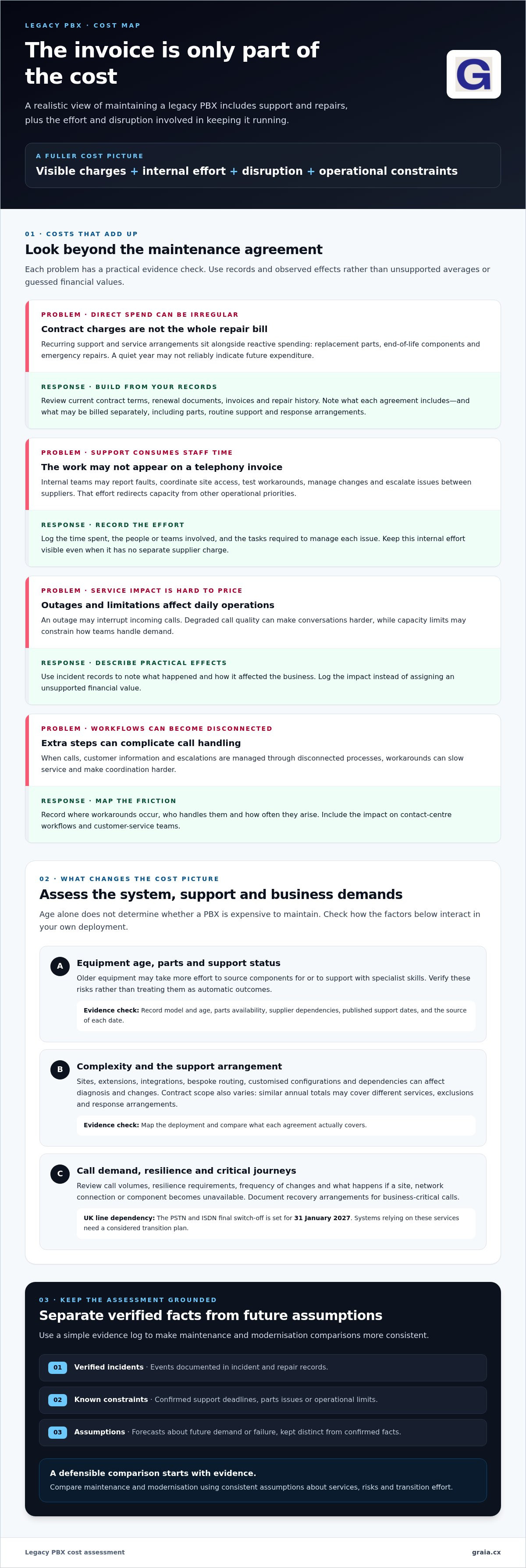
A PBX connects an organisation’s internal extensions and manages calls to and from external networks. If you need a quick refresher, this overview of the Private Branch Exchange (PBX) system explains the technology’s role. With an older system, the budget impact goes beyond keeping equipment operational. Costs accumulate through planned support, unplanned repairs and the work needed to manage its limitations.
Maintenance spend is what you pay to support and repair a PBX. Total lifecycle cost also includes the operational effort, disruption and constraints involved in keeping it in service.
That distinction matters because a system can still place and receive calls while using time and resources elsewhere. To understand the cost of maintaining legacy pbx systems, separate charges visible in contracts and invoices from indirect costs spread across IT, operations and customer-service teams.
Which direct costs appear in a legacy PBX budget?
Start with recurring charges: maintenance agreements, support renewals and service arrangements with vendors or specialist engineers. Then review reactive spending, including replacement parts, end-of-life components and emergency repairs. These costs can be irregular, so a quiet year may not be a reliable guide to future expenditure.
Build the estimate from your organisation’s records. Check current contract terms, renewal documents, invoices and repair history rather than relying on unsupported industry averages. Note what each agreement includes, such as routine support or parts, and what may be billed separately. Compare like with like: two similar annual totals can cover different services, exclusions and response arrangements.
Which indirect costs are easy to overlook?
Support takes internal effort, too. Staff may spend time reporting faults, coordinating site access, testing workarounds, managing changes and escalating issues between suppliers. Record that time even if it doesn’t appear as a telephony charge. It is capacity redirected from other operational priorities.
Disruption can be harder to quantify, but it still belongs in the assessment. An outage may interrupt incoming calls. Degraded call quality can make conversations harder, while capacity limits may constrain how teams handle demand. Log incidents and their practical effects instead of assigning an unsupported financial value.
Older telephony can also create friction with current contact-centre workflows. If teams manage calls, customer information or escalations through disconnected processes, extra steps can slow service and complicate coordination. Record where those workarounds occur, who handles them and how often they arise. Together, these records create a more realistic baseline for comparing ongoing support with modernisation.
What Drives Legacy PBX Maintenance Costs Higher Over Time?
Age alone doesn’t determine whether a PBX is expensive to maintain. The pressure comes from how its condition, support arrangements and business demands interact. A system with a clear support path and straightforward configuration may be easier to manage than a newer one with complex dependencies. Assess the evidence for your own deployment rather than assuming that age means failure or that quiet operation means low risk.
PBX upkeep requirements are shaped by equipment age, parts availability, support status, deployment complexity, resilience needs, call demand and the scope of maintenance arrangements.
How do age, parts and support status affect upkeep?
Build an asset record for the PBX and its connected components. Note model and age, relevant vendor support dates, parts availability, and dependencies on a particular supplier or specialist skill set. As equipment ages, sourcing a component or arranging experienced support may take more effort. Treat these as risks to verify, not automatic outcomes.
Check end-of-support dates in documentation from the relevant manufacturer or supplier, and record the date and source. Don’t treat a system as unsupported based on its age alone. Separate confirmed facts, such as a published support deadline or a documented parts issue, from forecasts about future failures. This keeps planning grounded in evidence.
How do complexity and business demands change the cost picture?
Two deployments with similar equipment can have very different support needs. Map the number of sites and extensions, call volumes, integrations, resilience requirements and frequency of changes. Bespoke routing, customised configurations or dependencies between systems can make fault diagnosis and later changes more involved. Contract scope matters, too: the support included for one arrangement may differ from what’s covered in another.
Business-critical calling adds another dimension. If customers rely on particular call journeys, assess what happens when a site, network connection or component becomes unavailable, and document recovery arrangements. For UK organisations, include line dependencies in that review: the PSTN and ISDN final switch-off is set for 31 January 2027, so systems relying on those services need a considered transition plan.
Keep a simple evidence log with three labels: verified incidents, known constraints and assumptions about future demand or failure. This helps distinguish a pattern in incident records from a risk that hasn’t occurred. It also makes later comparison with the cost of an upgrade more grounded.
For contact-centre workflows, perspectives on contact-centre modernisation can inform the broader assessment. They don’t replace a review of PBX support, call dependencies and continuity needs.
Legacy PBX Maintenance vs Modernisation: How to Compare the Options
There’s no universal point at which maintaining a PBX stops making sense. A stable, supported system that meets current business needs may remain a rational choice. The decision becomes harder when supportability, resilience or essential capabilities no longer match what the organisation needs. Compare both paths over the same evaluation period, using your cost records and clearly stated assumptions.
| Decision factor | Continue maintenance | Modernise |
|---|---|---|
| Ongoing support | Account for contracts, renewals, repairs and any support exclusions. | Include the proposed service model and the support needed during transition. |
| Operational exposure | Consider documented faults, recovery options and dependencies on specialist support. | Assess migration risks, continuity arrangements and how the new environment will be managed. |
| Capability | Check whether current calling features still meet user and customer needs. | Assess whether additional voice and digital capabilities address a genuine business requirement. |
| Flexibility | Consider how easily the system can accommodate changes to sites, users and workflows. | Evaluate how the proposed model could support planned changes and integrations. |
| Transition effort | Include ongoing administration and any workarounds required to keep existing processes running. | Include planning, configuration, integration, user change and any staged rollout effort. |
Keep the comparison fair. Set one time horizon for both options, list included services, state assumptions and identify exclusions. For example, don’t compare a maintenance contract alone with a modernisation estimate that includes transition work. Separate confirmed costs from estimates, and document what each option covers. That makes the cost of maintaining legacy pbx systems easier to weigh against the full effort of change.
When can continued PBX maintenance remain a rational choice?
Maintenance may suit an organisation when the system remains supported and reliable, its features meet present requirements, and established workflows serve users well. A documented support arrangement with manageable costs and clear responsibilities can provide a sound basis for continuing. Reassess if supportability, resilience or required capabilities fall short, rather than relying on the system’s age alone.
What should a modernisation comparison include?
Look beyond the replacement technology. Include migration effort, integrations, user workflows, security requirements and continuity planning. Modernisation can happen in stages, such as moving selected functions or user groups before others, rather than through a single cutover. For contact centres, CCaaS capabilities may change or complement operating models through automation, agent assistance or live call translation. Explore enterprise AI contact centre solutions as part of that wider assessment, while evaluating PBX and contact-centre integration requirements separately.
How to Calculate Your Legacy PBX Total Cost of Ownership
A useful total cost of ownership (TCO) estimate is built from evidence, not a single contract figure. Set a consistent evaluation period for continued maintenance and modernisation, then gather the records that show what the system costs today and what future work it may require. The result should make assumptions visible, not present uncertainty as a precise forecast.
Which records should a PBX cost assessment use?
Bring together financial and operational evidence. Review maintenance agreements, renewal notices, repair invoices, parts records and support correspondence. Then examine outage logs, incident duration, call-impact reports and internal time spent diagnosing faults, coordinating support or restoring service.
Record future requirements separately. Integration changes, resilience improvements and planned system changes may all create work. Don’t present them as confirmed expenditure until there’s a defensible basis for estimating them.
How can teams make the comparison useful to decision-makers?
Use a clear sequence to build the comparison:
- Set the scope. Choose one evaluation period and define which sites, users, services and business requirements are included.
- List known recurring costs. Use contracts, renewals and invoices, noting the source and responsible owner for each item.
- Add one-off costs. Record documented repairs, parts and other non-recurring work separately from regular support charges.
- Estimate operational impact carefully. Include staff time from incident records. Include downtime impact only where the organisation can explain and support its business assumption. Don’t assign an unsupported value to disruption.
- Separate uncertainty. Label forecasts and assumptions clearly, then test how changing them affects the decision.
For a sensitivity view, vary uncertain inputs, such as the possible frequency of repairs or the effort involved in a transition, without inventing figures. Show which assumptions materially change the outcome and which have little effect. This helps decision-makers see where better evidence is needed.
Compare maintenance and modernisation using the same time horizon, scope and service expectations. Keep recurring, one-off and uncertain costs on distinct lines, with a source and owner beside each. For a broader value assessment, consider how the cost of maintaining legacy pbx systems compares alongside AI readiness and modern platform capabilities.
Read GraiaCX’s contact-centre insights for additional perspectives to inform your assessment.
Plan the Next Step: Maintain, Modernise, or Transition in Stages
A cost assessment becomes useful when it leads to a clear, reviewable decision. Record why you’ll maintain the current system, begin modernisation or plan a transition in stages. Include the evidence behind the choice, the risks you’re accepting and the conditions that would prompt a reassessment. That makes the decision more robust than a simple “keep or replace” conclusion.
What should a practical PBX decision plan contain?
Start with a concise picture of the current environment: equipment and sites, support position, service dependencies, key workflows and known operational risks. Then define decision criteria that fit your organisation. These might include supportability, incident patterns, recovery arrangements, required features, integration needs and the cost of maintaining legacy pbx systems over the chosen review period.
Turn those criteria into clear options. Continued maintenance may be appropriate while support and business requirements remain aligned. Staged modernisation may suit a team that needs to protect continuity while changing selected workflows. Replacement planning may be warranted when essential needs can no longer be met. Assign technical, operational and financial owners to validate the evidence, manage actions and revisit assumptions on agreed review dates.
Where can contact-centre AI fit into modernisation?
Keep the contact-centre opportunity distinct from PBX hardware maintenance. GraiaCX’s conversational agent can understand intent, resolve routine enquiries and escalate to human agents. Agent Assist can provide real-time support, including next-best-action suggestions. These capabilities can form part of a broader contact-centre modernisation assessment, but they don’t determine whether an on-premise PBX needs repair or replacement.
GraiaCX integrates with major CCaaS providers, including Genesys, NICE CX and Avaya. This is a contact-centre platform consideration, not a claim of direct integration with every legacy PBX. Map the call journeys, systems and hand-offs involved, then assess the integration design and continuity requirements for the proposed deployment.
Make the next step proportionate to the evidence: document the decision, name its owners and set a date to review it. For further perspectives on AI-enabled modernisation, explore GraiaCX’s contact-centre insights.
Make Your Next Telephony Decision with Confidence
The true cost of maintaining legacy pbx systems extends beyond support contracts. A sound assessment also accounts for repairs, internal effort, service disruption and the capabilities your teams need. Compare maintenance and modernisation over the same period, using verified records and clearly labelled assumptions. Then document the risks, owners and review points behind your decision.
Modernisation doesn’t have to mean changing everything at once. For contact-centre teams, GraiaCX’s conversational agent can understand intent, resolve routine enquiries and escalate to human agents, while Agent Assist offers real-time support and next-best-action suggestions. GraiaCX integrates with major CCaaS providers, including Genesys, NICE CX and Avaya, as part of a broader contact-centre evaluation, distinct from PBX hardware maintenance or replacement.
Explore GraiaCX’s customer experience insights to consider how AI-enabled contact-centre capabilities could fit your plans. With clear evidence and a practical next step, you can protect continuity while preparing for what your organisation needs next.
Frequently Asked Questions
What does it cost to maintain a legacy PBX system?
There’s no single reliable figure for the cost of maintaining legacy pbx systems because each organisation’s cost profile is different. System condition, contract scope, parts availability, specialist support, integrations and incident history all affect the total. Calculate your own position from current invoices and internal records. Separate recurring charges, reactive repairs and documented operational impact so the estimate reflects your environment rather than an unverified industry average.
What hidden costs should businesses include when maintaining a legacy PBX?
Include staff time spent coordinating support, troubleshooting faults, managing workarounds and escalating issues, along with effort required to maintain integrations. Record the business impact of disruption where evidence supports it, such as affected call journeys or interrupted work. These costs may not appear on the maintenance invoice. Distinguish recorded expenses from assumptions, and avoid counting the same disruption in multiple categories. A clear cost register makes maintenance and modernisation easier to compare.
How can I calculate the total cost of ownership of a legacy PBX?
Set a consistent evaluation period, then gather maintenance contracts, renewal notices and invoices. Review repair and outage records, and estimate internal support time using incident or staff records. List recurring charges separately from one-off costs, and label estimates and assumptions clearly. Then compare the result with a modernisation scenario over the same period, using equivalent scope and service expectations. Avoid relying on benchmarks that aren’t verified or relevant to your deployment.
Is it cheaper to maintain a legacy PBX or move to a modern system?
It depends on the system’s condition and supportability, your business requirements, the transition scope and the operational risks of each option. Continued maintenance may make sense for a stable, supported system that meets current needs. Modernisation may better address changing capability or resilience requirements. Compare both choices over the same period, including implementation effort as well as ongoing operating costs, and make assumptions about future repairs or disruption visible.
When should a business replace or modernise its legacy PBX?
Consider planning a change when support status shifts, incidents recur, components become difficult to source, required capabilities are missing or integration constraints obstruct essential workflows. Age alone doesn’t prove replacement is necessary. First document service dependencies, business-critical call journeys and continuity requirements. Then compare the risks of continued support with the effort and operational impact of change. If a single cutover would create unnecessary disruption, a phased modernisation plan may be more appropriate.
Can a legacy PBX still be maintained if the supplier ends support?
Possibly, but the practical position depends on the system, contract, parts access and availability of relevant expertise. Review supplier documentation, contract records and support correspondence to establish the current arrangements. Treat uncertainty as a planning risk, not proof that the system will fail. Assess how the organisation would maintain continuity if support or a component became unavailable, then document contingency actions and the conditions that would trigger modernisation planning.
Can AI contact-centre tools work with a legacy PBX?
Compatibility depends on the telephony architecture, integration design and contact-centre platform involved. GraiaCX’s AI and contact-centre capabilities are distinct from PBX hardware maintenance. GraiaCX integrates with major CCaaS providers, including Genesys, NICE CX and Avaya, but that doesn’t mean every legacy PBX connects directly or without architecture work. Map the call flows and systems involved, then assess the integration design and continuity requirements for the proposed setup.