
Challenges of Global Customer Support: How to Build Consistent, Human-Centred Service
Global support doesn’t break at the border. It breaks when context gets lost. The challenges of global customer support show up when language gaps make customers repeat themselves, a culturally mismatched response feels impersonal, or different teams give different answers to the same question. Even a technically correct reply can leave a customer feeling unheard.
Adding channels or automation alone won’t solve these problems. Support needs clear processes that carry customer context from one interaction to the next, while giving people room to use their judgement. This article explores why global support becomes difficult to scale and how to improve consistency without losing the human connection customers expect.
You’ll find practical ways to address language and cultural friction, fragmented handoffs and inconsistent service. We’ll look at how to improve context-sharing, workflows and accountability across markets, and how translation and AI can support agents without replacing their judgement. Start by identifying where customers and agents encounter friction, then use that evidence to guide changes to your operations and tools.
Key Takeaways
- The challenges of global customer support grow as markets, channels and teams multiply. Identify where coordination creates friction before it spreads across the customer journey.
- Separate translation issues from cultural interpretation, and account for how local expectations and working hours shape the experience.
- Trace how knowledge gaps and disconnected channels lead to conflicting answers or repeated explanations, then identify which handoffs need attention.
- Prioritise improvements by mapping customer journeys and reviewing friction by language, channel, issue type and handoff point.
- Combine human judgement and context-preserving handoffs with capabilities such as live call translation in over 100 languages.
Why the Challenges of Global Customer Support Grow as You Expand
Global customer support means serving customers across markets, languages, channels and working hours. Expansion doesn’t simply add more enquiries to the queue. Each market can bring different language needs, product information, escalation routes and expectations, all of which must connect to shared service operations. Without clear coordination, a straightforward question can move between teams while ownership and context become less clear.
That’s why the challenges of global customer support can grow faster than contact volume. A new market may require updated knowledge, different routing rules and closer alignment between local teams and central operations. If those pieces aren’t coordinated, customers can receive different answers depending on where they ask or which channel they use. A language mismatch adds another layer: a customer may struggle to describe a problem, an agent may need clarification, and each exchange can extend resolution while increasing uncertainty.
International reach means being present in more markets. A consistently connected support experience means customers can get relevant help without losing context as they cross languages, channels or teams.
What makes customer support genuinely global?
Being available in multiple markets is a starting point, not the whole operating model. Genuine global support connects customer-facing channels with the people, knowledge and processes needed to serve those markets. A broad customer service overview spans channels such as phone and digital support. Operating across borders adds the work of making those channels coherent for customers with different language needs.
Reach also doesn’t automatically mean continuous or culturally relevant service. An organisation may support customers in several countries without providing uninterrupted coverage across every working hour, and that can be a deliberate operational choice. Set clear expectations about support hours and design handoffs so a customer’s request doesn’t lose momentum when it moves between teams or time zones.
Why do local expectations create operational pressure?
Customers can differ in how much formality they expect, how directly they want an answer, and what response pace feels reassuring. These preferences aren’t fixed rules for an entire market, but they can shape how a response is received. A concise reply about a booking change may feel efficient to one person and abrupt to another. A detailed explanation about an order may clarify next steps or obscure them if the essential answer gets buried.
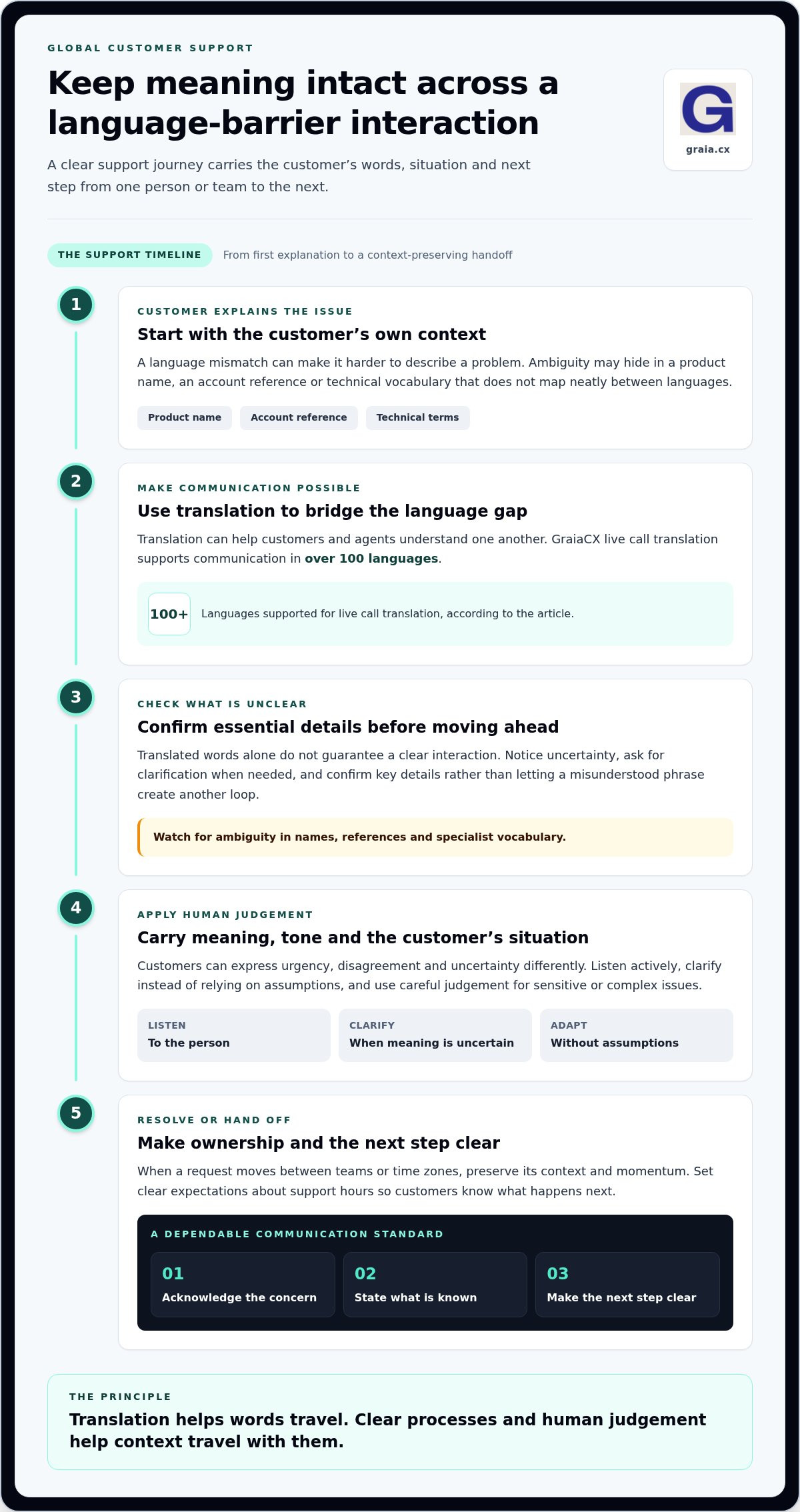
Expectation gaps affect more than satisfaction scores. If customers can’t tell what will happen next, they may hesitate to trust the guidance or contact support again to verify it. That creates avoidable work and can delay resolution. Teams can reduce the pressure by agreeing on adaptable communication principles: acknowledge the concern, state what is known, and make the next step clear. Consistency doesn’t require identical wording everywhere. It requires a dependable standard of clarity, respect and ownership, with room for agents to respond to the person in front of them.
Language, Culture and Time Zones: The Human Challenges of Global Support
Language, cultural context and working hours shape how quickly a customer can explain a problem and feel confident in the response. They also affect how support teams allocate work. A language-specific queue, for example, may leave customers waiting when few agents can handle that language, while those agents face concentrated demand and frequent context switching. The result can be longer clarification loops, not simply a busier queue.
Translated words alone don’t guarantee a clear customer interaction. Meaning, tone and the customer’s situation must travel with them.
Where language gaps affect resolution
Ambiguity often hides in the details: a product name that sounds like an everyday word, an account reference transcribed incorrectly, or technical vocabulary that doesn’t map neatly between languages. Each uncertainty can trigger another question or send an agent searching for someone with the right language or subject knowledge. That costs time and can make customers feel they haven’t been understood.
Translation can help customers and agents understand one another, but it shouldn’t erase human review. Agents still need to notice when a phrase is unclear, confirm essential details and recognise when a sensitive or complex issue calls for careful judgement. GraiaCX’s live call translation supports over 100 languages, helping agents communicate with customers across language barriers while remaining involved in the conversation.
Language access is also part of inclusive service design. Government customer experience challenges include barriers such as language and digital access. A channel can be available without being equally usable for every customer.
How cultural context and time zones shape the experience
Customers don’t all express urgency, disagreement or uncertainty in the same way. A direct request may be intended as efficient rather than confrontational; a formal greeting may reassure one person but feel distant to another. These are individual expectations shaped by context, not fixed traits of a nationality. Agents need adaptable guidance, active listening and permission to clarify rather than rely on assumptions.
Working hours add a separate operational choice. Not every organisation needs continuous coverage, but teams should make their support hours clear and plan what happens when an issue arrives outside them. Where shifts overlap or a case moves between teams, the next agent needs a concise record of the problem, checks already completed and promised next steps. Otherwise, customers repeat themselves and ownership can become uncertain.
To reduce friction, review waits by language as well as by channel, and look for repeated transfers or clarification requests. This can reveal whether the underlying issue is translation, queue design, terminology or an unclear handover. For further practical perspectives on improving customer conversations, explore GraiaCX customer experience insights.
Inconsistent Answers, Fragmented Channels and Compliance Risks
A customer may receive one answer by email, another in chat, and a third after an agent checks a separate knowledge base. This usually isn’t a people problem. It’s an information problem: teams may work from duplicated guidance, different market versions of a policy, or records that don’t show what was already discussed. As operations expand, these gaps make the challenges of global customer support harder to manage and weaken confidence in the service.
Changing channels shouldn’t mean starting again. If a customer moves from a digital conversation to a phone call, the next agent needs enough context to continue the work, not just a transcript to decipher. A useful handoff captures the customer’s goal, relevant account or case details, steps already taken, unresolved questions and any commitments made. It gives the receiving agent a clear starting point while leaving room to verify details and apply judgement.
Why knowledge and handoffs become inconsistent
Guidance can drift when teams maintain separate copies or update them at different times. A process change may reach one market’s team but not another, or an older answer may remain easy to find alongside the current one. Agents then spend time reconciling sources, and customers may get conflicting instructions. Give each knowledge item a clear owner and review process. Make the approved answer easy to distinguish from outdated material.
At escalation, a structured recap helps preserve continuity. It should make clear what the customer needs, what has happened so far, what remains unresolved and why the issue needs another person’s attention. This prevents a handoff from becoming a reset.
| Fragmented support | Context-preserving support |
|---|---|
| Separate records leave the next agent to reconstruct the issue. | A concise recap carries customer context and prior steps forward. |
| Duplicated guidance can produce different answers across teams. | Shared, maintained knowledge supports more consistent responses. |
| Escalations pass on a problem without clear ownership. | The handoff identifies open questions and the reason for escalation. |
How global service raises governance demands
Consistency also depends on governance. Teams need to know which policies apply to an interaction, which information they should use, and how decisions are recorded. The appropriate controls can vary with jurisdiction, service and use case. Establish approved procedures with the relevant internal specialists rather than assume one rule fits every market. Where GDPR is relevant, include it in that specific governance work; mentioning it alone doesn’t establish compliance.
For regulated or sensitive interactions, define when an agent must pause automation, verify information or escalate to a human. Keep a traceable account of the guidance used, the decision made and the point at which responsibility moved. These controls help teams respond consistently without treating every customer situation as identical. The aim is accountable support: clear enough to follow across teams, and flexible enough to handle exceptions responsibly.
How to Prioritize Improvements to Global Customer Support
Start with the customer journey, not a shopping list of tools. The challenges of global customer support can look similar on a dashboard but have different causes: a long wait may stem from language routing, unclear ownership or a complex issue. A practical review helps distinguish symptoms from root causes, then test improvements against the experience customers and agents actually have.
- Map the journey. Trace common requests from first contact through resolution and any follow-up. Include the channels customers use and the points where teams, markets or systems take over.
- Locate friction. Look for repeated explanations, waits for language support, avoidable transfers, unanswered questions and inconsistent guidance. Ask agents where the process creates hidden work, such as checking multiple sources or reconstructing a case.
- Segment the evidence. Review findings by language, channel, issue type and handoff point. A broad average can hide a specific group of customers experiencing longer waits or more repeat contacts.
- Prioritise the risks. Weigh the effect on customers, the likelihood of an error or delay, and the consequences of leaving the issue unresolved. Start with friction that undermines access, clarity, trust or appropriate escalation.
- Test and review. Trial a focused change, such as clarifying a routing rule or improving guidance for a recurring issue. Compare results with a baseline, gather agent and customer feedback, and refine the change before extending it.
Map friction before selecting technology
A journey map should show what customers experience and what agents must do behind the scenes. Mark each wait, transfer, repeated question and point where guidance is hard to locate. Pair interaction data with agent feedback: data can show where customers drop off, while agents can explain the workarounds and uncertainty behind that pattern. This diagnosis helps identify whether the real need is process clarity, better knowledge or a technology change.
Choose measures that reflect customer and agent experience
Set a baseline before making changes. Track resolution, repeat contact, waiting time and escalation alongside quality reviews and customer feedback. Efficiency alone can mislead: a shorter interaction isn’t a success if the customer has to return with the same issue. Compare like with like by channel, language and issue complexity, and record any changes in case mix. Treat an expected improvement as a hypothesis until your own results support it.
Use the findings to build a focused improvement plan, then revisit it as customer needs and operations change. Explore GraiaCX insights on customer experience for further perspectives on improving support journeys.
Build Global Customer Support Around Human-AI Collaboration
Technology can widen access and help teams carry context across interactions, but it shouldn’t remove human judgement. That distinction matters in global support: automation may assist with a routine request, while an unclear, sensitive or complex situation calls for a person who can listen, interpret nuance and take responsibility for the next step.
Use capabilities for specific jobs rather than treating AI as a single solution. GraiaCX live call translation supports over 100 languages, helping extend language access during calls. Conversational agents can handle routine interactions and take actions through connected business systems, then escalate with interaction context when human support is needed. Agent Assist can provide real-time guidance to human agents, helping them focus on the customer’s needs.
Where AI can support a global service team
These capabilities address different points in the service journey:
- Translation helps customers and agents understand one another across languages. The agent remains responsible for confirming meaning where terminology or nuance is unclear.
- Conversational agents can manage suitable routine enquiries, while a request that falls outside the intended workflow can be escalated with context.
- Agent Assist can help guide an agent during an interaction, supporting consistent use of relevant information without replacing the agent’s judgement.
Fit with existing operations matters, too. GraiaCX integrates with Genesys, NICE CX and Avaya. Map how the platform will connect with your contact-centre workflows, knowledge and escalation paths so the technology supports the operation you want to build.
Keep people accountable for empathy and exceptions
Escalation should be a designed part of the experience, not a last resort. Route interactions to a human when the customer’s request is complex, sensitive, uncertain or outside the approved process. A useful handover carries the interaction history and reason for escalation, so the customer doesn’t have to rebuild the story before receiving help. The agent can then confirm the facts, address what remains unresolved and decide what to do next.
Accountability also includes deciding how customer data is handled. GraiaCX does not use client data to train its own or third-party AI models. This privacy-focused approach is one consideration in designing human-AI support; organisations should also apply their own policies and safeguards to each use case.
The strongest model combines clear boundaries with useful support: let AI assist with access, routine work and agent guidance, while people remain responsible for empathy, exceptions and consequential decisions. Explore GraiaCX's customer experience insights for further ideas on building that balance.
Make Your Next Support Improvement Count
The next step doesn’t need to be a sweeping transformation. Choose one customer journey where uncertainty or effort is greatest, then give a cross-functional team the authority to improve it. Bring together the people who understand customer needs, local context, service operations and technology. Agree what a better experience should feel like, not just which process should change.
That focus turns the challenges of global customer support into an opportunity to build trust through deliberate, measurable progress. Keep listening after a change goes live. Customer feedback and agent insight can reveal where a new approach helps, where it creates friction and what deserves attention next.
Strong global service isn’t about making every interaction identical. It’s about making each one feel clear, connected and appropriately human, wherever the conversation begins. Explore GraiaCX insights on customer experience for ideas to inform your next step.
Start with one improvement, learn from it and build forward with confidence.
Frequently Asked Questions
What are the biggest challenges of global customer support?
The biggest challenges of global customer support are coordinating service across languages, customer expectations, working hours and operating teams. They can compound: a policy change might be understood differently across markets, then an agent may struggle to explain it clearly during a busy period. Start by identifying where customers experience the most effort, such as a particular request type or transfer, rather than assuming every market needs the same fix.
How does language affect global customer support?
Language can affect whether customers and agents understand details accurately enough to act. For example, a customer describing a delivery issue may use a product name or phrase that isn’t familiar to the agent, creating uncertainty about what to check. A shared glossary of product terms, accepted spellings and common abbreviations can help. For important details such as dates or account references, agents can repeat the information back and ask the customer to confirm it.
Why is cultural awareness important in customer support?
Cultural awareness helps agents respond to the person, not a broad assumption about their background. A customer who writes a short message may simply want an efficient answer, while another may appreciate more explanation before deciding what to do. Agents can check their understanding with respectful questions, then adapt their wording and level of detail. This reduces the chance that a well-intended response sounds dismissive or leaves the customer unsure about the next step.
Can AI help with global customer support without replacing agents?
Yes. AI can assist with tasks such as handling routine enquiries or helping an agent find relevant guidance, while people handle situations that need interpretation or care. Set clear boundaries: define which requests are suitable for automation, what should trigger escalation, and what information an agent needs to take over. Test those boundaries against realistic examples, including incomplete requests and unusual cases, before relying on the workflow in live customer interactions.
How can global support teams avoid making customers repeat themselves?
Make the transition between interactions carry forward the details needed to continue the case. For instance, a useful recap can state the customer’s desired outcome, any reference number, the troubleshooting already completed and the outstanding question. At handoff, the receiving agent should review the recap and confirm any uncertain detail, rather than ask the customer to start from the beginning. Auditing a sample of transferred cases can show where information gets lost.
What should organisations measure when improving global customer support?
Measure both whether the customer’s need was resolved and how much effort the process required. Track resolution, repeat contacts, waiting time and escalations, then review them alongside quality checks or customer feedback. Establish a baseline before changing a process, and compare similar enquiry types across channels or languages. If handling time falls but repeat contact rises, the change may have shifted work rather than solved the underlying problem.