
Best CCaaS for Enterprise UK: A 2026 Buying Guide
The best CCaaS for enterprise UK operations isn’t necessarily the platform with the longest feature list. Choosing one means weighing how it will work with existing systems, support customer journeys and meet your organisation’s operational and governance needs. Migration risk, integration gaps and AI that hasn’t been tested in real workflows can make the wrong decision costly.
This guide offers a practical framework for building a shortlist around what your teams need to do. You’ll learn how to assess integrations, security, resilience and migration, and how to test AI for accuracy, safe escalation and useful handoff. You’ll also see how conversational automation, agent assistance and live call translation could complement an existing CCaaS investment rather than require a full platform replacement.
We’ll compare options and deployment approaches, explain what to ask vendors, and show how to test shared customer context and human oversight. The aim is to help you make a procurement decision based on your systems, customer scenarios and service priorities.
Key Takeaways
- Define must-haves and differentiators before comparing vendors, so your shortlist reflects operating needs rather than feature volume.
- Use a weighted scorecard for channels, routing, AI, integrations, security, reporting and resilience. Test whether customer context carries across channels in a realistic demonstration.
- Compare full replacement, modular expansion and AI integration to understand how each approach affects existing platforms and migration risk.
- Verify data flows, security controls, relevant UK GDPR and Ofcom considerations, and rollout assumptions with the right internal and external specialists.
- When evaluating the best ccaas for enterprise uk, consider whether conversational automation, agent assistance or live call translation can add value alongside existing CCaaS, and validate integration scope before committing.
What enterprise buyers should expect from UK CCaaS in 2026
Contact Centre as a Service (CCaaS) delivers contact-centre capabilities through the cloud, including customer channels, interaction routing and service-management tools. Cloud delivery changes how systems are accessed and integrated, but it doesn’t remove the need to examine architecture, dependencies and controls. For background on the underlying model, see this overview of cloud computing.
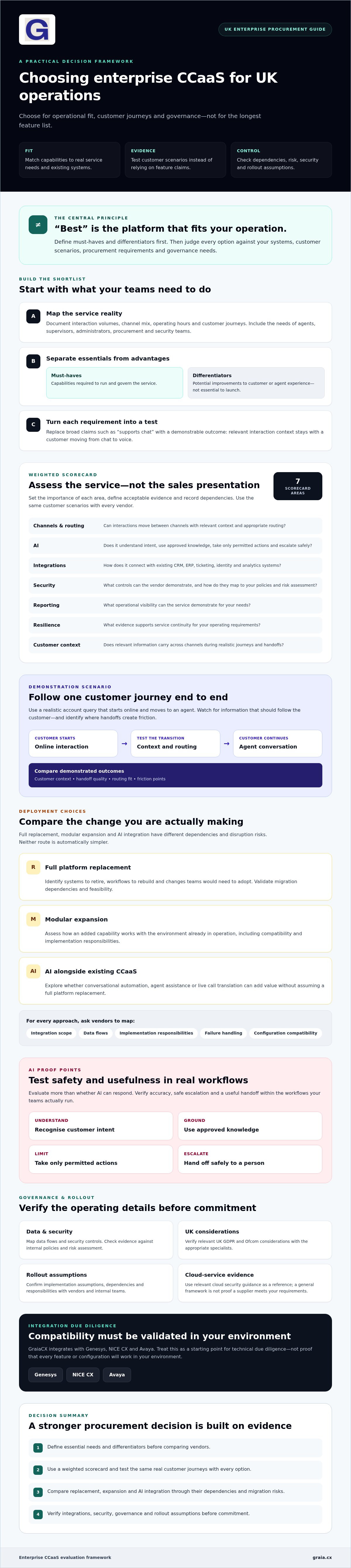
Start your shortlist with operational fit, not a vendor’s feature catalogue. Separate must-haves, the capabilities required to run and govern your service, from differentiators, which may improve the customer or agent experience but aren’t essential to launch. Assess suitability against your procurement requirements, existing integrations and governance needs. Verify the evidence for your use case rather than assuming a platform is suitable by default.
Which enterprise needs should shape a CCaaS shortlist?
Map interaction volumes, channel mix, operating hours and customer journeys before approaching vendors. Trace a typical request, such as an account query that begins online and moves to an agent. Note what information should follow the customer and where handoffs currently create friction. Include the needs of agents, supervisors, administrators, procurement and security teams. Prioritise current service problems over features that are attractive but don’t solve a defined need.
Turn the findings into a short requirements list. Mark each item essential, desirable or out of scope, and decide how you’ll test it. “Supports chat” is too broad to compare. “Preserves relevant interaction context when a customer moves from chat to voice” gives vendors something specific to demonstrate. This approach also keeps AI requirements tied to a real service need.
Does “best CCaaS” mean replacing your current platform?
No. A full migration and an AI capability integrated with existing infrastructure are different choices, with different dependencies and disruption risks. Assess a replacement by listing the systems to retire, workflows to rebuild and changes teams would need to adopt. Separately, test whether targeted capabilities can work with the environment you already operate. Neither route is automatically simpler. Vendors need to validate feasibility and compatibility against your configuration.
For enterprises considering an addition to their current platform, GraiaCX integrates with Genesys, NICE CX and Avaya. Treat the integration as a starting point for technical due diligence, not proof that every feature or configuration will work in your environment. Ask vendors to map the integration scope, data flows, implementation responsibilities and failure handling against your architecture.
There is no universal winner. The best ccaas for enterprise uk buyers is the option that meets defined service needs, fits procurement and governance controls, and can be tested against real customer journeys before commitment. The rest of this guide turns that principle into a practical comparison process.
How to evaluate enterprise CCaaS features beyond the feature list
A feature’s value depends on whether it works within your service model. Build a weighted scorecard covering channels, routing, AI, integrations, security, reporting and service resilience. Set the importance of each area, define acceptable evidence and record dependencies. Use the same customer scenarios with every vendor, then compare demonstrated outcomes rather than presentation quality.
- Channels and routing: Can interactions move between channels with relevant context and appropriate routing?
- AI: Does it understand intent, use approved knowledge, take only permitted actions and escalate safely?
- Integration: How does it connect with your existing CRM, ERP, ticketing, identity and analytics systems?
- Security, reporting and resilience: What controls, operational visibility and service-continuity evidence can the vendor demonstrate?
For security reviews, map vendor evidence to your own policies and risk assessment. The NCSC’s UK government security and governance standards offer a useful reference for examining cloud services. A general framework, however, isn’t proof that a particular supplier meets your requirements.
How can buyers test whether omnichannel is genuinely unified?
Ask the vendor to demonstrate a realistic customer journey across at least two channels, such as chat followed by voice. Check whether the next agent can see relevant history, routing follows your workflow, and the customer avoids repeating information. Record channel exceptions, configuration requirements and third-party dependencies. A list of channels alone doesn’t show whether context is shared.
Which AI capabilities deserve a practical evaluation?
Use representative scenarios, including ambiguous requests, specialist terminology and cases that should be escalated to a person. Test whether a conversational agent grounds answers in approved knowledge, stays within its permitted actions and passes useful context to an agent. For agent assistance, judge whether suggestions are relevant and fit existing workflows. Test live translation with representative accents and terminology, including situations where an agent needs to review or clarify meaning.
Keep architecture choices visible in your scorecard. A complete CCaaS replacement changes the core platform. Integrating an AI capability may preserve more of the existing environment, but still depends on compatibility, data flows and implementation scope. Compare these as separate options and ask vendors to demonstrate the proposed integration against your actual systems. Graia integrates with Genesys, NICE CX and Avaya, but confirm the specific scope and requirements for your deployment.
Use the evidence to identify the best ccaas for enterprise uk fit for your requirements, not a universal winner. For more perspectives on customer experience and AI evaluation, explore GraiaCX’s enterprise CX insights.
How to compare enterprise CCaaS vendors and deployment models
Compare evidence, not marketing labels. For each shortlisted provider, distinguish what is available now from what depends on another supplier or future delivery. Ask vendors to support each entry with a demonstration, technical documentation or a written commitment.
| Capability status | What to establish |
|---|---|
| Native | Included in the proposed platform and shown working in your use case. |
| Integration | Connected to a named external system, with scope and responsibilities confirmed. |
| Add-on | Available separately; clarify dependencies, administration and commercial terms. |
| Roadmap | Planned rather than currently available. Don’t count it as a launch requirement. |
Then compare three deployment paths: replace the existing contact-centre platform, expand it modularly, or integrate AI capabilities with current infrastructure. A replacement may involve broader workflow and migration changes. An AI layer may preserve more of the existing environment, but still needs compatibility checks. Neither approach is automatically lower risk. For architecture background, see this enterprise agentic CCaaS platform guide.
How should enterprises compare integration and migration risk?
Inventory the systems and connections that must keep working, including CRM, ERP, ticketing, APIs, telephony dependencies, identity controls and data flows. Ask vendors to label each connection as supported, custom work or roadmap, and identify what remains unverified. Request a phased migration proposal that sets out ownership, rollback assumptions and acceptance criteria for each stage. A contact centre modernisation case study can also prompt useful questions about planning and oversight.
How do you test multilingual support and human handoff?
Build a pilot script from realistic customer requests and approved terminology. For each language scenario, check how translated content and original audio appear to agents, and test how agents can respond or seek clarification. Then trigger an escalation. Does the agent receive the conversation history and useful context, or does the customer have to start again? Confirm language availability and integration scope directly with the vendor.
Use the same demonstration matrix for every provider. Include routine workflows, an exception or failed integration, reporting outputs and administrative tasks such as changing a route or permission. Record what was demonstrated, what needed configuration and what was deferred. This evidence helps connect each provider to documented requirements without imposing a universal ranking. The best ccaas for enterprise uk choice is the one that proves its fit against your real operating conditions. Graia integrates with Genesys, NICE CX and Avaya. Verify current scope and implementation requirements for your deployment.
What UK enterprise buyers should verify for security, governance, and rollout
Security and governance require evidence, not broad assurances. Before procurement, map how the proposed service handles your data and operations, then have legal, security and service owners review the details. UK GDPR, Ofcom considerations, data residency and sector controls depend on the use case. Ask qualified advisers to confirm what applies to your organisation rather than relying on a general vendor statement.
Use this diligence sequence to turn claims into decision points:
- 1. Map data: Identify personal and operational data involved, where it is processed, retention arrangements, subprocessors and access roles.
- 2. Review controls: Request security documentation, processing terms, access-control details, audit evidence and incident procedures. Check how recording controls, audit trails and human review work in practice.
- 3. Validate obligations: Ask internal legal and security teams to assess relevant UK GDPR, Ofcom and sector requirements for each intended workflow. Confirm data-location expectations and any restrictions before approving a design.
- 4. Test operations: Review resilience evidence, support coverage, service commitments and incident escalation against procurement requirements. Clarify dependencies and what happens if an integration or platform component becomes unavailable.
- 5. Agree rollout and exit: Document implementation responsibilities, acceptance criteria, data return or deletion arrangements, and exit provisions before commitment.
Which data and compliance questions belong in vendor diligence?
Ask for a clear account of data types, processing locations, retention periods, subprocessors and user permissions. Go beyond policy documents: request a walkthrough showing who can access recordings, how access is logged, and how review or correction works when AI is involved. Your legal and security teams should assess the proposed processing against your organisation’s obligations and risk controls.
How can a pilot expose rollout risks before commitment?
A pilot should reflect real operating conditions, not just a polished demonstration. Include representative workflows, channels, users, integrations and exception cases. Agree measurable acceptance criteria for accuracy, escalation and context transfer, agent usability and operational reporting. At the end, record unresolved risks, accountable owners, remediation actions and go-live thresholds. If a critical control or workflow fails, decide in advance how the rollout will be paused or revised.
The best ccaas for enterprise uk choice must meet operational needs as well as governance and procurement requirements. Confirm hosting, data-processing, security and service-level commitments for the specific deployment. Don’t assume a product description guarantees them. For further perspectives on AI-enabled customer experience and platform decisions, explore Graia’s CX insights.
Graia for Enterprise CCaaS: Strategy and Next Steps
Graia may suit enterprises looking to add conversational automation, agent assistance or live call translation without treating full platform replacement as the only path forward. Graia integrates with Genesys, NICE CX and Avaya, but integration availability alone doesn’t confirm compatibility with your configuration. Validate the required scope, implementation responsibilities and dependencies for your deployment.
Where could Graia complement an existing enterprise contact centre?
Assess conversational agents against routine enquiries and clearly permitted system actions. Test whether complex requests can be handed to a human agent with useful conversation context, so customers don’t have to repeat themselves. Evaluate Agent Assist for the relevance of real-time guidance, including next-best-action suggestions, within your agents’ existing workflows. Confirm which capabilities apply to your proposed configuration rather than assuming every feature is included.
For multilingual service, test Live Call Translation with representative customer requests, accents and specialist terminology. Check language coverage and how translated content fits the agent workflow. Graia supports over 100 languages for live call translation. Confirm current availability for the languages and scenarios your organisation needs, and consider how agents can review, clarify or respond when a translation needs human judgement.
This is a different option from replacing a core CCaaS platform. Compare both paths against your requirements: replacement changes the underlying platform, while an integrated capability may build on existing investment but still depends on validated technical fit. For broader context on assessing AI in a shortlist, read the enterprise AI contact-centre solutions guide.
What should procurement ask before selecting a provider?
Request a solution design tied to your workflows, written confirmation of integration scope, relevant security evidence and a clear allocation of implementation responsibilities. Ask how the proposed configuration handles data flows, permissions, escalation and exceptions. Have procurement review commercial terms and service commitments against organisational requirements. Don’t assume standard terms meet your needs.
There’s no unqualified “best” platform for every enterprise. The best ccaas for enterprise uk choice is the one that demonstrates fit against your documented needs and passes technical, operational and governance checks. Explore Graia’s enterprise CX and CCaaS insights as you shape your shortlist.
Move forward methodically: document requirements, shortlist providers, request demonstrations built around real workflows, then run a controlled pilot with agreed acceptance criteria. Let the evidence guide the decision.
Choose the platform that proves its fit
The best ccaas for enterprise uk buyers is the platform that meets documented service needs and stands up to scrutiny across integration, AI, security and rollout. Compare complete replacement with adding capabilities to existing infrastructure, then use realistic demonstrations and a controlled pilot to test the approach that fits your operation.
Graia may be worth assessing if conversational automation, agent assistance or live call translation are priorities. Graia integrates with Genesys, NICE CX and Avaya, but confirm the scope and implementation requirements for your environment. Its live call translation supports over 100 languages; verify current coverage and test it with your terminology and customer scenarios.
Before choosing, document requirements, compare vendor evidence and agree clear pilot acceptance criteria. This helps your teams move forward with confidence, without treating feature volume or a “best overall” label as proof of fit. Explore Graia’s enterprise CX insights as you develop your shortlist and next steps.
Frequently Asked Questions
What is the best CCaaS platform for a UK enterprise?
There’s no single best platform for every UK enterprise. The right choice depends on your customer journeys, channel mix, existing systems, governance requirements and appetite for migration. Define essential requirements first, then compare providers against the same scenarios and evidence. A platform that fits your contact-centre architecture and demonstrates safe, useful performance in a pilot may be a stronger choice than one with a longer feature list.
How should an enterprise compare CCaaS providers?
Compare providers with a weighted scorecard covering channels, routing, AI, integration, security, reporting and resilience. Ask each to distinguish native capabilities from integrations, add-ons and roadmap items, then demonstrate everyday workflows and exceptions using consistent scenarios. Check how the platform connects with your CRM, ERP, ticketing, identity and analytics systems. Record evidence, dependencies and unanswered questions so your shortlist reflects operational fit rather than presentation quality.
Can an enterprise add AI to its existing CCaaS platform?
Yes, some AI capabilities can be integrated with existing CCaaS, so replacing the core platform isn’t the only option. Feasibility depends on the current environment, integration scope, data flows and required workflows. Ask vendors to validate these against your configuration. Graia integrates with Genesys, NICE CX and Avaya. Confirm which capabilities are supported and what implementation each requires before relying on it.
What should UK businesses check about CCaaS data security and compliance?
Ask where data is processed, what information is retained, which subprocessors are involved, and how access, audit trails, recordings and incidents are handled. Review security documentation and processing terms with your legal and security teams. UK GDPR, Ofcom considerations, data residency expectations and sector controls depend on the use case. A general vendor statement doesn’t prove compliance. Confirm the requirements that apply to your organisation with qualified advisers.
How can we test whether a CCaaS platform is genuinely omnichannel?
Ask the vendor to demonstrate a customer journey across at least two channels, such as chat followed by voice. Check whether the agent can see relevant interaction history, routing follows your workflow, and the customer avoids repeating information. Test exceptions too, including a transfer or failed integration. Note any channel limitations, configuration needs and dependencies. A list of supported channels alone doesn’t establish that the experience is unified.
What should an enterprise CCaaS pilot measure?
Agree acceptance criteria before the pilot and use representative workflows, channels, users, integrations and exception cases. Assess AI accuracy against approved scenarios, whether escalations pass useful context, agent usability and the quality of operational reporting. Track failures and unresolved risks as well as successful interactions. Assign owners and remediation actions, then set clear go-live thresholds. This makes the pilot a decision tool, not simply a demonstration of features.
Can Graia work with an existing enterprise CCaaS provider?
Graia integrates with Genesys, NICE CX and Avaya, making it an option for enterprises considering AI capabilities alongside an existing platform. Its offerings include conversational agents, Agent Assist and Live Call Translation. Integration scope and implementation requirements can vary by deployment. Ask Graia to confirm compatibility with your specific configuration, identify dependencies and demonstrate the relevant workflow before making a procurement decision.